Back
Legal & Contract Analysis

A Self-Improving Contract Extraction Platform Processing Over a Million Documents

How Pfactorial Technologies built a legal contract processing system with a reusable model framework and an automated retraining pipeline that keeps improving in production.

August 21, 2026
Share
ENGAGEMENT SNAPSHOT

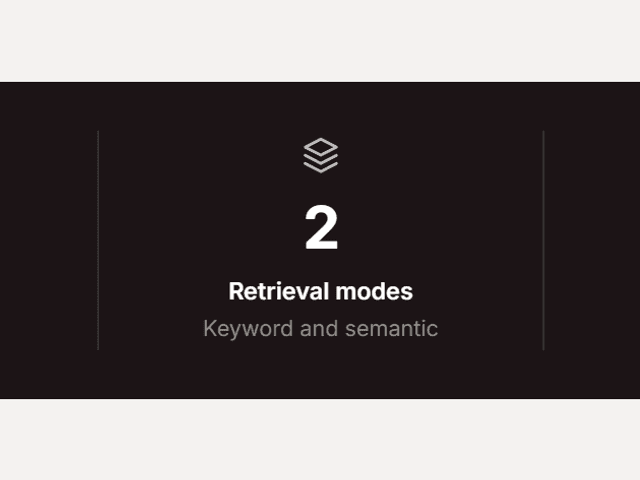
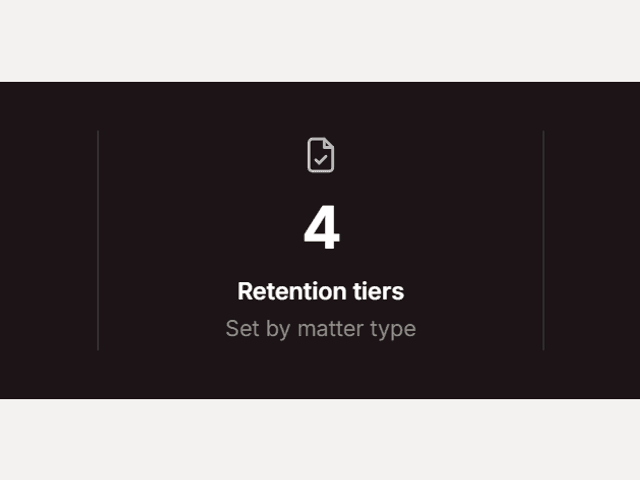
Pfactorial_Case_Study_Contract_Wrangler_Extraction_Platform image 1
Figure 1 - Key figures from this engagement, at a glance.
EXECUTIVE SUMMARY
Our client, a well-funded start-up modernizing contract management, wanted to replace slow, expensive manual contract review with automated extraction - but needed it to work across inconsistent scan quality, layouts, and contract templates at a volume of over a million documents.
Manual review imposed three compounding costs: attorneys personally reading every contract, skilled legal time spent on repetitive low-judgment extraction, and review cycles that scaled linearly with volume with no reuse of past effort. A one-off extraction script wouldn't solve any of that at scale, and would degrade the moment contract formats varied.
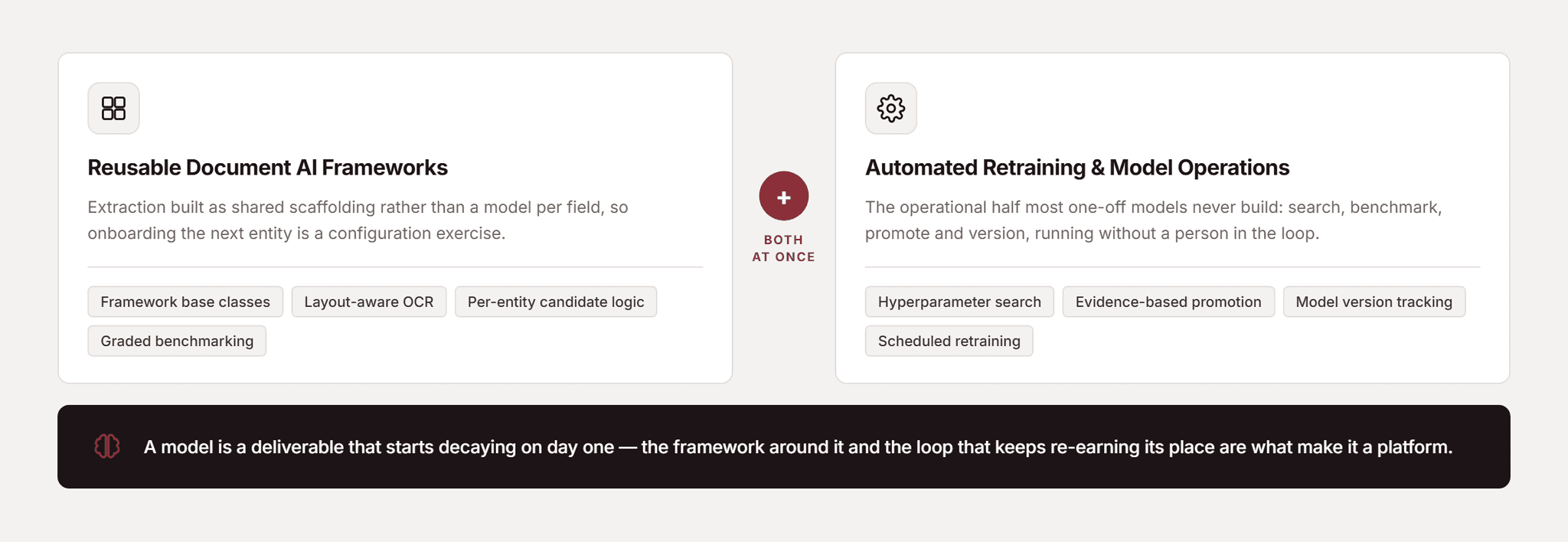
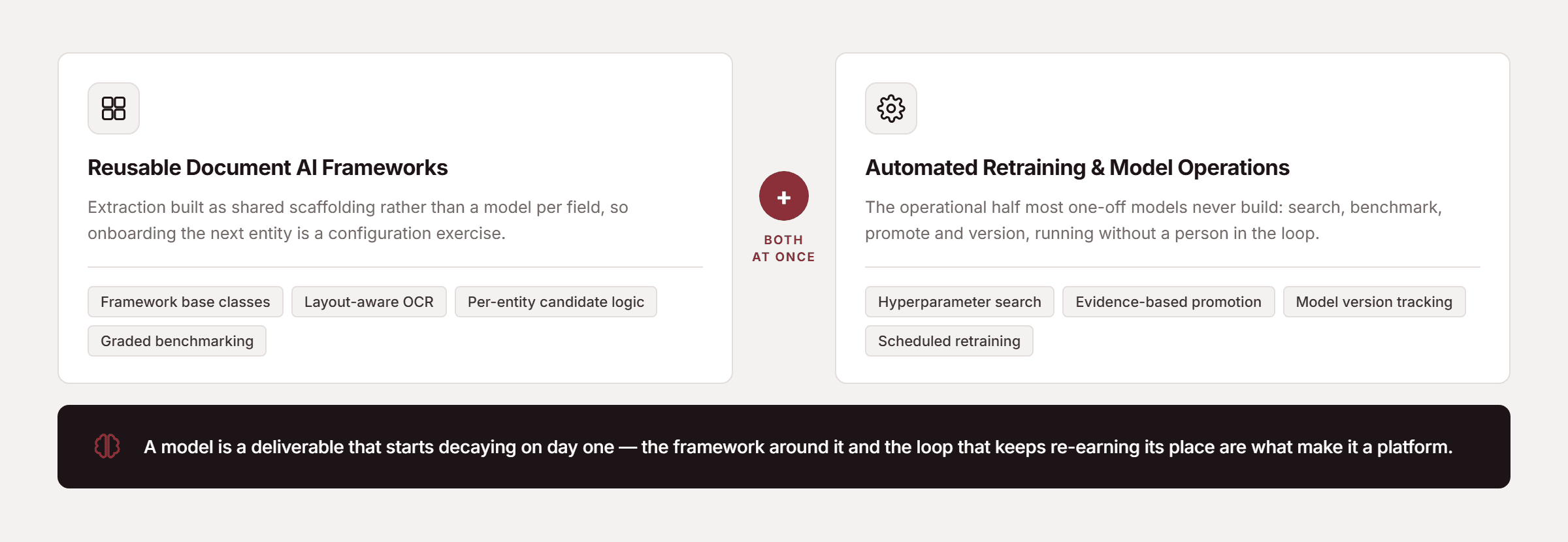
Pfactorial built a reusable extraction framework - the General-Purpose Model Architecture (GPMA) - standardizing how every legal-entity model is trained and served, wrapped in an automated retraining system (MRA) that benchmarks new models against production and promotes improvements without manual intervention.
Why this engagement is representative This engagement shows Pfactorial building not just an extraction model but the reusable framework and self-improving infrastructure around it - the difference between a one-off model and a platform that keeps getting better without repeated re-engineering.
THE CHALLENGE
Reaching reliable extraction at over a million documents required solving problems that don't show up at small scale.

1. Scanned contracts arrive in inconsistent layouts

Clustered OCR output without page context, vertical column misreads, and side-by-side layouts read in the wrong order all corrupt extraction if handled naively - and all three were observed as recurring failure modes in real scans.

2. No single extraction method covers every entity

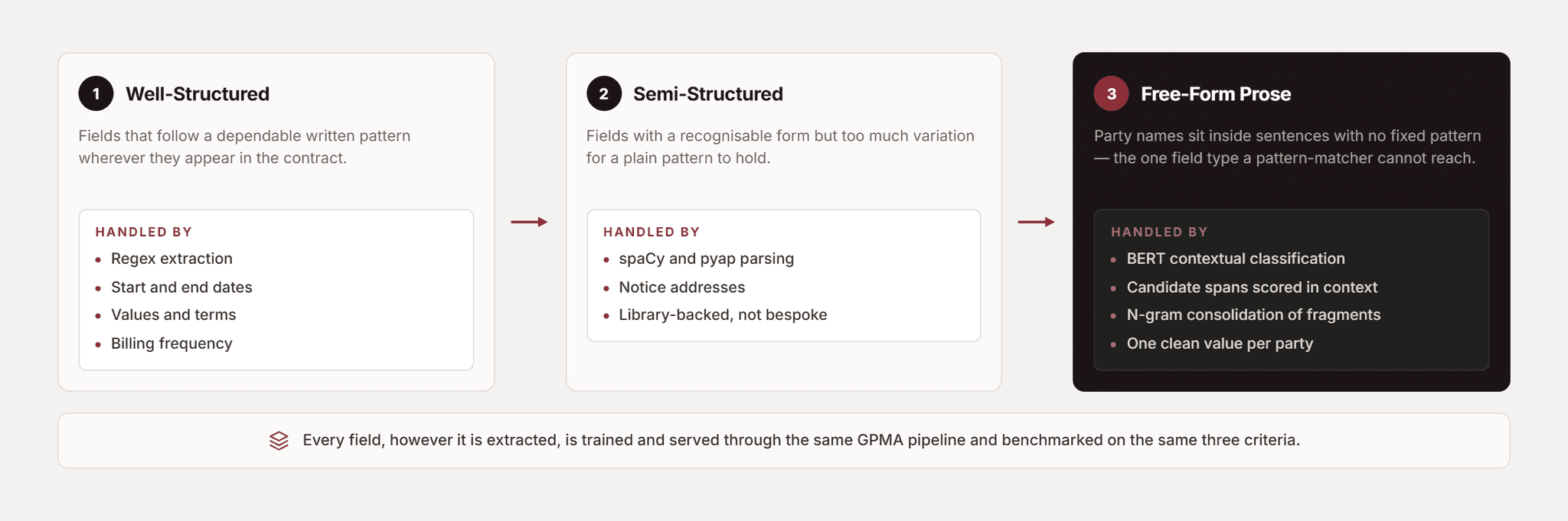
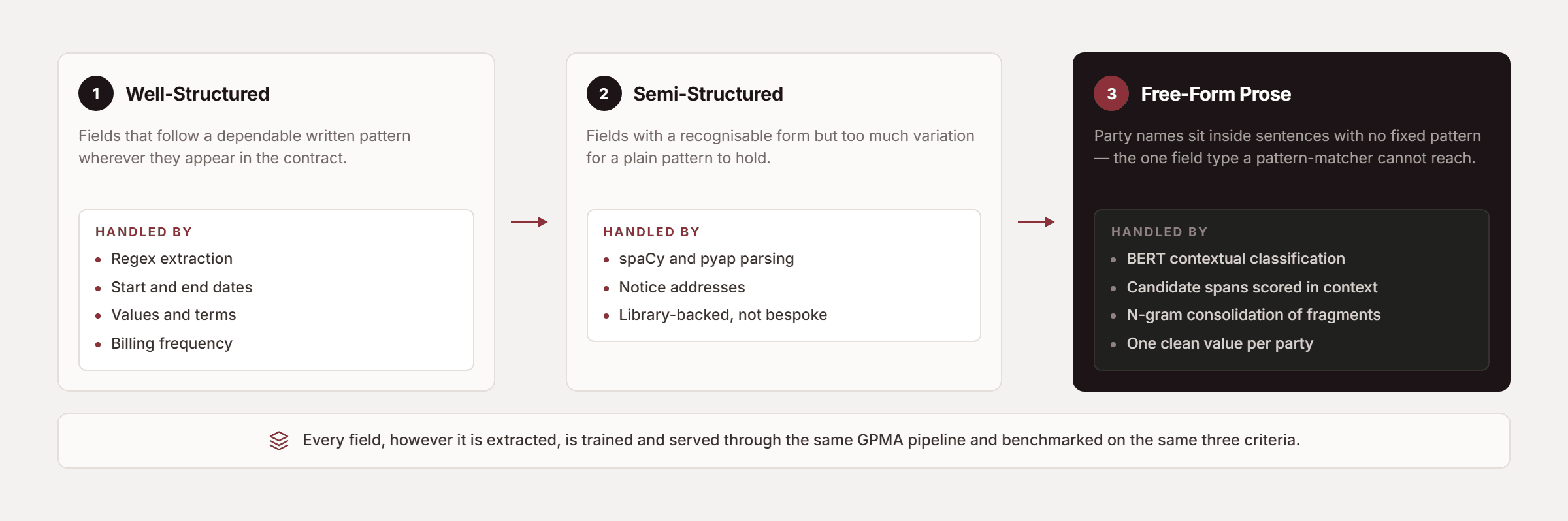
Structured fields like dates and values respond to regex; free-form fields like party names, embedded in prose without a fixed pattern, need contextual understanding a pattern-matcher can't provide.

3. Building a model per legal entity doesn't scale

Writing a bespoke training and prediction pipeline for every field - start date, party names, payment terms - multiplies engineering effort with every new entity added.

4. Models degrade without ongoing retraining

A model trained once against a snapshot of contract formats degrades as new formats and edge cases appear, unless retraining and promotion becomes a routine, automated part of operations rather than a manual project.
The real brief Not “extract these entities” but “build a reusable framework so extracting the next entity is a configuration exercise, and an automated system that keeps every deployed model current without manual re-benchmarking.”
THE SOLUTION
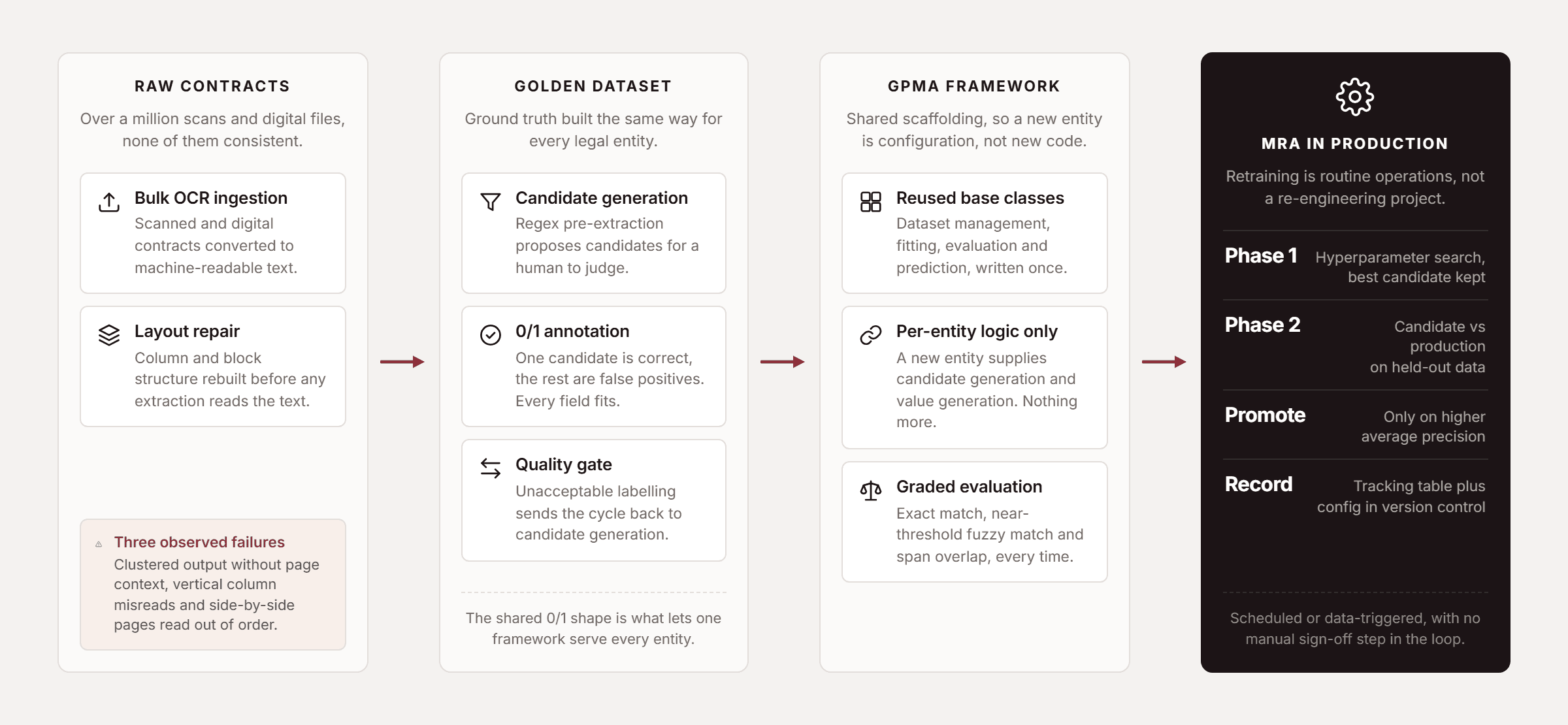
Pfactorial built GPMA as the shared scaffolding for training and prediction across every legal entity, with MRA running continuously on top to retrain, benchmark and promote improved models automatically.
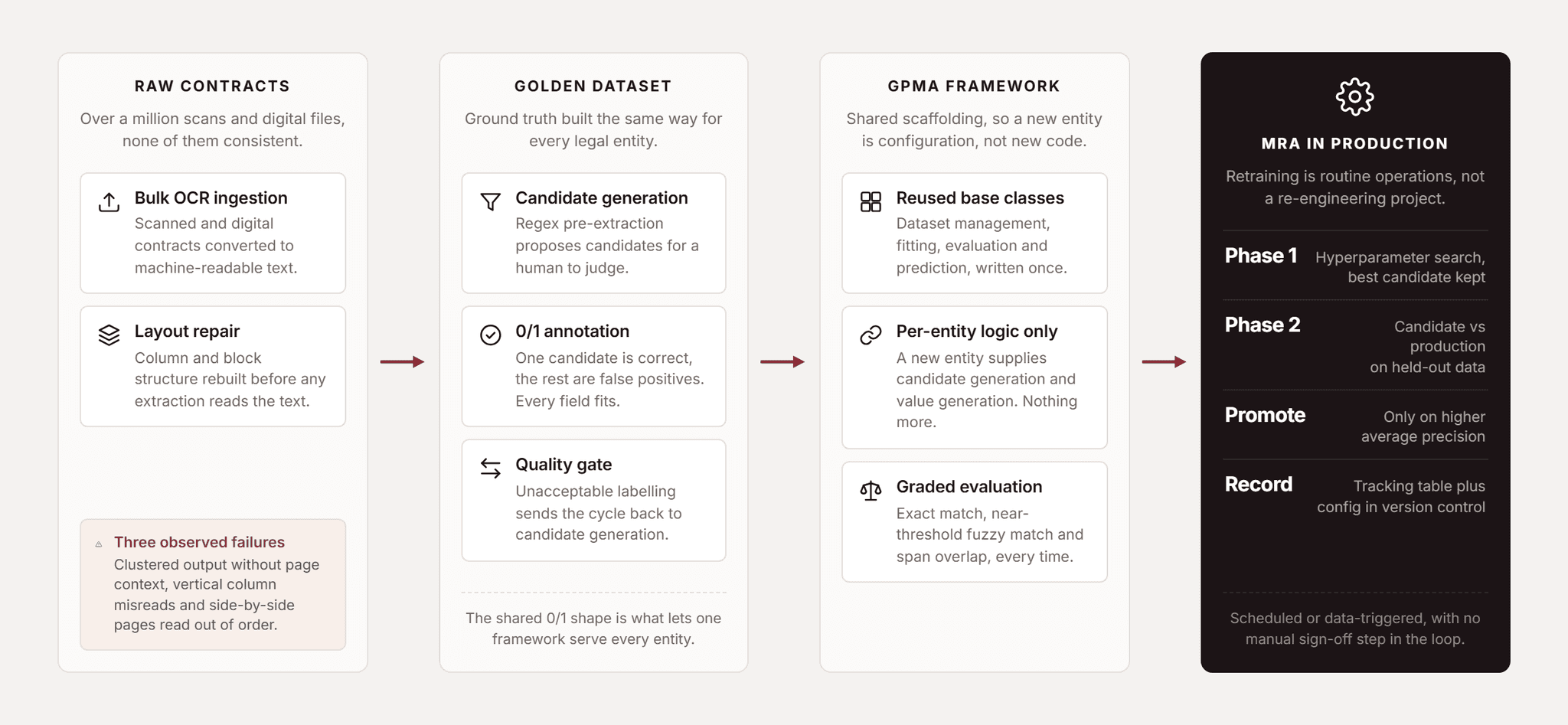
Pfactorial_Case_Study_Contract_Wrangler_Extraction_Platform image 2
Figure 2 - From raw contracts to a production model that keeps improving itself.

Architectural principles

  • One reusable framework, not bespoke code per entity - GPMA's base classes handle dataset management, model fitting, evaluation and prediction; onboarding a new legal entity means supplying only its candidate-generation and concrete-value-generation logic.
  • Layout-aware OCR post-processing - Column and block structure is reconstructed before text reaches downstream extraction, directly addressing the three recurring layout failure modes observed in real contract scans.
  • Method matched to field structure - Regex handles well-structured fields (dates, values, terms), spaCy/pyap handles addresses, and BERT-based contextual classification handles party names - the one field type that can't be pattern-matched.
  • Automated, benchmarked retraining - MRA retrains on new gold-labeled data, benchmarks the candidate against the current production model by average precision, and only promotes it if it genuinely performs better - no manual comparison required.
CAPABILITIES DELIVERED
The platform replaces manual re-reading of contracts with structured, continuously-improving extraction across every field an attorney previously had to find by hand.
CAPABILITY
WHAT IT DOES
Bulk OCR ingestion
Over 1 million scanned and digital contracts converted to machine-readable text.
Layout-aware preprocessing
Reconstructs column and block structure before entity extraction runs.
Ten-entity extraction
Dates, values, terms, billing frequency, notice address, and multi-party names.
Golden Dataset tagging
Regex pre-extraction plus manual 0/1 annotation producing labeled ground truth for every entity.
Automated retraining (MRA)
Scheduled or data-triggered retraining, benchmarking, and production promotion.
Application layer
Gives attorneys reminders and direct access to extracted contract data without re-reading documents.
Pfactorial_Case_Study_Contract_Wrangler_Extraction_Platform image 3
Figure 3 - Extraction technique matched to how each field actually appears in text.
Design note The 0/1 tagging format - within a set of extraction candidates, one is correct and the rest are false positives - is the shared pattern behind nearly every legal entity. That's what lets a single reusable framework serve every field instead of requiring bespoke modeling per entity.
ENGINEERING FOR SCALE AND RELIABILITY
Six decisions carry the platform from a working prototype to something that stays accurate as contract formats and volume grow.

Quality-gated labeling loop

Labeling passes branch on a quality gate - if results aren't acceptable, the cycle repeats from candidate generation, catching systematic labeling problems before they contaminate a trained model.

Hyperparameter search per retraining cycle

MRA's Phase 1 frames every hyperparameter combination in the defined search space, trains a candidate for each, and keeps only the best-performing one for head-to-head comparison.

Automated, evidence-based promotion

Phase 2 loads the best candidate and the current production model, evaluates both on the same held-out data, and promotes the candidate only if it outperforms production - end to end, with no manual sign-off step.

Auditable model versioning

Every promotion updates a tracking table and checks the corresponding model configuration into version control, so which model is in production - and why - is always reconstructable.

Standardized, strictness-graded evaluation

Every model is benchmarked with three matching criteria of increasing strictness - exact match, near-threshold fuzzy match, and span overlap - giving a consistent basis for comparing architectures.

Field-appropriate consolidation

After BERT identifies party-candidate spans, an N-gram consolidation step merges fragmented mentions of the same party into a single clean value before it reaches the application database.
DELIVERY APPROACH
The engagement built the extraction framework and its self-improvement loop as first-class deliverables, not an afterthought bolted onto a one-off model.
1. OCR & layout-aware preprocessing - converting over a million scanned and digital contracts, with post-processing correcting for observed layout failure modes.
2. Golden Dataset construction - regex pre-extraction and manual 0/1 annotation across all target legal entities.
3. GPMA framework build - the shared base classes, training pipeline, and prediction pipeline reused across every entity.
4. Per-entity extraction logic - regex, spaCy/pyap and BERT-based approaches matched to each field's structure.
5. MRA automated retraining - the hyperparameter search, benchmarking, and automated production-promotion pipeline.
6. Standardized evaluation - exact-match, near-threshold and span-overlap benchmarking applied consistently across all models.
RESULTS AND IMPACT

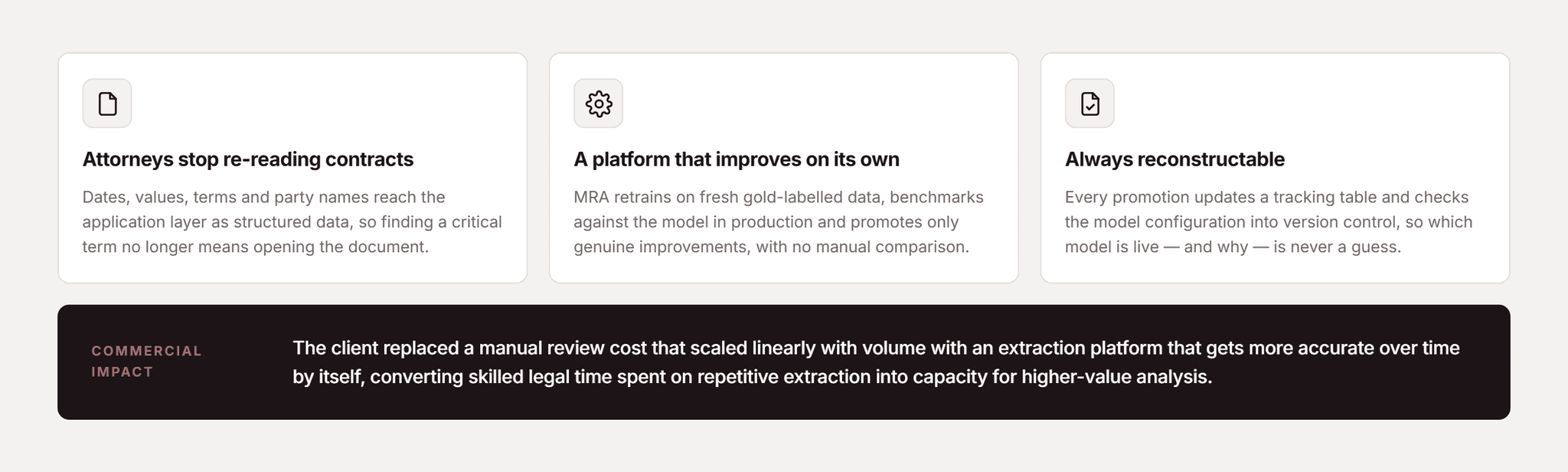
Pfactorial_Case_Study_Contract_Wrangler_Extraction_Platform image 4
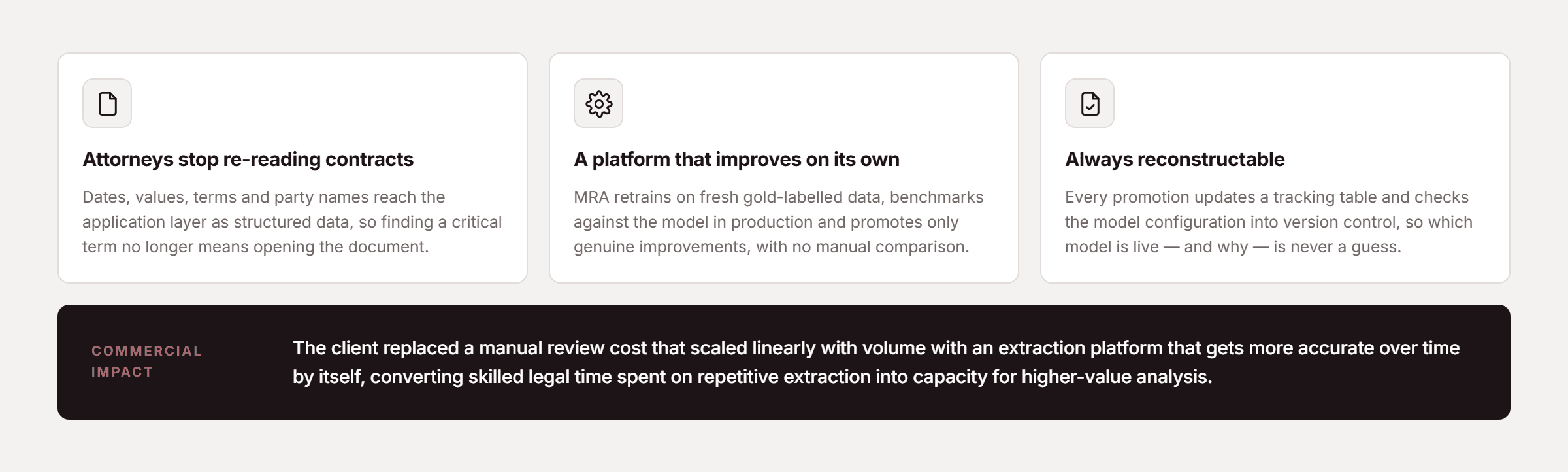
Figure 4 - Key outcomes from this engagement.
The application layer gives attorneys direct access to extracted contract dates, values, terms and parties, removing the need to manually re-read every contract to locate critical information.
Because MRA retrains and promotes models automatically against fresh gold-labeled data, the extraction platform improves on an ongoing basis without requiring a dedicated re-engineering project each time.

What it enabled commercially

The client replaced a linearly-scaling manual review cost with an extraction platform that gets more accurate over time on its own, converting skilled legal time previously spent on repetitive extraction into capacity for higher-value analysis.
WHY PFACTORIAL
This engagement reflects Pfactorial's ability to build not just an extraction model, but the reusable framework and automated retraining infrastructure that keeps a legal AI system accurate as it scales - the operational half of the problem most one-off models never solve.
Pfactorial_Case_Study_Contract_Wrangler_Extraction_Platform image 5
Figure 5 - Service lines this engagement draws on.
Engagement enquiries Pfactorial Technologies works with legal-tech and document-AI teams that need extraction systems built to stay accurate at scale, not just accurate on a demo set. If you're evaluating a contract or document extraction initiative, we're happy to give you an honest read on scope and risk before anyone commits to anything. · pfactorial.ai
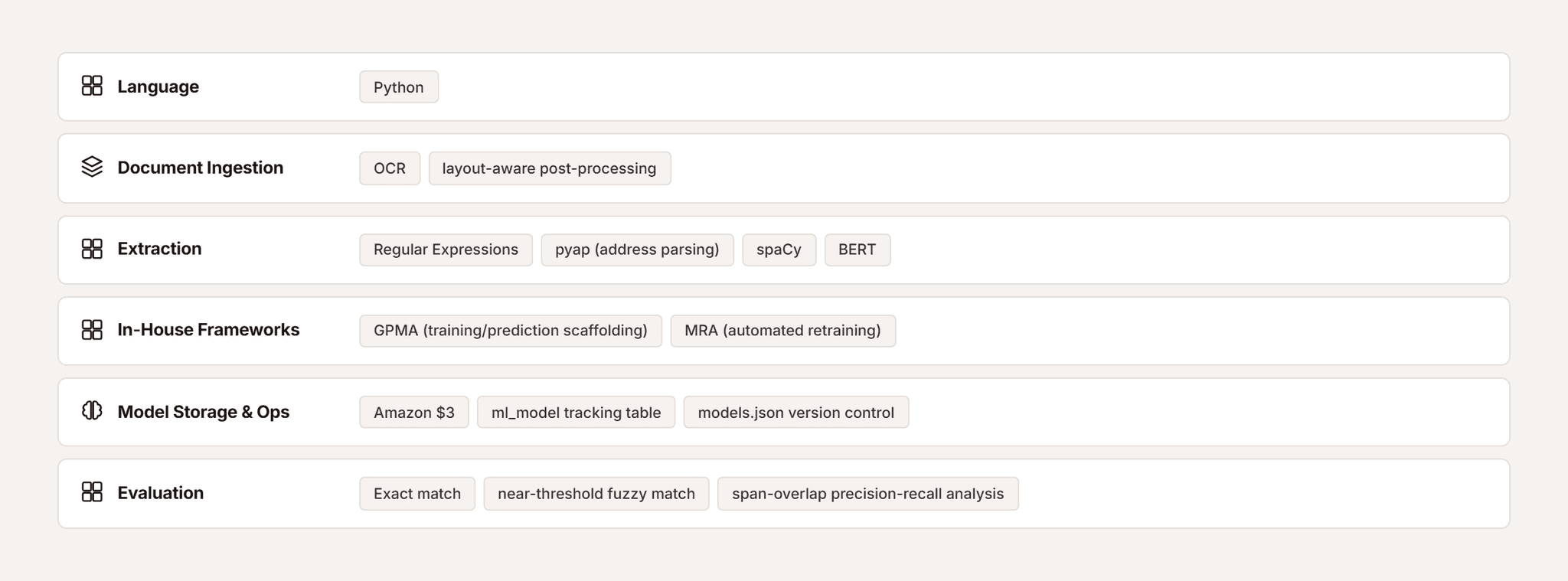
APPENDIX A - TECHNOLOGY STACK
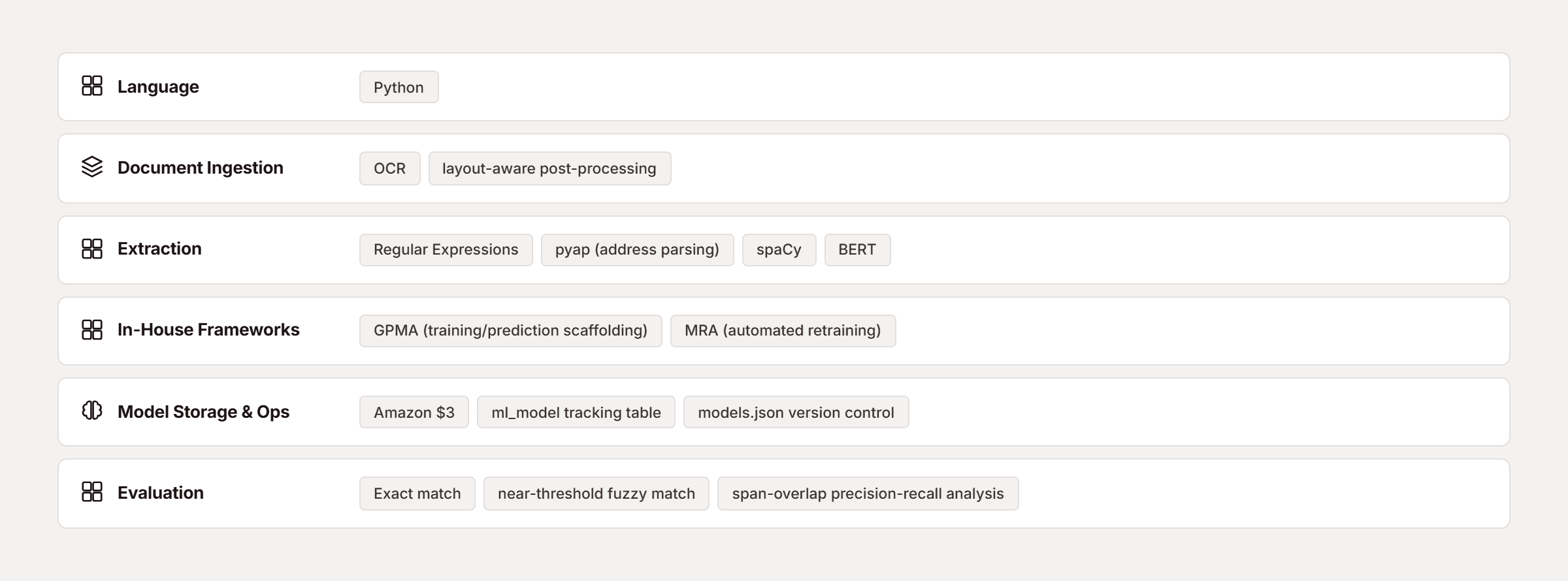
The technology stack underpinning the system, grouped by the layer it serves.
Pfactorial_Case_Study_Contract_Wrangler_Extraction_Platform image 6
© 2026 Pfactorial Technologies. Client identity and product-specific implementation detail are withheld or generalized; no client data, credentials, source code, or infrastructure detail is included in this document.

Result and Analysis

ENGAGEMENT SNAPSHOT

How Pfactorial Technologies built a legal contract processing system with a reusable model framework and an automated retraining pipeline that keeps improving in production.

Pfactorial_Case_Study_Contract_Wrangler_Extraction_Platform image 1
Pfactorial_Case_Study_Contract_Wrangler_Extraction_Platform image 2
Pfactorial_Case_Study_Contract_Wrangler_Extraction_Platform image 3
Pfactorial_Case_Study_Contract_Wrangler_Extraction_Platform image 4
Pfactorial_Case_Study_Contract_Wrangler_Extraction_Platform image 5
Pfactorial_Case_Study_Contract_Wrangler_Extraction_Platform image 6