Back
Healthcare & Clinical

Integrating i2b2, RStudio and LifeOmic Into One Clinical Research Analytics Workflow

How Pfactorial Technologies connected three specialized healthcare analytics platforms into one workflow - cohort identification, advanced statistics, and multi-omics integration - around a de-identified, standardized clinical dataset.

August 21, 2026
Share
ENGAGEMENT SNAPSHOT

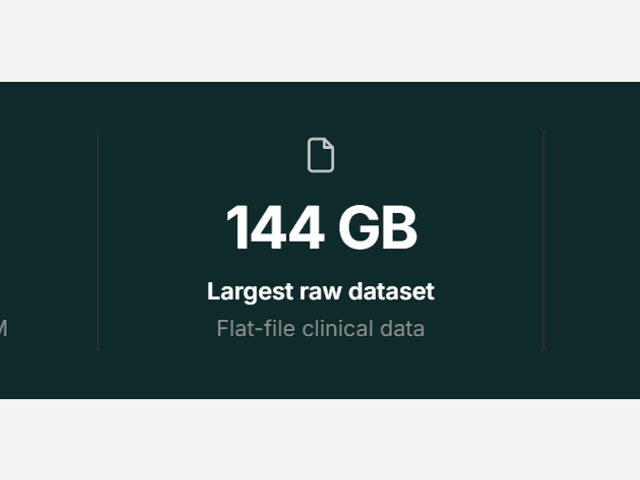
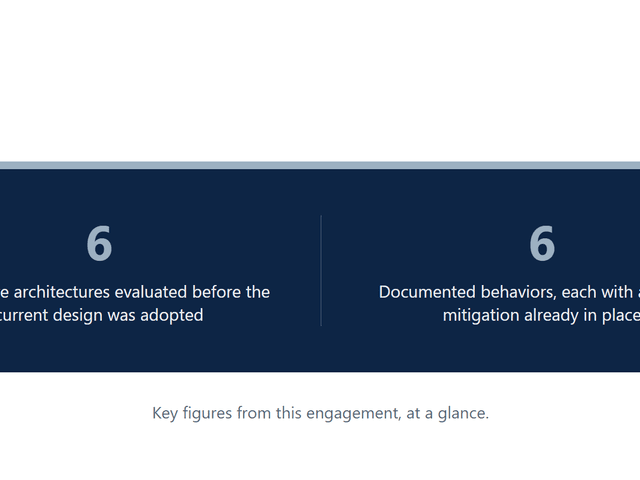
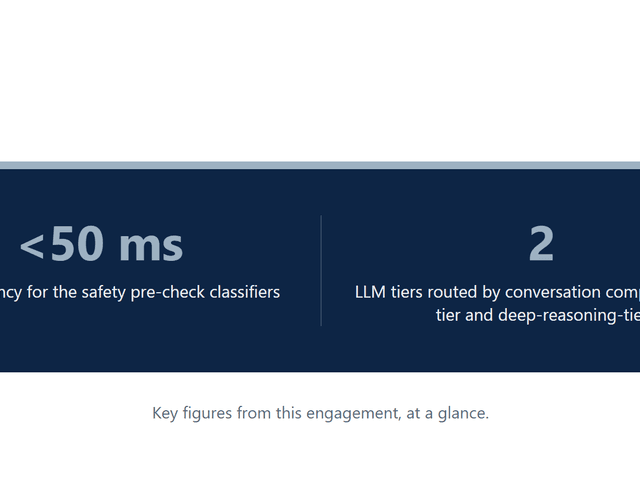
Pfactorial_Case_Study_Clinical_Analytics_Platform_Integration image 1
Figure 1 - Key figures from this engagement, at a glance.
EXECUTIVE SUMMARY
Our client's research team needed to go from raw, heterogeneous clinical data to statistically rigorous research insights, but no single platform covers that entire span - cohort discovery, advanced survival analysis, and multi-omics integration each demand different, specialized tools.
i2b2's intuitive cohort-query interface is not built for time-to-event or survival analysis. A general statistics environment isn't built for non-technical cohort discovery. And genomic, proteomic and clinical data each need to be unified before cross-domain research questions can even be asked.
Pfactorial connected i2b2, RStudio Server and LifeOmic into one coherent research workflow - i2b2 for accessible cohort identification against a custom clinical ontology, RStudio for advanced statistical analysis i2b2 can't perform natively, and LifeOmic for multi-omics data integration - built on top of a properly de-identified, OMOP-harmonized dataset.
Why this engagement is representative This engagement shows Pfactorial's approach to research infrastructure: rather than forcing one platform to do everything, connect specialized tools where each is genuinely strongest, with a properly de-identified and harmonized dataset as the shared foundation underneath all three.
THE CHALLENGE
Supporting the full span of the client's research needs - from non-technical cohort queries to advanced survival modeling to multi-omics analysis - meant integrating rather than choosing one platform.

1. i2b2's data model is not self-explanatory

i2b2's star-schema design requires understanding intricate data structures, creating a real adoption barrier for a platform meant to be usable by researchers without deep technical expertise.

2. Advanced statistical analysis exceeds i2b2's native capabilities

Time-to-event analysis, survival modeling and hypothesis testing that check patient observations across baseline and follow-up periods can't be fully performed within the i2b2 environment itself.

3. The default ontology doesn't match every dataset

i2b2's default concept vocabulary needed to be manually reviewed against the raw dataset and extended with missing concepts to reach the precision the research required.

4. Multiple data sources need to resolve to the same patient outcomes

Integrating OMOP-standardized data alongside the client's own data sources required a unified structure that lets researchers query across both without treating them as separate silos.
The real brief Not “deploy i2b2” but “connect the right specialized platform to each part of the research workflow, on top of one properly harmonized dataset.”
THE SOLUTION
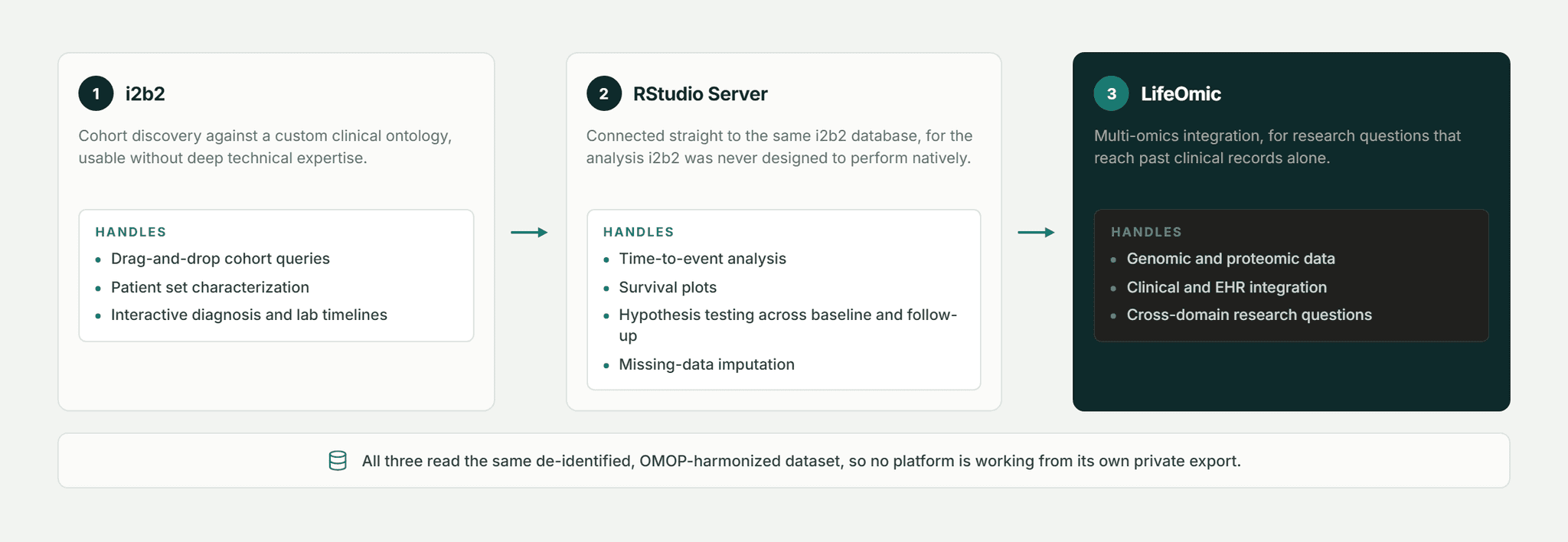
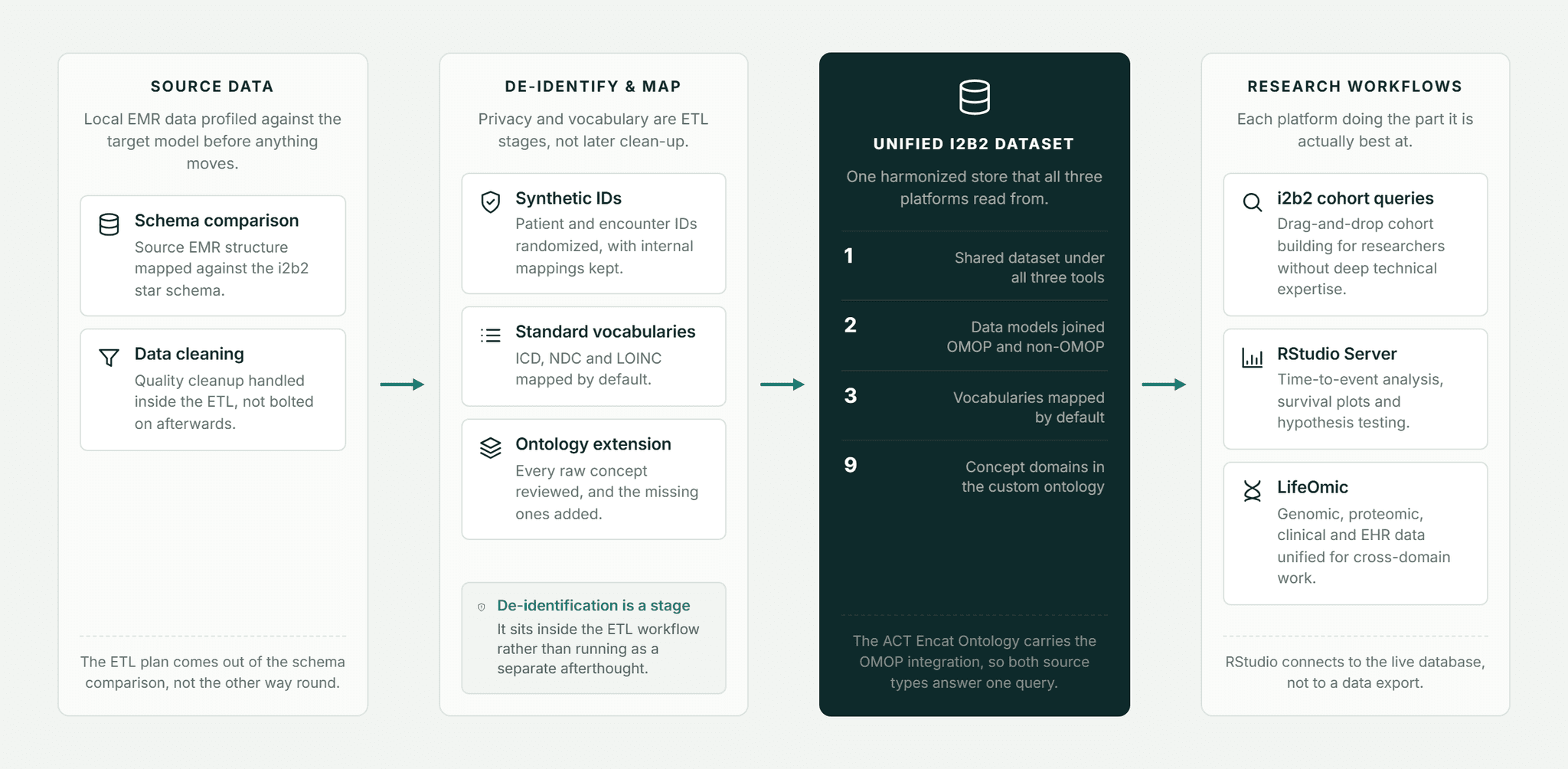
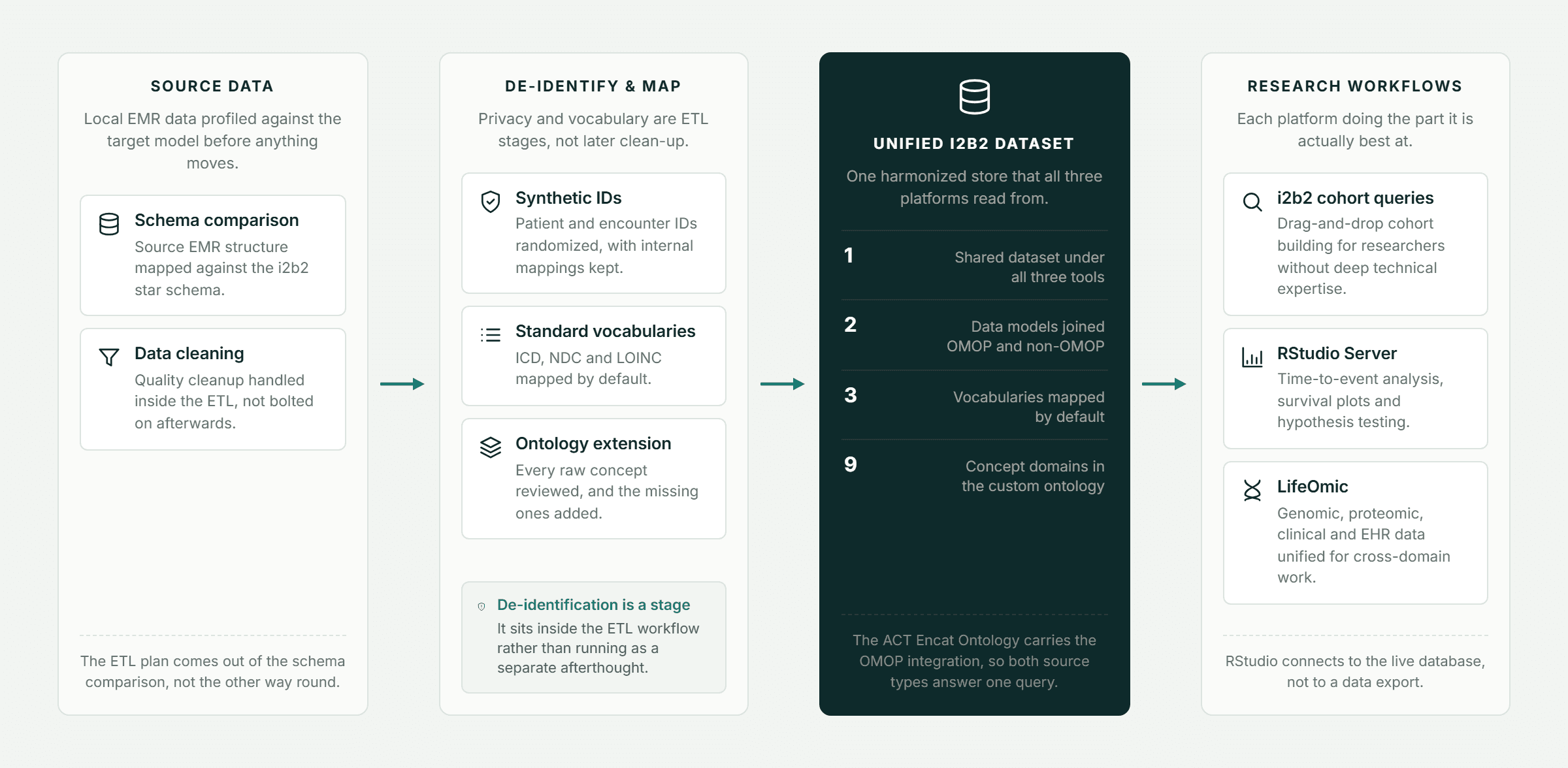
Pfactorial built the integration around i2b2 as the accessible entry point for cohort work, RStudio Server connected to the same database for advanced statistics, and LifeOmic for multi-omics data that spans beyond clinical records alone.
Pfactorial_Case_Study_Clinical_Analytics_Platform_Integration image 2
Figure 2 - From raw EMR data to advanced statistical analysis, across three connected platforms.

Architectural principles

  • Simplify the hard parts of adoption - Custom i2b2-ETL scripts were built specifically to streamline the data-loading process using a user-friendly input format, addressing the star-schema complexity that otherwise limits broader adoption.
  • Extend the platform's ontology to match the actual data - Every concept in the raw data was manually reviewed against the default i2b2 Ontology, with missing concepts added to create a refined, dataset-specific ontology rather than forcing data into a generic default structure.
  • Connect specialized tools rather than force-fitting one - RStudio Server was connected directly to the i2b2 database specifically because certain research protocols - baseline/follow-up comparison, missing-data imputation across periods - exceed what i2b2's native environment supports.
  • Unify data models before unifying questions - OMOP data was integrated using i2b2's ACT Encat Ontology, letting researchers query patient outcomes spanning both OMOP and non-OMOP sources through one unified structure.
CAPABILITIES DELIVERED
Each capability targets a distinct stage of the research workflow, from cohort discovery through advanced analysis.
CAPABILITY
WHAT IT DOES
Streamlined i2b2 data loading
Custom ETL scripts simplifying the star-schema data-loading process for broader researcher adoption.
Custom clinical ontology
A refined concept structure spanning demographics, diagnosis, expression, genetic variance, labs, medications, procedures, visits and vital status.
Drag-and-drop cohort queries
Non-technical researchers construct patient cohort queries via i2b2's query tool interface.
Demographics & timeline plugins
Patient set characterization and interactive timeline visualization of diagnoses, treatments and lab results.
Advanced statistical analysis
Time-to-event analysis, survival plots, and hypothesis testing via RStudio Server connected to the i2b2 database.
Multi-omics integration
LifeOmic-based unification of genomic, proteomic, clinical and EHR data for cross-domain research.
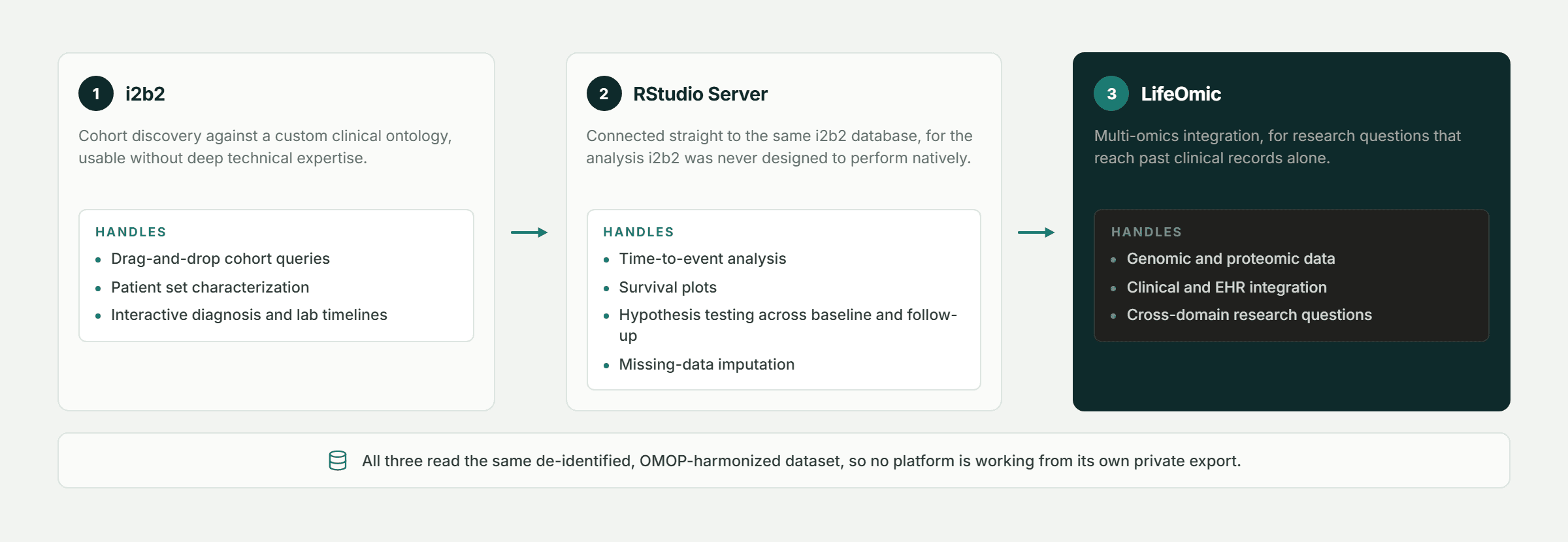
Pfactorial_Case_Study_Clinical_Analytics_Platform_Integration image 3
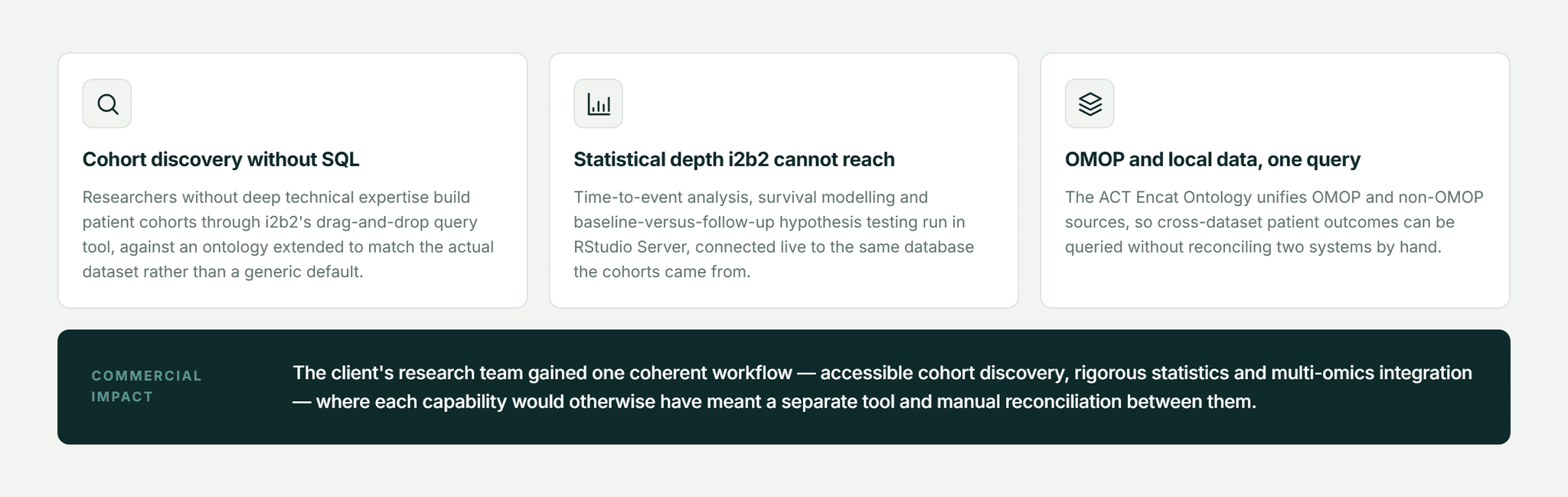
Figure 3 - Three platforms, three distinct and complementary roles.
Design note Choosing to connect i2b2 to RStudio, rather than trying to extend i2b2's native analytics, kept each platform doing what it's actually good at - i2b2 for accessible querying, RStudio for the statistical depth i2b2 was never designed to provide.
ENGINEERING FOR SCALE AND RELIABILITY
Five decisions kept the integrated workflow both usable by non-technical researchers and rigorous enough for advanced analysis.

R-based ETL for star-schema loading

Local data was transformed into an i2b2-compatible star schema using R-based ETL scripts, standardizing the loading process into the SQL Server-backed i2b2 database.

Privacy-first ETL sequencing

De-identification - randomizing patient and encounter IDs while maintaining internal mappings - is a defined stage within the ETL workflow itself, not a separate afterthought process.

Standard vocabulary mapping alongside custom extension

Widely recognized vocabularies (ICD, NDC, LOINC) are mapped by default, with the custom ontology extension layered on top for dataset-specific concepts rather than replacing the standard mappings.

ACT Encat Ontology for OMOP interoperability

i2b2's purpose-built ACT Encat Ontology, designed specifically for integrating OMOP data sources, was used rather than a custom-built mapping layer - using the tool built for exactly this integration problem.

Direct database connection for advanced analytics

RStudio Server connects directly to the same i2b2 database rather than working from a data export, keeping advanced analyses current with the underlying cohort data.
DELIVERY APPROACH
The engagement built the data foundation first, then connected each specialized platform to it in sequence.
1. Database structure analysis - comparing the source EMR schema against the i2b2 data model to plan the ETL approach.
2. De-identification & data cleaning - synthetic ID generation and data quality cleanup as defined ETL stages.
3. Ontology creation & customization - standard vocabulary mapping plus manual review and extension for dataset-specific concepts.
4. i2b2 data loading - R-based ETL transforming local data into the i2b2-compatible star schema.
5. OMOP integration - ACT Encat Ontology-based unification of OMOP and non-OMOP data sources.
6. RStudio & LifeOmic connection - advanced statistical analysis and multi-omics integration layered on top of the unified i2b2 dataset.
RESULTS AND IMPACT

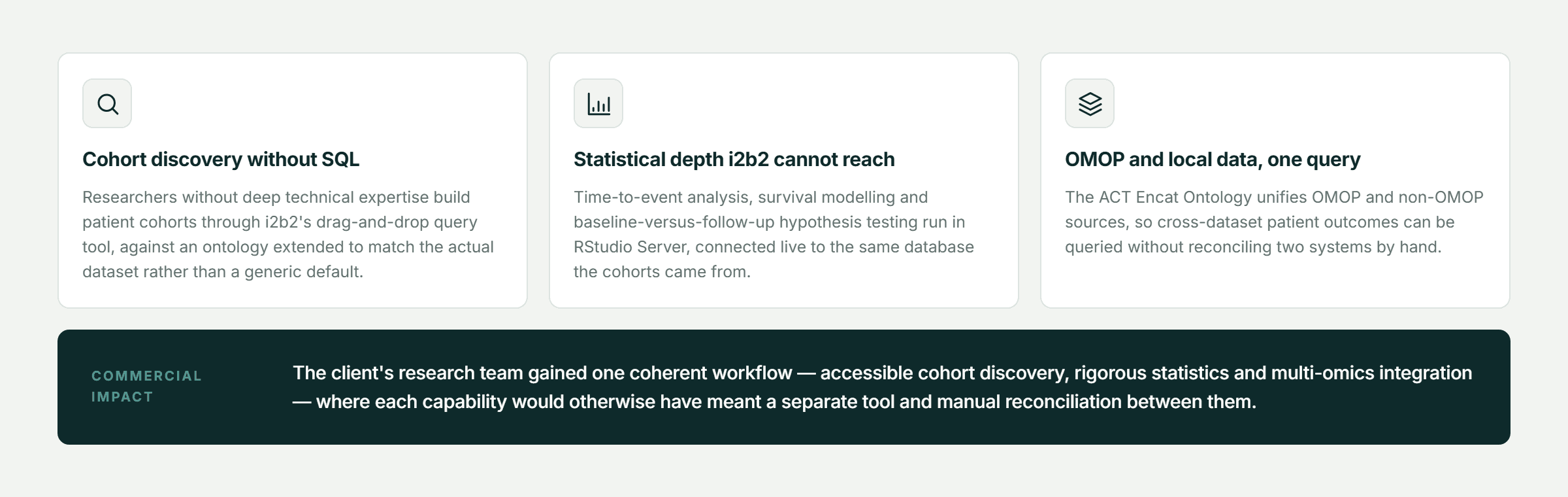
Pfactorial_Case_Study_Clinical_Analytics_Platform_Integration image 4
Figure 4 - Key outcomes from this engagement.
Researchers without deep technical expertise can identify patient cohorts through i2b2's drag-and-drop query interface, while advanced statistical work happens seamlessly in a connected RStudio environment.
Unified access to both OMOP and non-OMOP data sources through one ontology structure lets researchers query cross-dataset patient outcomes that would otherwise require reconciling two separate systems manually.

What it enabled commercially

The client's research team gained one coherent workflow - accessible cohort discovery, rigorous statistical analysis, and multi-omics integration - where previously each capability would have required a separate, disconnected tool and manual data reconciliation between them.
WHY PFACTORIAL
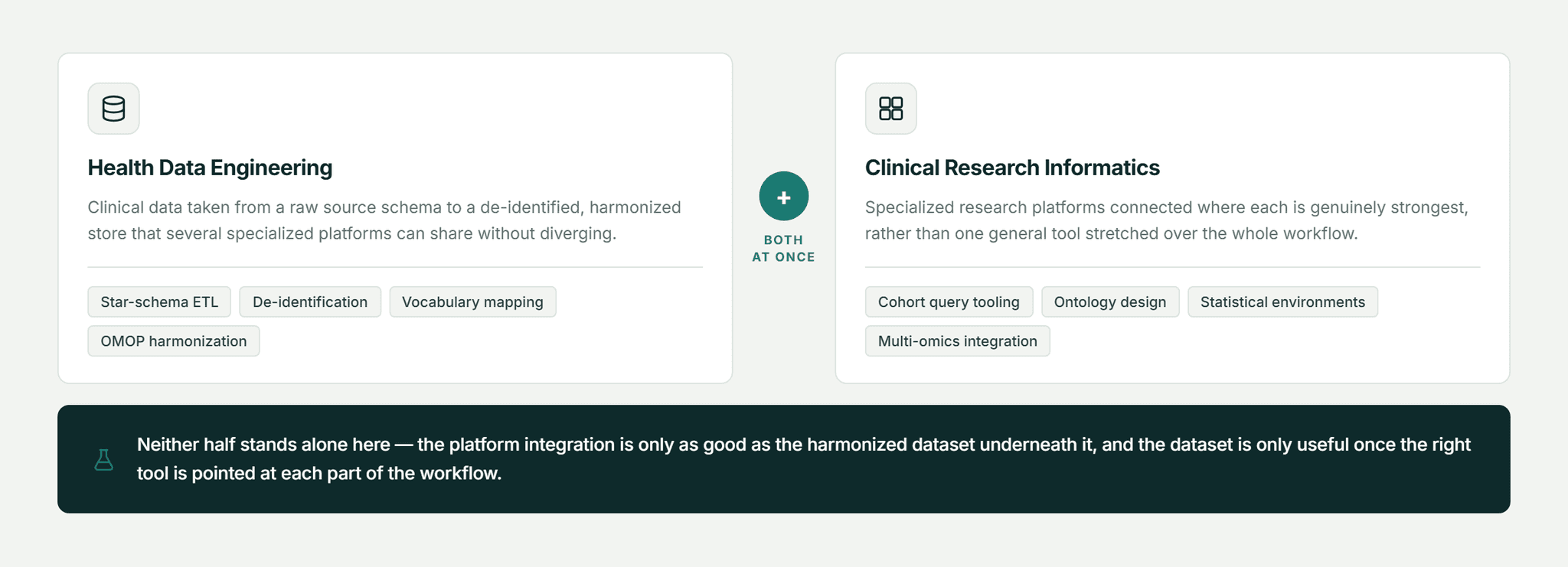
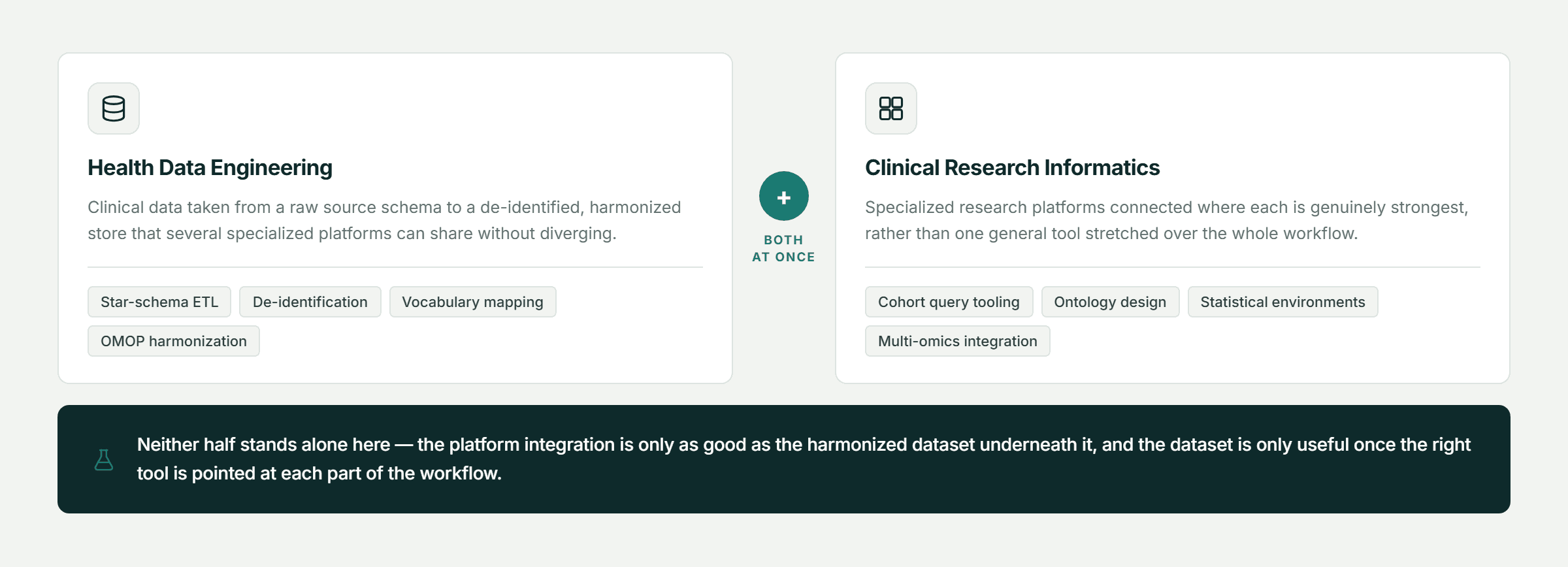
This engagement reflects Pfactorial's health data engineering service line: integrating specialized research platforms around a properly de-identified, harmonized dataset, rather than forcing one general-purpose tool to cover needs it wasn't built for.
Pfactorial_Case_Study_Clinical_Analytics_Platform_Integration image 5
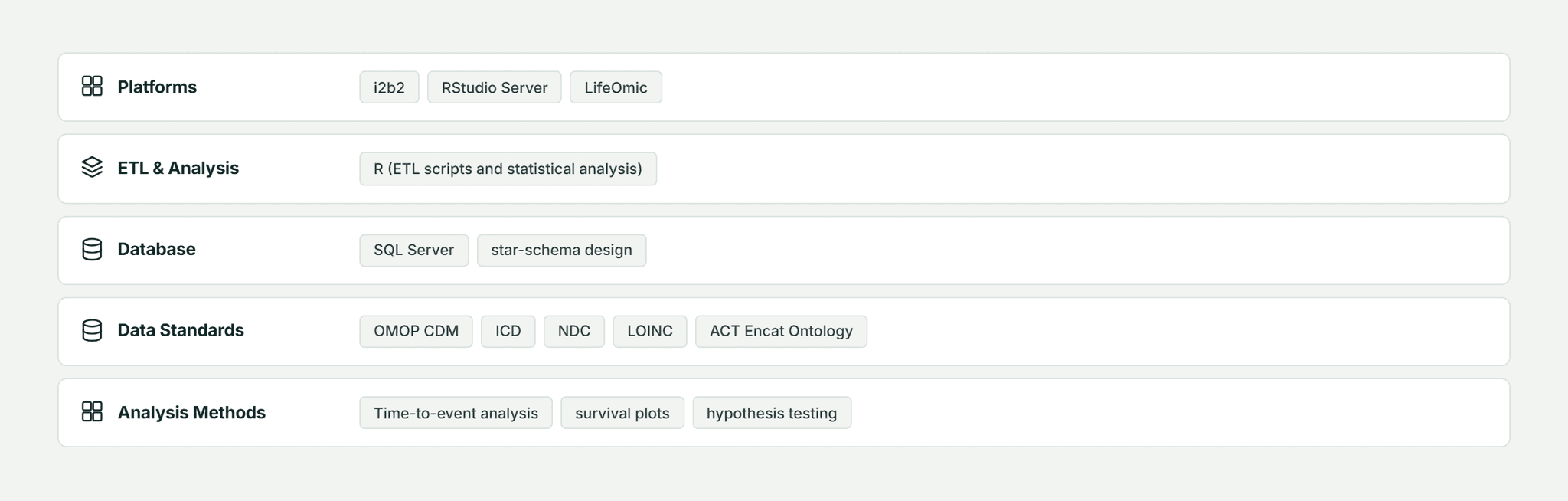
Figure 5 - Service lines this engagement draws on.
Engagement enquiries Pfactorial Technologies works with life-sciences and clinical research teams that need multiple specialized analytics platforms connected into one coherent research workflow. If you're evaluating a clinical research informatics initiative, we're happy to give you an honest read on scope and risk before anyone commits to anything. · pfactorial.ai
APPENDIX A - TECHNOLOGY STACK
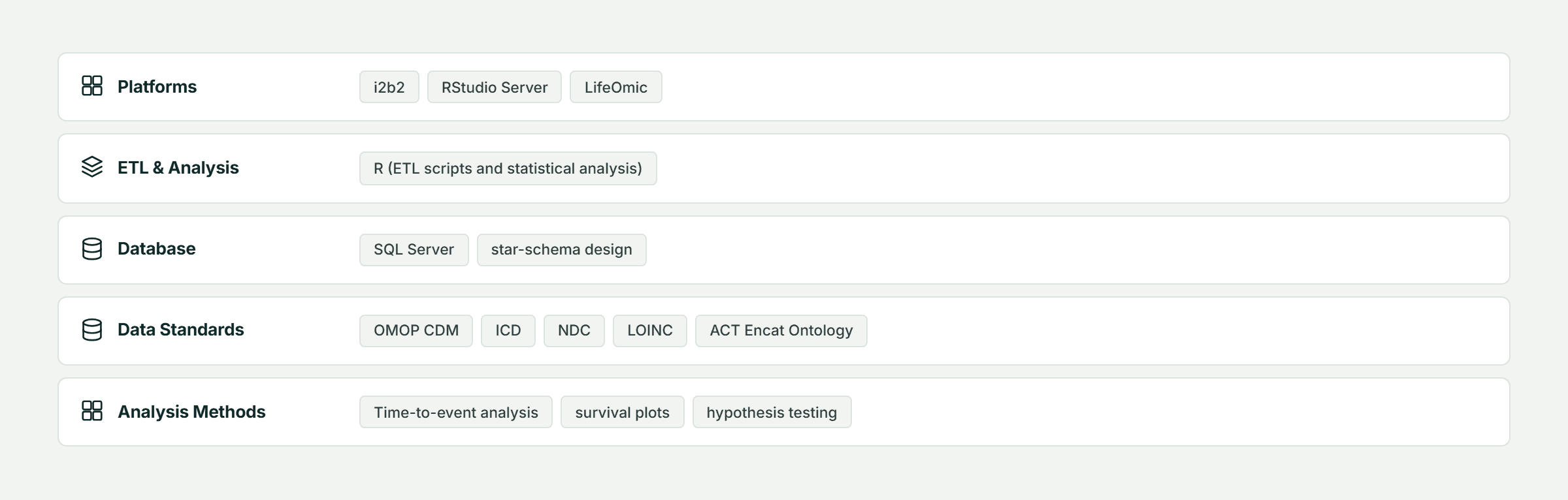
The technology stack underpinning the system, grouped by the layer it serves.
Pfactorial_Case_Study_Clinical_Analytics_Platform_Integration image 6
© 2026 Pfactorial Technologies. Client identity and product-specific implementation detail are withheld or generalized; no client data, credentials, source code, or infrastructure detail is included in this document.

Result and Analysis

ENGAGEMENT SNAPSHOT

How Pfactorial Technologies connected three specialized healthcare analytics platforms into one workflow - cohort identification, advanced statistics, and multi-omics integration - around a de-identified, standardized clinical dataset.

Pfactorial_Case_Study_Clinical_Analytics_Platform_Integration image 1
Pfactorial_Case_Study_Clinical_Analytics_Platform_Integration image 2
Pfactorial_Case_Study_Clinical_Analytics_Platform_Integration image 3
Pfactorial_Case_Study_Clinical_Analytics_Platform_Integration image 4
Pfactorial_Case_Study_Clinical_Analytics_Platform_Integration image 5
Pfactorial_Case_Study_Clinical_Analytics_Platform_Integration image 6