Back
Computer Vision
Grading Cricket Bat Condition With Computer Vision
A fine-tuned object detection model that replaces manual visual inspection with fast, consistent, repeatable condition grading.
August 21, 2026
Share
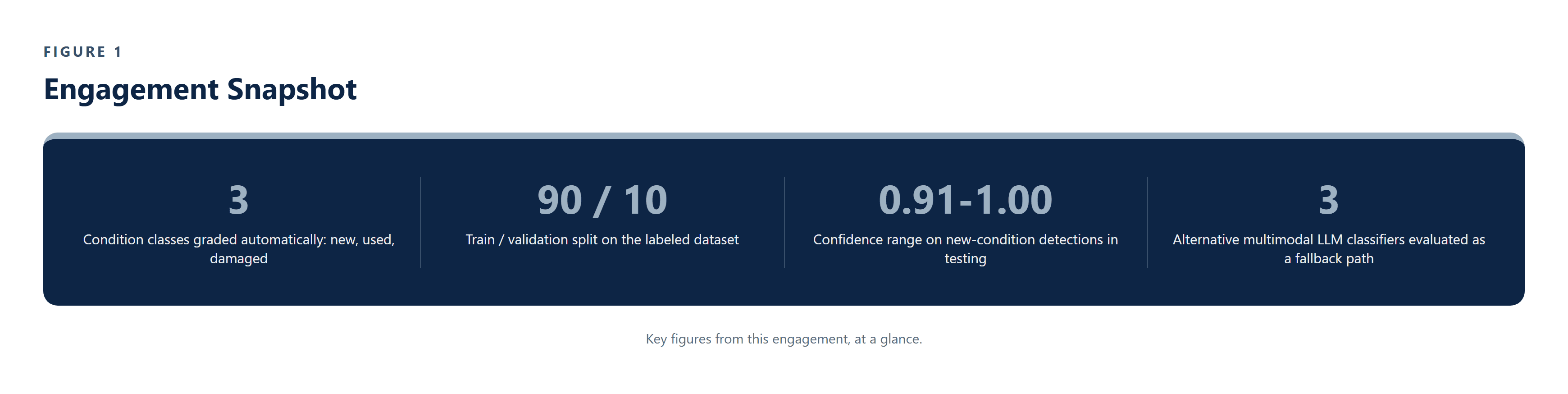
ENGAGEMENT SNAPSHOT

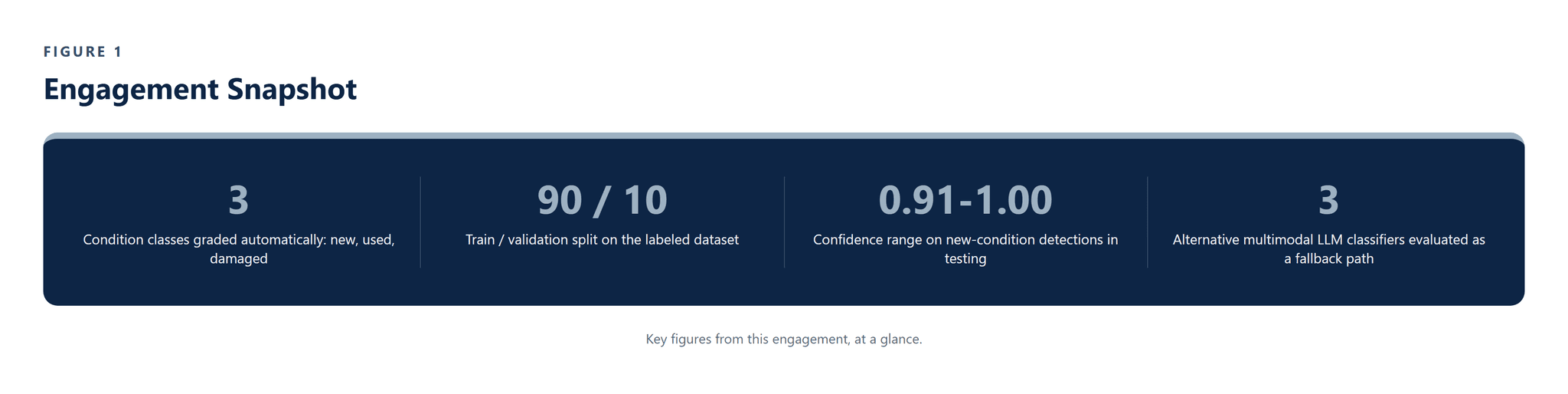
Figure 1 - Key figures from this engagement, at a glance.
EXECUTIVE SUMMARY
Our client's quality control workflow depended on a person looking at every bat and deciding, by eye, whether it was new, used, or damaged. That judgment call does not scale evenly - it is slower under volume, and consistency drifts across inspectors and across a shift.
Pfactorial Technologies built and validated a computer vision system that automates that grading step: a fine-tuned object detection model that takes a photo of a bat and returns its condition class alongside a confidence score, sorting each bat into one of three categories without a human reviewing every unit.
The model was deliberately kept lightweight rather than reaching for the largest available architecture, prioritising inference speed and deployment footprint so the system fits inspection and sorting workflows rather than a research benchmark.
Why this engagement is representative This engagement demonstrates Pfactorial's approach to applied computer vision: selecting the smallest model that reliably solves the actual task, validating it against held-out data, and documenting exactly where its judgment gets less reliable rather than overselling a single accuracy number.
THE CHALLENGE
Manual visual inspection was the only grading method in place, and it came with four compounding problems.
1. Manual grading does not scale evenly
A person reviewing every bat is a fixed-throughput step. As volume rises, either inspection time rises with it or grading gets rushed - there is no middle path with a manual process.
2. Consistency drifts between inspectors and over time
"New", "used", and "damaged" are judgment calls. Two inspectors - or the same inspector at the start versus the end of a shift - do not always draw the line in the same place.
3. Some conditions differ by colour more than by shape
Certain used-versus-new distinctions come down to subtle surface colour or wear changes rather than an obvious shape difference or visible damage, which is a harder signal for a purely shape-based detector to pick up reliably.
4. The dataset available at the start was small
Building a reliable classifier meant getting real signal out of a modestly sized, purpose-collected and hand-annotated dataset, not a large pre-existing labeled corpus.
The real brief Not "build a state-of-the-art classifier" but "replace a manual visual check with something fast, consistent, and honest about where it is less certain."
THE SOLUTION
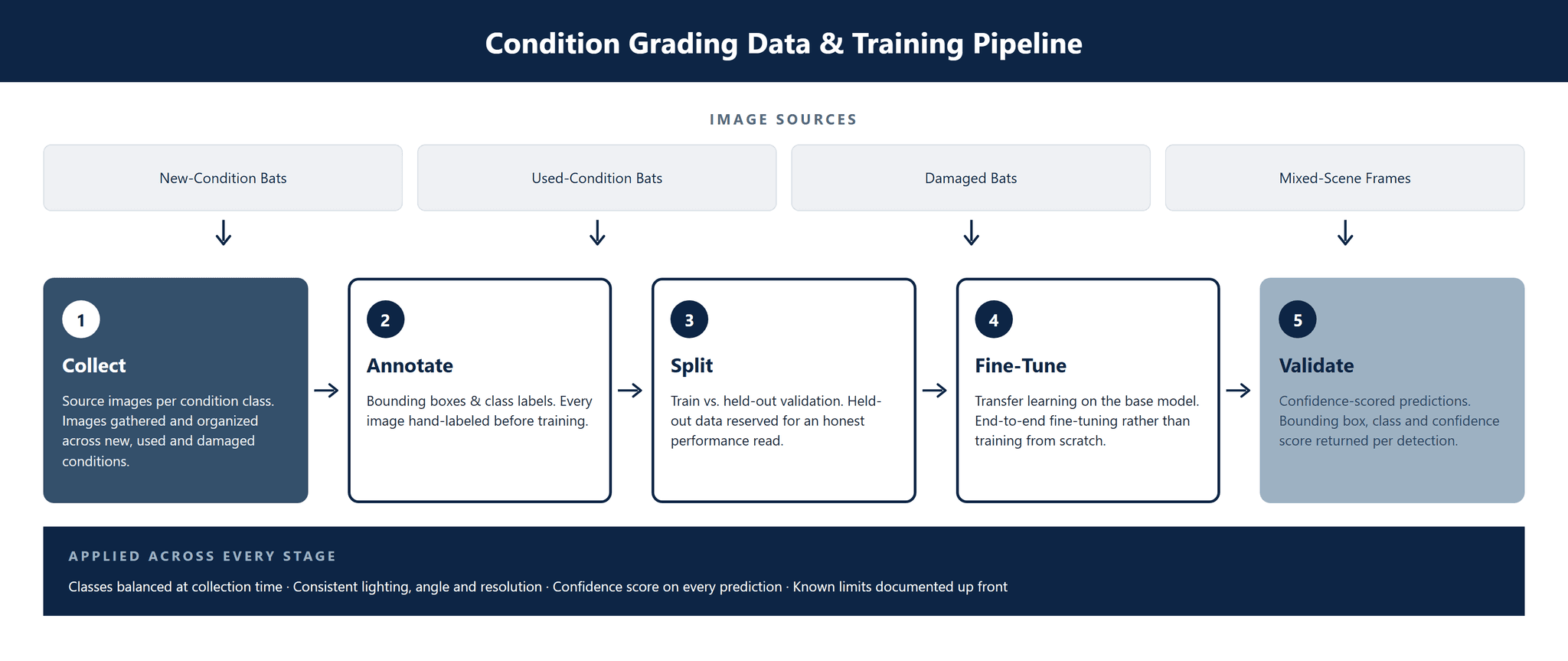
Pfactorial fine-tuned a compact object detection model end-to-end on a custom-labeled cricket bat dataset, choosing model size and training approach specifically for a focused, three-class grading task rather than a general-purpose vision benchmark.

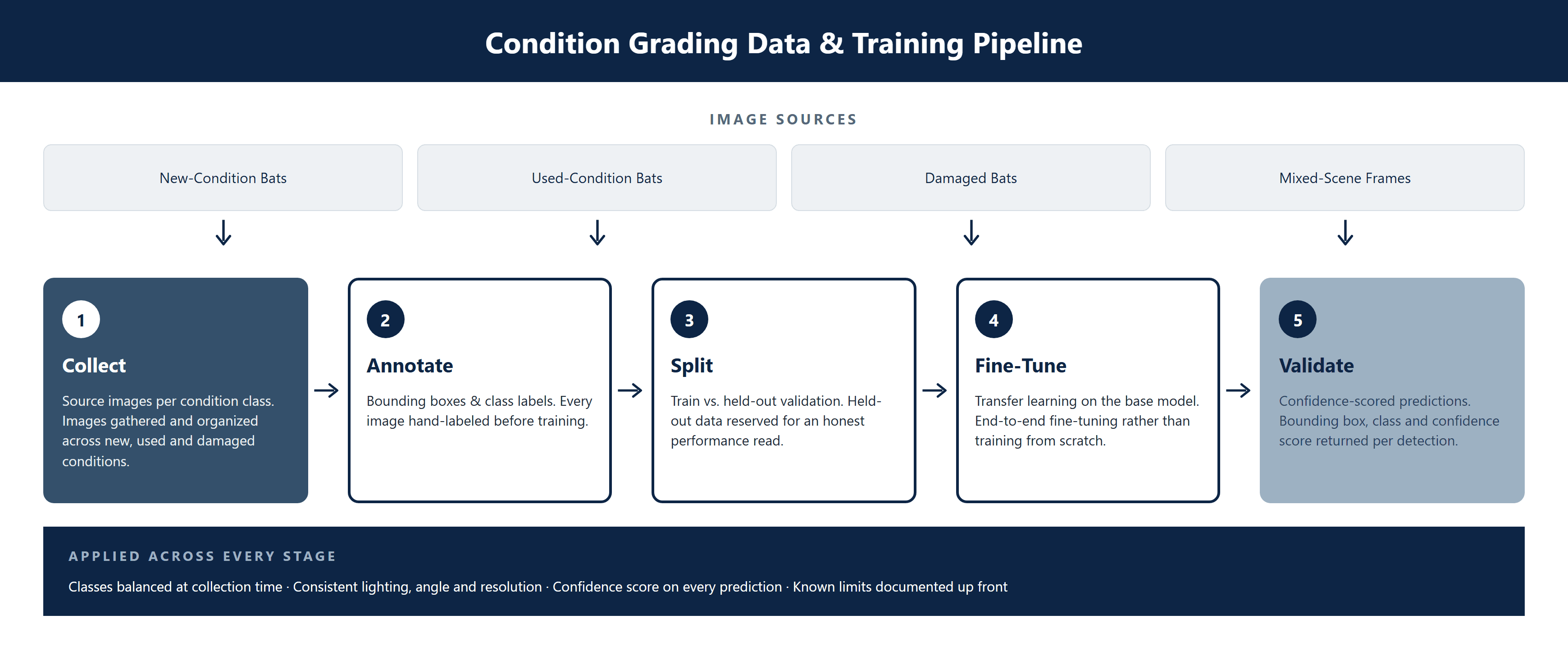
Figure 1 - Data and training pipeline: image collection, manual annotation, dataset split, and fine-tuning on the labeled dataset.
Architectural principles
- Right-sized model for the task - a nano-scale object detection architecture was selected for its balance of inference speed, deployment footprint, and accuracy on smaller, task-specific datasets - not the largest model available.
- Transfer learning over training from scratch - the base model was fine-tuned end-to-end on the cricket bat dataset starting from its pretrained weights, rather than training a detector from zero.
- Balanced, purpose-built dataset - images were collected and manually annotated across all three condition classes, with a 90/10 train-validation split to give an honest read on held-out performance.
- A documented fallback, not a silent gap - where the production model's shape-based detection is weaker - subtle colour or wear differences - a multimodal LLM classification path was evaluated and retained as a documented fallback.
CAPABILITIES DELIVERED
The system covers the full path from a photo to a graded, sorted result.
CAPABILITY | WHAT IT DOES |
|---|---|
Automated Condition Classification | Classifies each detected bat as new, used, or damaged directly from an input photo. |
Bounding Box Localization | Returns a bounding box around each detected bat in the frame, alongside its predicted class. |
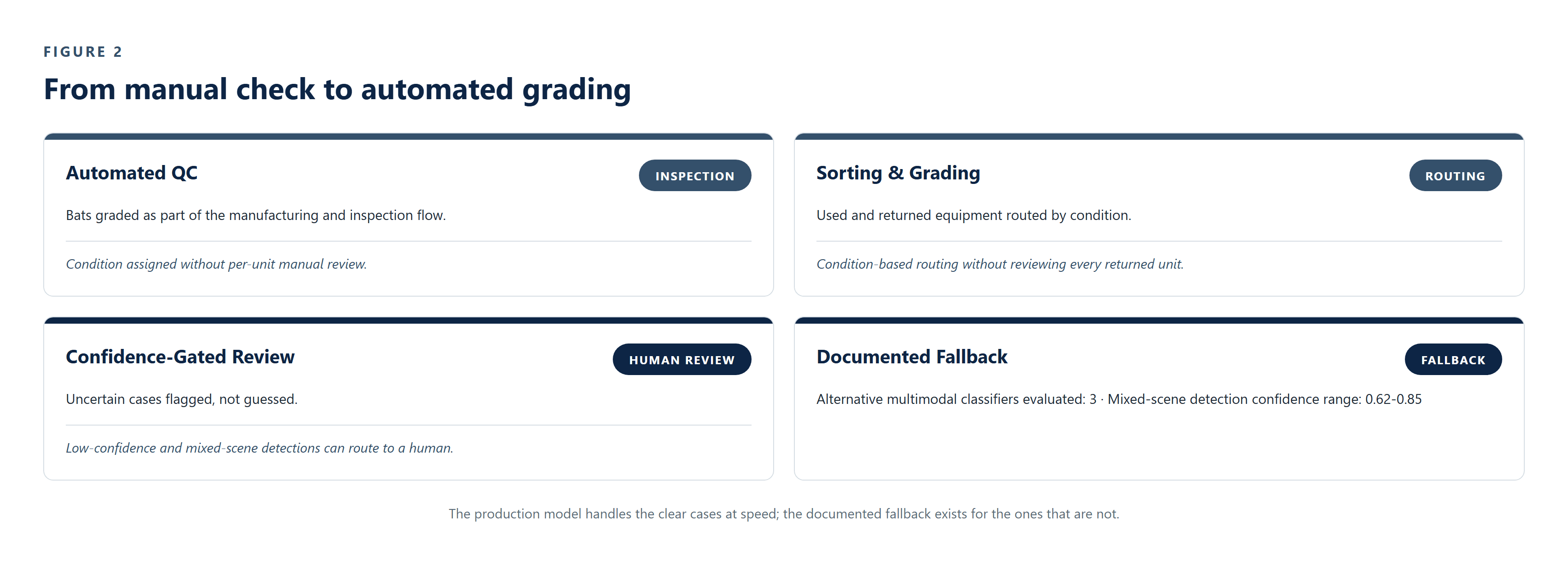
Confidence Scoring | Every prediction carries a confidence score, so low-certainty gradings can be routed for human review rather than accepted silently. |
Multi-Bat / Mixed-Scene Detection | Detects and grades multiple bats - and localizes specific damage regions - within a single frame. |
Fine-Tuned on Task-Specific Data | Trained on a custom-labeled, condition-balanced dataset rather than adapted from a generic pretrained classifier. |
Documented Fallback Path | A multimodal LLM classification approach is retained and documented for cases where colour-based differentiation dominates the grading decision. |
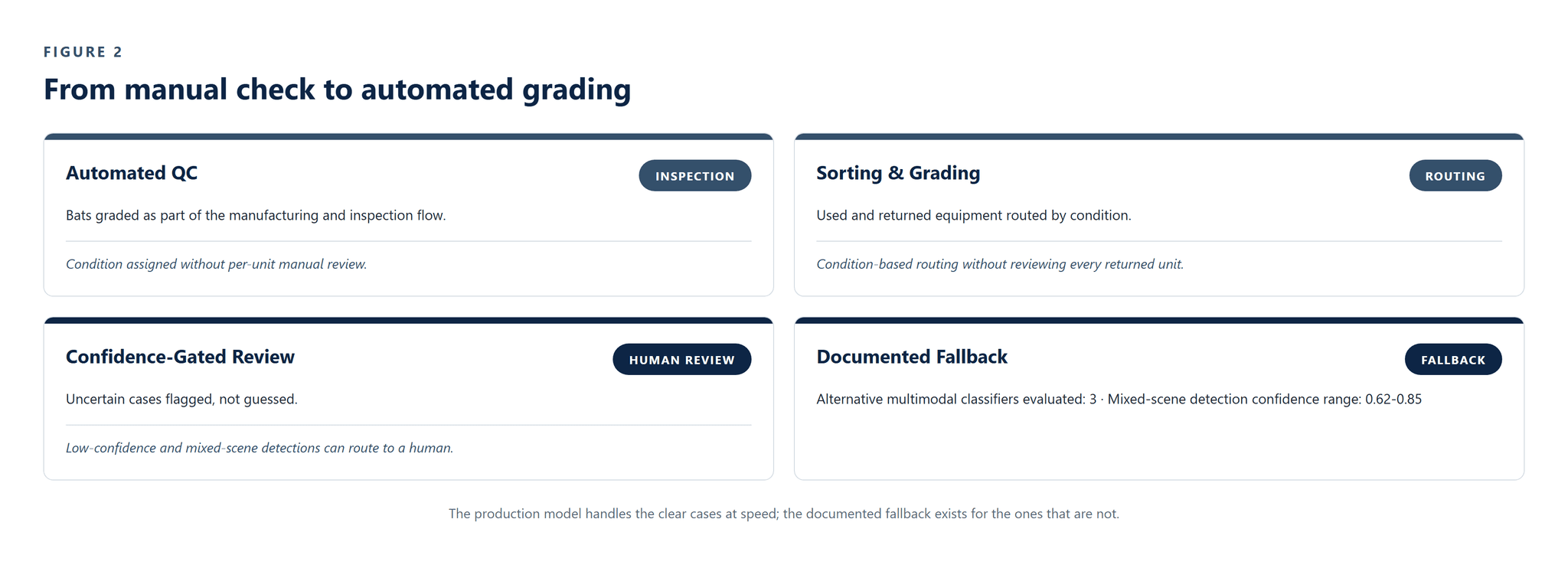
Figure 2 - Deployment surface: where automated grading replaces manual review, and the fallback path for harder cases.
Design note Multimodal LLM classification produced highly accurate results in testing, but per-image latency and API rate limits make it unsuitable as the primary path for high-throughput, real-time inspection. It remains the production model's documented fallback for finer-grained visual reasoning, not a replacement for it.
ENGINEERING FOR SCALE AND RELIABILITY
Several engineering decisions shape how this system holds up outside a clean test set.
Model choice was deliberate, not default
the nano-scale architecture was chosen over larger, newer alternatives specifically for its practical balance of training speed, inference latency, and resource footprint at this dataset size - not because it was the newest option available.
Architecture kept upgradeable
the pipeline is modular, so the underlying detection model can be upgraded in a future iteration without changes to the surrounding system.
Colour sensitivity, engineered for directly
consistent lighting, angle, and resolution across training images, combined with brightness, contrast, and hue augmentation, were used specifically to improve robustness to colour-based condition differences.
Dataset balance treated as a first-class concern
training data was curated to include well-labeled, balanced examples across all three conditions, with colour differences clearly represented, to avoid the model skewing toward whichever class was easiest to collect.
A known constraint, stated plainly
the model is more reliable distinguishing conditions by shape and surface damage than by subtle colour change or viewing angle alone - documented as a known limitation rather than discovered later in production.
Fallback evaluated on real trade-offs
the multimodal LLM alternative was benchmarked on accuracy against per-image latency and rate-limit behaviour under sustained batch use, not accuracy in isolation, before being scoped as a fallback rather than the primary path.
DELIVERY APPROACH
The engagement moved from raw images to a validated, deployable classifier in five phases.
1. Collect and organize image data - built an image sourcing pipeline and assembled a dataset spanning all three target conditions.
2. Annotate and split the dataset - manually annotated bounding boxes and class labels for every image, then split the dataset 90/10 between training and held-out validation.
3. Fine-tune the detection model - fine-tuned the base object detection model end-to-end on the prepared dataset, starting from its pretrained weights.
4. Validate against held-out images - ran the trained model against the held-out validation set and captured confidence scores across all three condition classes, including mixed-scene, multi-bat frames.
5. Evaluate a multimodal fallback - benchmarked multimodal LLM classification as an alternative path, and documented it as a fallback for finer-grained, colour-sensitive cases rather than the production default.
RESULTS AND IMPACT

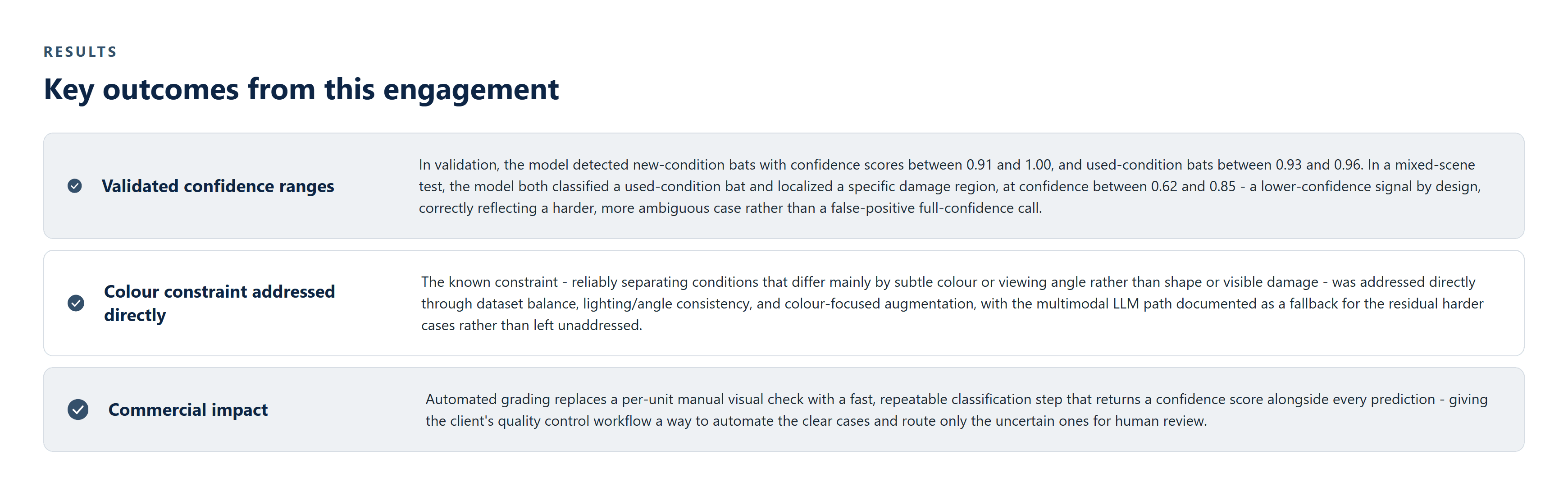
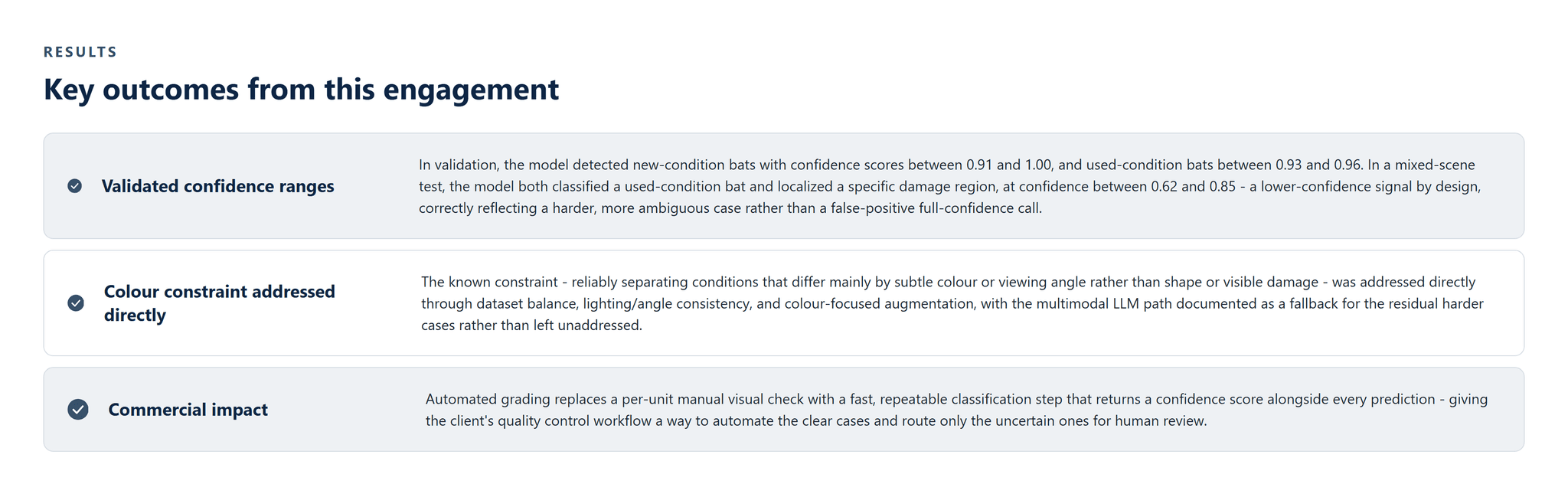
Figure - Key outcomes from this engagement.
In validation, the model detected new-condition bats with confidence scores between 0.91 and 1.00, and used-condition bats between 0.93 and 0.96. In a mixed-scene test, the model both classified a used-condition bat and localized a specific damage region, at confidence between 0.62 and 0.85 - a lower-confidence signal by design, correctly reflecting a harder, more ambiguous case rather than a false-positive full-confidence call.
The known constraint - reliably separating conditions that differ mainly by subtle colour or viewing angle rather than shape or visible damage - was addressed directly through dataset balance, lighting/angle consistency, and colour-focused augmentation, with the multimodal LLM path documented as a fallback for the residual harder cases rather than left unaddressed.
What it enabled commercially
Automated grading replaces a per-unit manual visual check with a fast, repeatable classification step that returns a confidence score alongside every prediction - giving the client's quality control workflow a way to automate the clear cases and route only the uncertain ones for human review.
WHY PFACTORIAL
This engagement draws on Pfactorial's AI product engineering capability: fine-tuning a right-sized model for a specific, real-world classification task, validating it honestly against held-out data, and documenting a fallback path rather than presenting a single model as a complete answer.

Figure - Service lines this engagement draws on.
Engagement enquiries Pfactorial Technologies works with manufacturing and inspection teams looking to automate visual quality control without over-building the solution. If you are weighing whether a grading or inspection task is a good fit for computer vision, we are happy to give you an honest read on scope, cost, and risk before anyone commits to anything. · pfactorial.ai
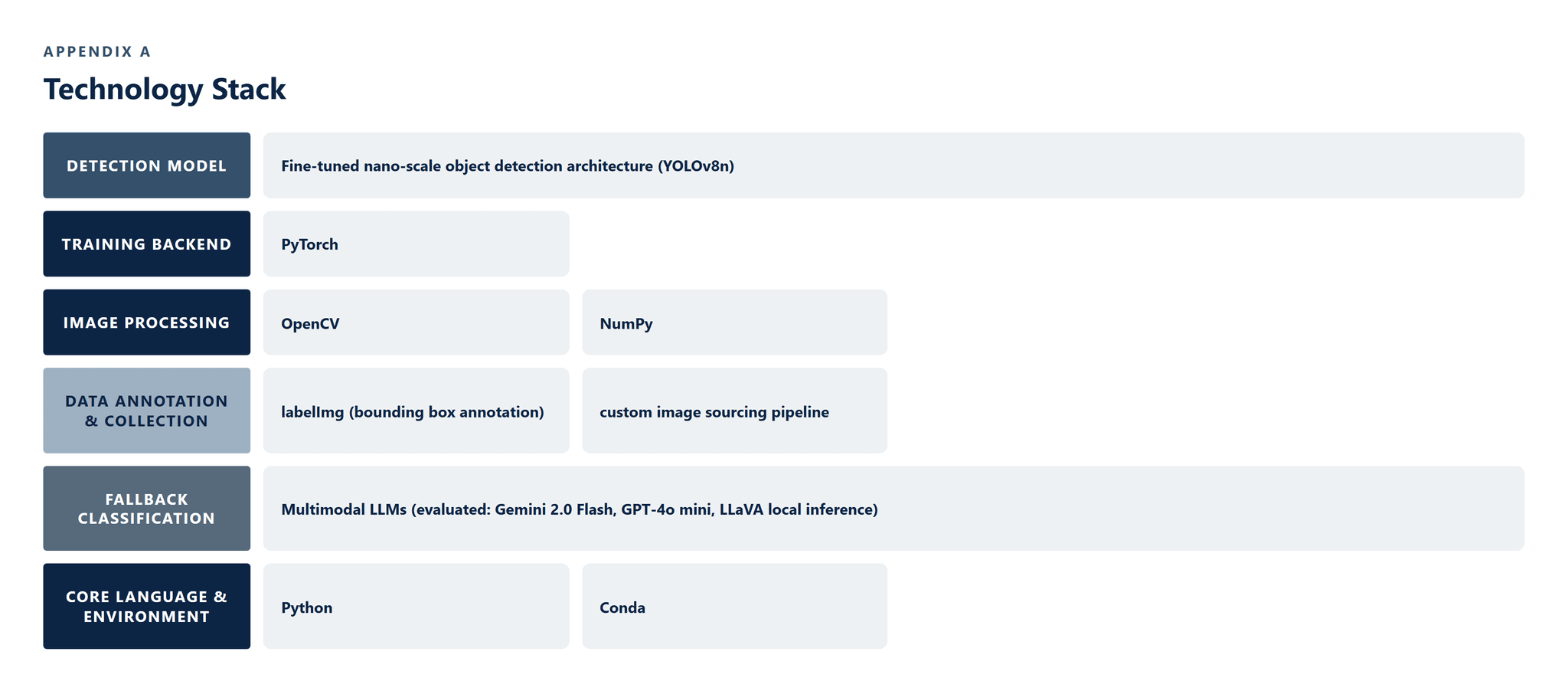
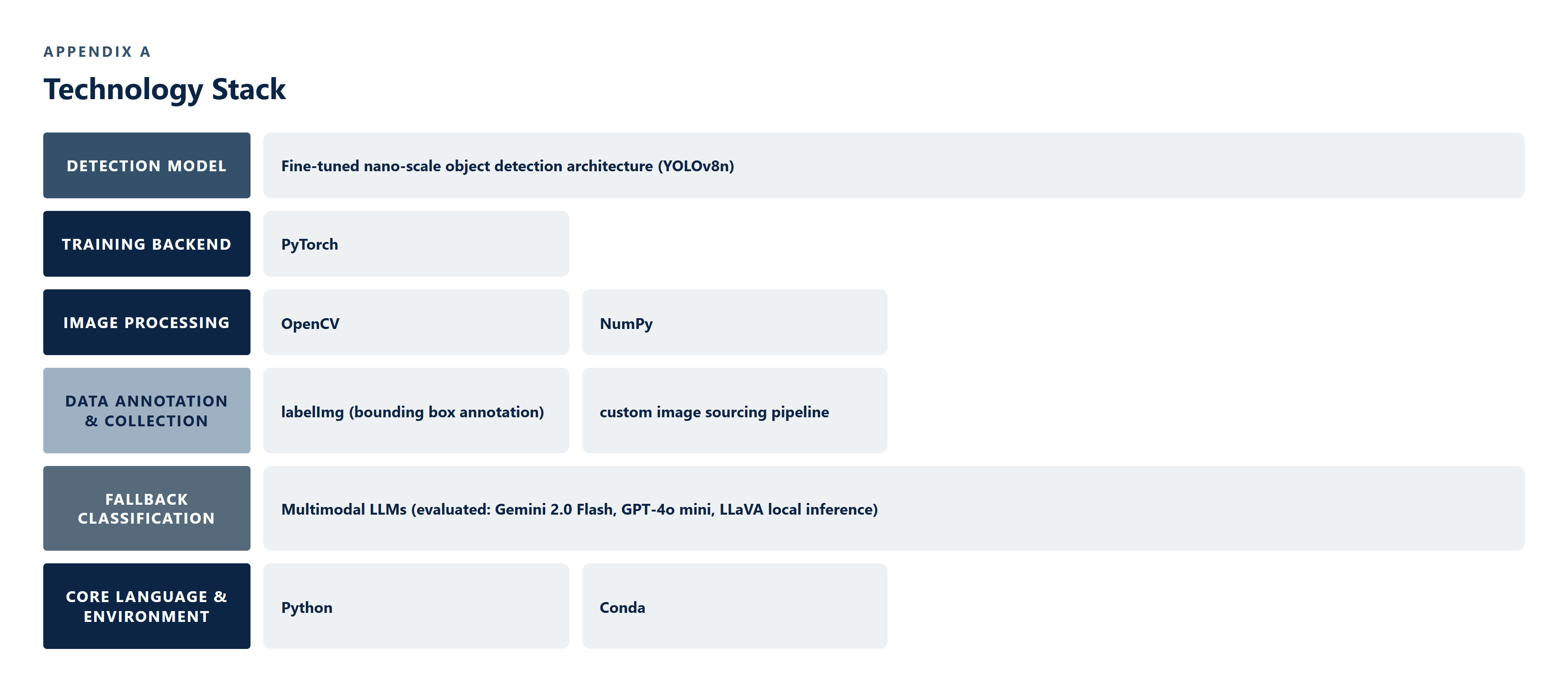
APPENDIX A - TECHNOLOGY STACK
The technology stack underpinning the system, grouped by the layer it serves.

Result and Analysis
ENGAGEMENT SNAPSHOT
A fine-tuned object detection model that replaces manual visual inspection with fast, consistent, repeatable condition grading.
CASE STUDIES
You might also like...

OCR & Document ExtractionAutomotive & Vehicle
Aug 21, 20267 min readRead

Computer VisionML Infra, Classifiers & RL
A Deep Learning Classifier That Separates True-Negative Mammograms from Genuine BIRADS 0 Cases
Aug 21, 20266 min readRead

Content & Media Generation
A Failover-Chained Text-to-Image Service Built on Three Stable Diffusion Models
Aug 21, 20267 min readRead

Analytics & BI DashboardsAutomotive & Vehicle
A Five-Capability Computer Vision Platform for Vehicle Identity, Traffic, and Parking Intelligence
Aug 21, 20267 min readRead

OCR & Document Extraction
A Hugging Face Inference-Backed Handwriting Transcription Tool for Single-Line Document Digitization
Aug 21, 20266 min readRead

A Shared-Model Architecture for Consistent AI Character Generation at Scale
Aug 21, 20268 min readRead