Back
Computer Vision
A Shared-Model Architecture for Consistent AI Character Generation at Scale
A proposed production diffusion pipeline that generates hundreds of distinct, identity-consistent AI characters from one frozen base model and lightweight, independently trained LoRA adapters.
August 21, 2026
Share
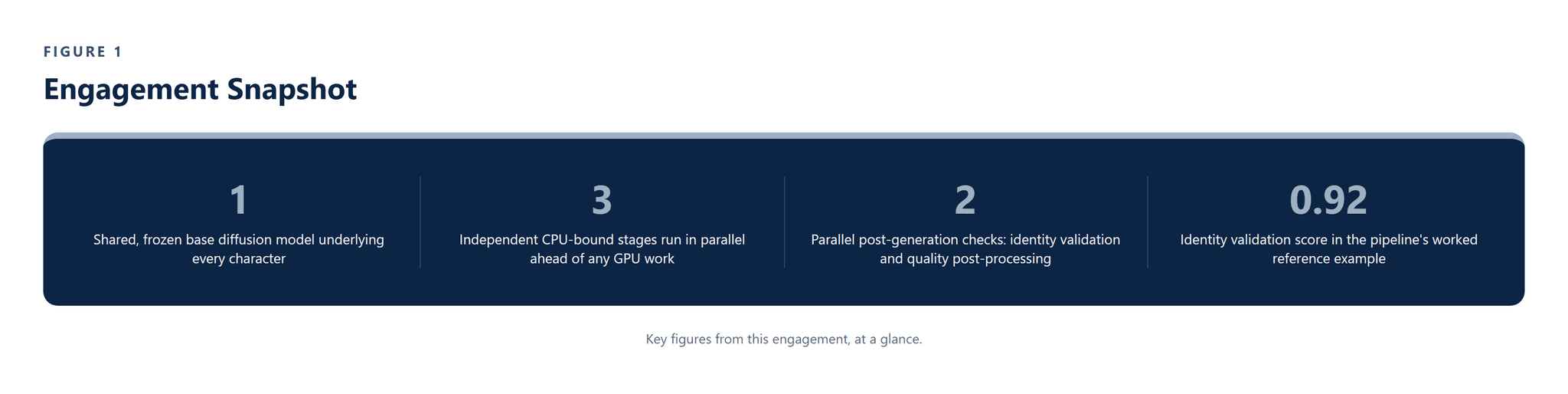
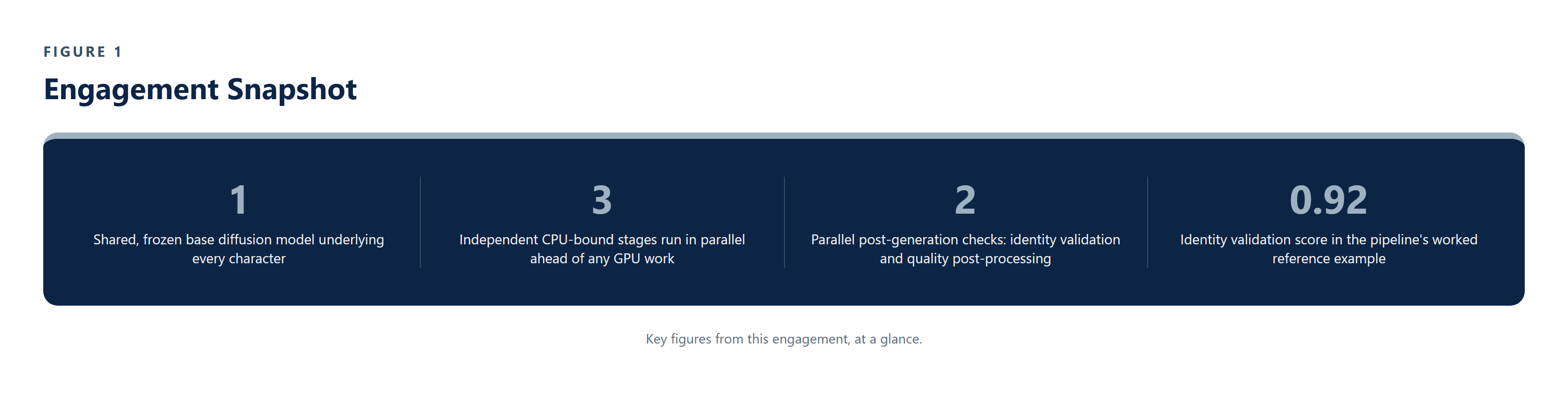
ENGAGEMENT SNAPSHOT

Figure 1 - Key figures from this engagement, at a glance.
EXECUTIVE SUMMARY
Our client needed to generate images for hundreds or thousands of distinct AI characters at production volume, with each character's visual identity staying consistent across prompts, styles, and repeated automated requests - without training or hosting a separate model per character.
Pfactorial Technologies proposed a shared-model architecture: a single frozen diffusion base model combined with a lightweight, character-specific LoRA adapter per character. At inference time, the system dynamically loads the correct character LoRA into the shared base, so identity consistency is preserved without duplicating models or infrastructure for every character added.
The design keeps training and inference deliberately separate: each character is trained independently against the same frozen base, so adding, updating, or retiring one character never touches another, and the inference layer is built as a native diffusion stack - not infrastructure repurposed from language-model serving - to match how diffusion models actually execute.
Why this engagement is representative This engagement demonstrates Pfactorial's approach to generative AI systems that must scale across many distinct identities: one shared, stable foundation model, with per-entity customization isolated into small, independently versioned adapters rather than duplicated infrastructure.
THE CHALLENGE
Generating consistent character images at scale is a different problem from generating a single good image. Four constraints shaped the proposed architecture.
1. Identity has to stay consistent, per character, at volume
The same character has to look like itself across different prompts, styles, and thousands of automated requests - not just in a single curated demo image.
2. One model per character does not scale
Training and hosting a full, separate model for every character would multiply infrastructure cost and operational complexity linearly with the character catalogue, which was not viable at hundreds or thousands of characters.
3. Same-model synthetic data does not teach new identity
Generating training images purely from the base model reinforces what it already knows rather than expanding its ability to represent a genuinely new character - a subtlety that determines whether the dataset strategy actually works.
4. Diffusion inference has different execution needs than LLM serving
Iterative denoising, per-request LoRA injection, and image-level job isolation do not map cleanly onto infrastructure built for autoregressive language model serving.
The real brief Not "generate good-looking AI characters" but "generate hundreds of distinct characters that each stay visually consistent at production request volume, without a model or infrastructure footprint that scales linearly with the character count."
THE SOLUTION
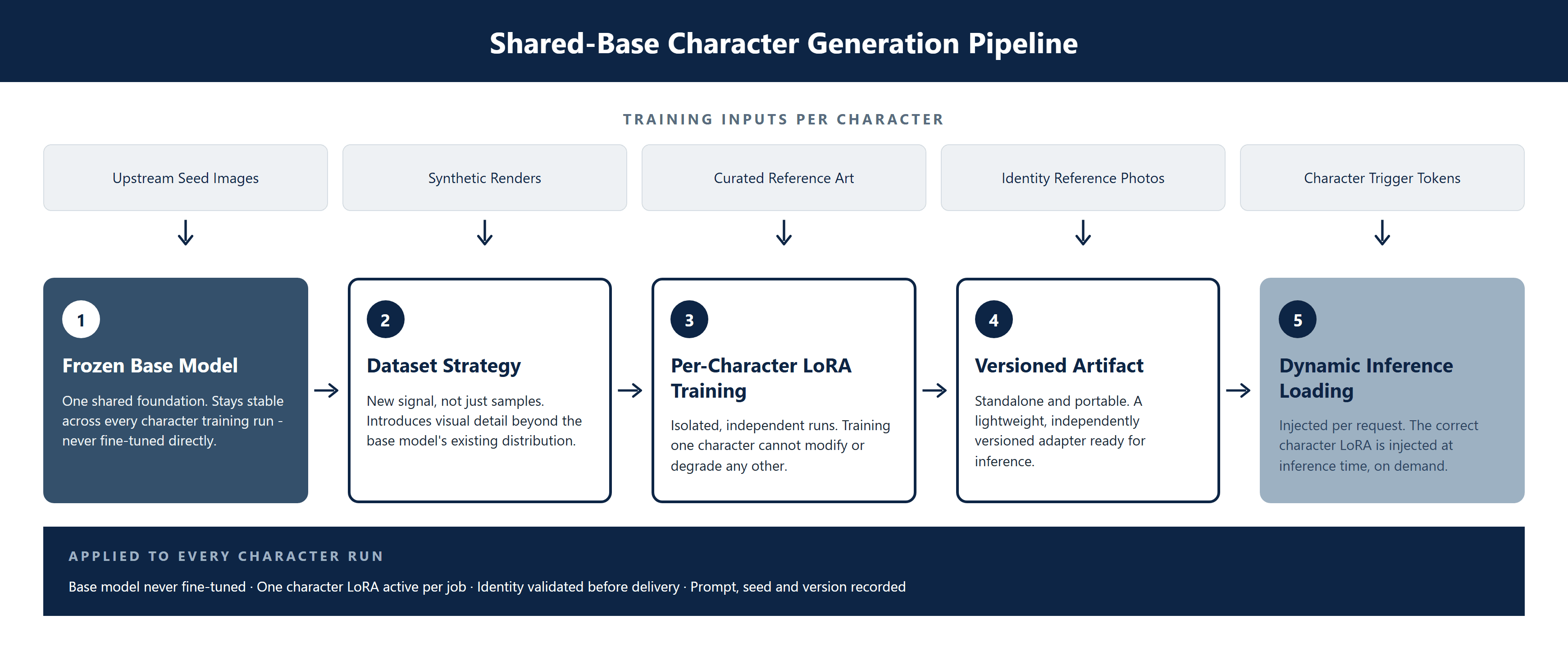
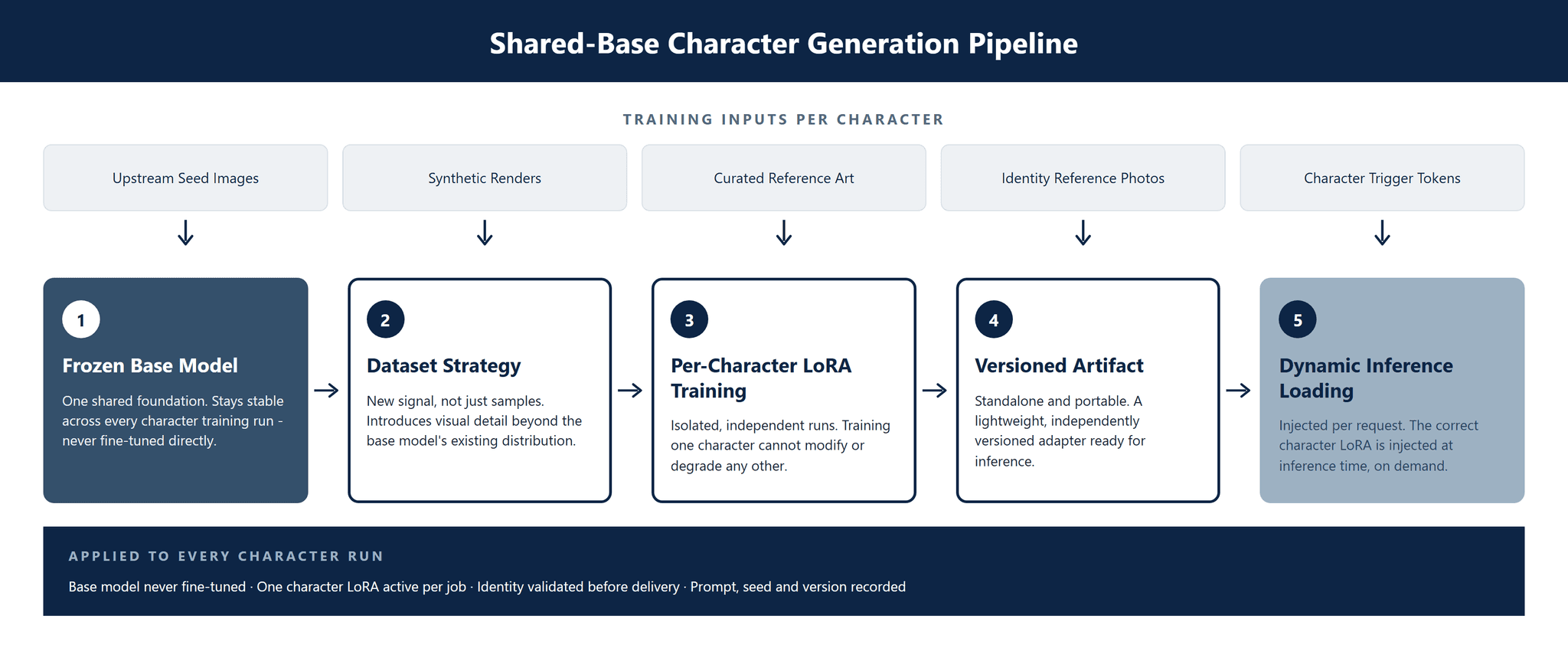
Pfactorial proposed training each character as an independent, lightweight LoRA against a single shared, frozen base model, with a dedicated inference pipeline that dynamically loads the right character LoRA per request.

Figure 1 - Character training approach: a shared frozen base model, independent per-character LoRA training, and a systematic pipeline for producing versioned, standalone character artifacts.
Architectural principles
- One frozen base, many independent adapters - the base diffusion model remains frozen and stable across all character training runs, while each character is trained as its own lightweight LoRA - training one character cannot degrade another.
- New visual signal, not just more samples - dataset strategy prioritizes seed images from a higher-capacity upstream model to introduce genuinely new visual detail, using same-model synthetic data only as a supporting signal for pose and lighting diversity.
- Shape and identity, solved with the tools built for them - a native diffusion inference stack handles iterative denoising and LoRA injection, rather than infrastructure adapted from autoregressive language-model serving.
- Every artifact is versioned and portable - each character LoRA is a standalone, versioned artifact that can be added, updated, or removed independently, so the system scales linearly as new characters are introduced rather than requiring retraining.
CAPABILITIES DELIVERED
The proposed system covers the full path from a client request to a validated, delivered image, with identity consistency checked before any output reaches the caller.
CAPABILITY | WHAT IT DOES |
|---|---|
Dynamic Character LoRA Loading | Loads the correct character-specific LoRA into the shared base model at inference time, based on the request's character identifier. |
Prompt Processing & Safety Locking | Cleans and normalizes the user prompt, injects hidden trigger tokens, and applies system-level negative prompts and identity constraints before generation. |
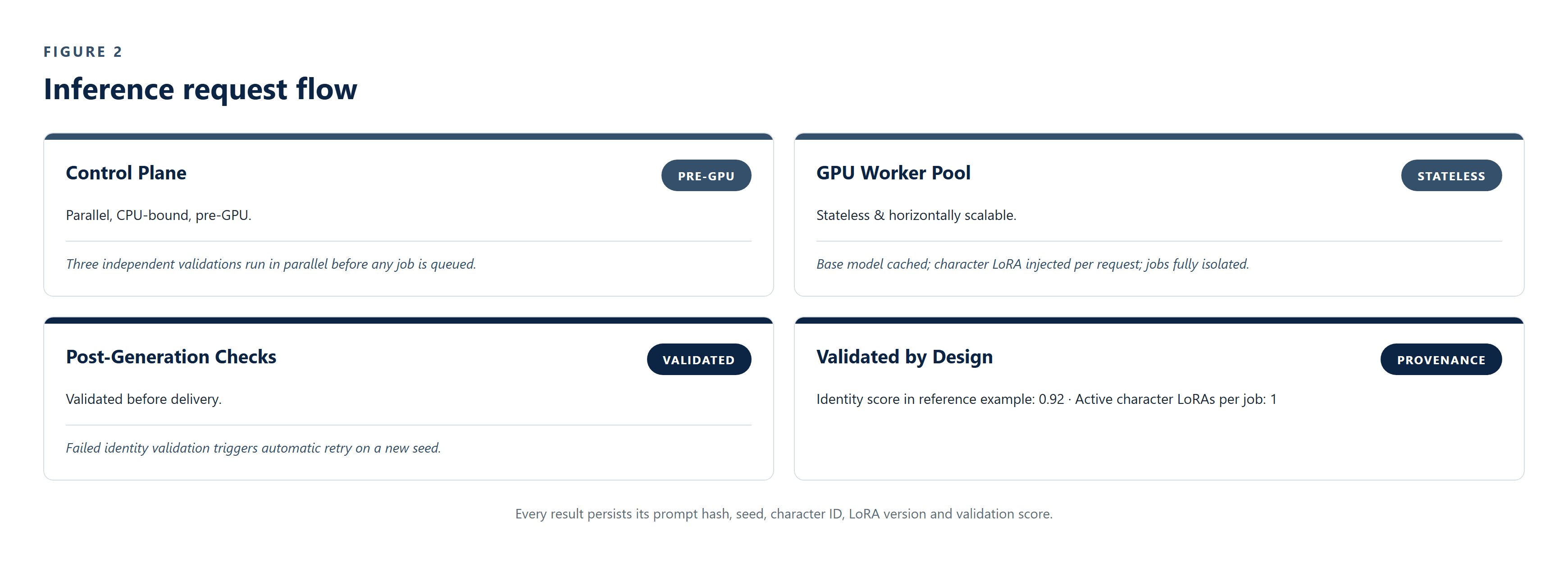
Parallel Control-Plane Validation | Runs prompt processing, character resolution, and request validation as independent parallel checks before any job reaches the GPU. |
GPU Worker Pool with Job Isolation | Stateless, replaceable GPU workers each hold the cached base model and inject exactly one character LoRA per job. |
Identity Validation on Every Output | Every generated image is checked against the intended character identity, with automatic retry on a new seed if validation fails. |
Full Generation Provenance | Every result stores its prompt hash, seed, character ID, LoRA version, and validation score for reproducibility, debugging, and audit. |
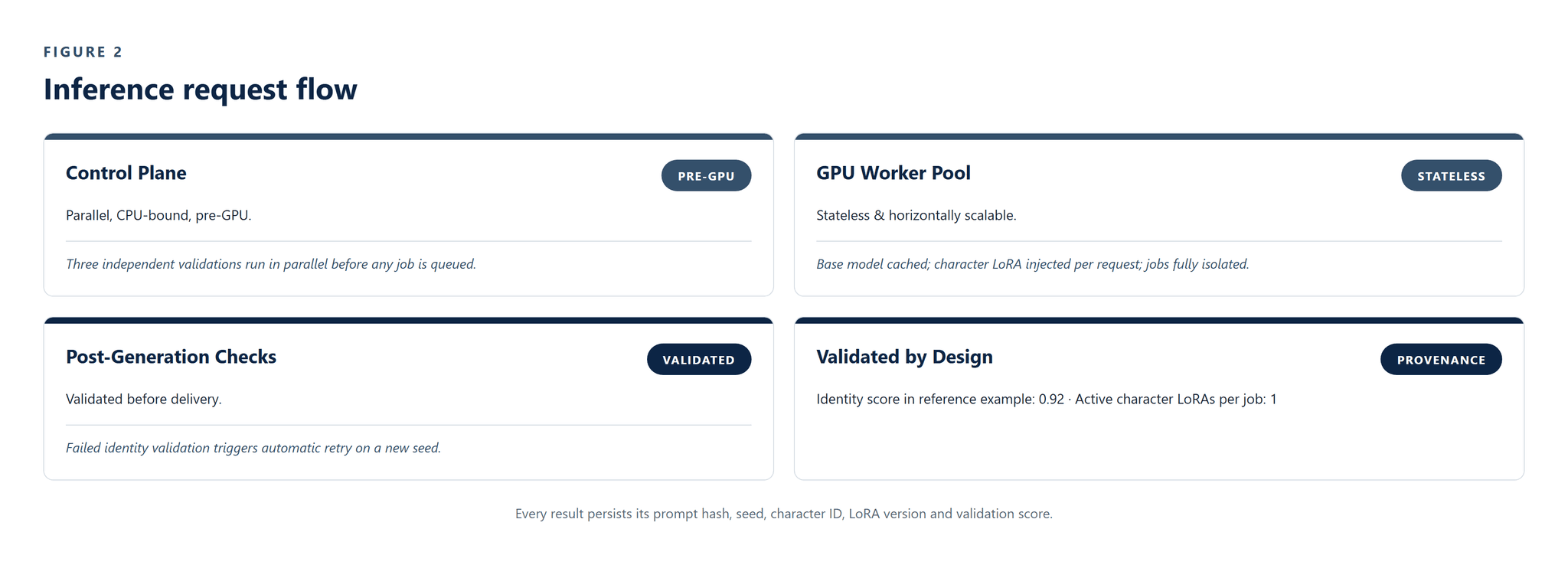
Figure 2 - Inference request flow: from client prompt through parallel control-plane checks, GPU generation with LoRA injection, and post-generation identity validation.
Design note The proposed dataset strategy favors seed images from a higher-capacity upstream model as the primary source of new visual signal, with same-model synthetic data and optional web-sourced or curated imagery used as supporting inputs - not the primary route to teaching the base model a genuinely new character.
ENGINEERING FOR SCALE AND RELIABILITY
Several architectural decisions distinguish a system built to hold up under real production request volume from one that only works in a controlled demo.
Control-plane work never touches the GPU
prompt processing, character resolution, and request validation are all CPU-bound and run in parallel ahead of the job queue, so GPU capacity is reserved exclusively for actual image generation.
A queue decouples traffic spikes from GPU throughput
the inference job queue prevents GPU overload, enables retries and prioritization, and allows the GPU worker pool to scale horizontally independent of request volume.
Only one character LoRA is active per job
each GPU worker injects exactly one character LoRA per generation job, keeping character identity isolated and avoiding cross-character interference at inference time, mirroring the isolation already built into training.
An optional identity adapter strengthens preservation where needed
a face identity adapter (for example InstantID, PuLID, or IP-Adapter FaceID) is available as an additional conditioning module for cases where identity preservation needs extra reinforcement beyond the character LoRA alone.
Failed identity checks trigger automatic retry, not silent acceptance
if post-generation identity validation fails, the job is retried with a new seed rather than returning an image that does not match the intended character.
The client never controls internal generation parameters
the external API accepts a high-level request - what to generate - while model selection, LoRA version, seed assignment, and internal prompt construction remain fully system-controlled.
DELIVERY APPROACH
The proposed engagement moves from architecture definition through a working, production-grade inference and training pipeline in five phases.
1. Define the character abstraction layer - specify each character as a LoRA, a trigger token or internal identifier, and optional identity reference data, decoupled from the shared base model.
2. Build the per-character training pipeline - implement dataset preparation, captioning, and normalization, and the independent LoRA training run per character against the frozen base.
3. Build the inference pipeline's control plane - implement the API gateway, rate limiting, and the parallel prompt processing, character resolution, and request validation stages.
4. Build the GPU worker pool - implement stateless GPU workers with the cached base model, dynamic character LoRA injection, and optional face identity adapter conditioning.
5. Add post-generation validation and delivery - implement identity validation with automatic retry, post-processing (upscaling, enhancement), and full metadata persistence for every result.
RESULTS AND IMPACT

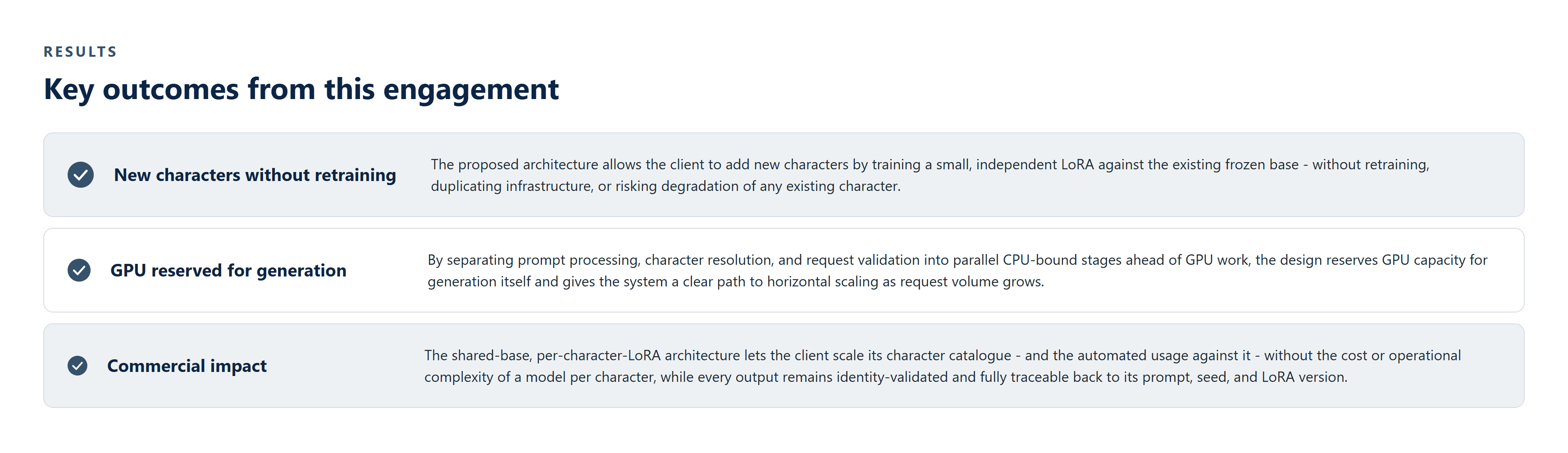
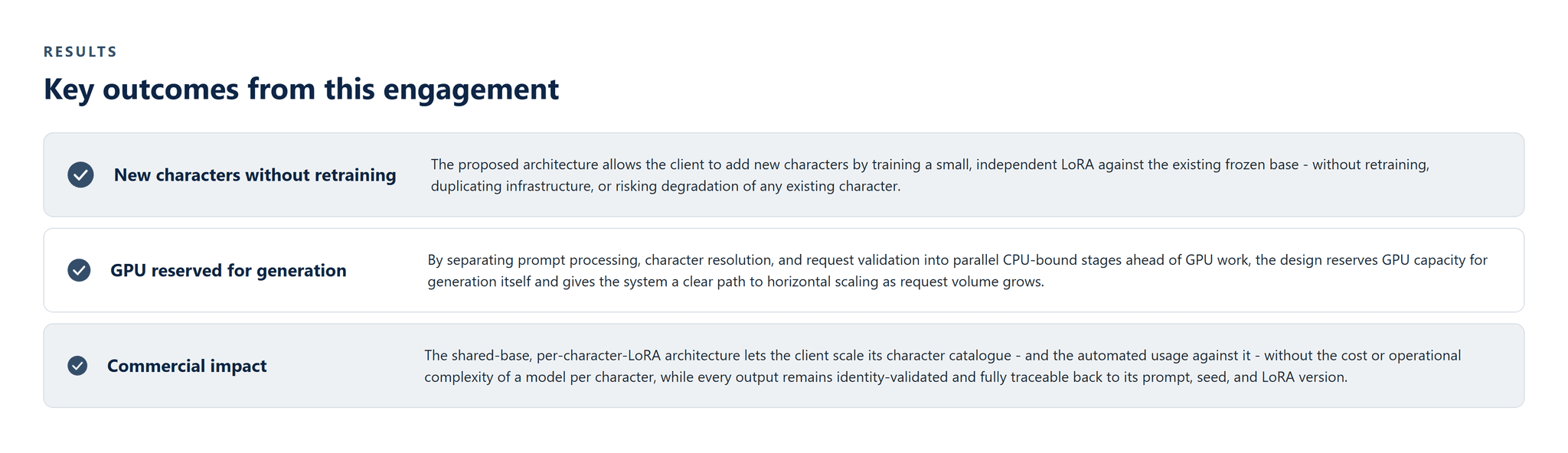
Figure - Key outcomes from this engagement.
The proposed architecture allows the client to add new characters by training a small, independent LoRA against the existing frozen base - without retraining, duplicating infrastructure, or risking degradation of any existing character.
By separating prompt processing, character resolution, and request validation into parallel CPU-bound stages ahead of GPU work, the design reserves GPU capacity for generation itself and gives the system a clear path to horizontal scaling as request volume grows.
What it enabled commercially
The shared-base, per-character-LoRA architecture lets the client scale its character catalogue - and the automated usage against it - without the cost or operational complexity of a model per character, while every output remains identity-validated and fully traceable back to its prompt, seed, and LoRA version.
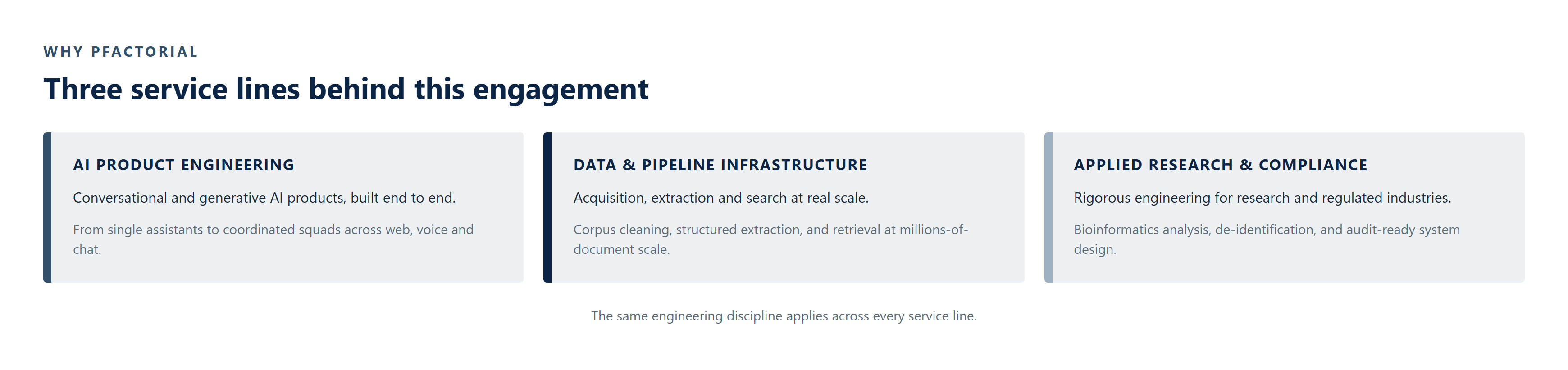
WHY PFACTORIAL
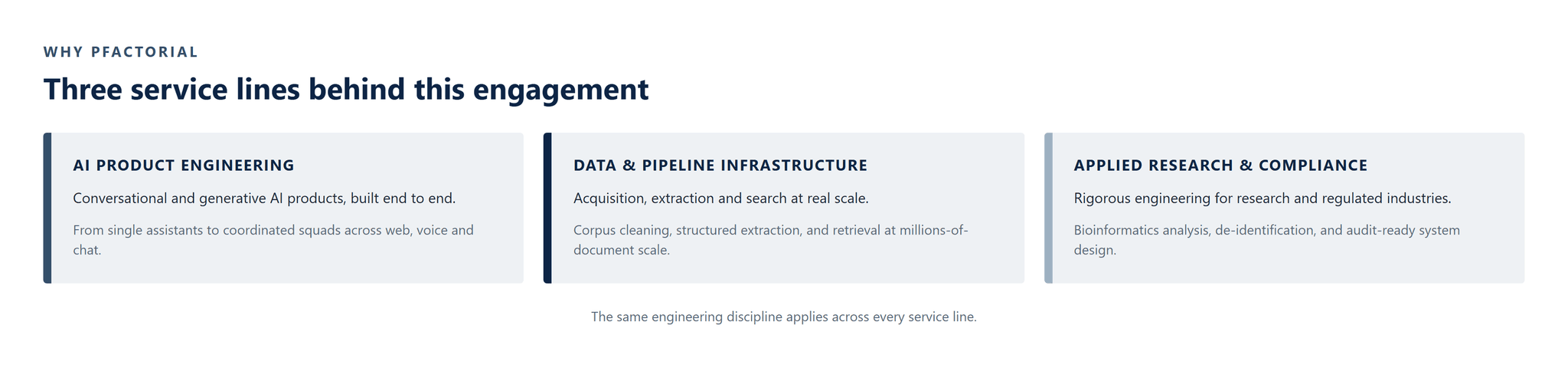
This engagement draws on Pfactorial's AI product engineering capability: designing generative systems that scale across many distinct entities on shared infrastructure, with validation and provenance built into the pipeline rather than left to spot-checking.

Figure - Service lines this engagement draws on.
Engagement enquiries Pfactorial Technologies works with teams building generative media products that need to scale across many distinct identities, styles, or SKUs without a linear infrastructure cost. If you are evaluating a character, avatar, or identity-consistency pipeline, we are happy to give you an honest read on scope, cost, and risk before anyone commits to anything. · pfactorial.ai
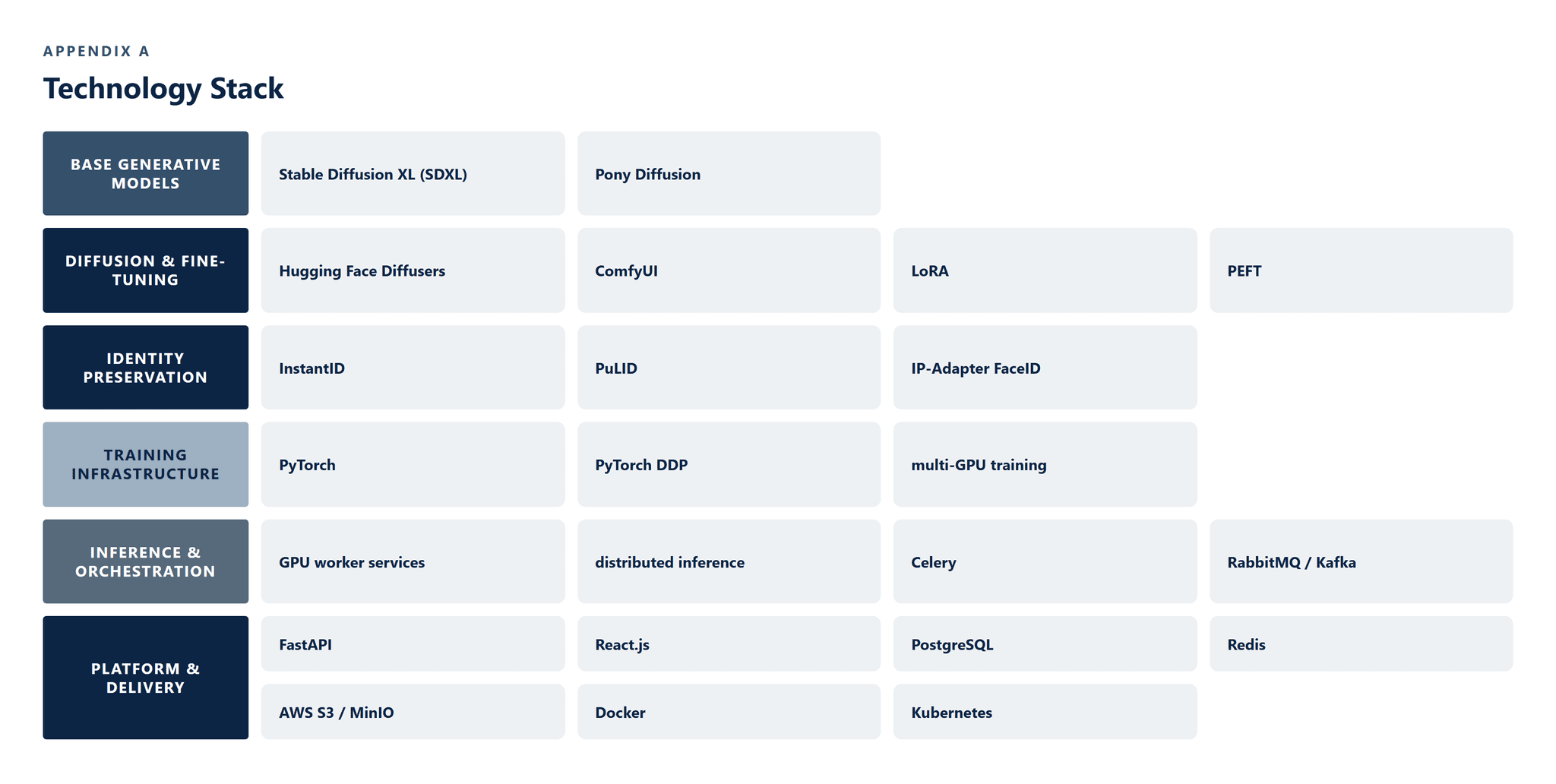
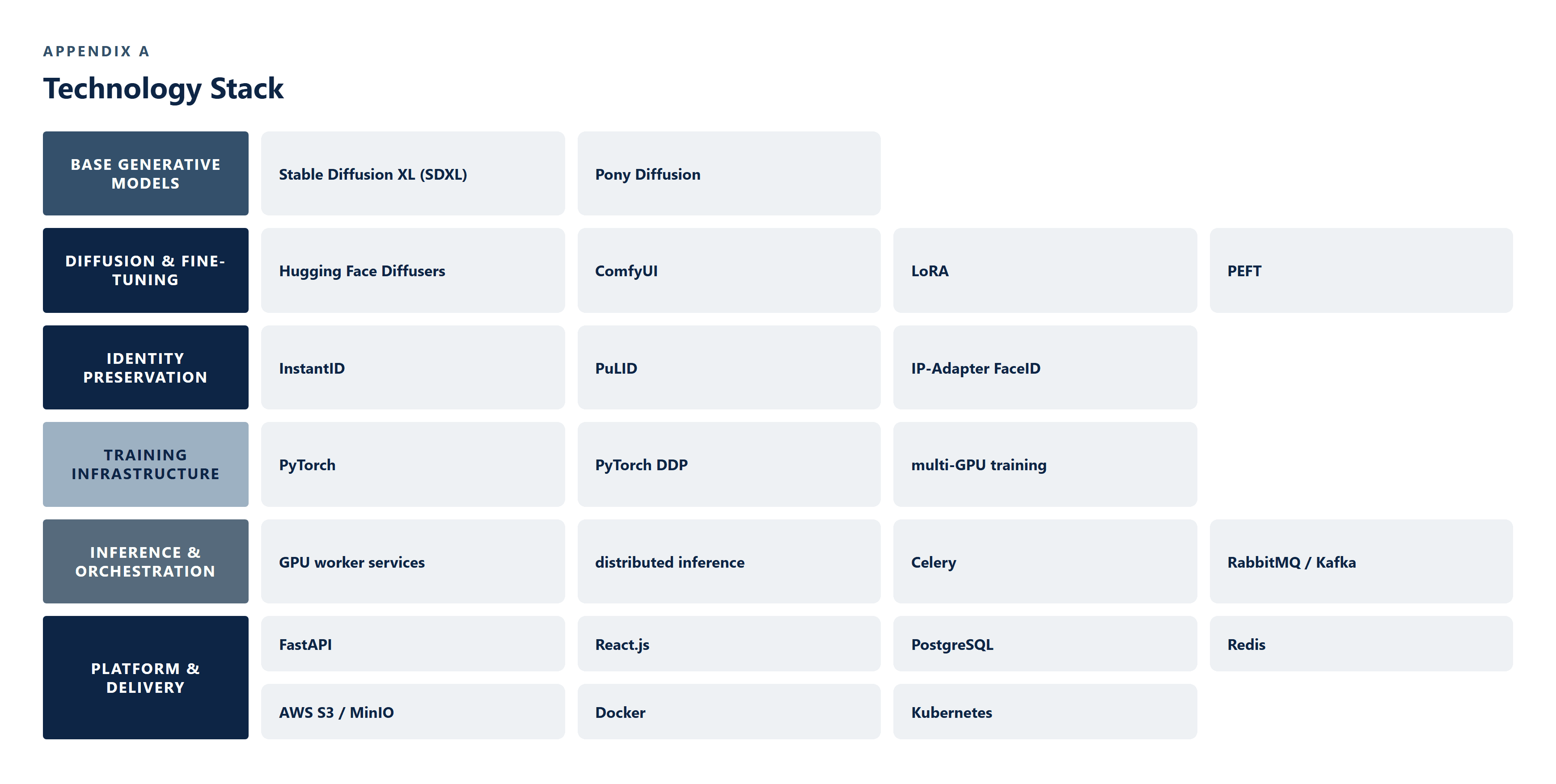
APPENDIX A - TECHNOLOGY STACK
The technology stack underpinning the system, grouped by the layer it serves.

Result and Analysis
ENGAGEMENT SNAPSHOT
A proposed production diffusion pipeline that generates hundreds of distinct, identity-consistent AI characters from one frozen base model and lightweight, independently trained LoRA adapters.
CASE STUDIES
You might also like...

OCR & Document ExtractionAutomotive & Vehicle
Aug 21, 20267 min readRead

Computer VisionML Infra, Classifiers & RL
A Deep Learning Classifier That Separates True-Negative Mammograms from Genuine BIRADS 0 Cases
Aug 21, 20266 min readRead

Content & Media Generation
A Failover-Chained Text-to-Image Service Built on Three Stable Diffusion Models
Aug 21, 20267 min readRead

Analytics & BI DashboardsAutomotive & Vehicle
A Five-Capability Computer Vision Platform for Vehicle Identity, Traffic, and Parking Intelligence
Aug 21, 20267 min readRead

OCR & Document Extraction
A Hugging Face Inference-Backed Handwriting Transcription Tool for Single-Line Document Digitization
Aug 21, 20266 min readRead
Computer Vision
An AI Detection Engine for Visual Intellectual Property Infringement at Scale
Aug 21, 20267 min readRead