Back
Speech & Audio Pipelines

Let your words say in any voice : Voice cloning

Author
Pfactorial
June 19, 2024
Share
voice cloning image
Introduction
The world of voice is getting a major upgrade! Deepfake technology is revolutionizing how we create audio, allowing for incredibly realistic, computer-generated voices. Imagine your favorite actor narrating your audiobook, or a brand crafting the perfect voice for their next ad campaign.
This blog dives into the world of deepfake voices, exploring how it works and how you can leverage this exciting tech to bring your text to life in any voice you desire!
voice cloning image
What is voice cloning
Voice cloning is an innovative  technology utilizing artificial intelligence (AI) and computer technology to replicate the distinctive and unique speech of a real individual, essentially creating a digital duplicate of their voice.  It involves the precise replication of someone's voice, including their tone, cadence, and pronunciation, by analysing and synthesising speech patterns. To train this model we need a vast dataset of recorded speech samples. During this training phase, the model learns the unique features of that voice . Once trained, the model is capable of taking text input and generating synthetic speech.

Now, let's take a closer look at the model's functionality.
model working architecture voice cloning
This is a  neural network-based system for text-to-speech (TTS) synthesis. It employs a transfer learning approach, transitioning from speaker verification to multi speaker text-to-speech synthesis (SV2TTS), consisting of a separate vocoder component. This model has three independently trained parts
Speaker encoder
The first part is a speaker encoder network . This encoder is trained on a speaker verification task. It uses  an independent dataset of noisy speech without transcripts from thousands of speakers. The information from the voice is stored as speaker embedding.
Synthesizer
Next is A sequence-to-sequence synthesis network based on Tacotron 2 architecture to support multiple speakers. The synthesizer is trained on pairs of text transcript and target audio. You can see in the diagram synthesizer using a pre-trained speaker encoder to extract a speaker embedding and it is concatenated with speaker embedding from the speaker encoder. Synthesizer module produces a mel-spectrogram.
vocoder  
An auto-regressive Wave Net-based vocoder network that converts the mel spectrogram into time domain waveform samples. The mel spectrogram captures all relevant details of voices and has the capability to facilitate the development of a multi speaker vocoder.
Let us discuss how we can implement the code in our system.
To implement the code we can make use of this GitHub repo :
We can start by  creating  a virtual environment in our folder. And navigate to that folder.
Virtual environment voice cloning
navigate to path voice cloning
Next Clone the GitHub repo to our created folder.
Cloning repo voice cloning
Now in your  voice cloning folder you can see , there will be a created environment and cloned folder.
Navigate to the Real-Time Voice-Cloning folder.
folder voice cloning
In our next  step, we'll focus on installing essential dependencies for implementation. We begin with FFmpeg, a versatile tool for audio and video processing. Ensure that FFmpeg is installed and added to your system's PATH; detailed installation guidance is available in this link https://phoenixnap.com/kb/ffmpeg-windows . Moving forward, we need PyTorch. For PyTorch installation, follow the instructions provided in this  https://learn.microsoft.com/en-us/windows/ai/windows-ml/tutorials/pytorch-installation .Once these installations are complete, proceed to add all the necessary libraries to our  environment by installing requirements.txt.

With all these installations in place, we are  ready to run the code . Simply execute "python demo_cli.py" in the terminal. If the code runs successfully without any errors, we are  all set. It will also automatically handle the download of pretrained models.
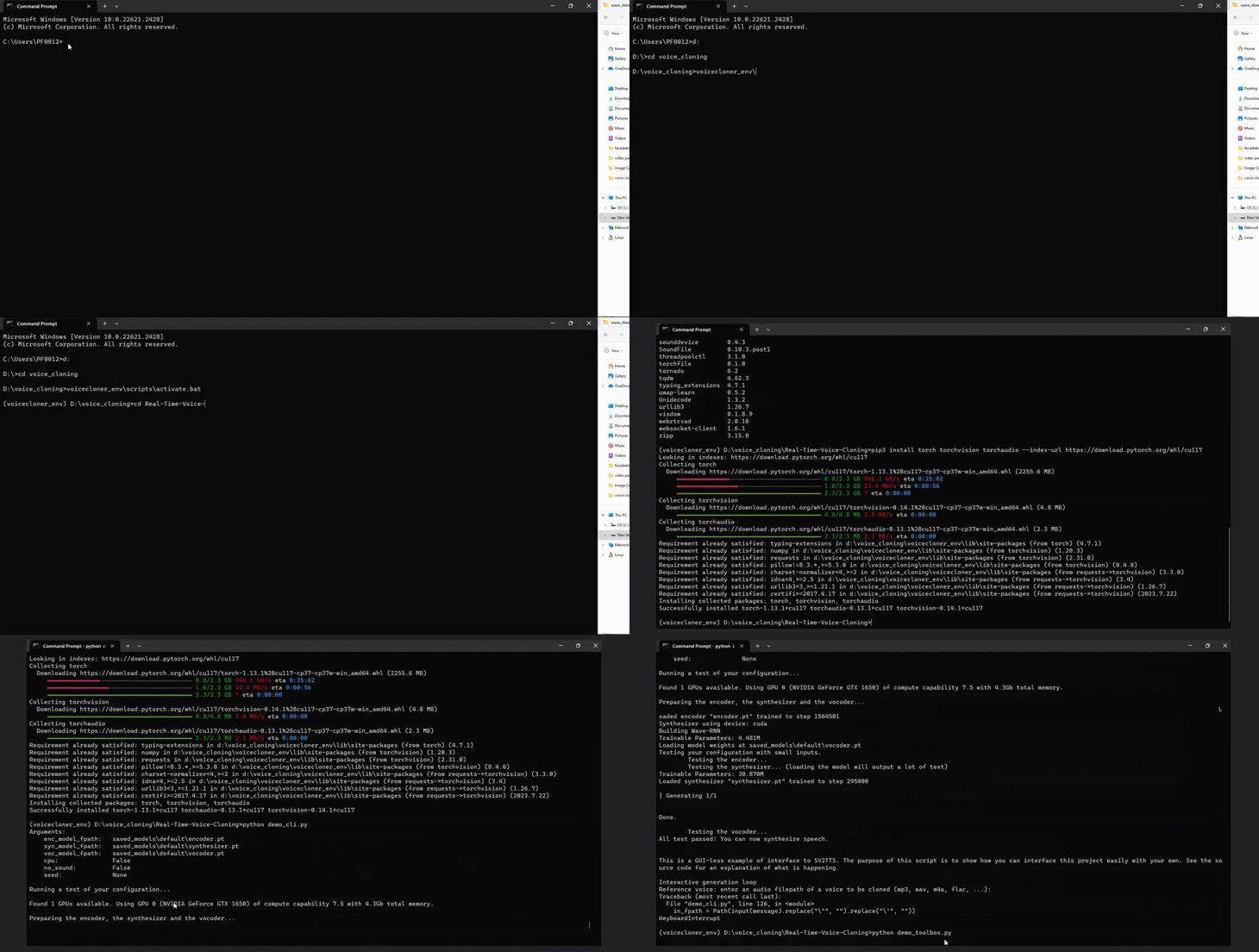
Voice cloning
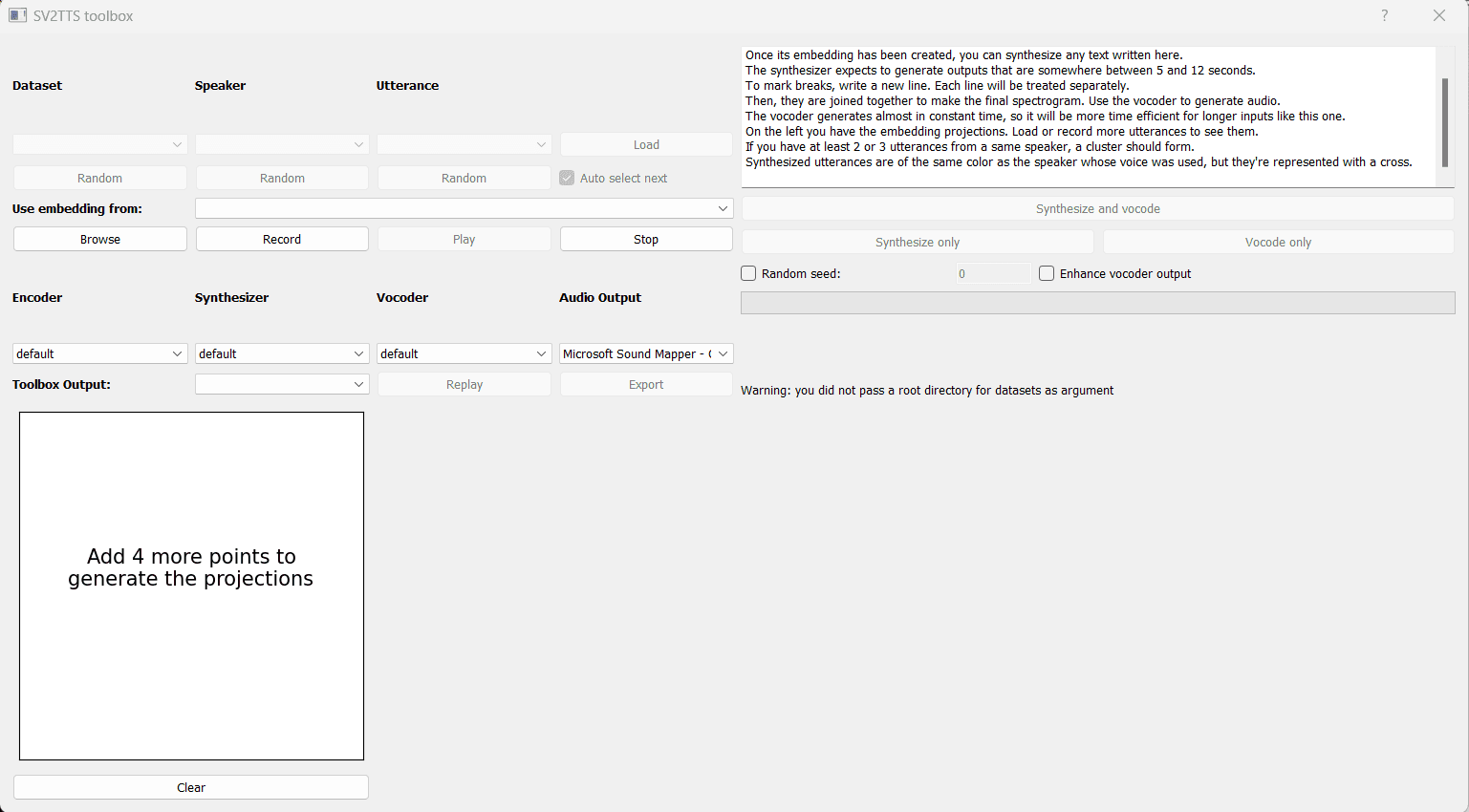
Next run python demo_toolbox.py

Then we will have a toolbox like this.
Voice cloning
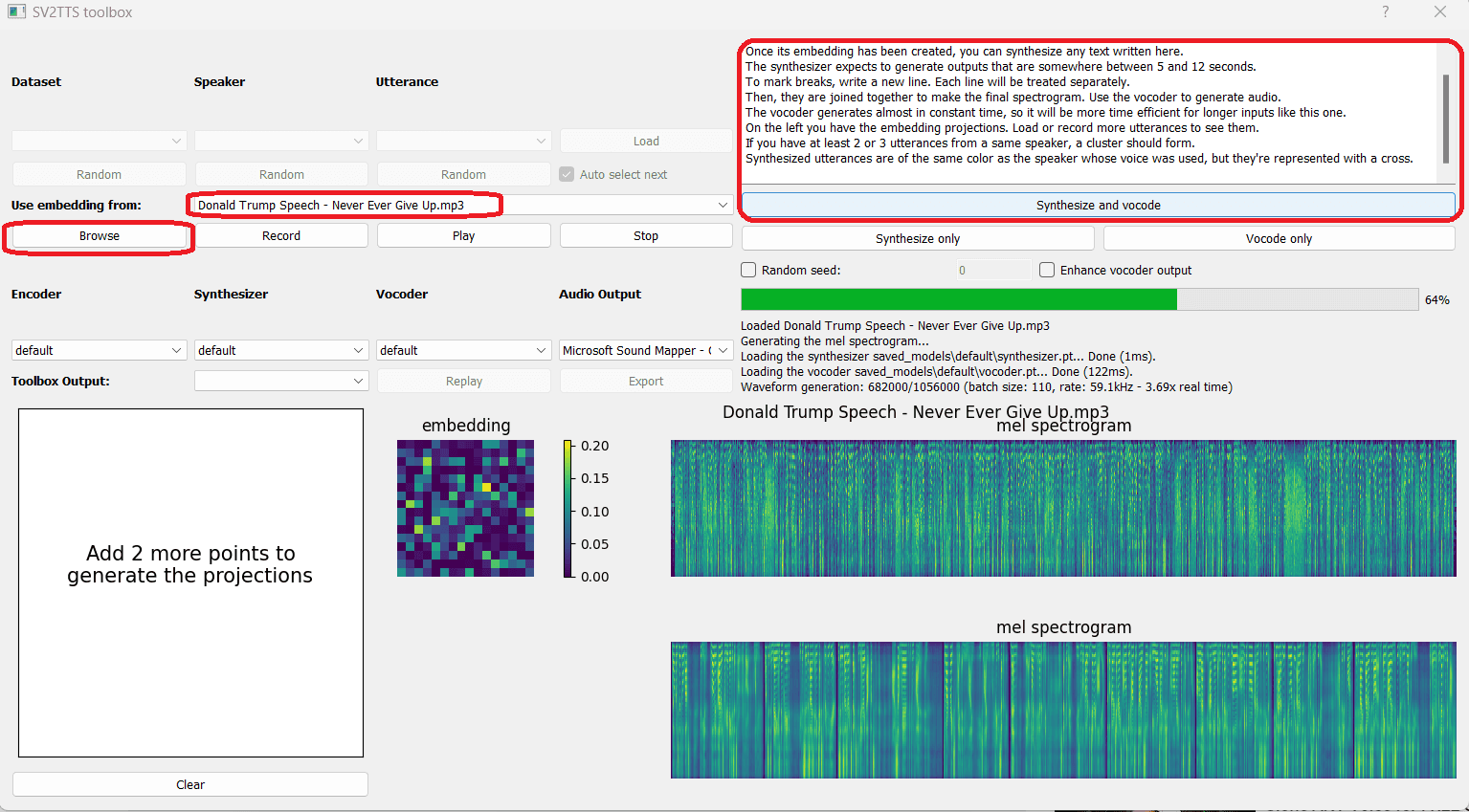
Here we can upload or record the audio. Enter the text and click synthesize and vocode. Then output will be generated in the uploaded voice.
Voice cloning
The GitHub repo  consists of folders and code for preprocessing and training of these models . Finally python demo_toolbox.py is for running a toolbox. By running this script we can have a TTS toolbox. This  allows users to specify datasets, models, and other configurations through command-line.
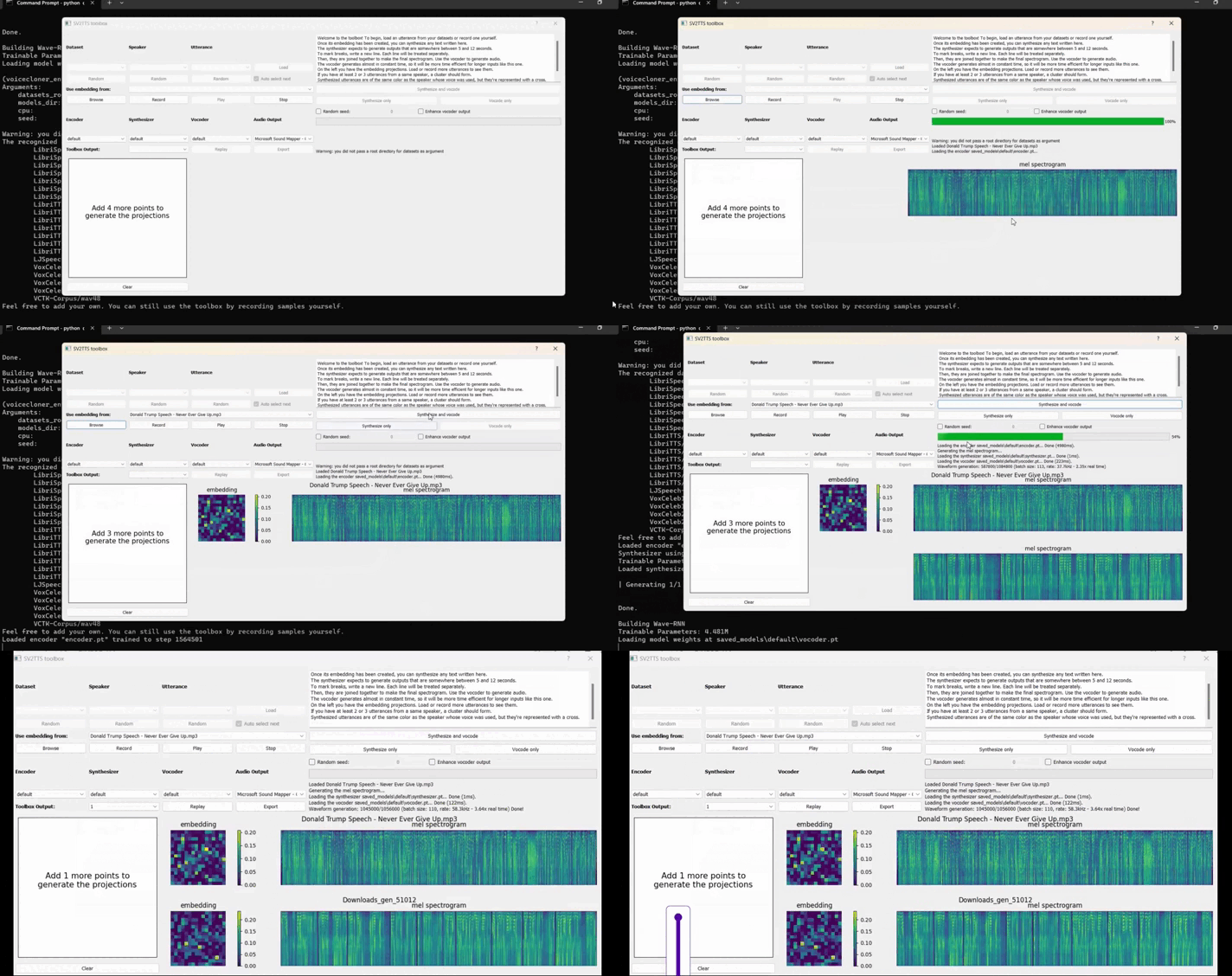
Voice cloning
Applications of voice cloning
  • Replicate anybody’s voice to create a perfect match in film and TV. Using voice cloning technology, we can generate new dialogues and responses for this character. The technology perfectly mimics the actor's voice, capturing the same nuances and intonations.
  • Create speech that’s indistinguishable from the original speaker for game developers.
  • Set the ideal tone for your ad: Voice cloning makes the workflow for the production of advertisements more efficient. For instance, a luxury car company can create an entire series of ads with the same sophisticated and compelling voice, maintaining a strong brand identity. Voice cloning doesn't just save time; it opens up a world of creative possibilities for advertisers looking to make a lasting impact
  • Speed up and ease the dubbing process. Instead of hiring voice actors to manually dub a movie or TV show, a voice clone of the original actor can be used to generate the required audio
  • Provide interactive content for online learning courses. Creating interactive content for online learning courses can greatly enhance the learning experience. One way to achieve this is by converting text-based content into voice format, adding audio elements to the course.
  • Customer service : Imagine you manage a customer service call center and are seeking ways to create more engaging and personalized interactions with your valued customers. Voice cloning can be used in this scenario, as it allows you to provide a truly authentic human interaction that sounds as though it's coming directly from the customer's dedicated representative.

Voice cloning has the potential to enhance our lives in numerous ways, from providing tailored voice interfaces to preserving and celebrating linguistic diversity. In recent years, voice cloning technology has made significant advancements, resulting in more natural-sounding and expressive synthetic voices. As a result, it continues to expand its influence in various industries and improve accessibility, entertainment, and communication for people around the world. However, it also demands a cautious and ethical approach to ensure that the benefits of this technology are realized without compromising privacy, security, and authenticity.
DISCOVER MORE. CONNECT WITH US!

Intrigued by what you have read? Dive deeper and stay ahead with the latest insights and trends. We are here to answer your questions and help you explore further.