Back
June 27, 2024
Content & Media Generation
Deepfake
Pfactorial
Share

Introduction
In a time when technology consistently blurs the boundary between fact and fiction, deepfake emerges as both a marvel of artificial intelligence and a potent reminder of its darker potential. Deepfake are synthetic media in which a person in an existing image or video is replaced with someone else’s likeness.If we break the name ‘Deepfake’ we will get deep learning + fake. The first Deepfake Production was FakeApp, developed by Reddit users.

How deepfake works
Deepfake leverages powerful techniques from machine learning and artificial intelligence to manipulate or generate visual and audio content. It involves training generative neural networks architectures, such as autoencoders or generative adversarial networks(GANs).
auto-encoder/decoder
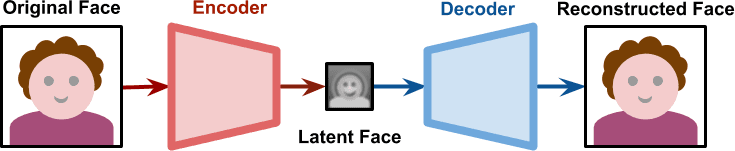
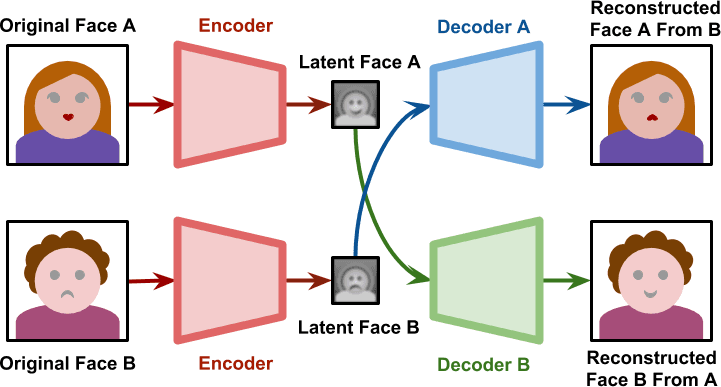
Deepfake’s Face Swapping technology uses auto-encoder and decoder pairs where the autoencoder extracts dormant features of face images and the decoder is used to reconstruct the face images.
Extraction :
The process begins by extracting the section of the image containing the original face from a video frame. This facial image is then used as input for either an Encoder or a Deep Neural Network (DNN). This latent facial image having hidden characteristics, is generated and given as the input for the Decoder. Reconstructed Face image is produced for both the images

Training :
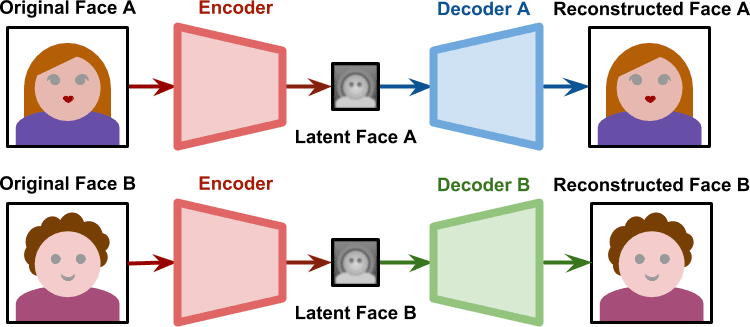
During the training phase, the network employs a shared encoder to ensure consistency. If two separate autoencoders were trained on distinct faces, their latent spaces would capture different characteristics. Deepfakes solved this by having both networks sharing the same encoder, yet using two different decoders. During the training phase, these two networks are treated separately. The Decoder A is only trained with faces of A; the Decoder B is only trained with faces of B. This approach ensures that specific facial features are consistently extracted from both sets of faces.

Creation :
When the training phase is completed, we can pass a Latent Face A to Decoder B and Latent Face B to Decoder A. This means generating a face for Subject B with the same expression and orientation of Subject A.

GAN(generative adversarial network)
GAN uses an unsupervised process to discover and learn automatically from input data to generate new data. It has two parts: generator and discriminator. First we give some noise to the generator. Then it generates some samples from that .These images from the generator along with a set of real images are sent to the discriminator. The discriminator combines both images to make it look like a real image.The process is repeated numerous times and the result is a perfectly forged image.
How to Create Deepfake
Let's examine an illustrative example of creating a deepfake video. In this case, we will utilize a video featuring Donald Trump and an image of Leonardo DiCaprio. Our objective is to seamlessly incorporate DiCaprio's facial characteristics into the video.
first Clone the GitHub repository and navigate to the "roop" directory. Once inside, proceed to install the dependencies listed in the "requirements.txt" file.
Here we use run.py to run the code. run .py import all code from core.py and run the code.
lets discuss about the files in the cloned directory
Core.py : Code in this py file manipulate images and videos, apply various frame processors, and generate output with specific configurations.
Predictor.py : This code provides functions to predict NSFW content in both images and videos using the OpenNSFW2 library. It sets a threshold probability for classifying content as NSFW and ensures thread-safe access to the prediction model.
Capturer.py : This code is for extracting specific frames from video files or determining the total number of frames in a video. Here it is using the opencv library.
Face_analyser.py : For facial analysis and recognition tasks using the InsightFace library. They encapsulate the details of model initialization, face detection, and similarity calculation, making it easier to work with facial analysis
face_referance.py : This code defines a set of functions related to managing a reference face for use in facial analysis and recognition in deepfake
Ui.py : This code sets up the GUI for an image and video processing application, providing functionality for media selection, configuration, and real-time preview. It uses the Tkinter library for creating the graphical interface and integrates drag-and-drop functionality for ease of use.
Utilities.py : contain all functions related to code
Important libraries in this code :
InsightFace : InsightFace is an integrated Python library for 2D&3D face analysis. InsightFace efficiently implements a rich variety of state of the art algorithms of face recognition, face detection and face alignment, which are optimized for both training and deployment.
Opennsfw2 : The opennsfw2 library, also known as Open NSFW 2.0, is a library used for classifying and detecting potentially "Not Safe for Work" (NSFW) content in images.
GFPGAN : GFPGAN, short for "Generative Face PerfectorGAN," is a type of Generative Adversarial Network (GAN) designed specifically for facial image enhancement and beautification. It is a neural network model that leverages the power of deep learning to enhance facial images, making them look more appealing and refined
hope you get an idea about the folder. next we need to download the model
Next upload video and image to the google drive and replace the path in given code. It will take some time to execute . and it will create a swapped.mp4 . Now you can download the swapped video.
.jpg&w=2048&q=75)

Applications of Deepfake
- Digital Doubles: Deepfakes can create digital doubles of actors for use in movies, TV shows, and video games, allowing for realistic special effects and reducing the need for dangerous stunts.
- Voice Acting: Deepfake voices can be used for dubbing, voiceovers, and impersonations in the entertainment industry.
- Historical Preservation: Deepfakes can enhance and restore historical photos and videos, bringing old footage to life with colorization and animation.
- Education: Deepfakes can assist a teacher in delivering engaging lessons. Also, these lessons would go beyond traditional visual and media formats.
- Deepfake is also gaining traction as a way to engage customers and deliver value.
Harmful Applications of Deepfake
- Identity Theft: Deepfakes can impersonate individuals, making it easier for malicious actors to commit identity theft or engage in fraudulent activities.
- Privacy Invasion: Deepfake technology can be used to create non-consensual explicit content or to manipulate personal videos, violating the privacy of individuals.
- Legal Challenges: The use of deepfake evidence in legal proceedings can present challenges, as it may be difficult to distinguish manipulated content from reality.
- Cybersecurity Threats: Deepfakes can be employed in phishing attacks, where attackers use manipulated audio or video to deceive individuals into divulging sensitive information
Deepfakes presents a remarkable opportunity to bring about positive transformations in our lives. The synthesis of media using artificial intelligence carries immense potential as an empowering tool. These advancements offer a chance for individuals to overcome limitations and embrace new avenues of empowerment, ultimately fostering inclusivity and progress for all. The future of Deepfakes ultimately rests in the hands of those who create and employ this technology. As creators and consumers, we must be vigilant, critical, and responsible. We must recognize the power and potential for harm that deepfake technology carries and advocate for its ethical and lawful use.
BLOGS
You might also like...

Deep learningData Science Deep Learning+5
Jun 18, 20246 min readRead

Deep learningData ScienceContent & Media Generation+4
Let your words say in any voice : Voice cloning
Jun 19, 20245 min readRead

Deep learningData ScienceComputer Vision+5
Transforming Sketches into realistic Face Images
Jun 27, 20247 min readRead