Back
Healthcare & Clinical
Improving Clinical Trial Matching Accuracy with a Blended Retrieval Pipeline
How Pfactorial Technologies enhanced an existing clinical-trial matching system's retrieval accuracy by layering semantic search and hybrid query strategies on top of its production pipeline.

August 21, 2026
Share
ENGAGEMENT SNAPSHOT

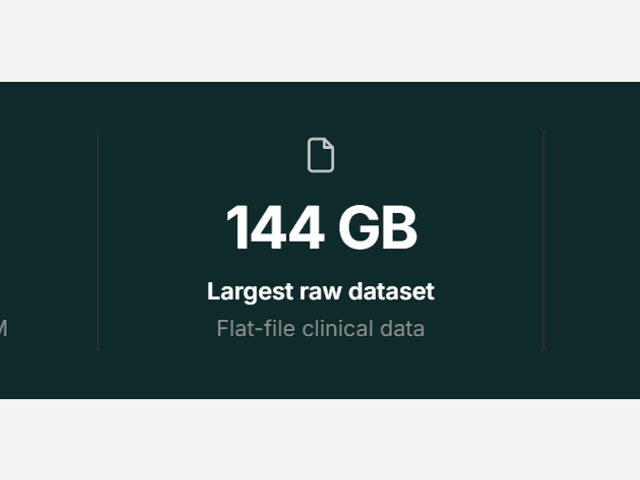
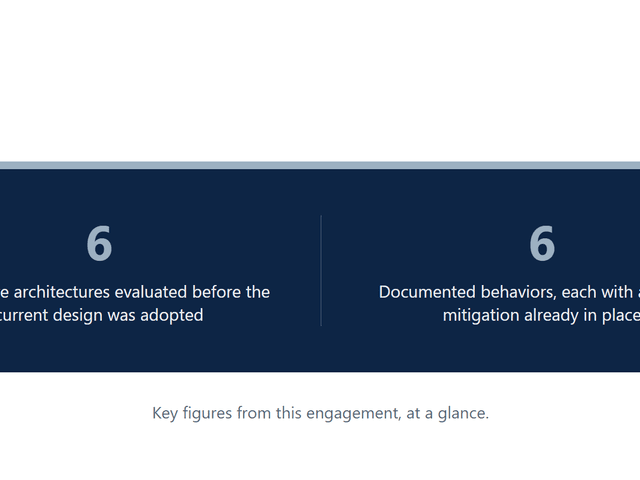
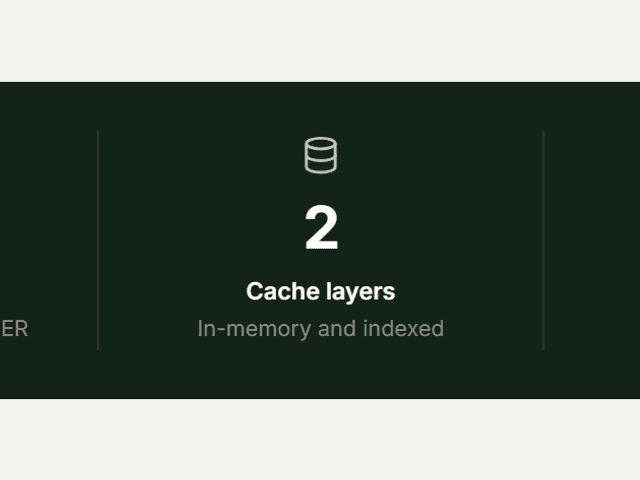
Figure 1 - Key figures from this engagement, at a glance.
EXECUTIVE SUMMARY
Our client's clinical-trial matching system, built on the TrialGPT framework, evaluates a patient's eligibility for a trial by predicting on a criterion-by-criterion basis and consolidating those predictions into an overall match. Its accuracy was solid, but bounded by the retriever surfacing candidate trials in the first place.
Manually matching patients to trials is labor-intensive and error-prone at any scale, and in any retrieval-augmented pipeline, the quality of the retriever is the ceiling on everything built on top of it - irrelevant candidate trials degrade eligibility predictions no matter how capable the downstream model is.
Pfactorial applied a research method called Blended RAG - combining sparse keyword search, medical-domain dense vector search, and hybrid query strategies - to the client's existing retrieval stage, improving candidate-trial relevance without requiring changes to the downstream eligibility-scoring logic already in production.
Why this engagement is representative This engagement shows a different kind of Pfactorial engagement than a from-scratch build: improving the retrieval accuracy at the core of a system a client already has in production, without disrupting what's built on top of it.
THE CHALLENGE
The client's existing hybrid retriever performed well, but four specific limitations left accuracy on the table.
1. Manual matching doesn't scale
Cross-referencing a patient's full medical history against every open trial's eligibility criteria by hand is slow, inconsistent, and doesn't scale to a large or growing trial corpus.
2. Retriever quality is the ceiling on RAG accuracy
Irrelevant context pulled into the pipeline directly degrades the eligibility predictions built on top of it - no downstream model can fully compensate for a weak retrieval stage.
3. Single-method retrieval leaves accuracy on the table
Keyword matching (BM25) alone and dense vector search alone each catch trial matches the other would miss; relying on just one method means giving up recall the other method would have provided.
4. Filtering has to survive a large corpus without ballooning cost
Narrowing thousands of candidate trials down to a manageable, relevant shortlist has to be both accurate and computationally affordable at scale.
The real brief Not “swap in a better embedding model” but “improve the retriever a working clinical-matching system depends on, without disrupting the eligibility logic already built on top of it.”
THE SOLUTION
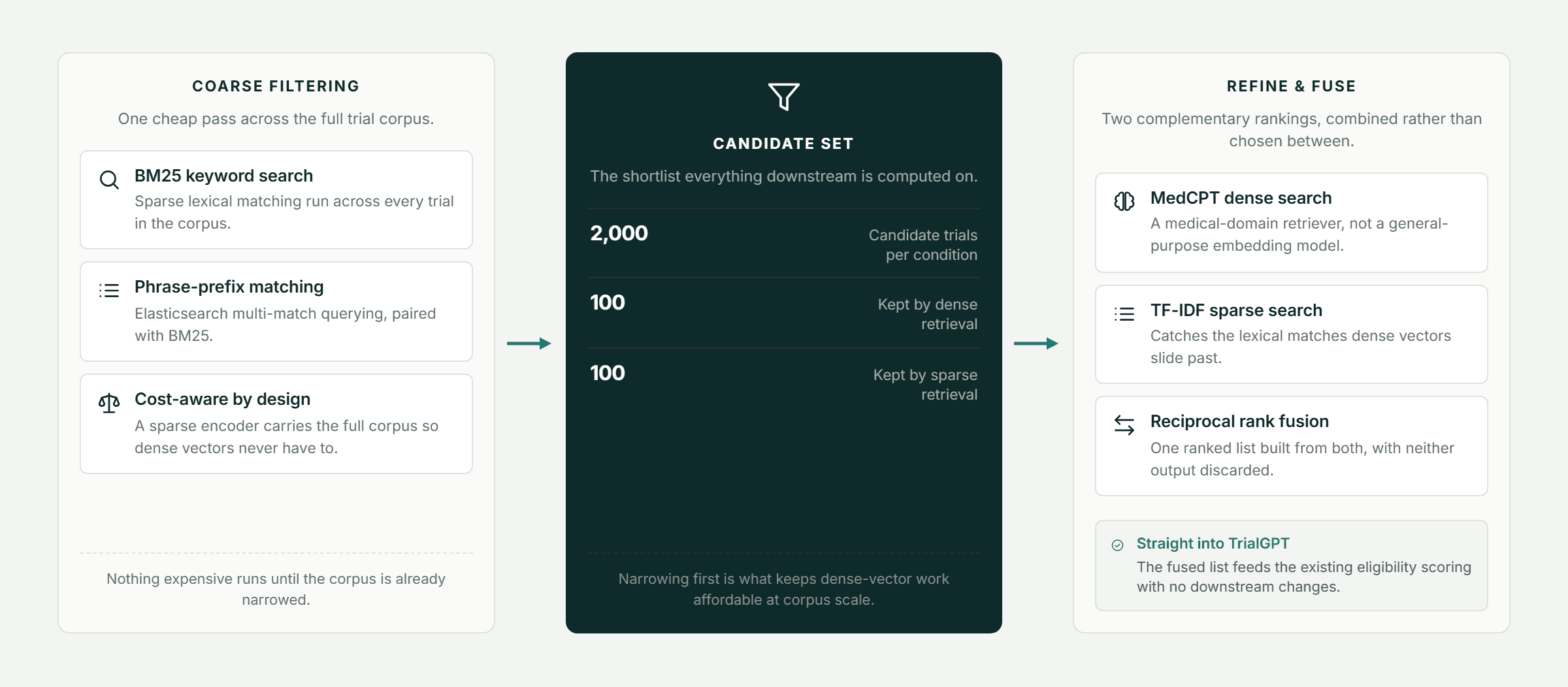
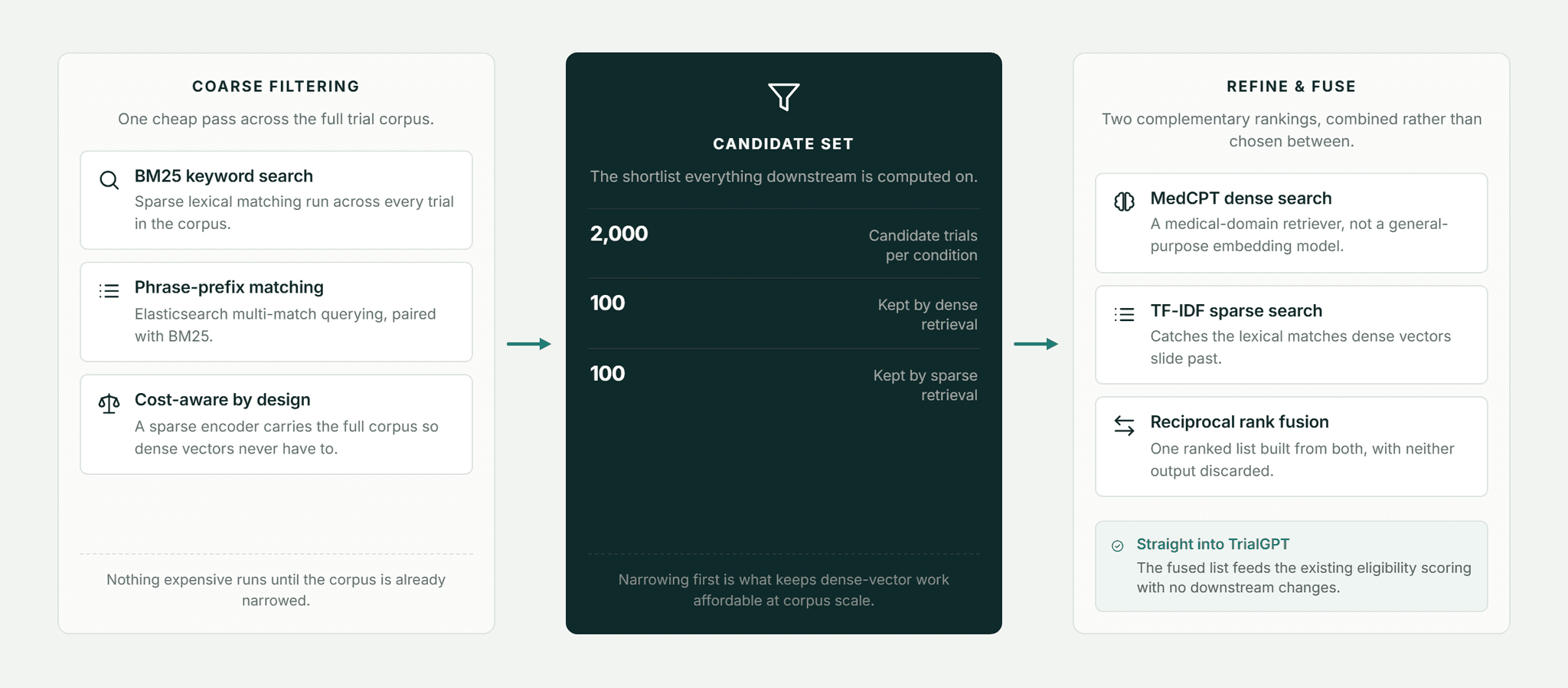
Pfactorial applied the Blended RAG method: a progressive, two-stage retrieval pipeline that fuses sparse keyword search, a medical-domain dense retriever, and a sparse encoder before results ever reach the client's TrialGPT eligibility scoring.

Figure 2 - Two-stage retrieval: coarse filtering, then semantic refinement, then fusion.
Architectural principles
- Progressive narrowing, not one-shot search - Coarse filtering (BM25 combined with phrase-prefix matching) runs first across the full trial corpus; refinement (dense and sparse vector matching) runs second on the much smaller candidate set - rather than asking one method to do everything at once.
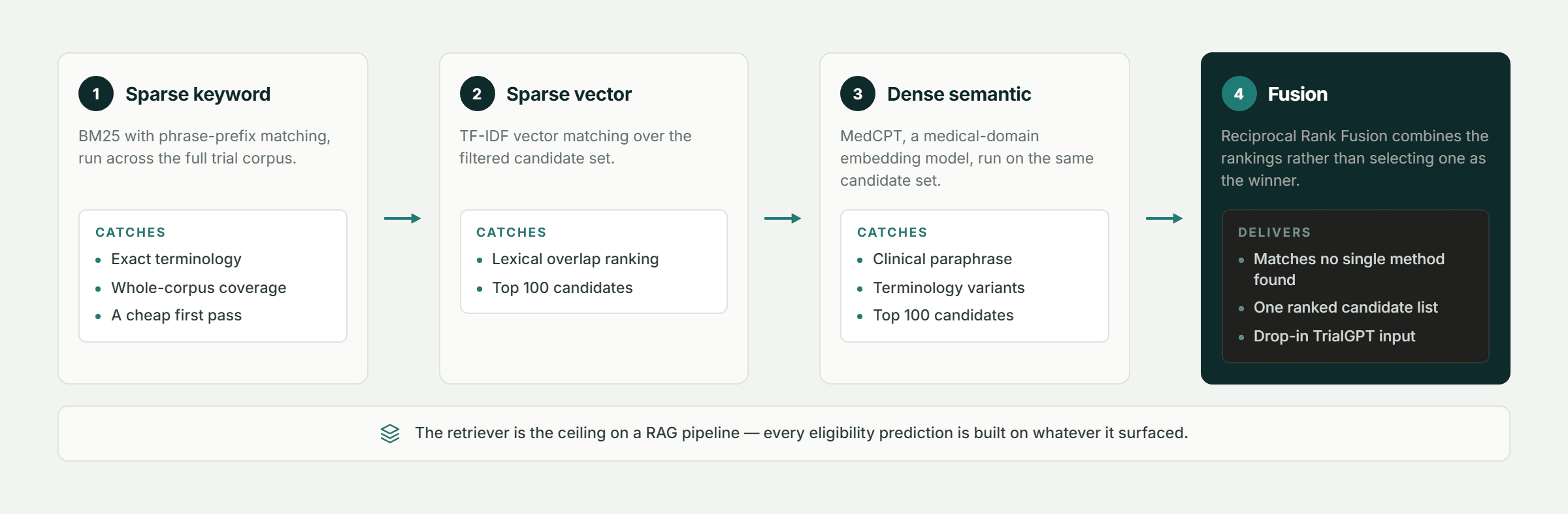
- Blend complementary retrieval signals - Sparse keyword-based methods (BM25, TF-IDF) and dense semantic search (MedCPT) are combined, since each surfaces trial matches the other would miss.
- Fuse, don't just pick a winner - Results from multiple retrieval methods are combined via Reciprocal Rank Fusion, rather than selecting one method's output as “best” and discarding the rest.
- Domain-tuned components - A medical-domain dense retriever (MedCPT) is used in place of a general-purpose embedding model, since clinical language and terminology don't behave like general web text.
CAPABILITIES DELIVERED
The engagement delivered a retrieval pipeline that plugs into the client's existing TrialGPT framework without requiring changes downstream.
CAPABILITY | WHAT IT DOES |
|---|---|
Two-stage retrieval pipeline | BM25 and phrase-prefix filtering, followed by dense and sparse vector refinement. |
Per-condition candidate generation | Up to 2,000 candidate trials filtered per condition from the full trial corpus. |
Reciprocal rank fusion | Combines results from multiple retrieval methods into one ranked candidate list. |
Drop-in TrialGPT integration | Feeds directly into the existing eligibility-scoring framework with no downstream changes required. |
Benchmarked comparison | Side-by-side evaluation against the baseline retriever on the same patient notes. |
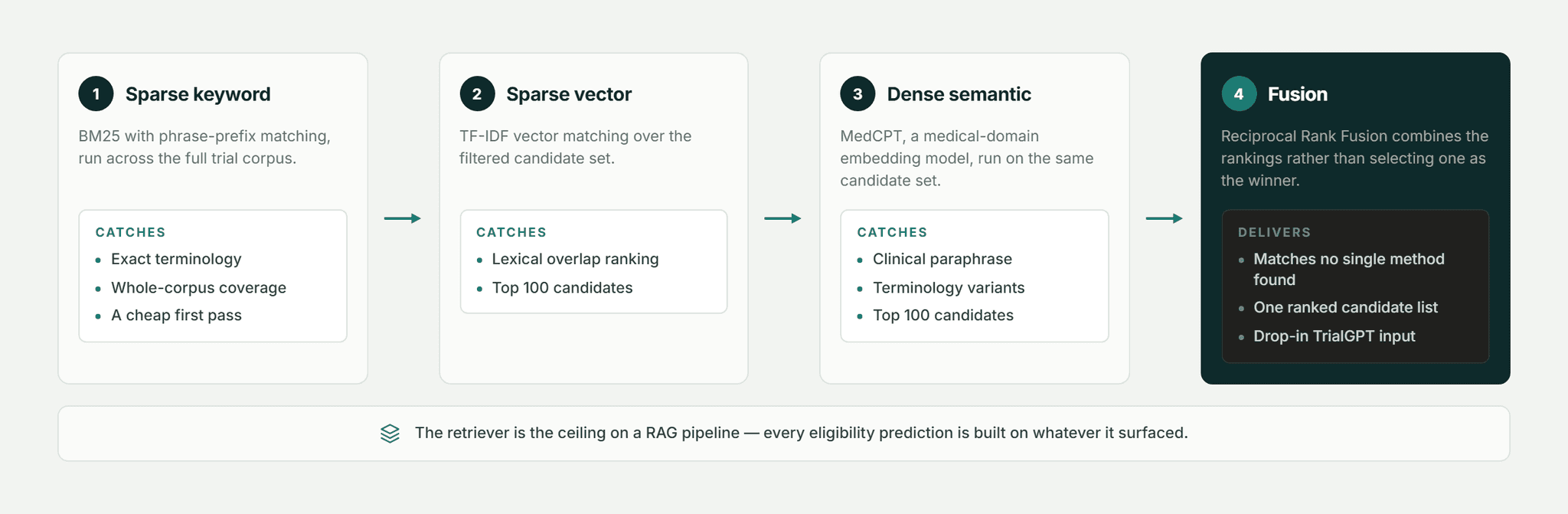
Figure 3 - Complementary retrieval signals, fused rather than chosen between.
Design note The value isn't a single retrieval method being “better” than another - it's that fusing complementary methods recovers matches that any single method, used alone, would have missed.
ENGINEERING FOR SCALE AND RELIABILITY
Improving a retriever without regressing anything downstream requires disciplined benchmarking, not just a plausible-sounding new method.
Elasticsearch-backed multi-match querying
Multiple multi-match query types - cross-fields, most-fields, best-fields and phrase-prefix - were evaluated to determine which best surfaced relevant trials.
Cost-aware first-stage filtering
A sparse-encoder approach handles first-stage filtering across the full corpus, keeping the more expensive dense-vector computation limited to a much smaller, pre-filtered candidate set.
Domain-specific dense retriever
MedCPT, a medical-domain embedding model, was used over a general-purpose alternative, since clinical terminology requires domain-aware semantic matching.
Top-k retrieval accuracy as the benchmark
Retrieval performance was measured using top-k accuracy across query-type variants, giving a consistent metric for comparing methods.
Head-to-head baseline comparison
Results were compared directly against the existing TrialGPT baseline retriever on the same patient notes, isolating the improvement attributable to the new pipeline.
DELIVERY APPROACH
The engagement moved from baseline assessment to a validated, drop-in replacement for the existing retrieval stage.
1. Baseline benchmarking - assessment of the existing hybrid BM25 + dense retriever's performance on representative patient notes.
2. First-stage filter design - BM25 and phrase-prefix matching across the full trial corpus, filtering to ~2,000 candidates per condition.
3. Second-stage refinement - dense (MedCPT) and sparse (TF-IDF) vector matching, each retaining the top 100 candidates.
4. Fusion & ranking - Reciprocal Rank Fusion combining the outputs of both refinement methods into a single ranked list.
5. TrialGPT integration - connecting the refined retrieval output directly into the existing eligibility-scoring pipeline.
6. Comparative evaluation - benchmarking the blended pipeline's results against the original baseline retriever.
RESULTS AND IMPACT

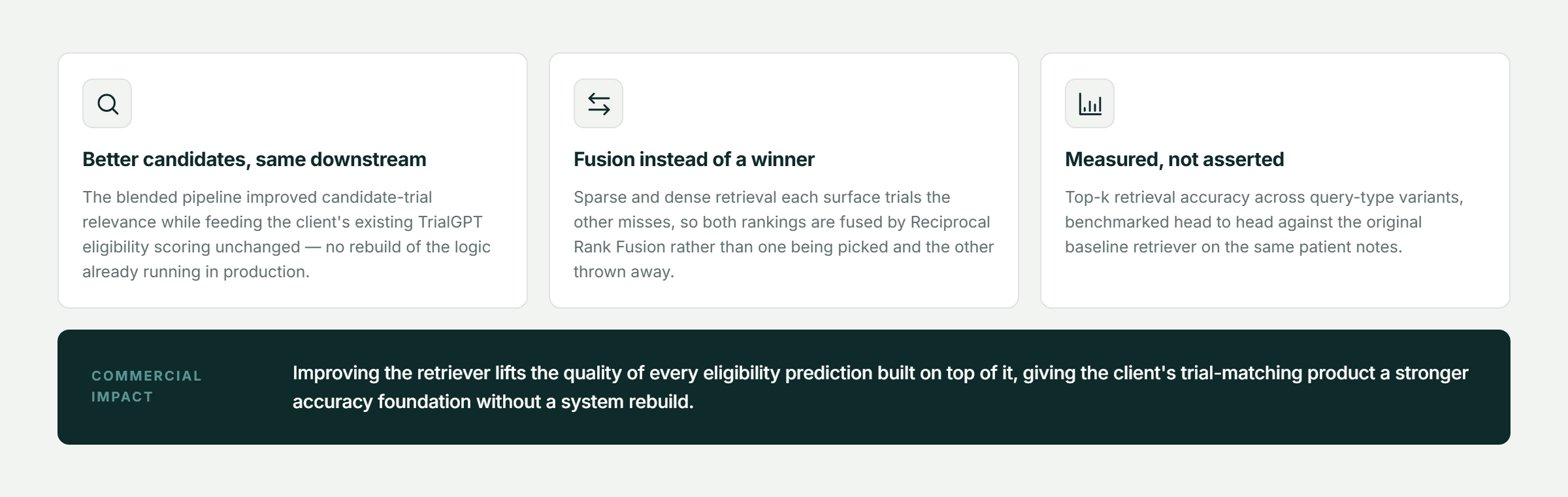
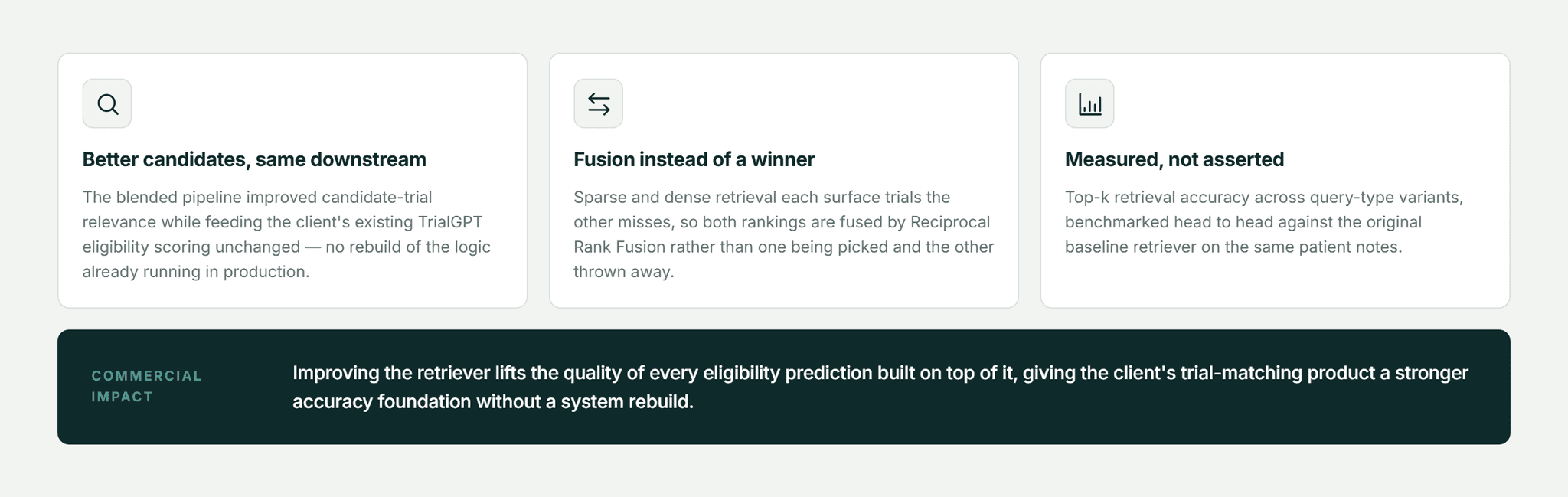
Figure 4 - Key outcomes from this engagement.
The blended retrieval pipeline surfaced improved candidate-trial matches without requiring any changes to the client's downstream eligibility-scoring logic.
The approach is documented for extension to additional retrieval strategies (bool-prefix, most-fields, best-fields) as future refinement work.
What it enabled commercially
Improving the retriever directly improves the quality of every eligibility prediction built on top of it, giving the client's clinical trial matching product a stronger accuracy foundation without a system rebuild.
WHY PFACTORIAL
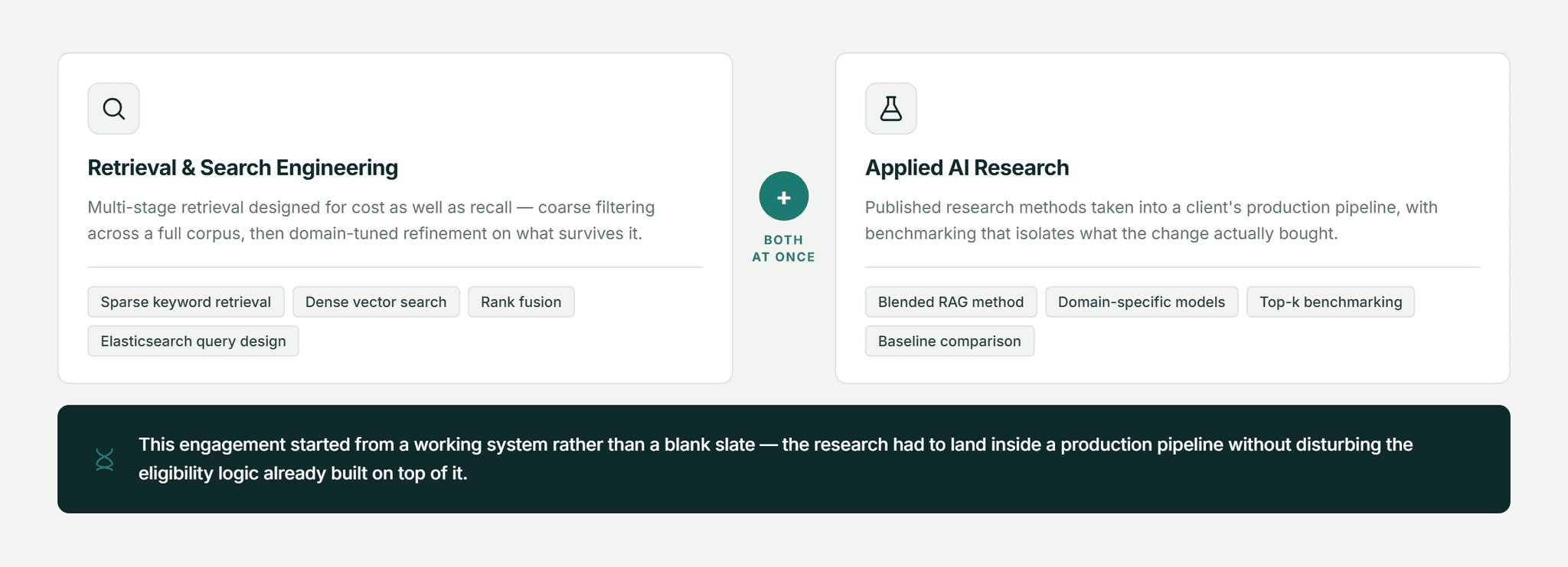
This engagement reflects Pfactorial's ability to improve the core accuracy bottleneck of an AI pipeline a client already has in production - the kind of engagement that starts from “we have something working, make it better,” not a blank slate.

Figure 5 - Service lines this engagement draws on.
Engagement enquiries Pfactorial Technologies works with teams that have a working retrieval-augmented system and want to improve its accuracy at the source. If you're evaluating whether your retriever is the limiting factor in your RAG pipeline, we're happy to give you an honest read on scope and risk before anyone commits to anything. · pfactorial.ai
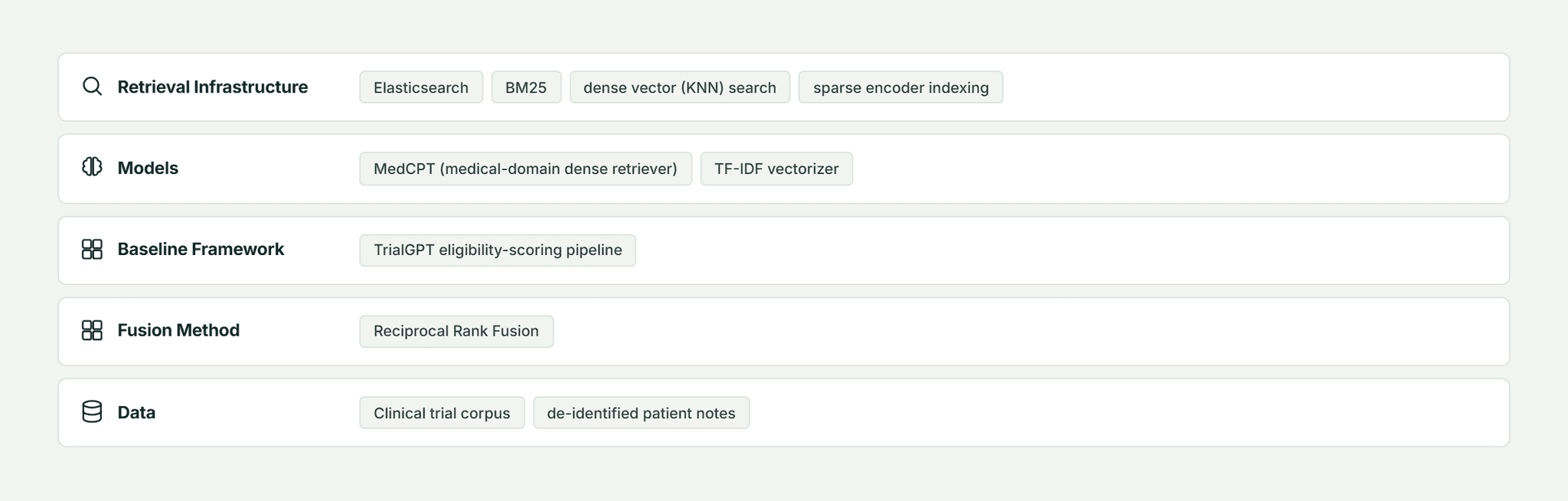
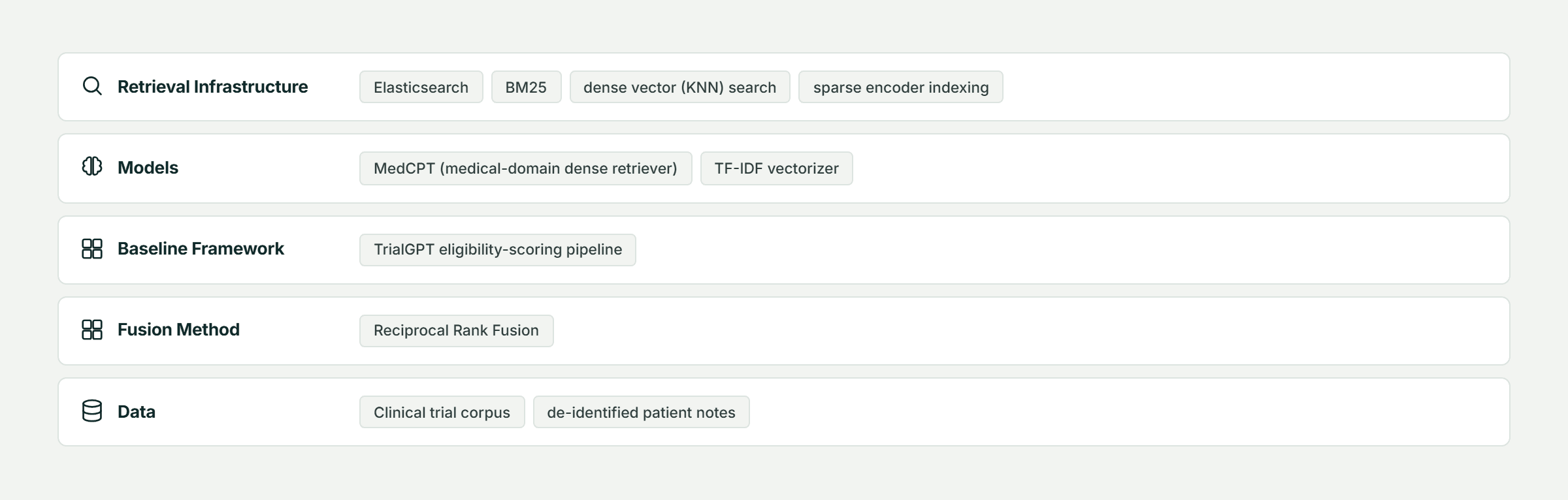
APPENDIX A - TECHNOLOGY STACK
The technology stack underpinning the system, grouped by the layer it serves.

© 2026 Pfactorial Technologies. Client identity and product-specific implementation detail are withheld or generalized; no client data, credentials, source code, or infrastructure detail is included in this document.
Result and Analysis
ENGAGEMENT SNAPSHOT
How Pfactorial Technologies enhanced an existing clinical-trial matching system's retrieval accuracy by layering semantic search and hybrid query strategies on top of its production pipeline.

CASE STUDIES

You might also like...

Recruiting & HR TechRAG & Semantic Search
Aug 21, 20267 min readRead

Multi-Agent & Agentic SystemsRAG & Semantic Search
An Agentic, Six-Agent Pipeline for Deterministic Clinical Trial Eligibility Matching
Aug 21, 20267 min readRead

RAG & Semantic SearchAutomotive & Vehicle
A Botpress-Built AI Sales & Service Assistant That Qualifies Automotive Leads 24/7
Aug 21, 20267 min readRead

Computer VisionML Infra, Classifiers & RL
A Deep Learning Classifier That Separates True-Negative Mammograms from Genuine BIRADS 0 Cases
Aug 21, 20266 min readRead

Legal & Contract Analysis
A HIPAA-Compliant De-Identification Pipeline for Multi-Format Clinical Data
Aug 21, 20266 min readRead

RAG & Semantic Search
A Layered Analytics Platform for CXO-Level Decision-Making
Aug 21, 20268 min readRead