Back
Computer Vision
From Working Text-to-Lip Prototype to a Proposed Diffusion-Based Video Pipeline
Building on a delivered VITS-and-Wav2Lip lip-sync system, a proposed next-generation workflow adds diffusion-model video generation and distributed training for higher-fidelity output.
August 21, 2026
Share
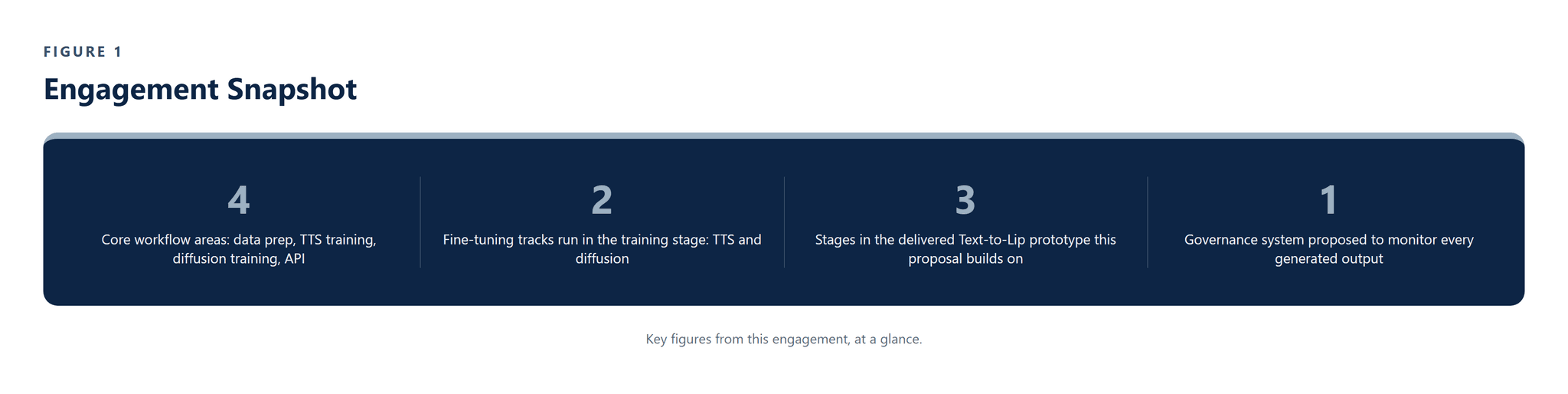
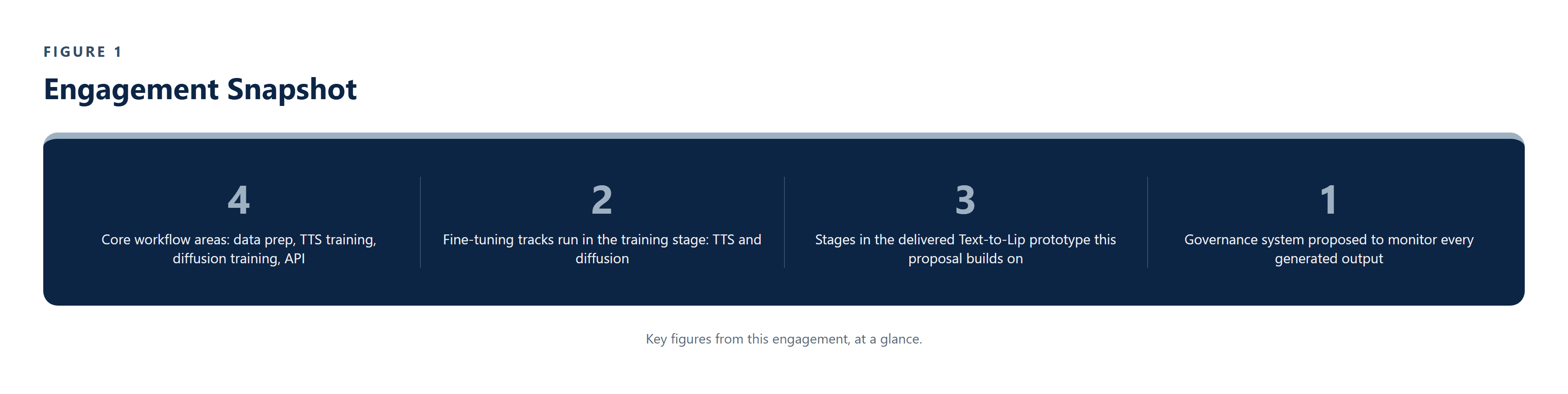
ENGAGEMENT SNAPSHOT

Figure 1 - Key figures from this engagement, at a glance.
EXECUTIVE SUMMARY
Our client already had a working lip-sync prototype - Text-to-Lip - that turned typed text into a lip-synced video using a text-to-speech model and an open-source GAN, and had proven the approach for use cases like automated news anchoring. The next step was a genuine production pipeline, not another prototype.
Pfactorial Technologies proposed a four-area workflow - data preparation, TTS fine-tuning, diffusion-model fine-tuning, and production deployment through an API - that builds on the validated Text-to-Lip approach while replacing its GAN-based video generation with a diffusion model trained across multiple GPUs for higher-fidelity, more natural lip synchronization.
The proposal treats governance as part of the architecture rather than an add-on: an AI governance system is proposed as a standard deployment-phase component, specifically to monitor output for ethical use, bias, and content authenticity before the API serves a single request.
Why this engagement is representative This engagement demonstrates Pfactorial's approach to iterating a validated prototype into a production-grade pipeline: keeping what already worked (text-to-speech, the overall pipeline shape) while deliberately upgrading the highest-leverage component (GAN to diffusion) and building governance in from the start.
THE CHALLENGE
Moving from a working prototype to a production-ready pipeline meant addressing several gaps the original Text-to-Lip system didn't need to solve.
1. GAN-based lip-sync had reached its ceiling
The delivered Text-to-Lip pipeline relied on Wav2Lip, an open-source GAN, which excelled at aligning lip movement to audio but left headroom for smoother, more natural synchronization that a diffusion-based approach could close.
2. Training needed to scale beyond a single-GPU setup
A production-grade diffusion model for video generation requires distributed training across multiple GPUs to be trained and evaluated in a reasonable timeframe, rather than the more modest compute footprint the original prototype needed.
3. Ethical and content-authenticity risk needed a systematic answer
Lip-synced video generation - especially applications like avatars and dubbing - carries real risk of misuse, bias, and authenticity concerns that a prototype built to prove feasibility hadn't yet needed to address at a systems level.
4. The pipeline needed to be consumable as a service
Text-to-Lip's NewsVideoCreation.py script proved the underlying approach worked, but real applications - virtual avatars, dubbing, AI-driven video content - need the capability exposed as a scalable, accessible API, not a standalone script.
The real brief Not "build lip-sync from scratch" but "take a proven pipeline and its underlying TTS approach, and evolve its weakest link - the video generation model - into something production-grade, with governance built in."
THE SOLUTION
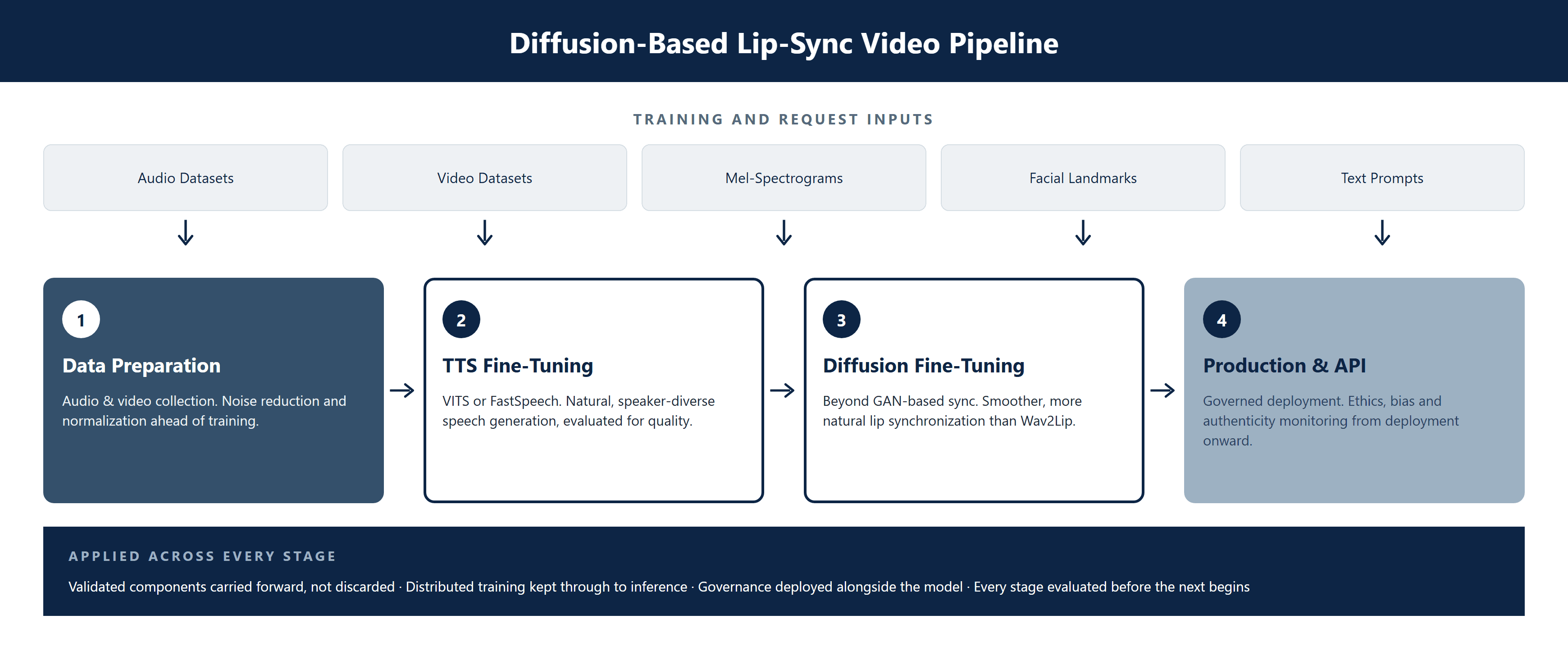
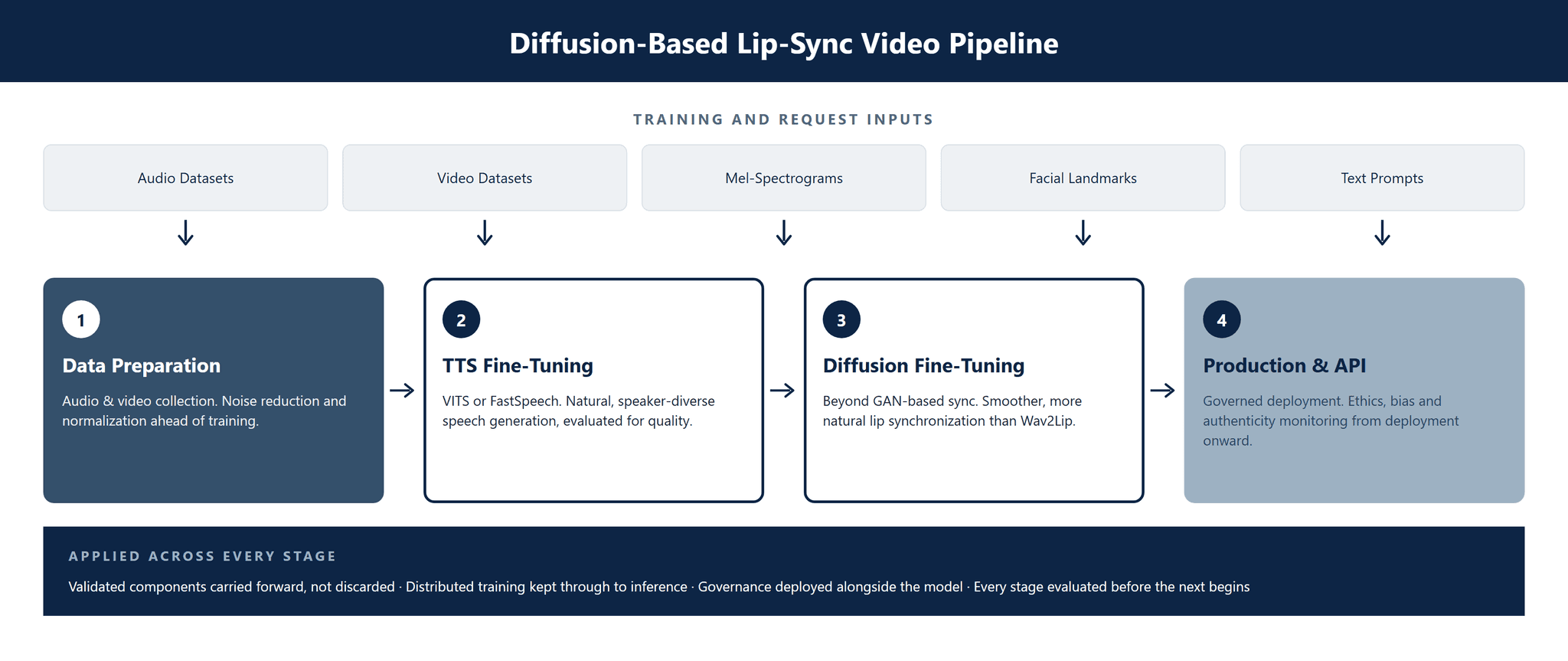
Pfactorial proposed a four-area workflow that carries forward what already worked in Text-to-Lip - a TTS-driven pipeline - while replacing GAN-based video generation with a diffusion model trained across multiple GPUs.

Figure 1 - Proposed workflow: data preparation, TTS fine-tuning, diffusion fine-tuning, and production deployment via API.
Architectural principles
- Build on what's already validated - the proposed pipeline keeps the TTS-driven approach proven in Text-to-Lip - where VITS generated natural, speaker-diverse audio - rather than discarding a component that already worked well.
- Upgrade the highest-leverage component deliberately - video generation moves from Wav2Lip's GAN architecture to a fine-tuned diffusion model specifically because that's where the delivered prototype had the most headroom for improvement in smoothness and naturalness.
- Distributed training as a first-class design decision - Distributed Data Parallel (DDP) training across multiple GPUs is applied to the diffusion fine-tuning stage specifically for efficient training at the scale a production-grade video model requires.
- Governance is deployed alongside the model, not after it - an AI governance system is proposed as part of the production deployment phase itself, monitoring output for ethical use, bias, and content authenticity as a standing capability rather than a manual review process.
CAPABILITIES DELIVERED
The proposed workflow's capabilities extend the validated Text-to-Lip pipeline into a production-ready, API-accessible service.
CAPABILITY | WHAT IT DOES |
|---|---|
Audio & Facial Feature Extraction | Collects audio and video datasets and extracts Mel-spectrograms and facial landmarks as the pipeline's training features. |
Fine-Tuned TTS Generation | Selects and trains a TTS architecture (VITS or FastSpeech), building on the speaker-diverse, natural speech approach validated in Text-to-Lip. |
Diffusion-Based Lip Synchronization | Fine-tunes a diffusion model for video generation, trained via DDP across multiple GPUs for smoother, more natural results than the GAN-based predecessor. |
AI Governance & Output Monitoring | Monitors generated video output to prevent bias, maintain content authenticity, and comply with regulatory standards. |
Scalable API Service | Exposes TTS and lip-sync generation as a real-time API, accessible for virtual avatars, dubbing, and AI-driven video content. |
Proven Prototype Foundation | Builds directly on Text-to-Lip's validated three-stage flow: text-to-speech generation, template-based video sequencing, and Wav2Lip-based synchronization. |
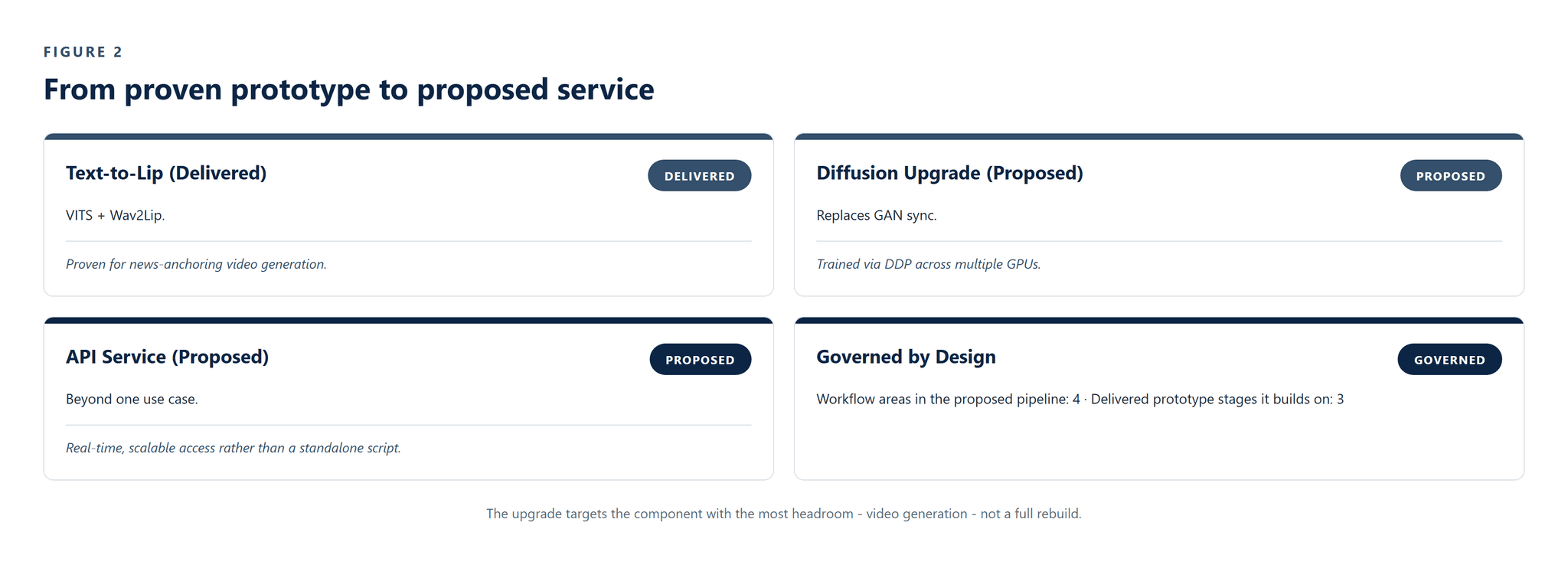
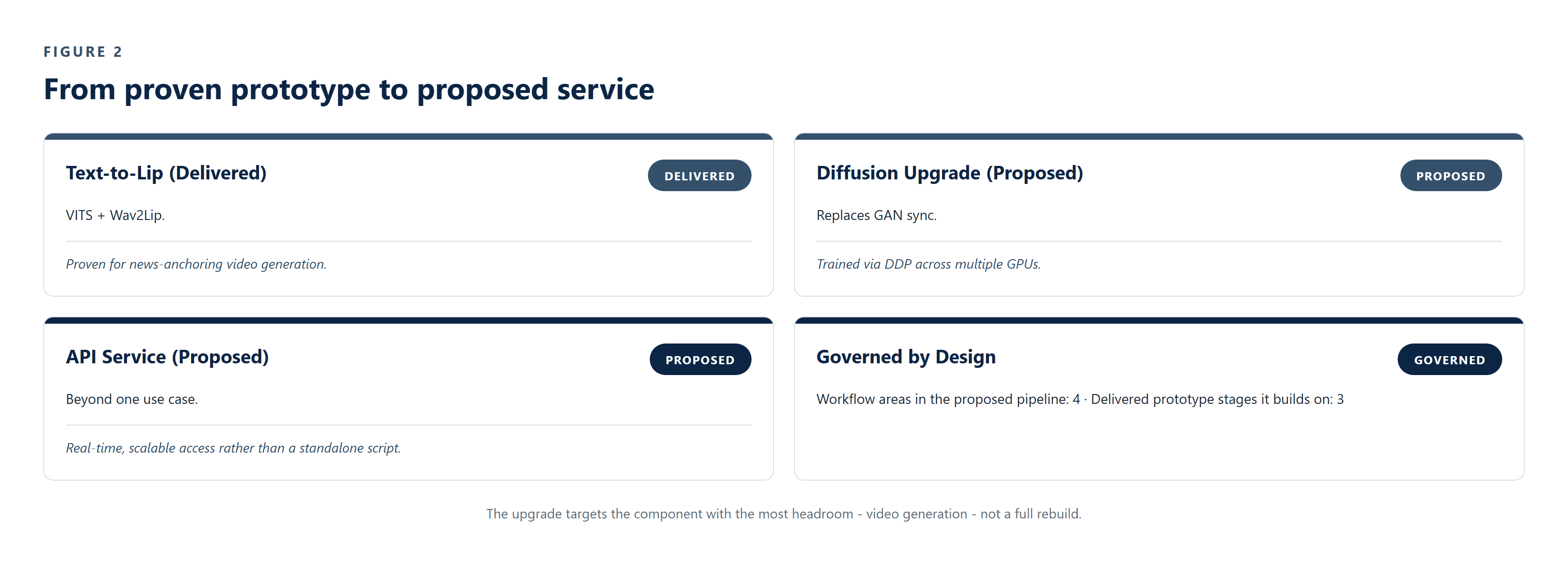
Figure 2 - How Text-to-Lip's proven flow evolves into the proposed diffusion-based, API-accessible pipeline.
Design note The delivered Text-to-Lip prototype remains a validated reference point: its VITS-based TTS module and its user-facing flow (text input, avatar and voice selection, generated video) inform the proposed system's design rather than being discarded in favor of an unproven approach.
ENGINEERING FOR SCALE AND RELIABILITY
Several engineering decisions in the proposal reflect deliberate choices about what to keep, what to replace, and what to add.
TTS model selection stays open, not fixed
the proposal names VITS or FastSpeech as candidate architectures for the TTS fine-tuning stage, keeping model selection an evaluated decision rather than committing to a single option before training begins.
Diffusion training is evaluated for latency and performance
the DDP architecture is proposed specifically to be carried through into production deployment, chosen for better latency and performance rather than only being used during training and discarded at inference.
Feature engineering carries forward proven signals
Mel-spectrograms and facial landmarks - the same feature classes that underpinned Text-to-Lip's working pipeline - remain the core extracted features for the new diffusion-based approach.
The API is designed for multiple downstream applications
the proposed API explicitly targets virtual avatars, dubbing, and AI-driven video content as distinct use cases, rather than being scoped narrowly to the news-anchoring application Text-to-Lip was built around.
Governance is scoped to specific, named risks
the proposed AI governance system is scoped to ethical AI usage, bias prevention, content authenticity, and regulatory compliance - four specific concerns rather than a generic monitoring catch-all.
The prior system's script-based delivery informs the API design
Text-to-Lip's NewsVideoCreation.py already integrated TTS generation, video sequencing, and lip-sync into one automated flow - the proposed API generalizes that same integration pattern into a reusable service.
DELIVERY APPROACH
The proposal lays out four workflow areas moving from data preparation through to a deployed API service.
1. Data preparation - collect audio and video datasets, extract Mel-spectrograms and facial landmarks, and apply noise reduction and normalization before storage.
2. TTS fine-tuning - select the TTS architecture (VITS or FastSpeech), train on the processed dataset, and evaluate for accuracy and naturalness.
3. Diffusion fine-tuning - train the diffusion model for lip-synced video generation using DDP across multiple GPUs, then evaluate for synchronization quality.
4. Production deployment - deploy the trained models with the DDP architecture for latency and performance, alongside the AI governance system for output monitoring.
5. API service delivery - expose the trained TTS and lip-sync models as a real-time API service supporting virtual avatars, dubbing, and AI-driven video content.
RESULTS AND IMPACT

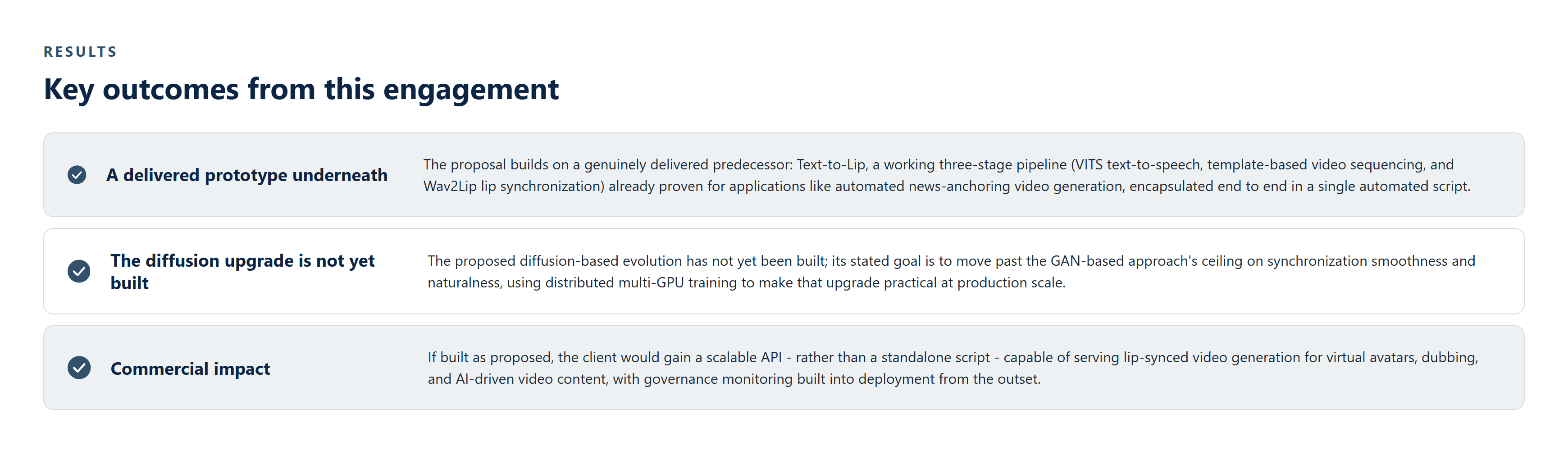
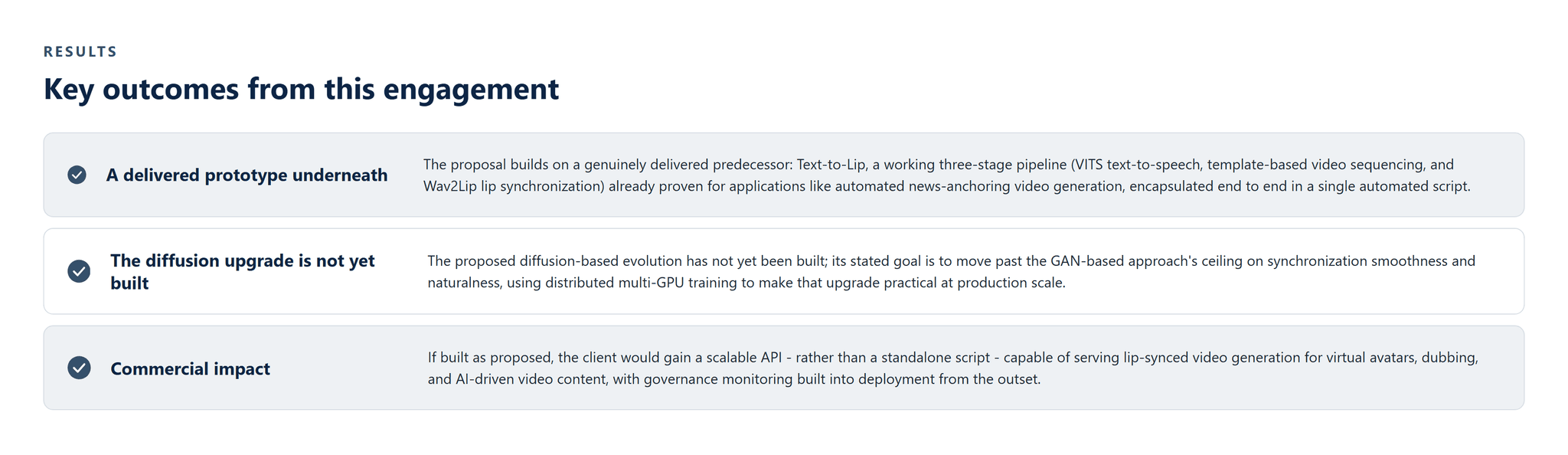
Figure - Key outcomes from this engagement.
The proposal builds on a genuinely delivered predecessor: Text-to-Lip, a working three-stage pipeline (VITS text-to-speech, template-based video sequencing, and Wav2Lip lip synchronization) already proven for applications like automated news-anchoring video generation, encapsulated end to end in a single automated script.
The proposed diffusion-based evolution has not yet been built; its stated goal is to move past the GAN-based approach's ceiling on synchronization smoothness and naturalness, using distributed multi-GPU training to make that upgrade practical at production scale.
What it enabled commercially
If built as proposed, the client would gain a scalable API - rather than a standalone script - capable of serving lip-synced video generation for virtual avatars, dubbing, and AI-driven video content, with governance monitoring built into deployment from the outset.
WHY PFACTORIAL
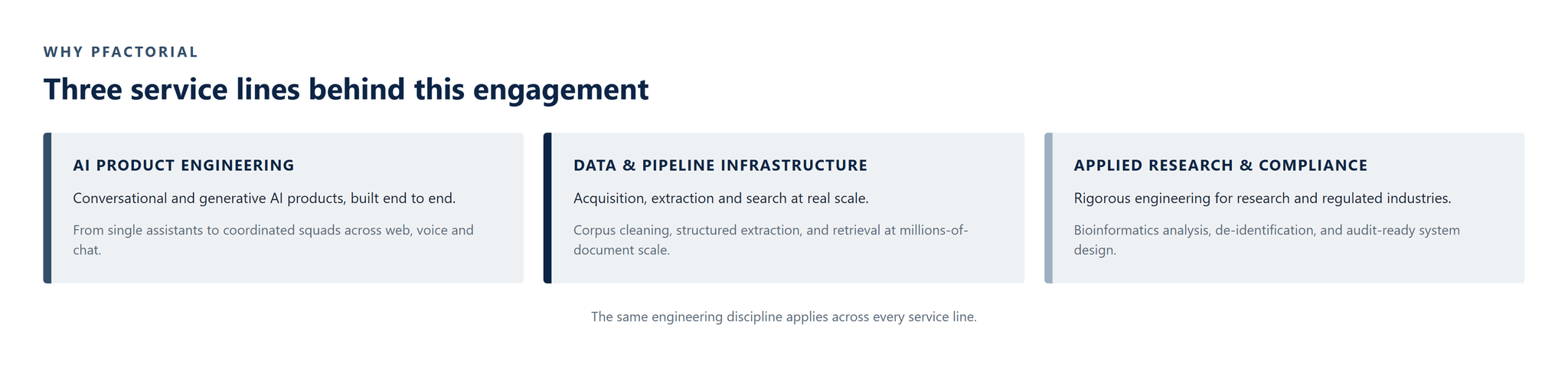
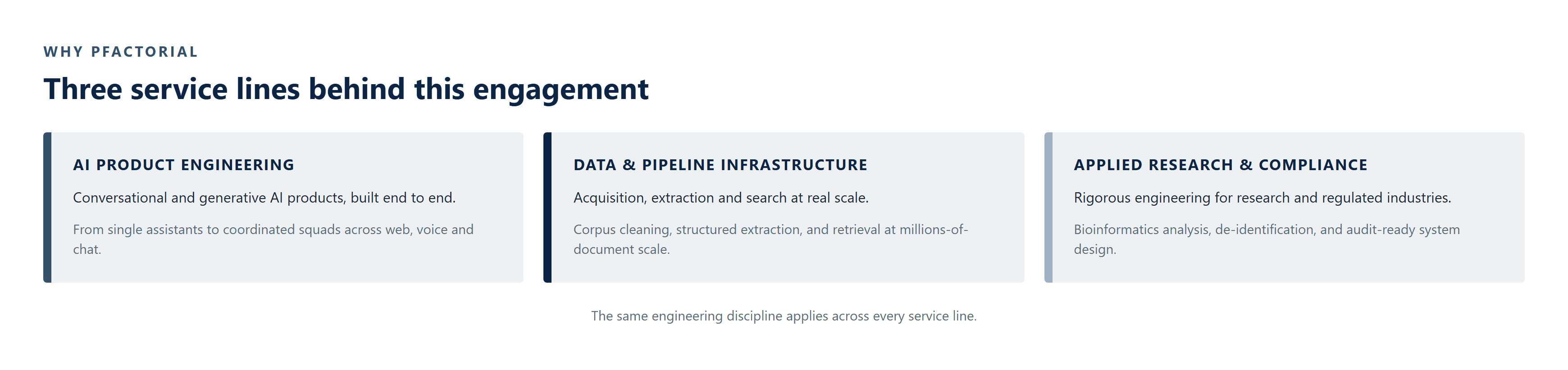
This engagement draws on Pfactorial's AI product engineering capability: evolving a validated prototype deliberately, upgrading the component with the most headroom rather than rebuilding what already works, and building governance into deployment rather than adding it after the fact.

Figure - Service lines this engagement draws on.
Engagement enquiries Pfactorial Technologies works with media and content teams looking to move a working AI prototype into a production-grade, governed service. If you are evaluating whether a generative video pipeline is worth building properly, we are happy to give you an honest read on scope, cost, and risk before anyone commits to anything. · pfactorial.ai
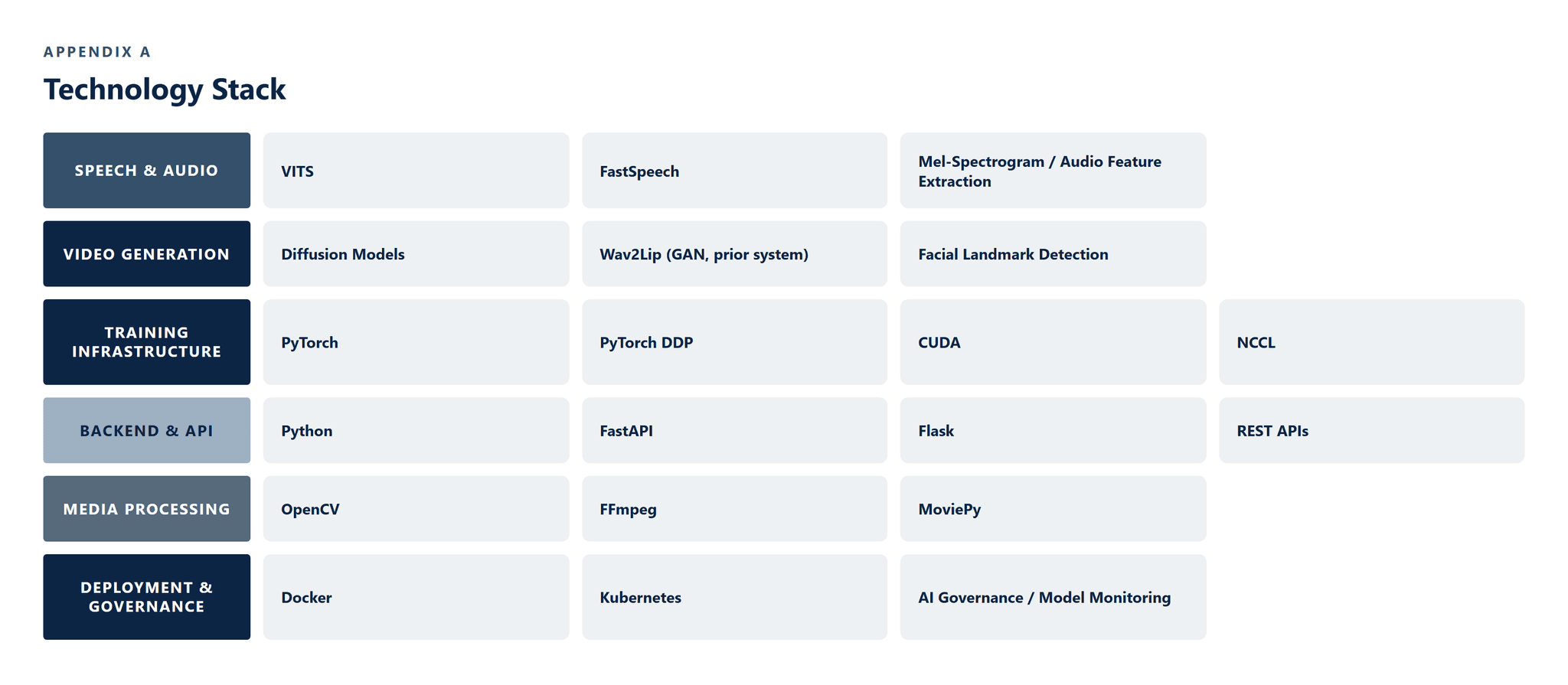
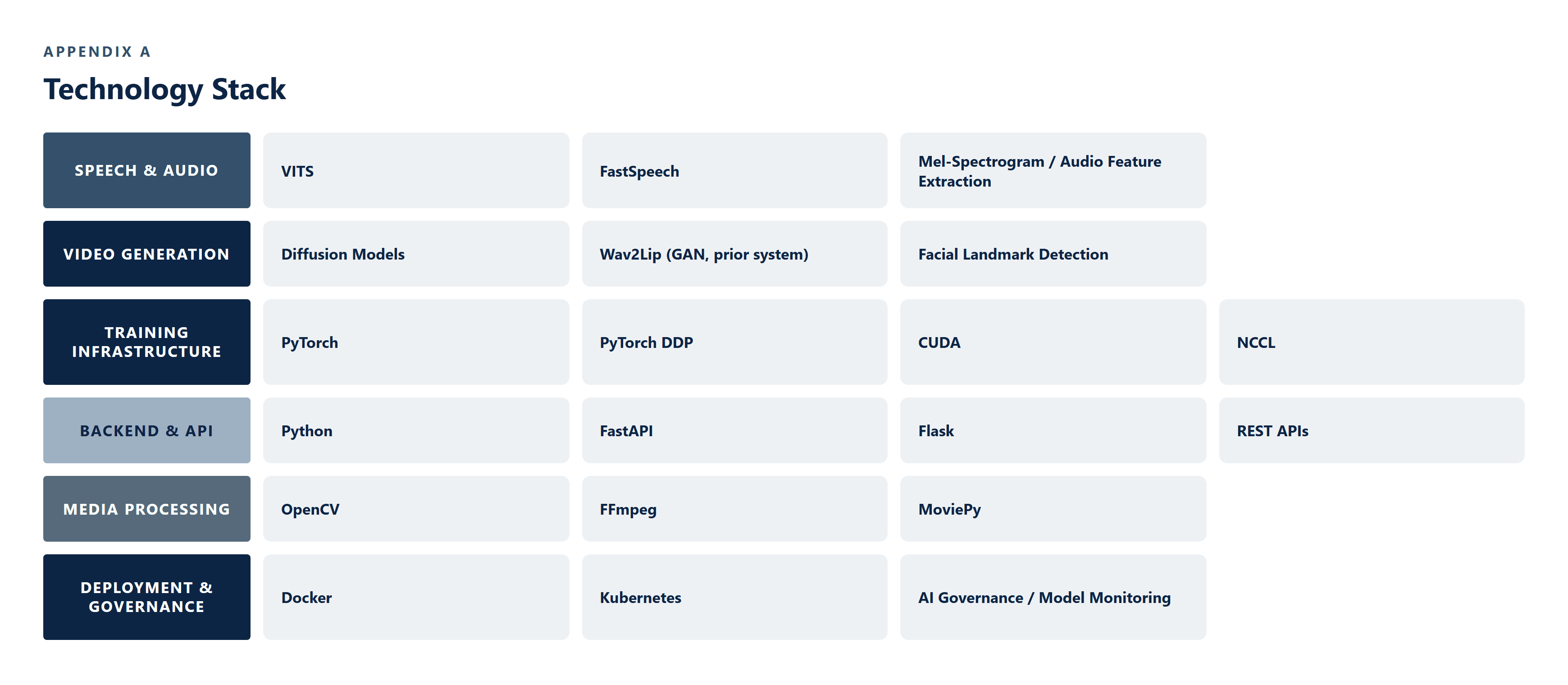
APPENDIX A - TECHNOLOGY STACK
The technology stack underpinning the system, grouped by the layer it serves.

Result and Analysis
ENGAGEMENT SNAPSHOT
Building on a delivered VITS-and-Wav2Lip lip-sync system, a proposed next-generation workflow adds diffusion-model video generation and distributed training for higher-fidelity output.
CASE STUDIES
You might also like...

OCR & Document ExtractionAutomotive & Vehicle
Aug 21, 20267 min readRead

Computer VisionML Infra, Classifiers & RL
A Deep Learning Classifier That Separates True-Negative Mammograms from Genuine BIRADS 0 Cases
Aug 21, 20266 min readRead

Content & Media Generation
A Failover-Chained Text-to-Image Service Built on Three Stable Diffusion Models
Aug 21, 20267 min readRead

Analytics & BI DashboardsAutomotive & Vehicle
A Five-Capability Computer Vision Platform for Vehicle Identity, Traffic, and Parking Intelligence
Aug 21, 20267 min readRead

OCR & Document Extraction
A Hugging Face Inference-Backed Handwriting Transcription Tool for Single-Line Document Digitization
Aug 21, 20266 min readRead

Speech & Audio Pipelines
A Modular Pipeline for Multilingual Manuscript Narration
Aug 21, 20268 min readRead