Back
Multi-Agent & Agentic Systems

Evolving a Prompt-Driven Content Platform Into an Agentic System

A proposed redesign of a production content research and generation platform around context engineering, multi-agent orchestration, and automated evaluation - rather than incremental prompt tuning.
August 21, 2026
Share
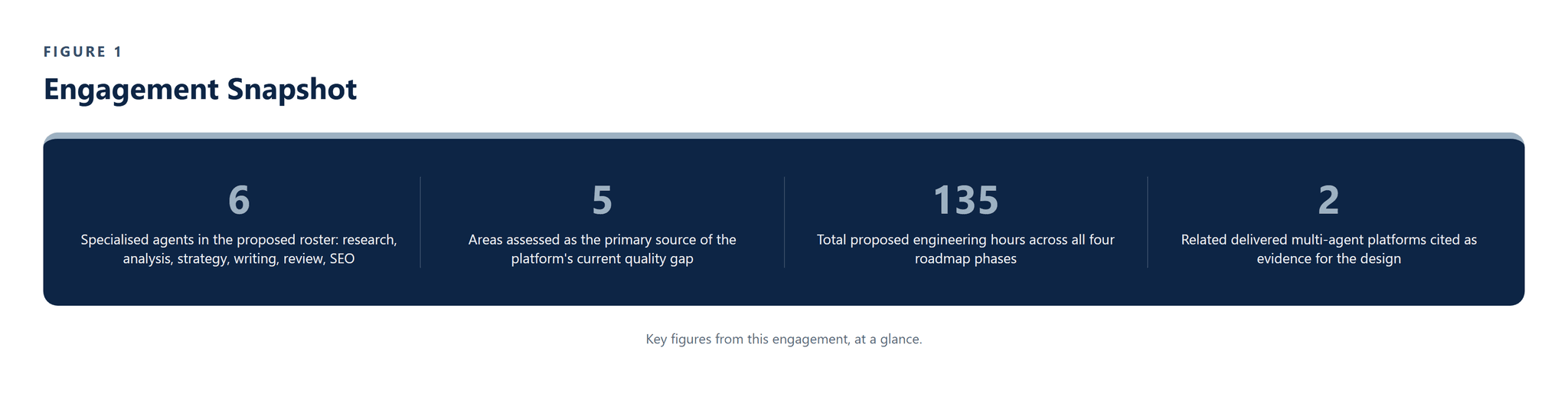
ENGAGEMENT SNAPSHOT

CS-006_Content_Intelligence_Platform image 1
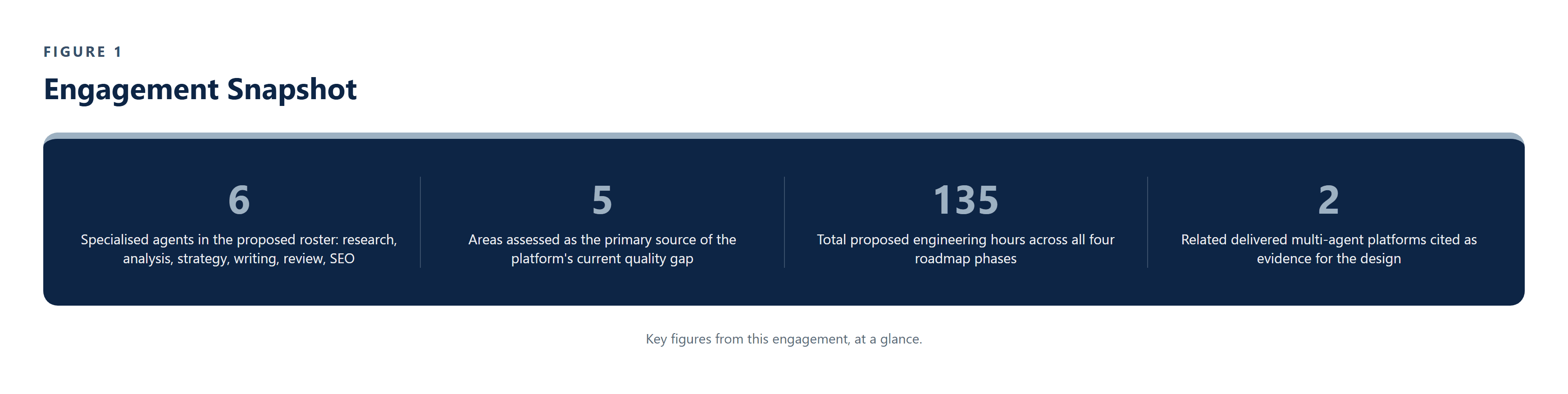
Figure 1 - Key figures from this engagement, at a glance.
EXECUTIVE SUMMARY
Our client already had an LLM in production for content research, analysis, and creation, but the system was built around single-shot prompts rather than the engineering practices needed to get consistently higher-quality output from the same underlying model.
Pfactorial Technologies proposed redesigning the AI layer around six modern LLM engineering principles - context engineering, agent orchestration, memory, tool use, evaluation pipelines, and the Model Context Protocol - to close the quality gap between the current system and what the same model can deliver with better engineering around it.
The proposed architecture decomposes content analysis and creation into discrete, specialised stages instead of a single prompt doing every task at once, with an evaluation pipeline that turns quality into something measured on every change rather than judged subjectively after the fact.
Why this engagement is representative This engagement demonstrates Pfactorial's approach to maturing a production AI product: identifying precisely where prompt engineering alone runs out of headroom, and replacing it with context assembly, specialised agents, and automated evaluation rather than continuing to hand-tune single prompts.
THE CHALLENGE
Five areas accounted for most of the gap between the platform's current output and what the same underlying model could deliver with better engineering around it.

1. Context was static and generic

Prompts carried missing business context and unmanaged token spend rather than context assembled dynamically per request, from the client's own catalogue, brand rules, and live data.

2. One prompt was asked to do every analysis task at once

Content analysis ran as a single prompt rather than being decomposed into specialised reasoning stages, making it hard to identify which stage was responsible when output was wrong.

3. Generation was single-shot, without a quality loop

Content creation produced a single draft rather than iterating against a quality and safety check until a defined threshold was met.

4. Retrieval and quality assurance had no rigor

Document lookup used simple, low-relevance search, and quality assurance was manual, subjective, and not repeatable - so nothing prevented a regression from shipping unnoticed.
The real brief Not "tune the prompts further" but "redesign the AI layer around context engineering, orchestration, memory, tool use, and automated evaluation - so quality improvement becomes measurable and repeatable rather than a matter of opinion."
THE SOLUTION
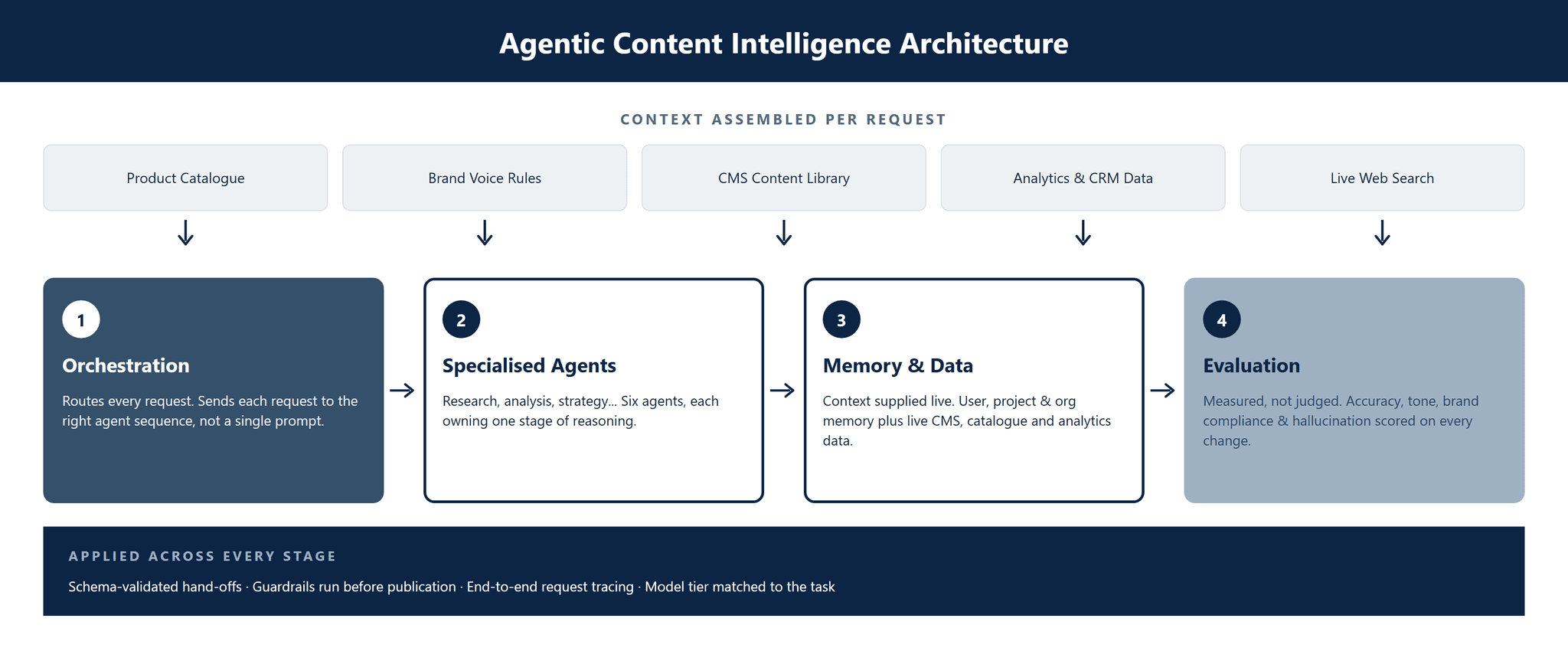
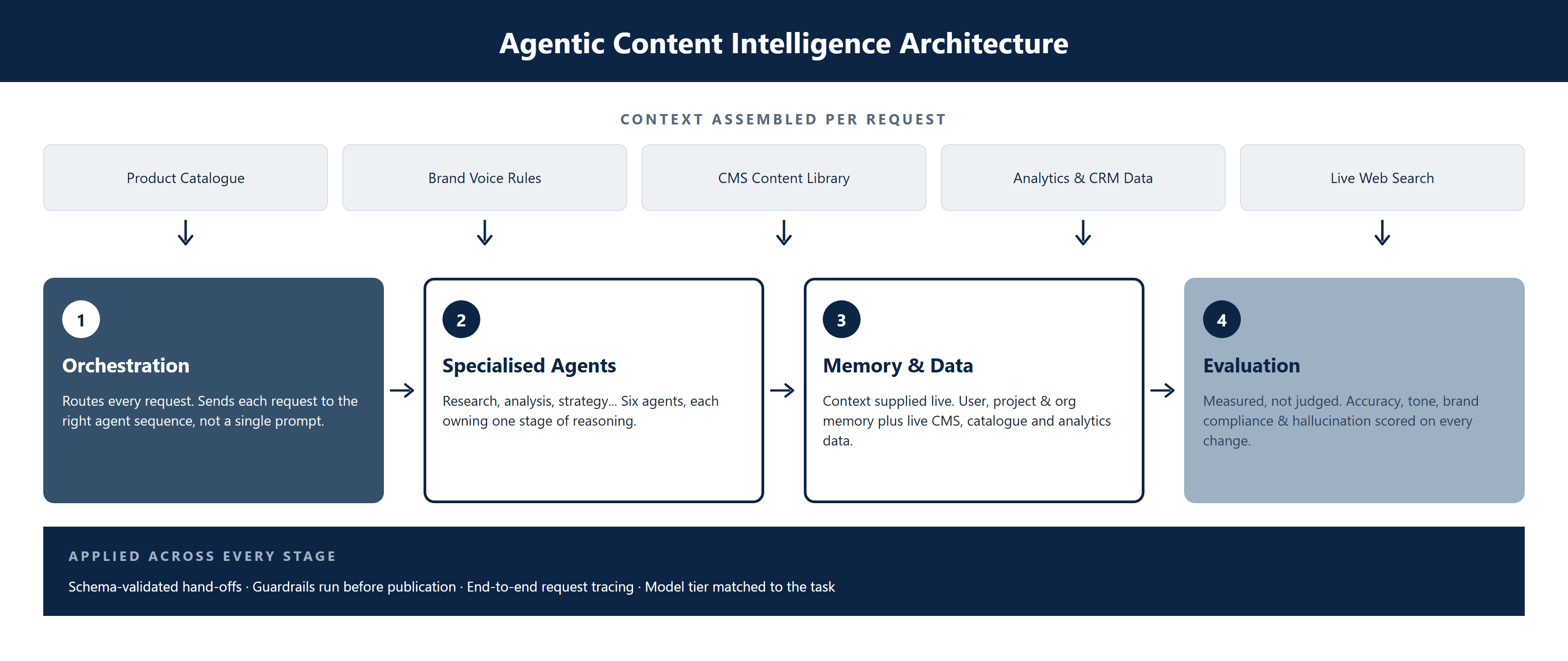
Pfactorial proposed a modular, agentic architecture: an orchestration layer routes each request, specialised agents perform the reasoning, memory and data layers supply context, and an observability layer measures the result.
CS-006_Content_Intelligence_Platform image 2
Figure 1 - The proposed architecture: request orchestration, specialised reasoning agents, memory and retrieval, and automated evaluation and observability.

Architectural principles

  • Context is assembled, not pasted - a dynamic context builder prioritises and compresses relevant business context - brand voice, catalogue data, prior top performers - per request, rather than relying on static, generic prompts.
  • Analysis and creation are decomposed into stages - each stage of content analysis and the creation workflow has one responsibility, which improves accuracy, consistency, and explainability - when output is wrong, the failing stage is identifiable.
  • Memory spans sessions, projects, and the organisation - user memory (preferences, tone), project memory (research, drafts, objectives), and organisational memory (brand voice, approved references) give continuity across sessions rather than starting from zero each time.
  • Quality is evaluated automatically, on every change - automated scoring for accuracy, completeness, relevance, citations, tone, brand compliance, hallucination, latency, and token efficiency replaces manual, subjective review as the quality gate.
CAPABILITIES DELIVERED
The proposed platform spans context assembly, retrieval, memory, tool use, and evaluation - the six engineering principles behind the redesign.
CAPABILITY
WHAT IT DOES
Dynamic Context Engineering
Assembles, prioritises, and compresses request-specific context with metadata filtering and long-context management, rather than static prompts.
Hybrid Retrieval with Re-Ranking
Combines semantic, keyword, and metadata search with re-ranking and context scoring for materially higher relevance than simple document lookup.
Layered Memory
Maintains user, project, and organisational memory so brand voice, prior research, and preferences persist across sessions and projects.
Live Tool Use via MCP
Connects agents to web search, the content library, CMS, product catalogue, analytics, and CRM as callable tools, so the model acts on live systems rather than its own training data.
Six-Agent Analysis & Creation Roster
Research, Analysis, Strategy, Writing, Review, and SEO agents each own a narrow task and hand off to the next, rather than one agent doing everything.
Automated Evaluation Pipeline
Scores every output on accuracy, completeness, relevance, citations, tone, brand compliance, hallucination, latency, and token efficiency as a regression gate.
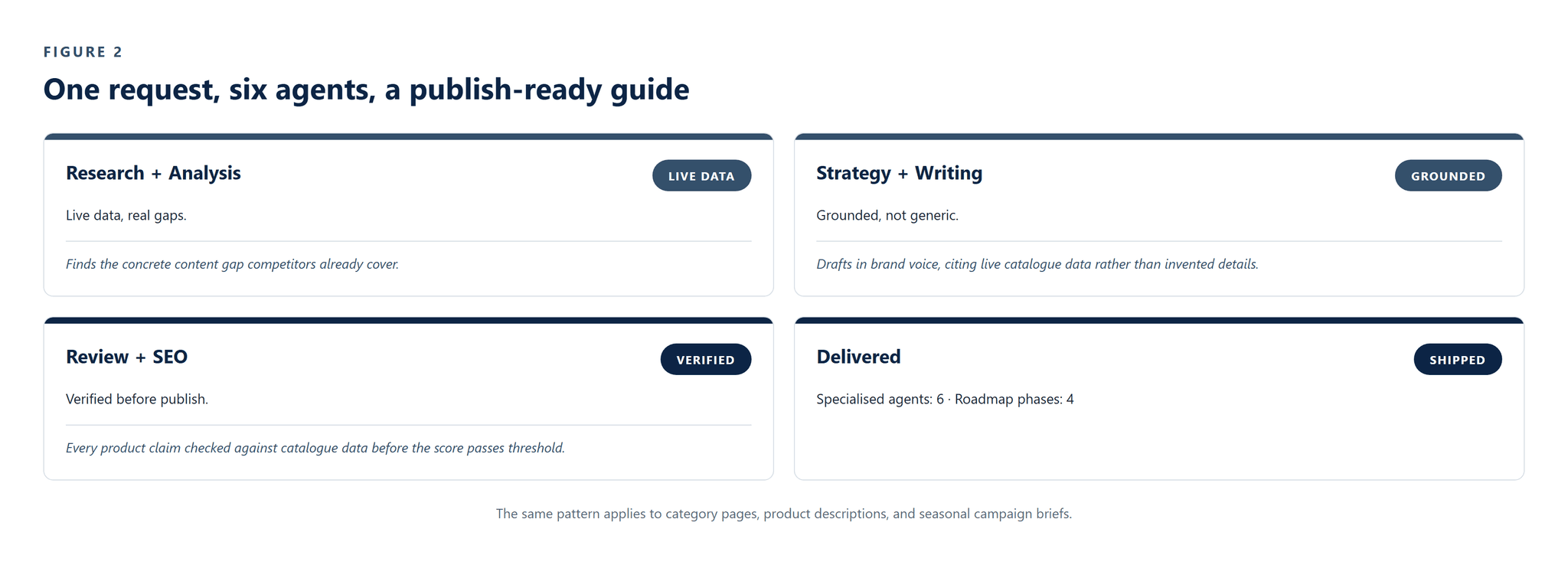
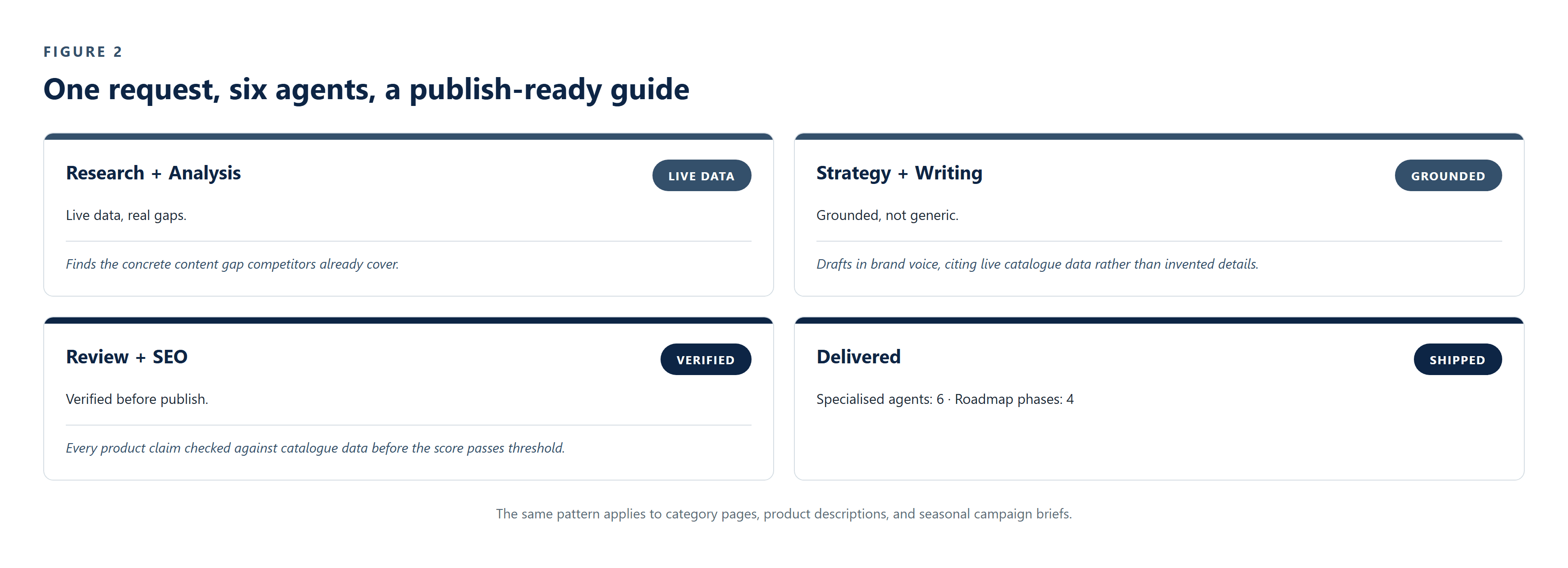
CS-006_Content_Intelligence_Platform image 3
Figure 2 - A worked example: one marketer request flows through six agents into a publish-ready guide, citing real catalogue data rather than invented product details.
Design note The architecture is deliberately sequenced so that Phases 1 and 2 - context engineering, retrieval, multi-agent workflows, memory, and evaluation - deliver the majority of the quality improvement, with new product capabilities (research assistant, automated briefs, editorial workflow) sequenced into later phases once that foundation is in place.
ENGINEERING FOR SCALE AND RELIABILITY
Several engineering decisions distinguish a genuinely agentic redesign from a larger prompt with more steps bolted on.

MCP connectors keep prompts small and information live

secure connectors to the CMS, analytics, content library, and search indexes let agents read live systems at the moment they need to, rather than pasting stale context into an ever-larger prompt.

Structured, validated output at every hand-off

agent output is constrained to a JSON schema or tool-call format, so each stage's result is machine-readable and validated before the next agent consumes it.

Guardrails run before publication, not after

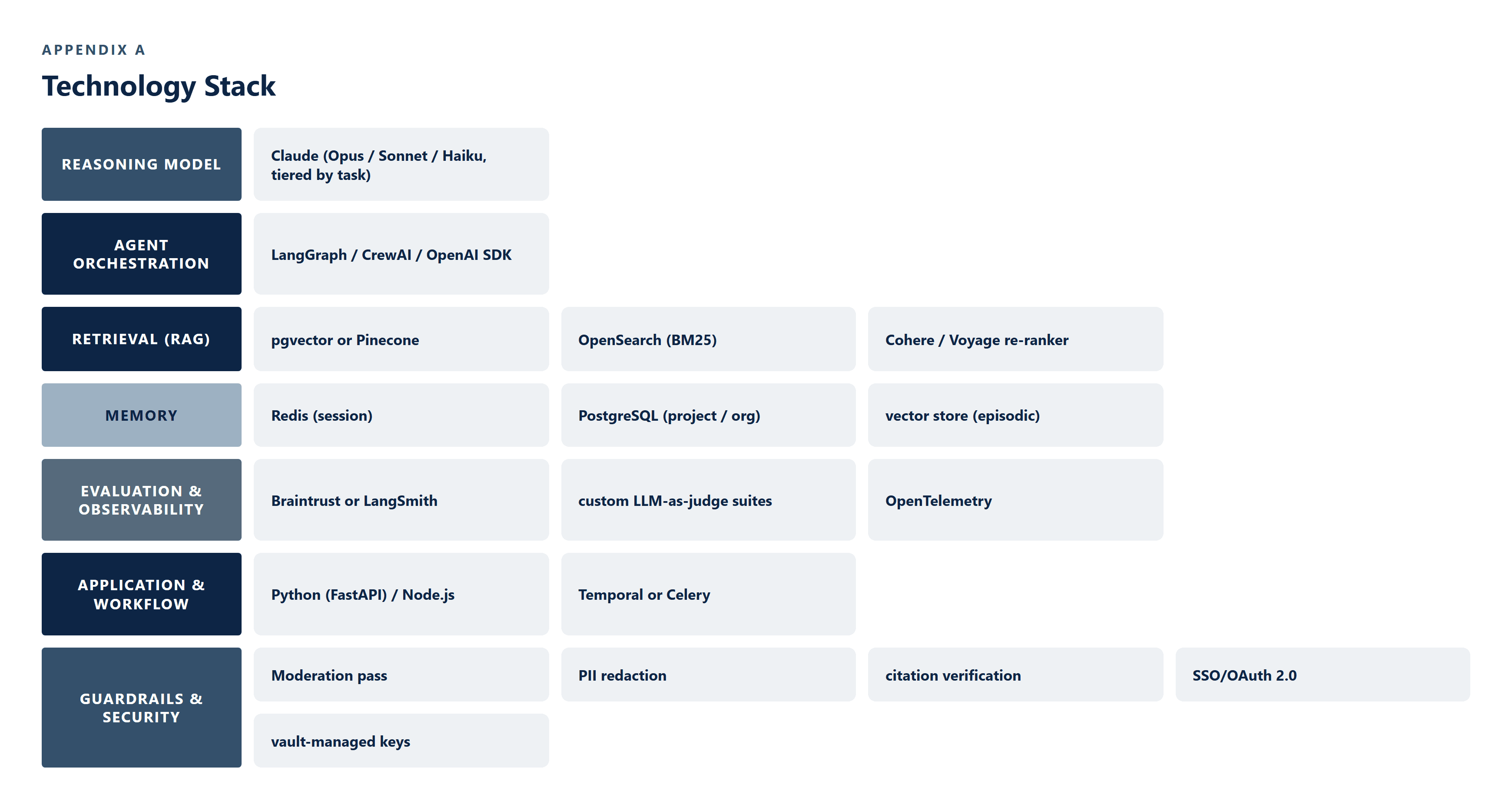
a moderation pass, PII redaction, and citation verification are applied as guardrails ahead of publication, rather than as a manual review step after the fact.

Every request is traced end to end

OpenTelemetry tracing with token, latency, and cost dashboards give per-request and per-agent visibility, so a regression in quality or cost can be attributed to a specific stage.

Long-running agent work is resumable

workflow execution runs on a durable executor (Temporal or Celery) so multi-step agent runs survive restarts rather than needing to start over.

The reasoning model is tiered by task

heavier reasoning runs on the more capable model tier, with high-volume, simpler steps routed to a faster, cheaper tier - matching model cost to what each stage actually requires.
DELIVERY APPROACH
The proposed roadmap runs in four phases, with the first two delivering the majority of the quality improvement before new product capabilities are layered on.
1. AI audit and retrieval improvements - audit existing prompts, and implement context engineering and hybrid retrieval improvements as the foundation for everything after.
2. Multi-agent workflows and evaluation - build the six-agent roster, memory layers, structured outputs, and the automated evaluation framework that turns quality into a measured, regression-gated process.
3. MCP integrations and external tools - connect agents to the CMS, product catalogue, analytics, and other live systems via MCP, plus advanced automation.
4. New AI-powered product capabilities - layer on the research assistant, automated brief generation, brand voice enforcement, and automated editorial workflow the new architecture unlocks.
RESULTS AND IMPACT

CS-006_Content_Intelligence_Platform image 4
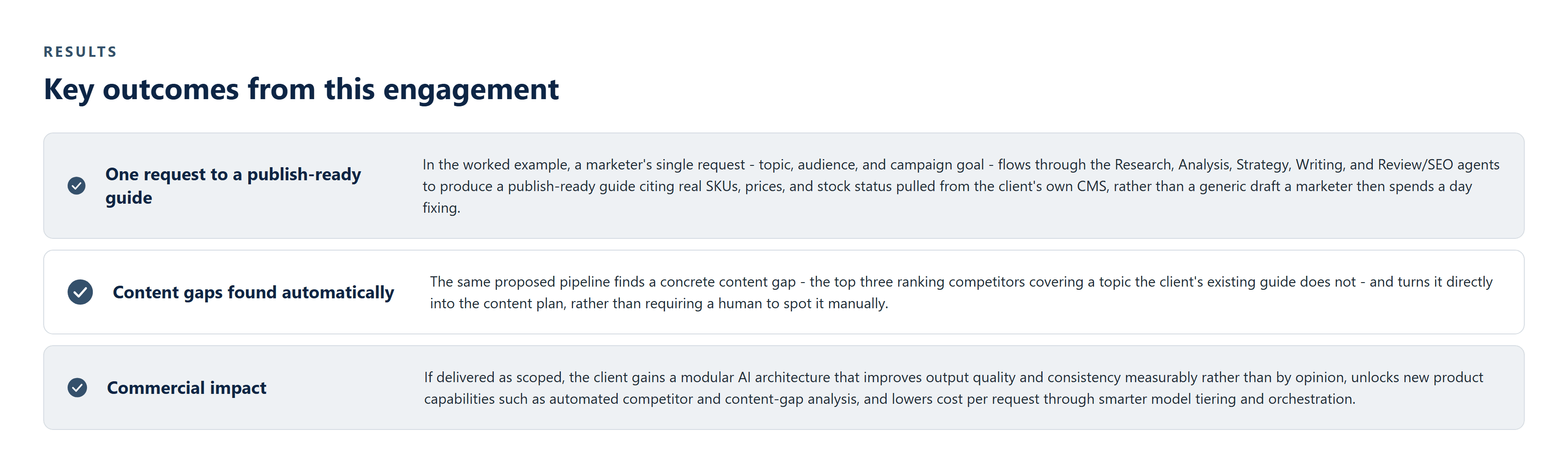
Figure - Key outcomes from this engagement.
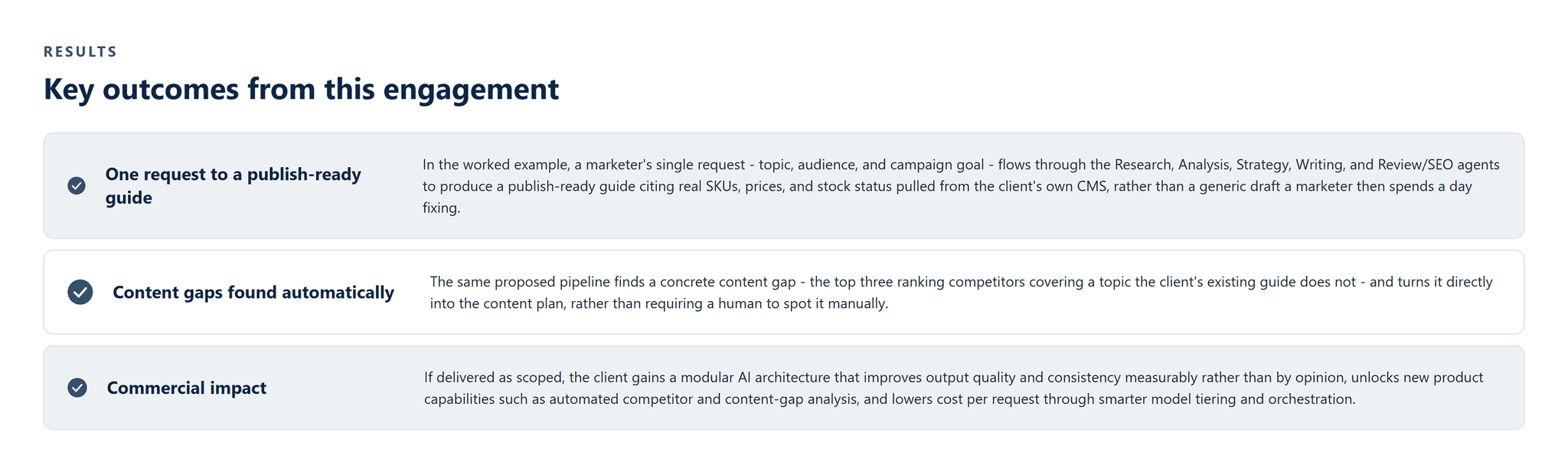
In the worked example, a marketer's single request - topic, audience, and campaign goal - flows through the Research, Analysis, Strategy, Writing, and Review/SEO agents to produce a publish-ready guide citing real SKUs, prices, and stock status pulled from the client's own CMS, rather than a generic draft a marketer then spends a day fixing.
The same proposed pipeline finds a concrete content gap - the top three ranking competitors covering a topic the client's existing guide does not - and turns it directly into the content plan, rather than requiring a human to spot it manually.

What it enabled commercially

If delivered as scoped, the client gains a modular AI architecture that improves output quality and consistency measurably rather than by opinion, unlocks new product capabilities such as automated competitor and content-gap analysis, and lowers cost per request through smarter model tiering and orchestration.
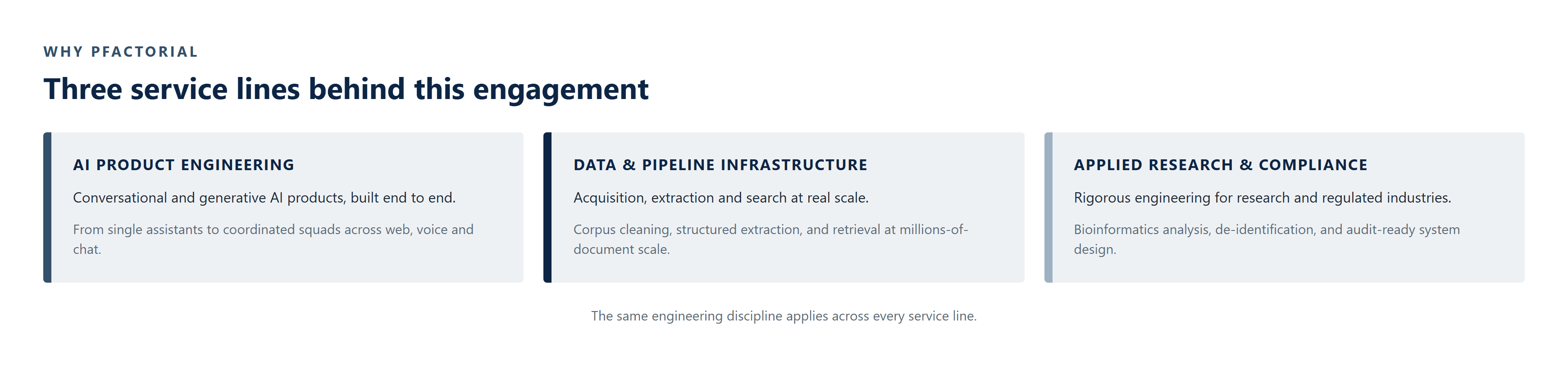
WHY PFACTORIAL
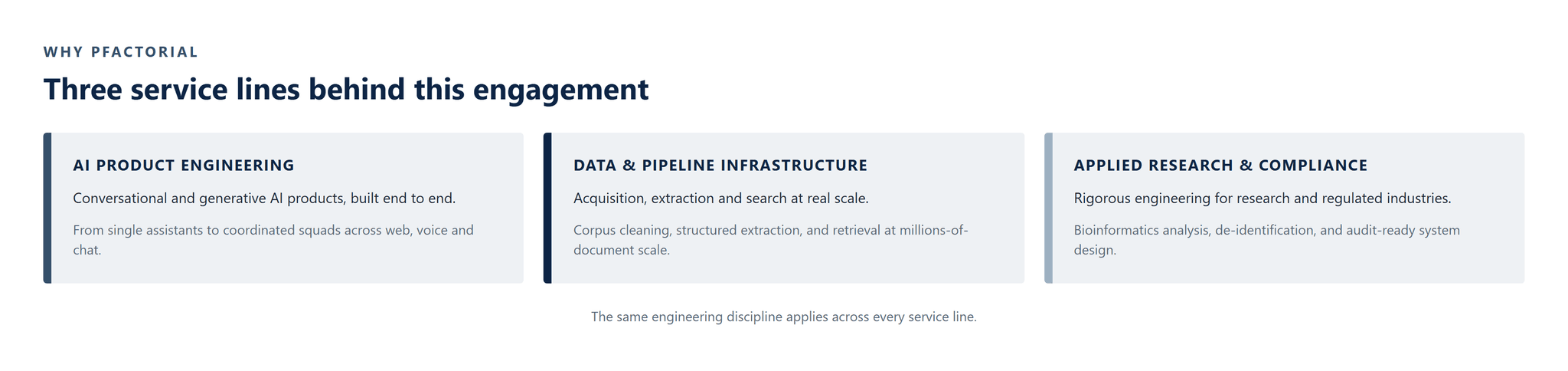
This engagement draws on Pfactorial's AI product engineering capability: taking a production system already using a capable model and rebuilding the engineering around it - context, orchestration, memory, and evaluation - rather than continuing to hand-tune prompts.
CS-006_Content_Intelligence_Platform image 5
Figure - Service lines this engagement draws on.
Engagement enquiries Pfactorial Technologies works with product teams whose AI features have plateaued on prompt tuning alone. If you are evaluating a move from single-prompt AI features to a genuinely agentic architecture, we are happy to give you an honest read on scope, cost, and risk before anyone commits to anything. · pfactorial.ai
APPENDIX A - TECHNOLOGY STACK
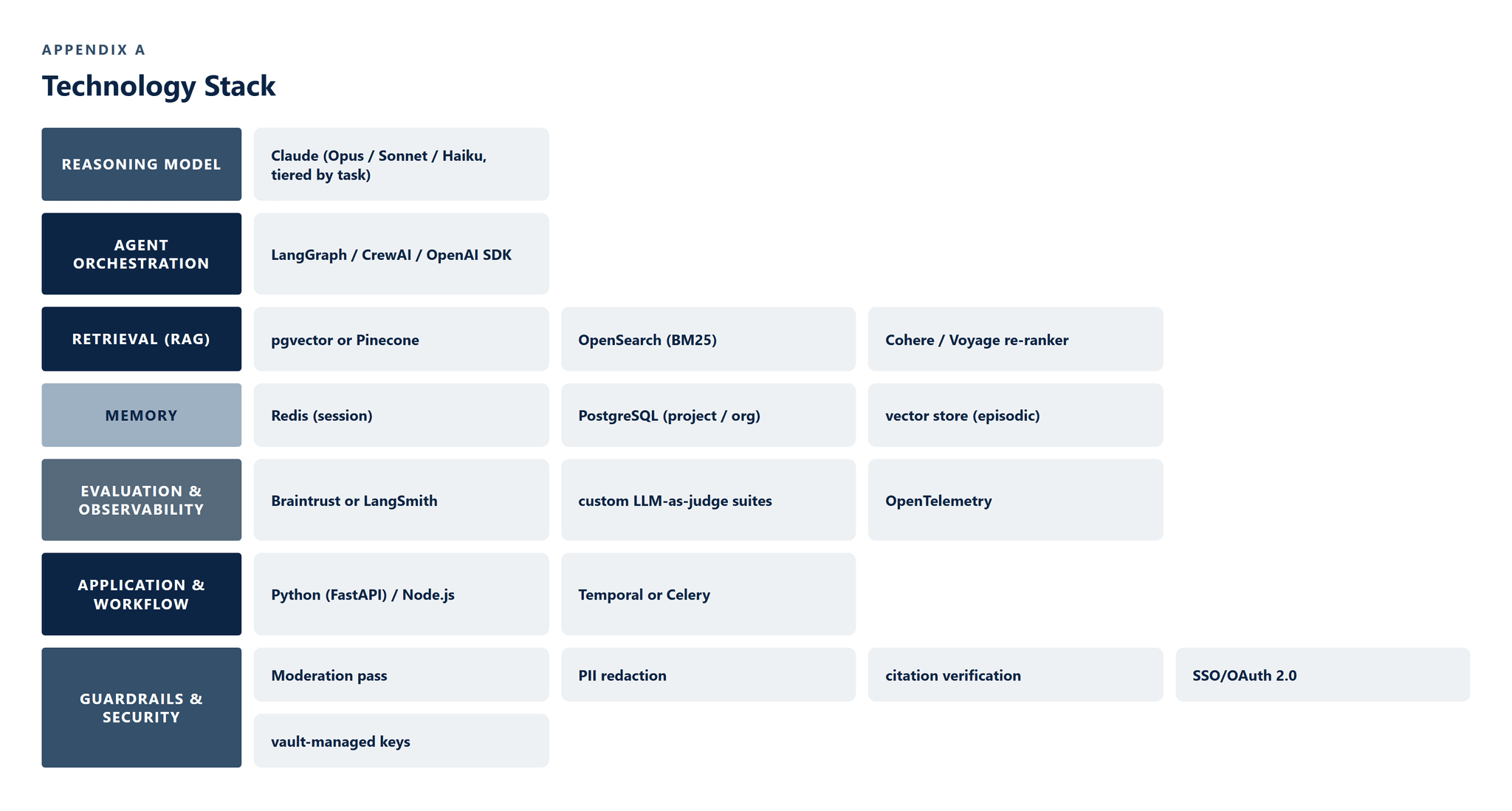
The technology stack underpinning the system, grouped by the layer it serves.
CS-006_Content_Intelligence_Platform image 6

Result and Analysis

ENGAGEMENT SNAPSHOT

A proposed redesign of a production content research and generation platform around context engineering, multi-agent orchestration, and automated evaluation - rather than incremental prompt tuning.
CS-006_Content_Intelligence_Platform image 1
CS-006_Content_Intelligence_Platform image 2
CS-006_Content_Intelligence_Platform image 3
CS-006_Content_Intelligence_Platform image 4
CS-006_Content_Intelligence_Platform image 5
CS-006_Content_Intelligence_Platform image 6