Back
Voice AI & Telephony

An AI Voice Assistant That Answers Live Neighborhood Questions and Captures Every Real Estate Lead by Phone

How Pfactorial Technologies built an AI-powered voice agent that answers live, location-specific real estate questions by phone and automatically captures qualified leads.
August 21, 2026
Share
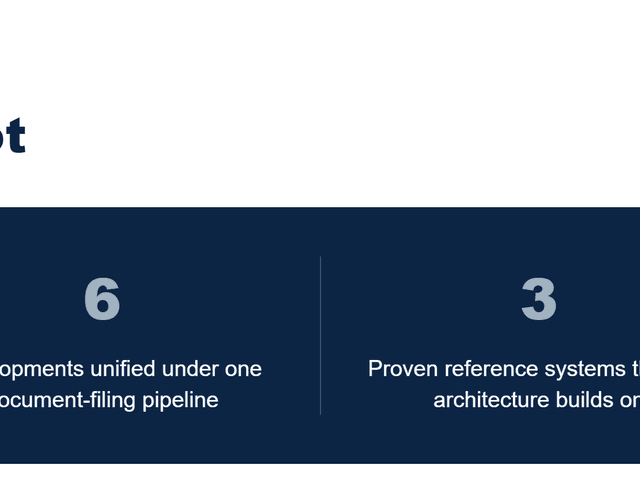
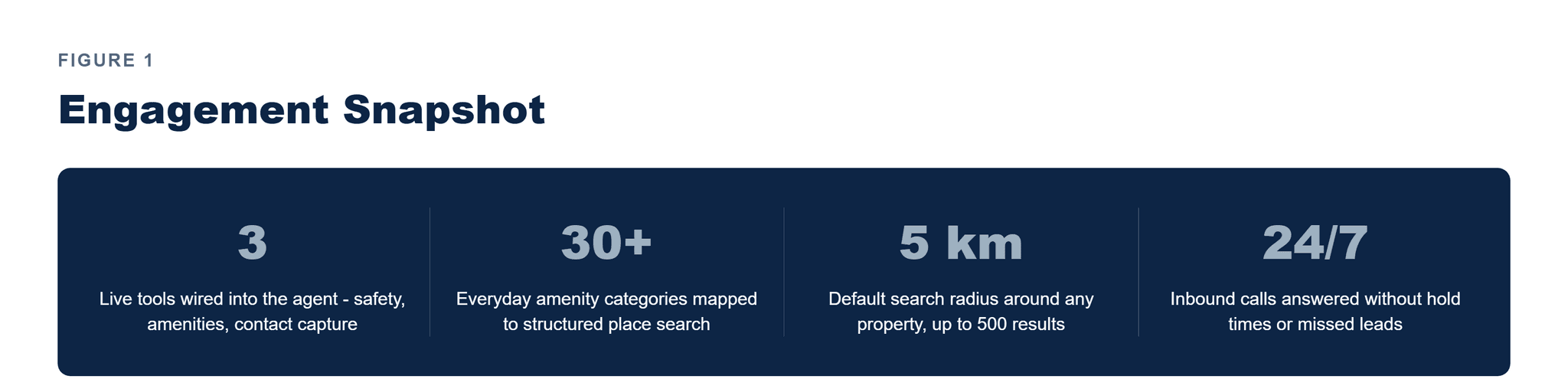
ENGAGEMENT SNAPSHOT

Pfactorial_Case_Study_Real_Estate_Voice_Agent image 1
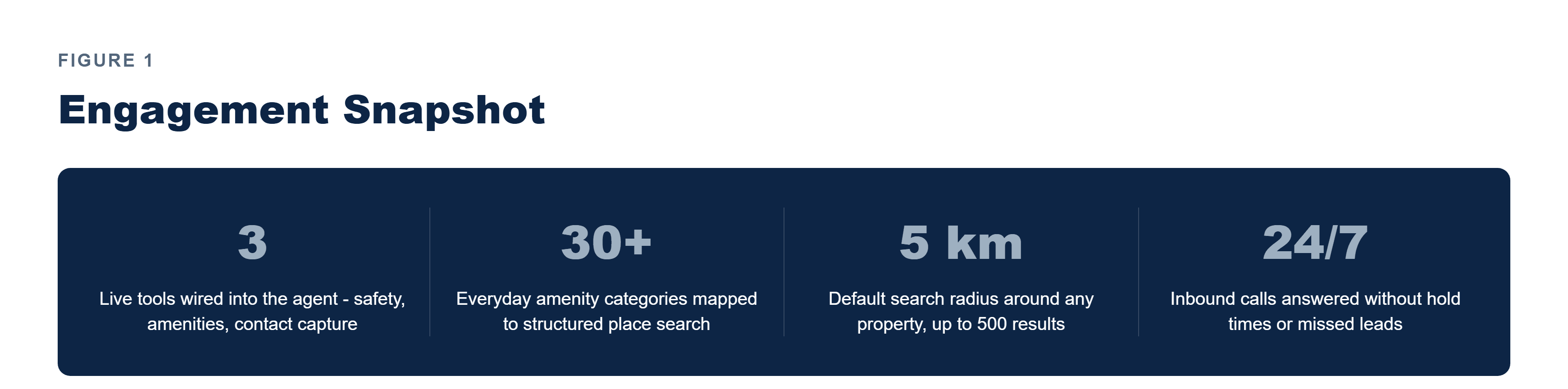
Figure 1 - Key figures from this engagement, at a glance.
EXECUTIVE SUMMARY
Our client's real estate agents were spending significant time answering the same repetitive caller questions - is this neighborhood safe, what's nearby, what schools and hospitals are close - before ever getting to whether the caller was a qualified lead worth following up with.
A static phone tree or scripted bot doesn't solve this, because the questions callers actually ask are open-ended and location-specific, and a wrong or outdated answer about neighborhood safety or nearby amenities costs more credibility than no answer at all. The assistant needs to sound natural, fetch genuinely live information mid-conversation, and still know when to hand off or redirect rather than guess.
Pfactorial built a voice assistant on the Retell AI platform that holds a natural phone conversation, calls out to live data sources mid-call for neighborhood safety and nearby amenities, and automatically captures a qualified caller's contact details for the sales team - with API credentials that never leave the server.
Why this engagement is representative This engagement demonstrates Pfactorial's ability to build voice AI that does more than converse - it reaches out to live, real-world data sources mid-call and turns every inbound inquiry into a captured, follow-up-ready lead.
THE CHALLENGE
Replacing a human receptionist's judgment with a voice agent meant solving problems that a scripted phone tree never has to face.

1. Callers ask open-ended, location-specific questions

"Is this neighborhood safe?" and "what's nearby?" can't be answered from a fixed script - the assistant has to recognize the question, fetch the right live data for that specific property, and weave it back into natural conversation.

2. Stale or generic answers on safety and amenities cost more than no answer

A safety or amenities answer needs to reflect current, real-world information rather than the model's static training data, or it risks giving callers confidently wrong information about a decision as significant as where to live.

3. Natural language has to map onto a structured places taxonomy

A caller asking about a "school" or "hospital" is speaking casually, not in API category names, and the system has to translate that reliably across dozens of amenity types without missing the caller's intent.
4. The conversation has to flow between live lookups and general discussion without breaking
Callers move between questions that need live data and questions that don't, sometimes in the same call, and the assistant has to move with them without the conversation feeling like it's switching modes.

5. Every call is a potential lead that has to be captured, not just answered

Answering questions well is not the point if the caller's contact details and preferences are never captured for the sales team to follow up with.
The real brief Not "build a phone bot that can answer FAQs" but "build a voice agent that reaches into live data mid-conversation for genuinely current answers, and converts every call into a captured, qualified lead."
THE SOLUTION
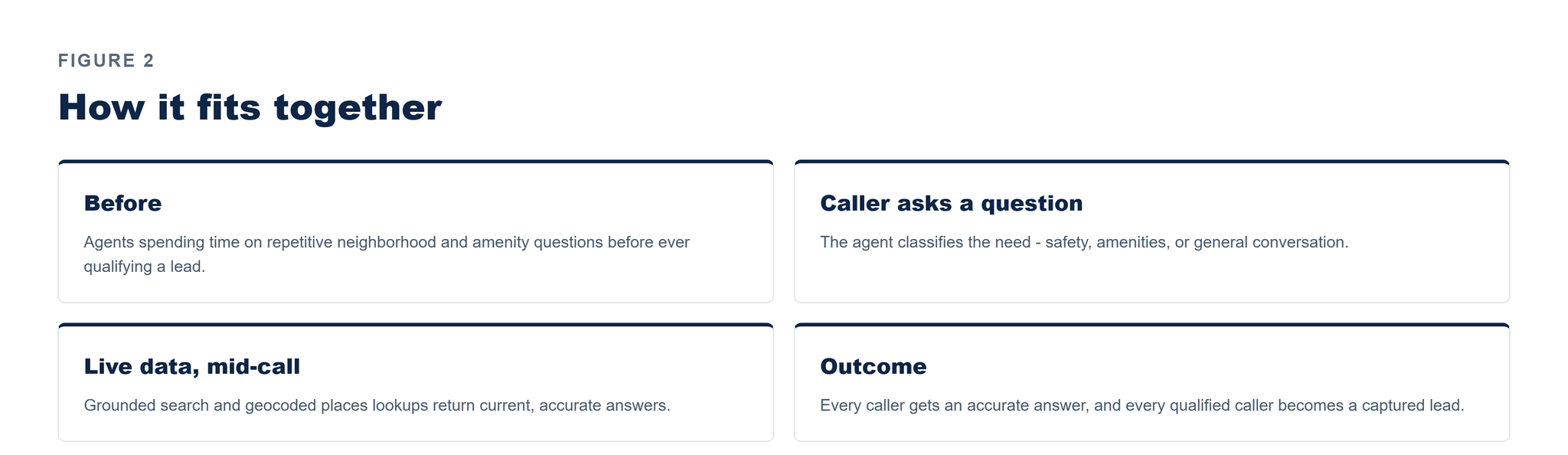
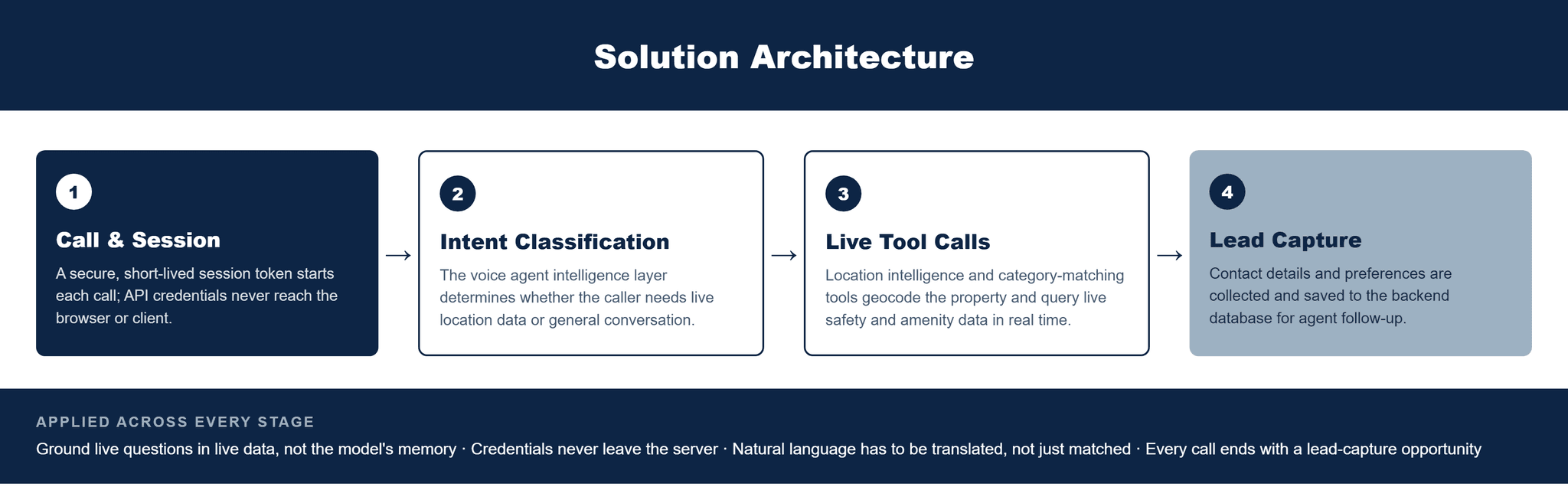
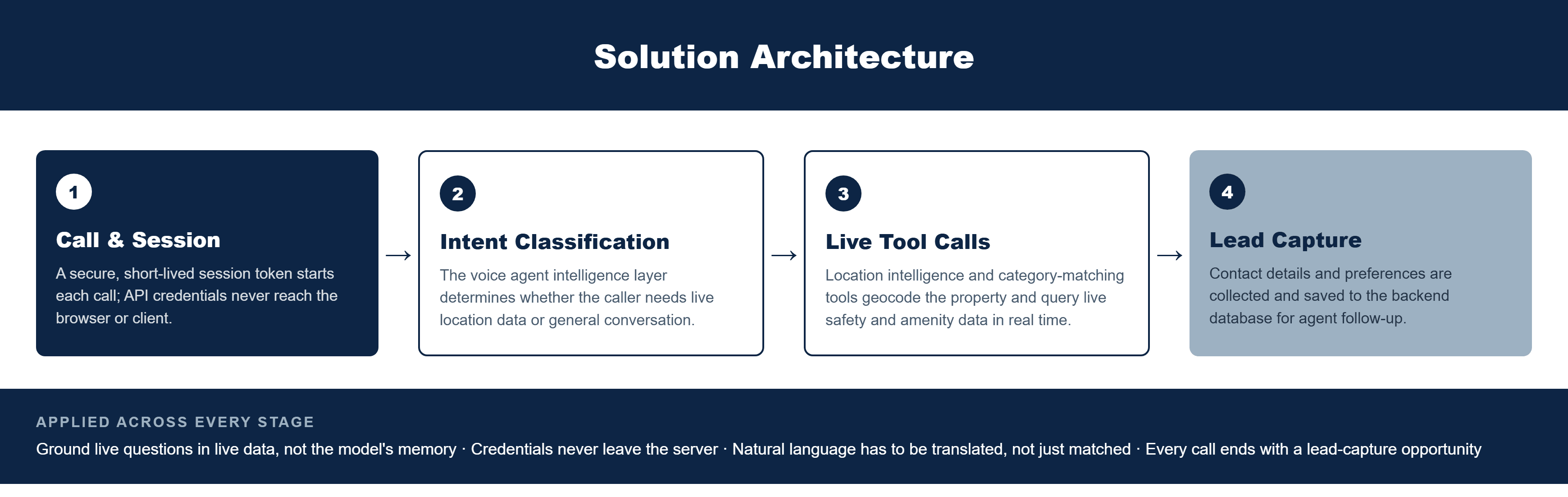
Pfactorial built a voice assistant on Retell AI that classifies each caller need in real time, invokes the right backend tool for live data, and closes every call by capturing contact details for follow-up.
Pfactorial_Case_Study_Real_Estate_Voice_Agent image 2
Figure 1 - The agent moves fluidly between live tool calls and general conversation within a single call, closing with automatic lead capture.

Architectural principles

  • Ground live questions in live data, not the model's memory - safety and amenity questions are answered by querying real-time sources at call time, not by letting the language model answer from static training data that can be outdated or simply wrong.
  • Credentials never leave the server - each session gets a short-lived, single-use access token rather than a permanent key, so sensitive account credentials stay server-side even as the assistant powers live customer-facing calls.
  • Natural language has to be translated, not just matched - a dedicated category-matching layer converts everyday phrases like "is there a school nearby" into the structured queries the underlying places database actually needs.
  • Every call ends with a lead-capture opportunity - once questions are addressed, the assistant proactively asks for contact details and preferences, so answering well and capturing the lead aren't two separate outcomes.
CAPABILITIES DELIVERED
Each capability turns a routine caller question into a live, accurate answer - or a captured lead ready for the sales team.
CAPABILITY
WHAT IT DOES
Neighborhood safety insights
Answers "is this a safe neighborhood?" by grounding a live query in current, real-world search results rather than static data.
Nearby amenities & points of interest
Finds schools, hospitals, restaurants, transit, and more around a property's actual location, covering 30+ everyday categories.
Natural-language category matching
Translates casual phrases like "hospital" or "school" into the structured categories the places search needs.
Multi-turn, mode-switching conversation
Moves between live-data lookups and general real estate discussion within a single call without breaking flow.
Automatic contact capture
Collects and securely stores a caller's name, phone number, preferred callback time, and preferences at the end of the call.
Safety-first call handling
Routes to human transfer or emergency guidance when input is unclear or a call falls outside the assistant's scope.
Home price insights (in development)
A fully built but not-yet-activated capability for property value forecasts and pricing trend comparisons by city, region, or ZIP.
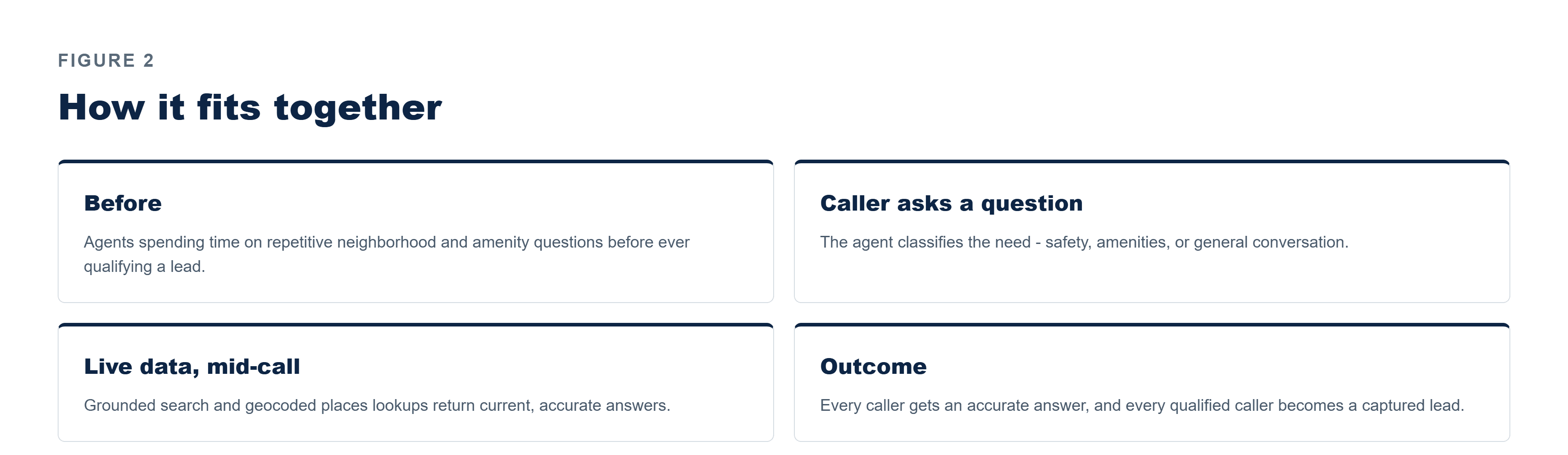
Pfactorial_Case_Study_Real_Estate_Voice_Agent image 3
Figure 2 - The same call can move through multiple live tool calls and still end in a clean, natural lead-capture close.
Design note Only the safety and amenities tools, plus contact capture, are currently wired live - a home-price forecasting tool is fully built and coded but deliberately held back from the live agent until its underlying pricing dataset is validated further, rather than shipping a capability the team isn't ready to stand behind on a live call.
ENGINEERING FOR SCALE AND RELIABILITY
Five decisions kept the assistant accurate, secure, and natural under real call conditions.

Short-lived session tokens instead of exposing a permanent API key

Each web or demo session requests a fresh, single-use credential from the voice platform rather than using a long-lived key, so sensitive account credentials never travel to the browser.

Search-grounded generation for time-sensitive facts

Neighborhood safety queries route through a language model with live web-search grounding rather than relying on the model's static training data, because crime and safety information changes over time and has to stay current.

A dedicated geocoding step before every places lookup

Addresses are converted to precise coordinates before any amenities search runs, ensuring "nearby" results are actually measured from the property in question rather than a fuzzy text match.

A separate category-matching layer decoupled from the places API itself

Mapping casual language to the places taxonomy is isolated in its own component, so expanding or correcting category coverage doesn't require touching the core places-lookup or conversation logic.

Holding back an unvalidated capability rather than shipping it live

The home-price forecasting tool is complete in code but intentionally not connected to the live agent, keeping the assistant's live answers limited to data sources the team is confident are accurate.
DELIVERY APPROACH
The engagement built outward from the core conversation and session layer toward each live data capability.
1. Session and security layer - built the web interface and short-lived session-token handshake that keeps platform credentials server-side.
2. Conversation intelligence - built the voice agent intelligence layer that classifies caller intent and routes between live tool calls and general conversation.
3. Location intelligence engine - built geocoding and live places lookup against a property's actual coordinates.
4. Category matching layer - built the natural-language-to-taxonomy translation covering 30+ amenity categories.
5. Lead capture - wired the end-of-call contact and preference collection into the backend database.
6. Price tool (built, held back) - developed the home-price forecasting tool against a market dataset, ready to activate once validated.
RESULTS AND IMPACT

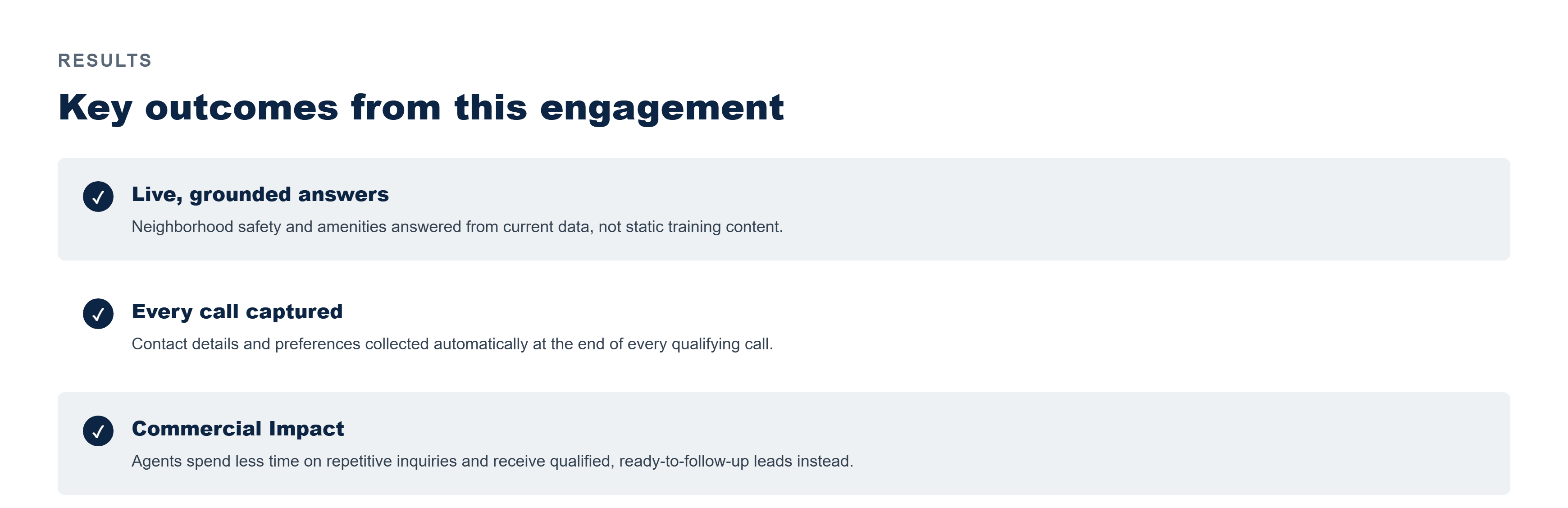
Pfactorial_Case_Study_Real_Estate_Voice_Agent image 4
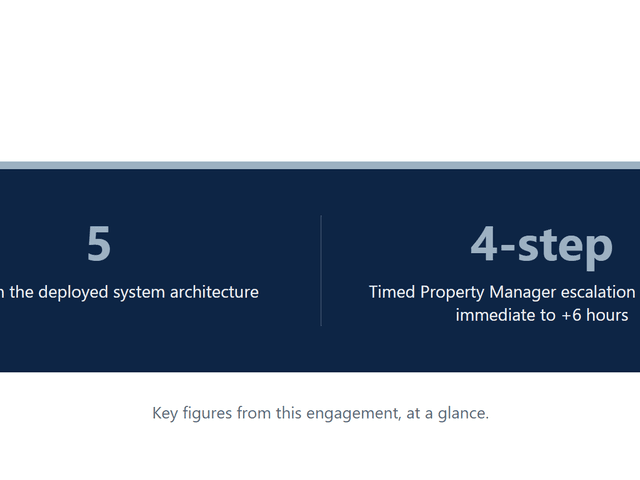
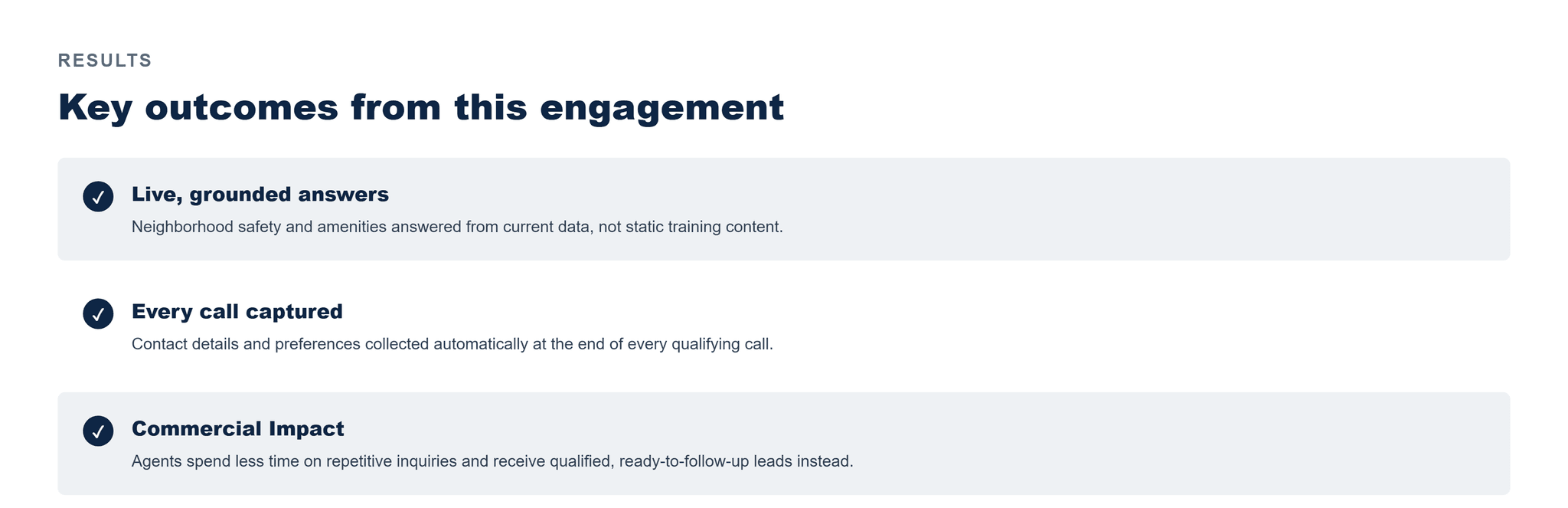
- Key outcomes from this engagement.
The assistant is live with three active tools - neighborhood safety grounded in real-time search, amenities lookup across 30+ categories within a 5 km radius, and automatic contact capture - handling calls end-to-end through natural conversation rather than a scripted menu.
Because safety and amenity answers are grounded in live data rather than the model's static memory, callers get current, trustworthy information on their first call, and every qualifying conversation ends with contact details captured for the sales team automatically.

What it enabled commercially

The client's agents can now let the assistant handle repetitive neighborhood and amenity questions around the clock, arriving at each qualified lead with contact details and preferences already captured - with a home-price insights capability built and ready to extend the assistant further once activated.
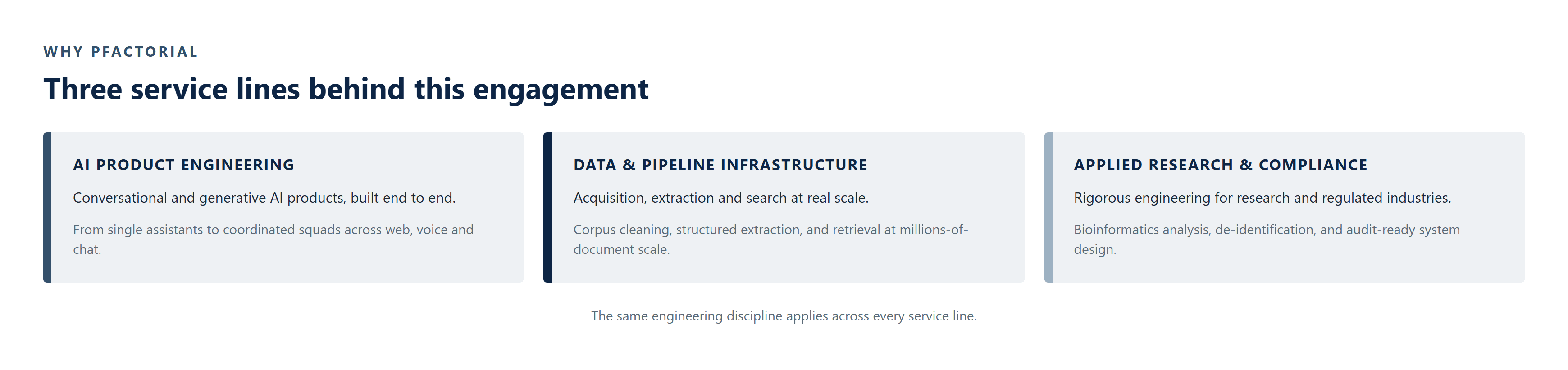
WHY PFACTORIAL
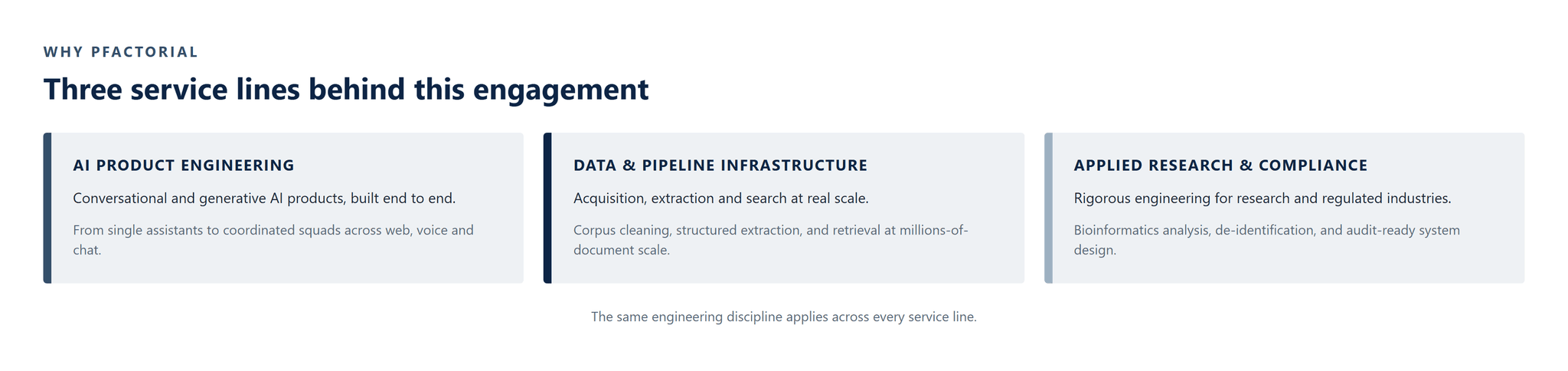
This engagement reflects Pfactorial's voice AI practice - natural, tool-augmented phone conversation grounded in live data rather than static model memory, engineered with the security discipline a customer-facing system carrying contact data requires.
Pfactorial_Case_Study_Real_Estate_Voice_Agent image 5
- Service lines this engagement draws on.
Engagement enquiries Pfactorial Technologies works with real estate and other service businesses that field high call volumes of repetitive, location-specific questions and don't want to miss a lead outside business hours. If you're evaluating a voice AI project, we're happy to give you an honest read on scope and risk before anyone commits to anything. · pfactorial.ai
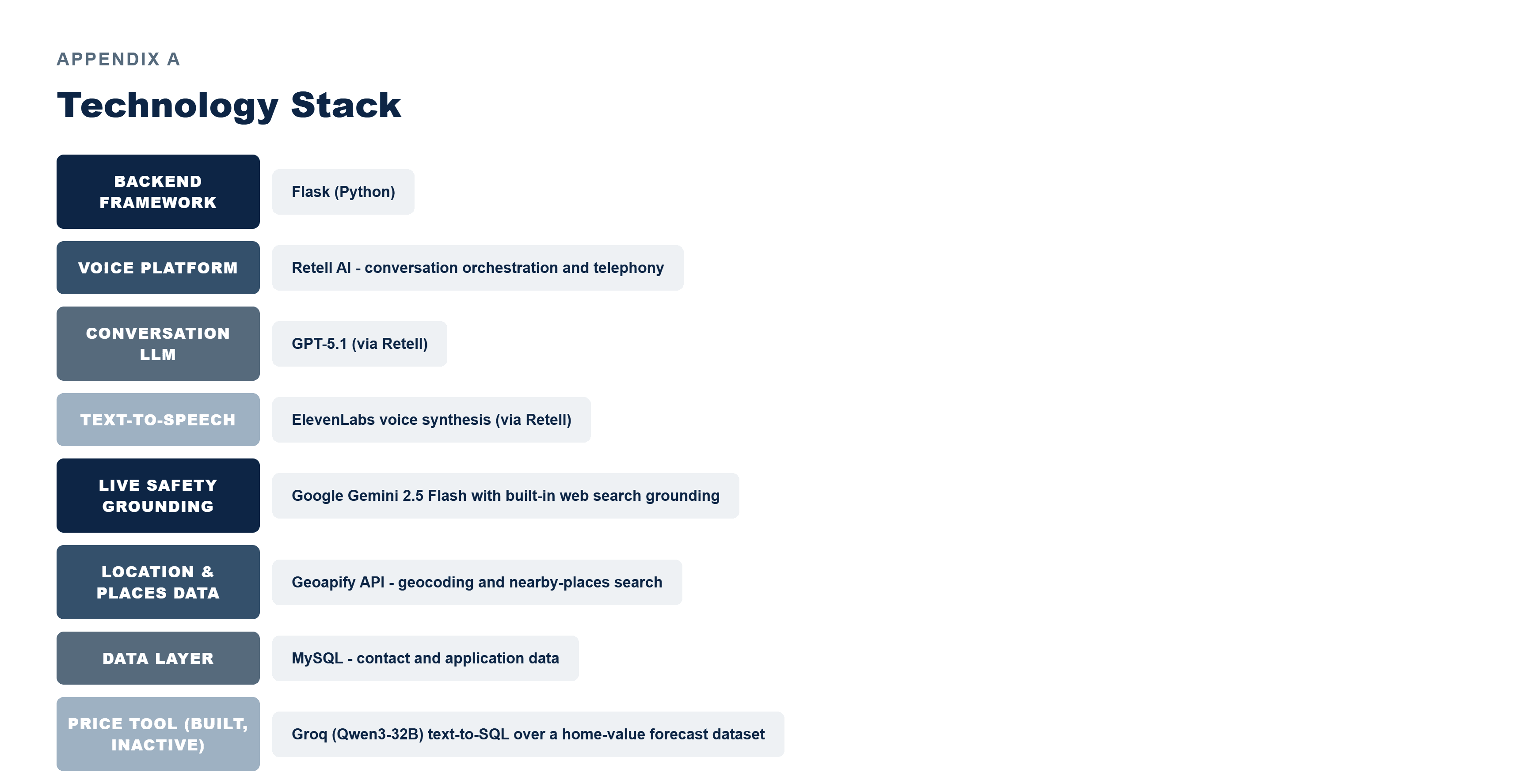
APPENDIX A - TECHNOLOGY STACK
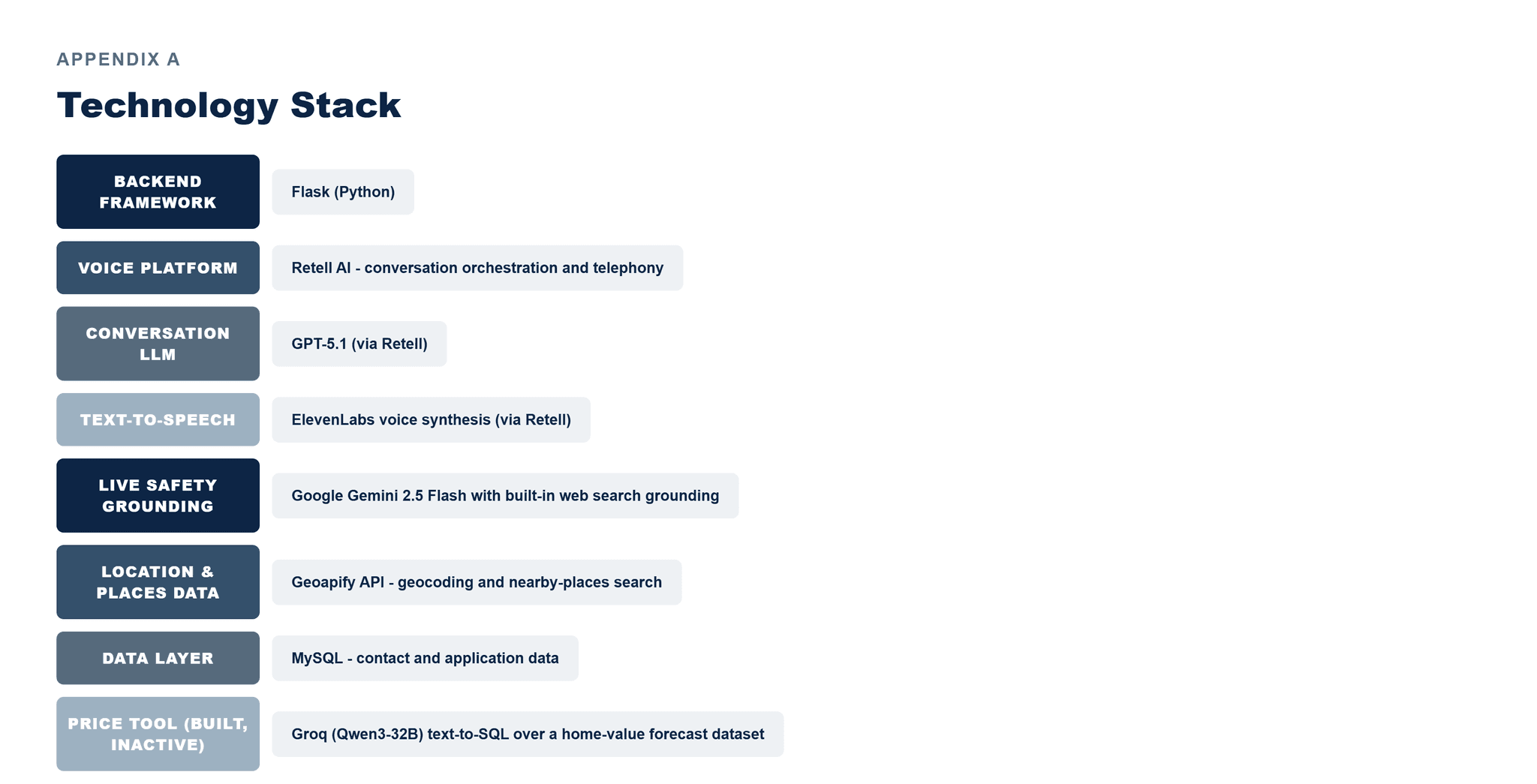
The technology stack underpinning the system, grouped by the layer it serves.
Pfactorial_Case_Study_Real_Estate_Voice_Agent image 6

Result and Analysis

ENGAGEMENT SNAPSHOT

How Pfactorial Technologies built an AI-powered voice agent that answers live, location-specific real estate questions by phone and automatically captures qualified leads.
Pfactorial_Case_Study_Real_Estate_Voice_Agent image 1
Pfactorial_Case_Study_Real_Estate_Voice_Agent image 2
Pfactorial_Case_Study_Real_Estate_Voice_Agent image 3
Pfactorial_Case_Study_Real_Estate_Voice_Agent image 4
Pfactorial_Case_Study_Real_Estate_Voice_Agent image 5
Pfactorial_Case_Study_Real_Estate_Voice_Agent image 6