Back
Voice AI & Telephony

A Voice AI Receptionist for Independent Auto Repair Shops

A proposed production-track proof of concept: a natural, interruptible phone assistant that answers every call, books and manages appointments, and knows exactly when to bring in a human - validated on one pilot shop before duplication across an agency's client base.
August 21, 2026
Share
ENGAGEMENT SNAPSHOT

CS-008_AI_Receptionist_Auto_Repair image 1
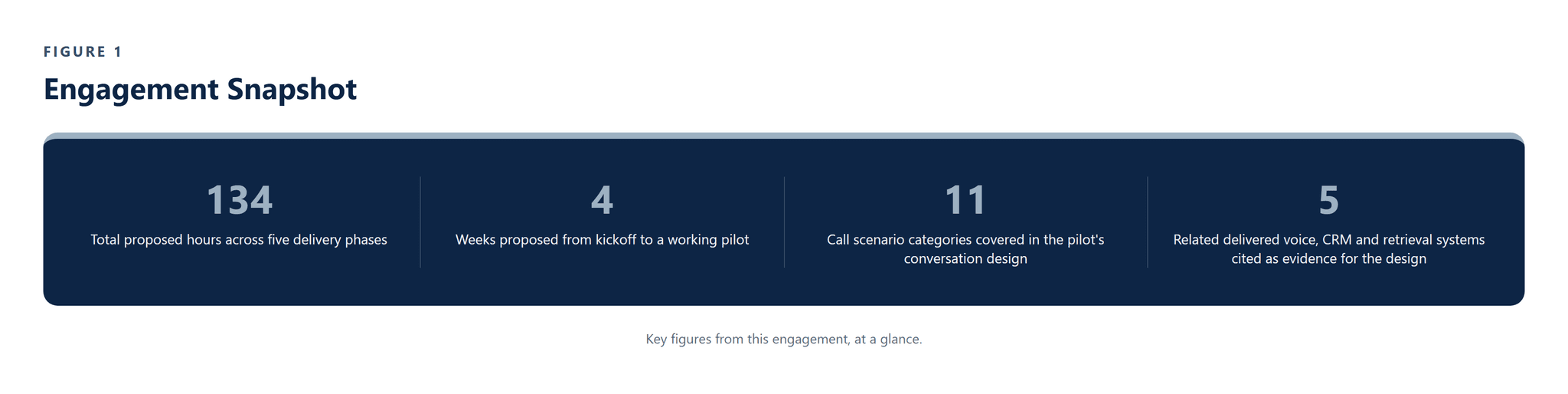
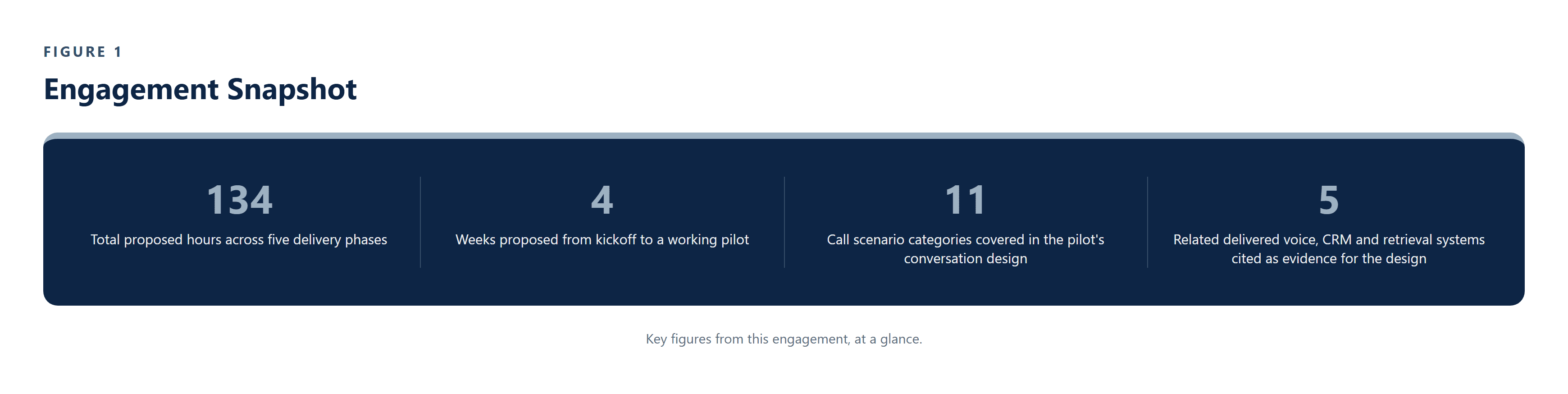
Figure 1 - Key figures from this engagement, at a glance.
EXECUTIVE SUMMARY
Our client, a marketing and technology agency serving independent auto repair shops, needed a phone receptionist that could answer every call, book real appointments against a live calendar, and know exactly when to hand off to a human - built once and cleanly duplicated across many shops rather than rebuilt per client.
Pfactorial Technologies proposed a coordinated set of specialist responsibilities working underneath a single phone call: one component holds the conversation, one keeps the call on a structured path, one checks shop-specific policy on what can be promised or quoted, one talks to the calendar and CRM, and one confirms nothing inaccurate is said before it reaches the caller.
The proof of concept is scoped to validate the complete pattern in a real environment on a single pilot shop - handling actual customer calls, live calendar checks, real CRM records, and real SMS notifications - so the architecture becomes the foundation for agency-wide rollout rather than something rebuilt before deployment.
Why this engagement is representative This engagement demonstrates Pfactorial's approach to voice AI in a service-business context: a coordinated set of narrow-responsibility components rather than one large prompt, a hard rule against ever diagnosing, quoting, or guaranteeing, and an architecture designed from day one to be duplicated cleanly across many clients.
THE CHALLENGE
Replacing a front desk's phone handling with an AI receptionist that shops and callers would actually trust surfaced four core requirements.

1. A rigid phone tree does not match how people call a repair shop

Callers describe a check-engine light, a stranded vehicle, or a scheduling change in their own words, and the assistant needs to hold a real back-and-forth - identifying the need, checking availability, and confirming - rather than routing through fixed menu options.

2. The assistant must never overstate its authority

It must never diagnose a mechanical problem, guarantee pricing or completion times, or state anything the shop has not explicitly authorized it to say - a hard rule across every one of the call scenarios in scope.

3. Reliability cannot depend on one enormous prompt

A single monolithic prompt trying to hold the conversation, track booking state, check policy, call external systems, and verify its own output is a fragile design for a system answering calls unattended, day or night.

4. The architecture has to be built once, not per shop

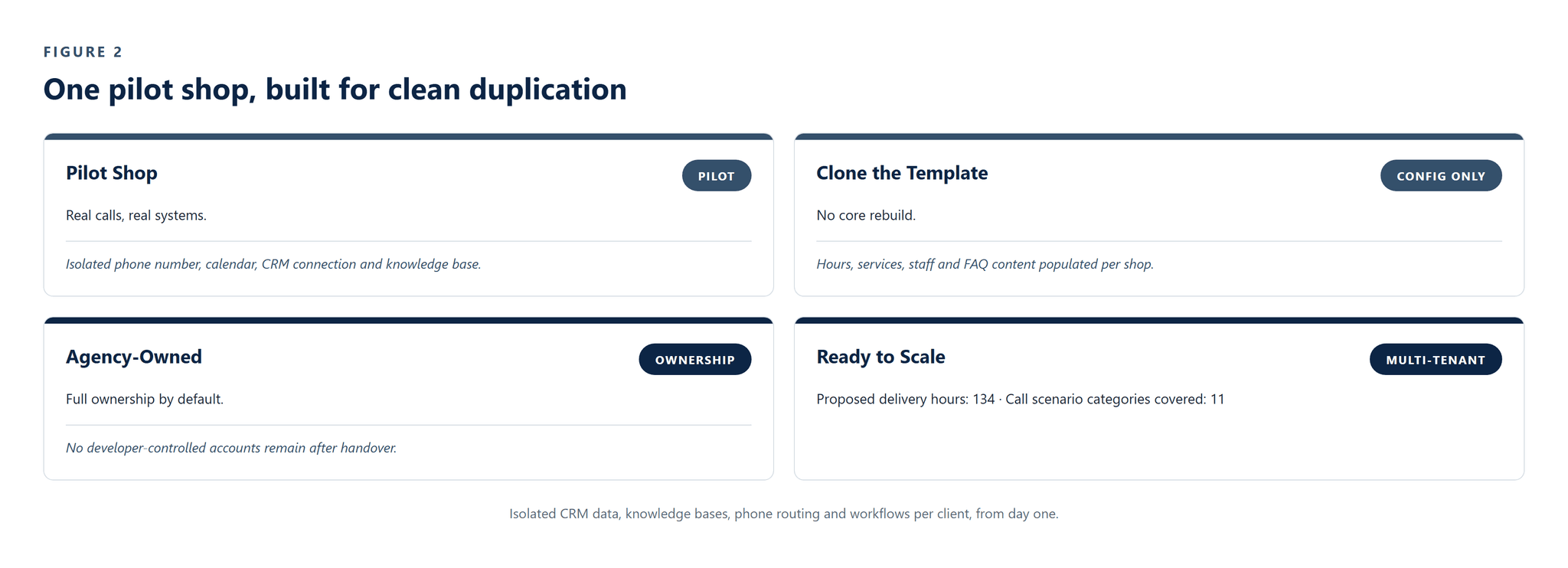
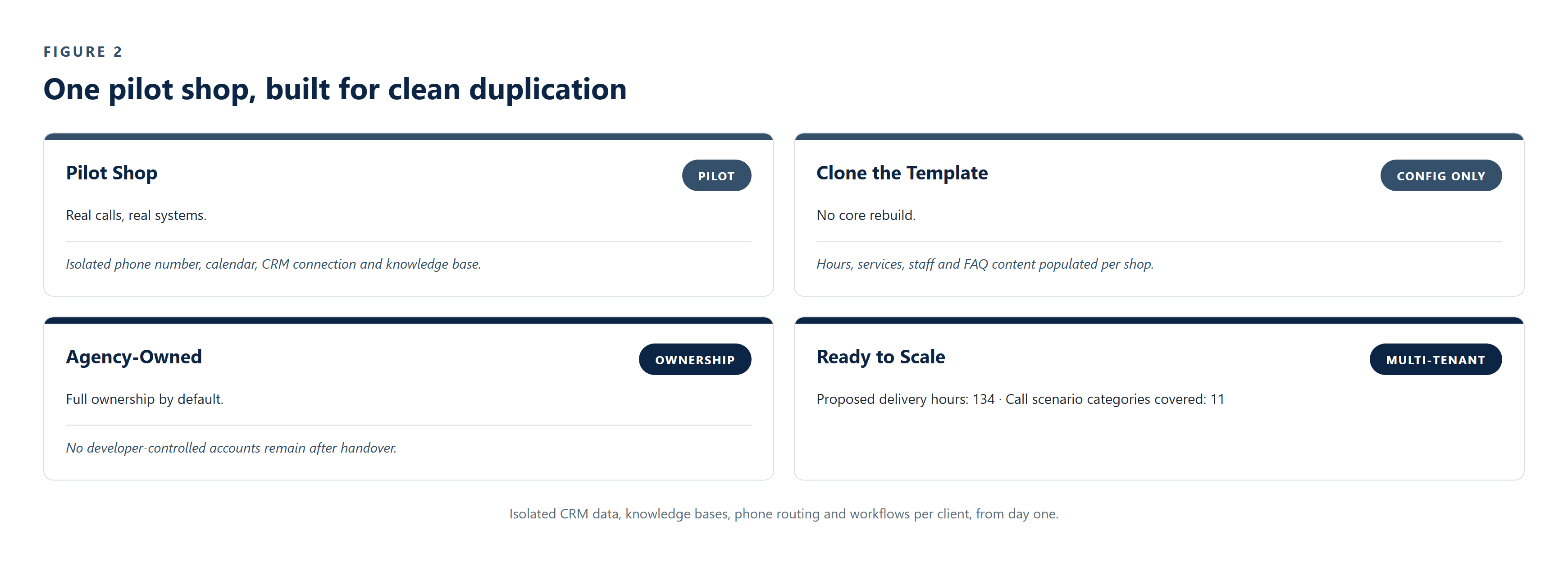
Because the receptionist is being built for an agency serving many shops, the system needed to be designed from day one for clean duplication - not retrofitted for multi-tenancy after the pilot.
The real brief Not "script an auto-repair chatbot" but "prove the full pattern end to end on one real pilot shop - real calls, a live calendar, a real CRM - so the same architecture can be cloned across the agency's other shops with only configuration changes."
THE SOLUTION
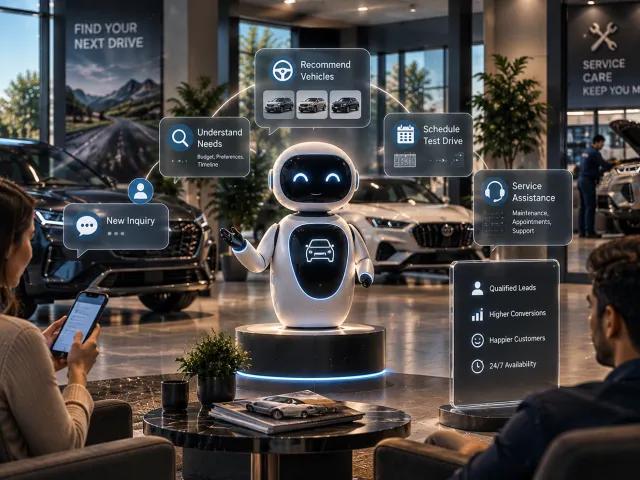
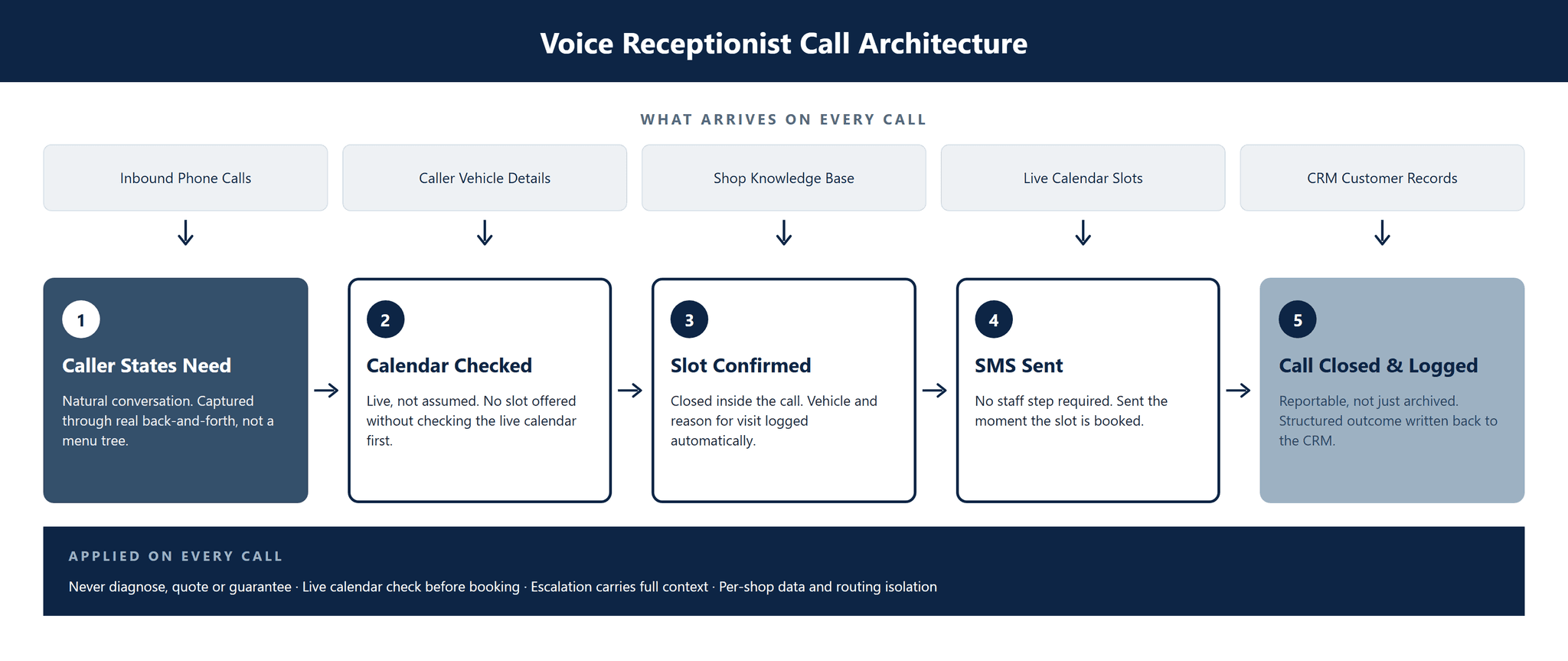
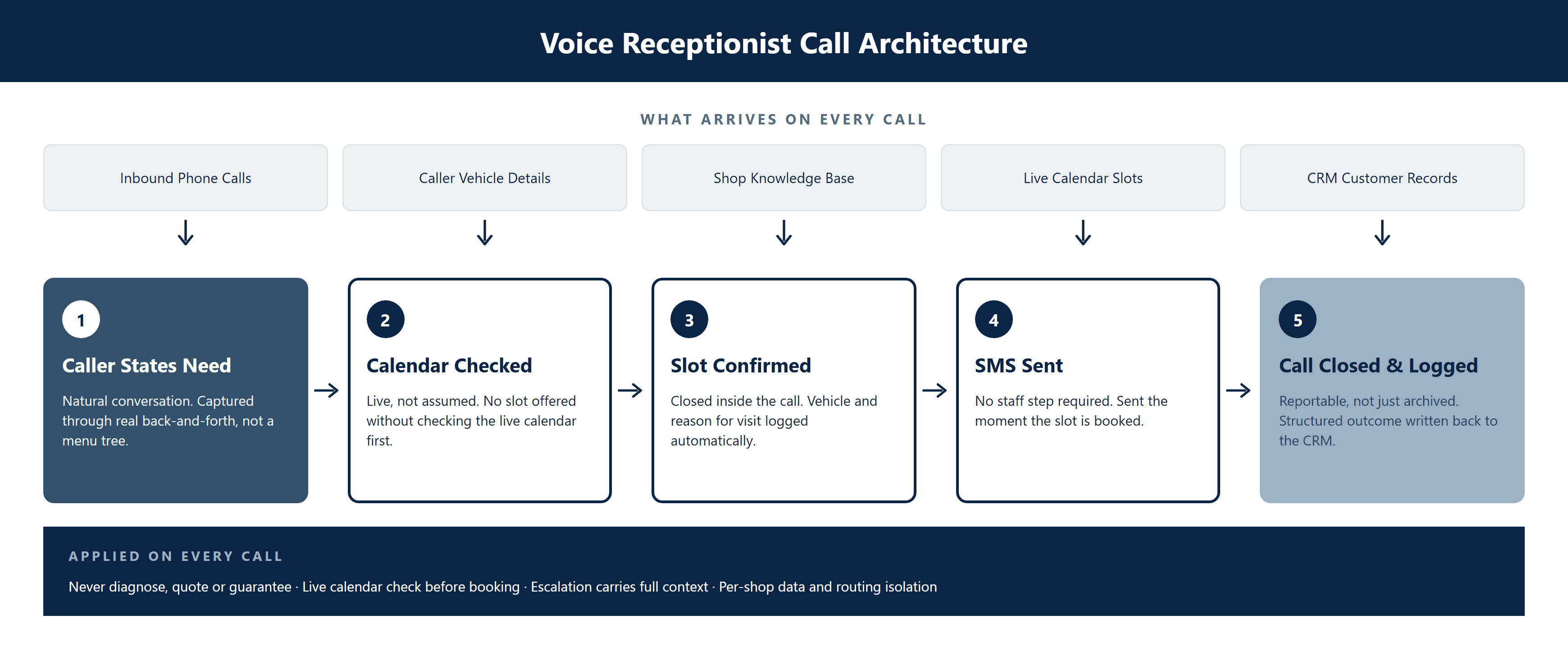
Pfactorial proposed an event-driven architecture where a conversation layer handles the live spoken exchange, and a small set of supporting components each own one narrow responsibility - booking, policy, integrations, and escalation - underneath it.
CS-008_AI_Receptionist_Auto_Repair image 2
Figure 1 - The proposed call path: telephony intake, live conversation handling, structured booking against a real calendar, and CRM logging with human escalation where required.

Architectural principles

  • Reliability through narrow, coordinated responsibilities - one component holds the conversation, one keeps booking calls on a structured path, one checks shop policy, one talks to the calendar and CRM, and one verifies accuracy before anything reaches the caller - not one prompt trying to do all of it.
  • A hard rule, applied everywhere - across every call scenario the assistant follows one boundary without exception: never diagnose, never guarantee pricing or timing, never say anything the shop has not explicitly authorized.
  • Event-driven, not request-response - inbound calls are received through the telephony layer, routed to the voice platform for real-time processing, and business workflows - booking, SMS, transfers, follow-ups - execute automatically off that event stream.
  • Multi-tenant from the first design decision - the decoupled architecture isolates CRM data, knowledge bases, phone routing, and workflows per client from day one, so the same solution replicates across shops without redesign.
CAPABILITIES DELIVERED
The proposed pilot covers the full call path from an inbound ring to a booked, logged appointment, plus the guardrails that keep the assistant inside shop policy.
CAPABILITY
WHAT IT DOES
24/7 Natural Conversation
Callers can interrupt, ask follow-ups, and speak conversationally - handled the way a front-desk person would, not a rigid phone tree.
Live Appointment Booking
Checks real calendar availability and books, reschedules, or cancels appointments without double-booking a bay or technician.
Vehicle & Customer Intake
Captures name, phone, email, vehicle year/make/model, mileage, and reason for the visit automatically on every call.
Guarded, Policy-Bound Answers
Answers hours, services, pricing ranges, and policy questions from an approved knowledge base only - never guesses, diagnoses, or quotes a firm price.
Confirmations & Follow-Ups
Sends SMS confirmations, reminders, and missed-call follow-ups without staff involvement.
Human Handoff With Full Context
Routes urgent, high-value, or frustrated-caller situations to staff immediately, with the full conversation attached.
CS-008_AI_Receptionist_Auto_Repair image 3
Figure 2 - The seven-layer platform: telephony and speech through orchestration, business-system integrations, and human handoff - each isolated per shop for clean multi-tenant duplication.
Design note The pilot is explicitly scoped to inbound call handling, booking and cancellation against a live calendar, customer/vehicle intake, SMS confirmations, a curated per-shop knowledge base, and escalation logic for one shop - multi-shop admin tooling, bulk migrations, outbound campaigns, and a white-label portal are deliberately deferred to full rollout.
ENGINEERING FOR SCALE AND RELIABILITY
Several design decisions shape whether a voice receptionist is trustworthy enough to run unattended against a shop's real calendar and customer base.

Booking never proceeds without a live calendar check

no appointment is booked without checking real, live calendar availability first - a stated success criterion, not an assumption, so a double-booking cannot occur.

Interruptions are handled at the voice-platform layer

the assistant stops speaking the instant the caller does, acknowledges what was said, and continues without losing its place - proven native interruption handling carried into this design.

Every call produces reportable data, not just a transcript

at call end the full transcript passes through a structured extraction step that writes the outcome and captured fields as data, so every call becomes reportable rather than merely archived.

External systems are synced, never treated as the source of truth

the calendar and CRM are kept in sync but the platform recovers cleanly when a third-party integration is briefly unavailable, retrying the action safely and telling the caller plainly if it still fails.

The pilot configuration clones without touching core logic

a new shop is onboarded by cloning the pilot's configuration template - hours, services, staff, FAQ content - with no rebuild of the underlying assistant required.

Every account and credential remains under agency ownership

the agency owns the CRM, calendar, phone numbers, and SMS sending identity for each shop by default, with any shared infrastructure used during the pilot explicitly identified and transitioned at handover.
DELIVERY APPROACH
The proposed proof of concept moves from telephony connection to a validated, documented pilot in four weeks across five phases.
1. Foundation - connect telephony, establish a live voice session, and implement natural interruption handling and call routing to the assistant.
2. Core workflows - build the booking, reschedule, and cancel workflow, calendar integration, customer and vehicle intake, and CRM write-back.
3. Assurance and messaging - build the knowledge base and policy guard, SMS confirmations and reminders, human handoff logic, and missed-call follow-up.
4. Extended testing and refinement - run real-call testing across the full scenario set, including interruptions, accents, and incomplete answers, refining fallback and error handling.
5. Validation and handover - review transcripts and logging, deliver documentation, and train the client's team on the working pilot.
RESULTS AND IMPACT

CS-008_AI_Receptionist_Auto_Repair image 4
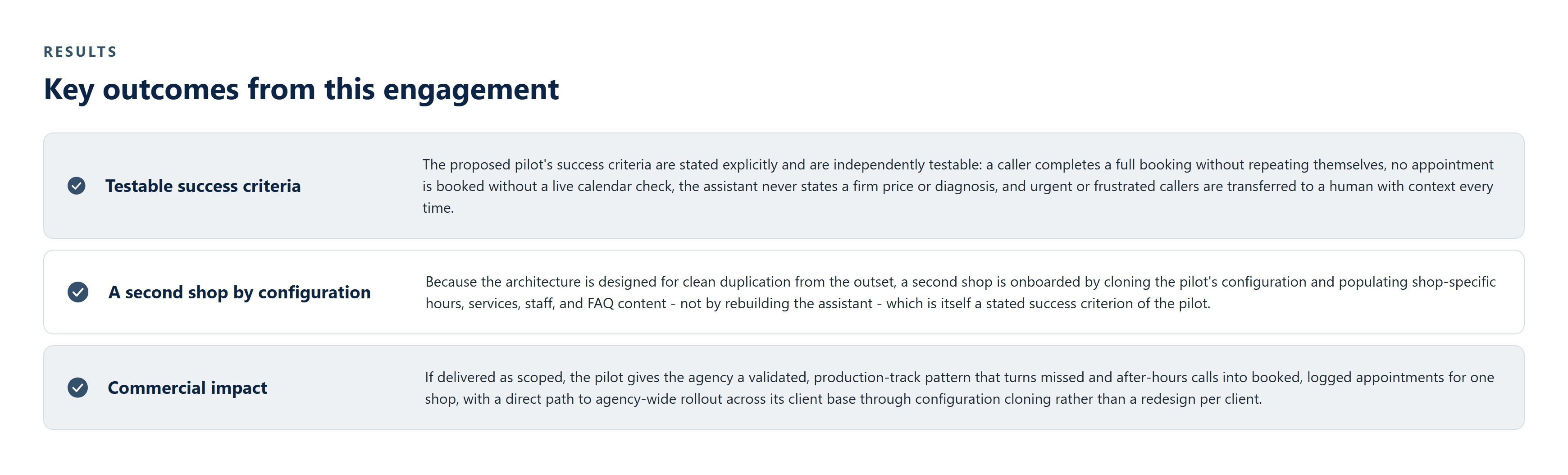
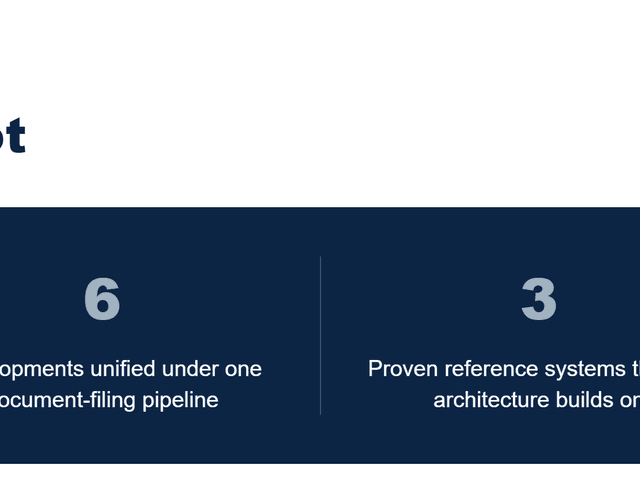
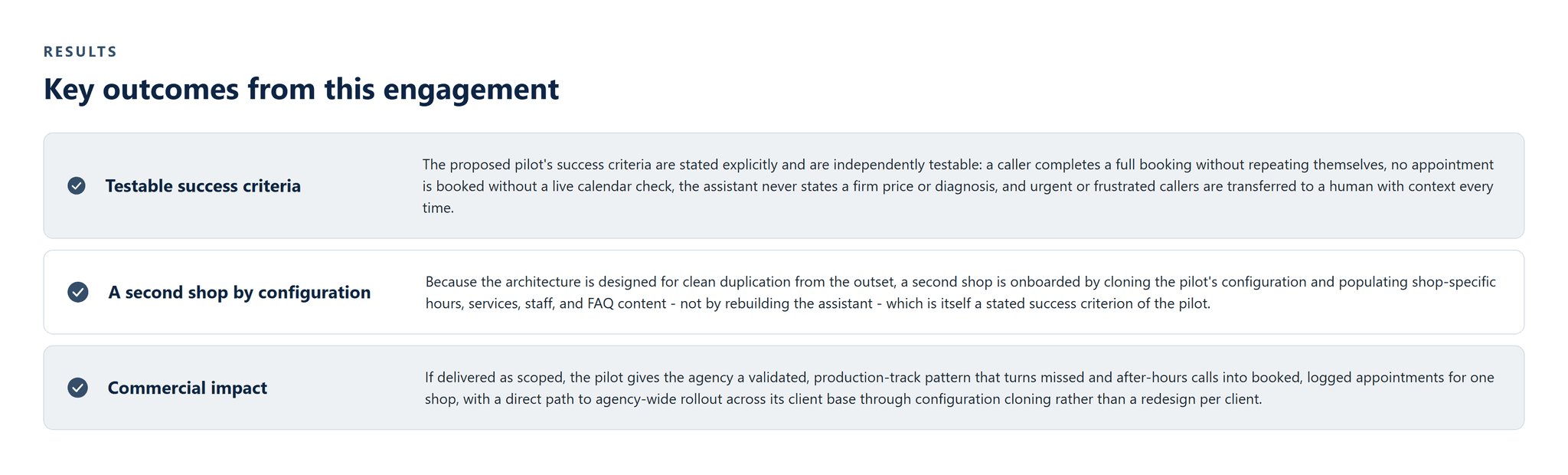
Figure - Key outcomes from this engagement.
The proposed pilot's success criteria are stated explicitly and are independently testable: a caller completes a full booking without repeating themselves, no appointment is booked without a live calendar check, the assistant never states a firm price or diagnosis, and urgent or frustrated callers are transferred to a human with context every time.
Because the architecture is designed for clean duplication from the outset, a second shop is onboarded by cloning the pilot's configuration and populating shop-specific hours, services, staff, and FAQ content - not by rebuilding the assistant - which is itself a stated success criterion of the pilot.

What it enabled commercially

If delivered as scoped, the pilot gives the agency a validated, production-track pattern that turns missed and after-hours calls into booked, logged appointments for one shop, with a direct path to agency-wide rollout across its client base through configuration cloning rather than a redesign per client.
WHY PFACTORIAL
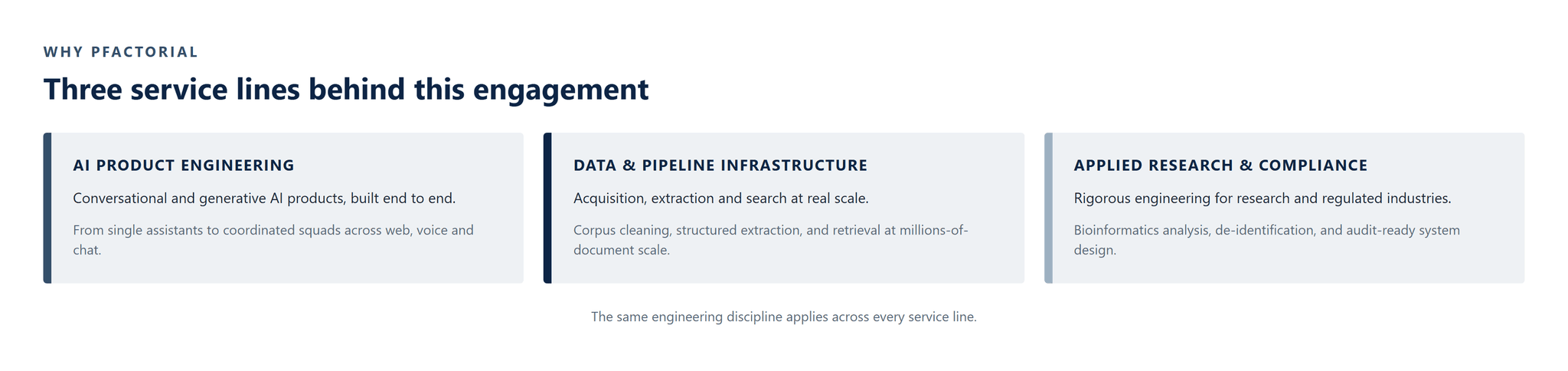
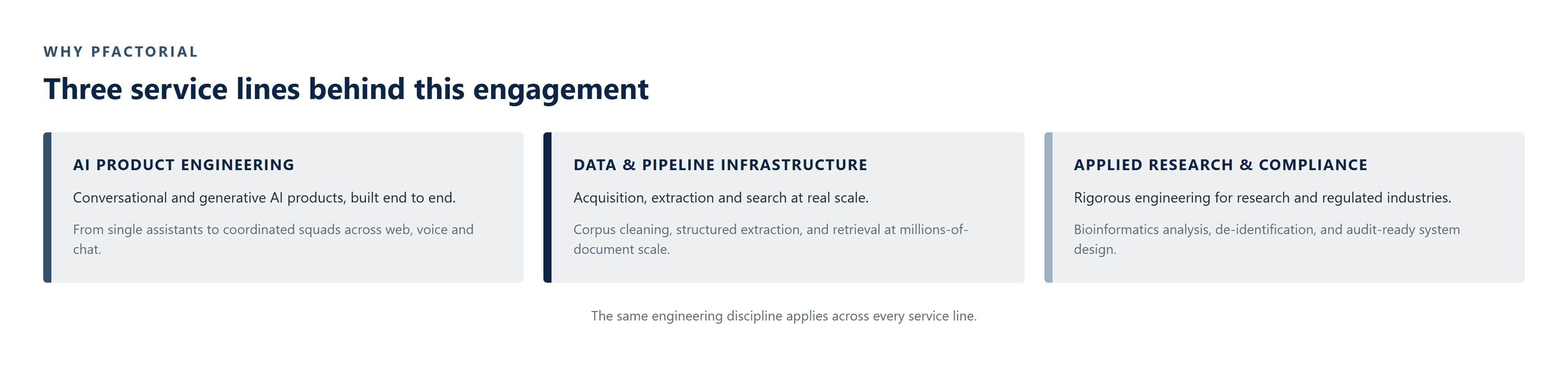
This engagement draws on Pfactorial's AI product engineering capability: voice AI systems that hold a real conversation inside explicit policy boundaries, built for multi-tenant duplication from the first architectural decision rather than retrofitted for it later.
CS-008_AI_Receptionist_Auto_Repair image 5
Figure - Service lines this engagement draws on.
Engagement enquiries Pfactorial Technologies works with agencies and service businesses looking to automate inbound call handling without losing the judgment a good front-desk employee applies. If you are evaluating a voice AI receptionist for a multi-location or multi-client business, we are happy to give you an honest read on scope, cost, and risk before anyone commits to anything. · pfactorial.ai
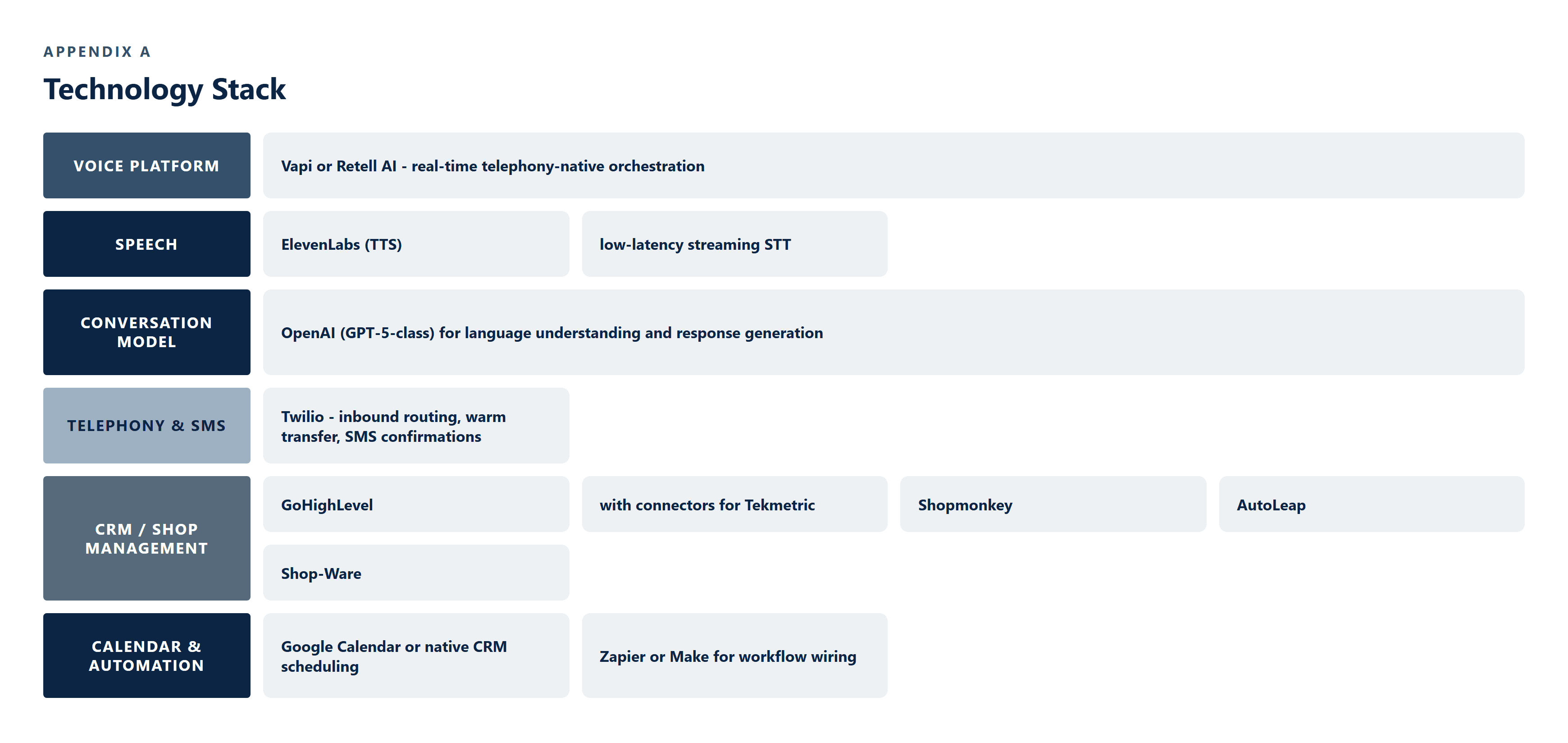
APPENDIX A - TECHNOLOGY STACK
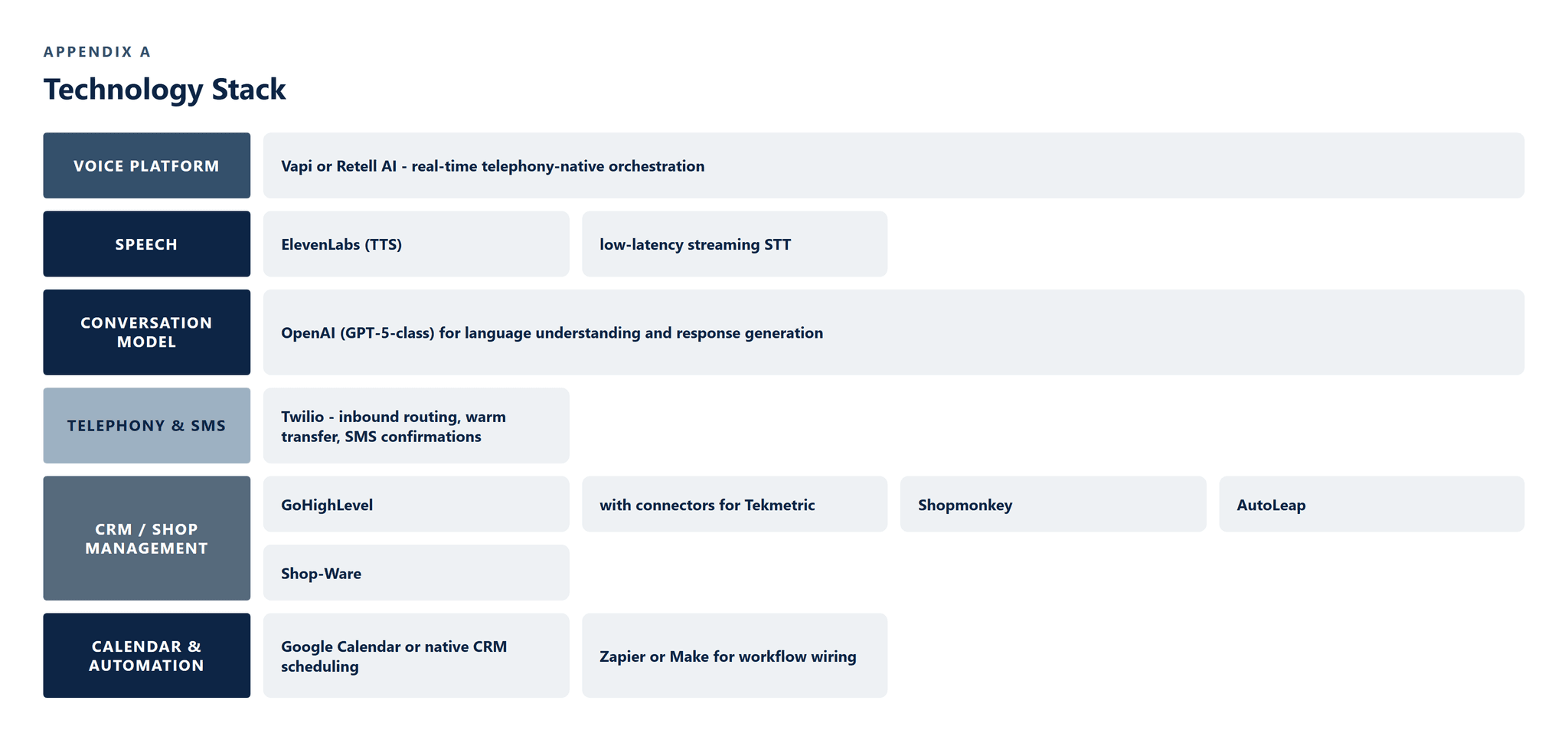
The technology stack underpinning the system, grouped by the layer it serves.
CS-008_AI_Receptionist_Auto_Repair image 6

Result and Analysis

ENGAGEMENT SNAPSHOT

A proposed production-track proof of concept: a natural, interruptible phone assistant that answers every call, books and manages appointments, and knows exactly when to bring in a human - validated on one pilot shop before duplication across an agency's client base.
CS-008_AI_Receptionist_Auto_Repair image 1
CS-008_AI_Receptionist_Auto_Repair image 2
CS-008_AI_Receptionist_Auto_Repair image 3
CS-008_AI_Receptionist_Auto_Repair image 4
CS-008_AI_Receptionist_Auto_Repair image 5
CS-008_AI_Receptionist_Auto_Repair image 6