Back
Automotive & Vehicle
A Single-Endpoint VIN Decoder Validating and Parsing Eight Vehicle Attributes From One 17-Character Code
How Pfactorial Technologies built a VIN decoding service that validates, parses, and returns a full vehicle profile from a single 17-character identification number.
August 21, 2026
Share
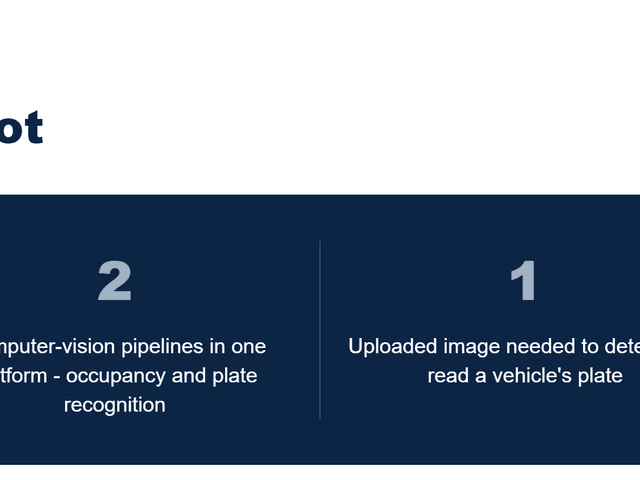
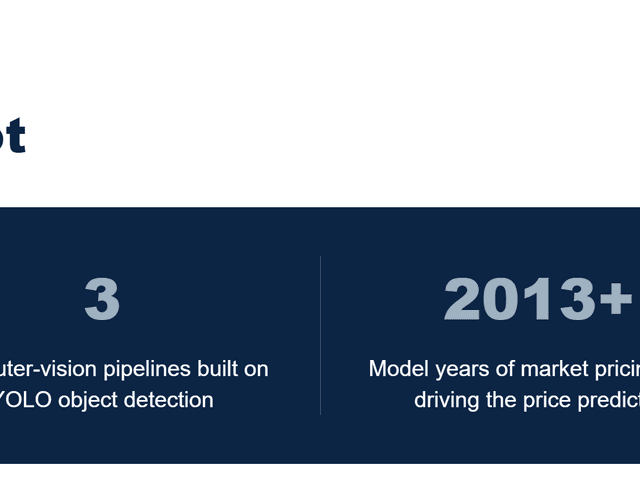
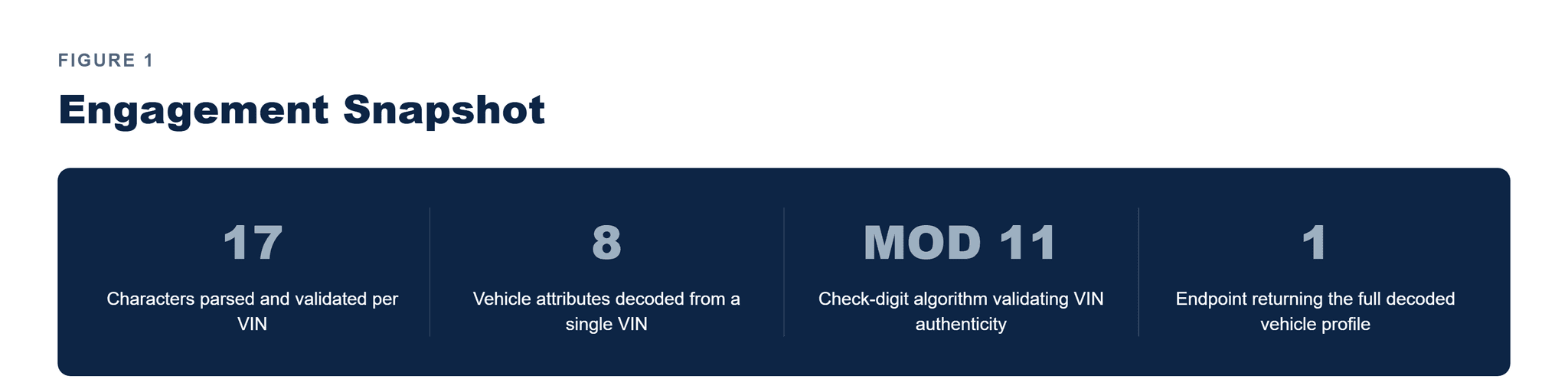
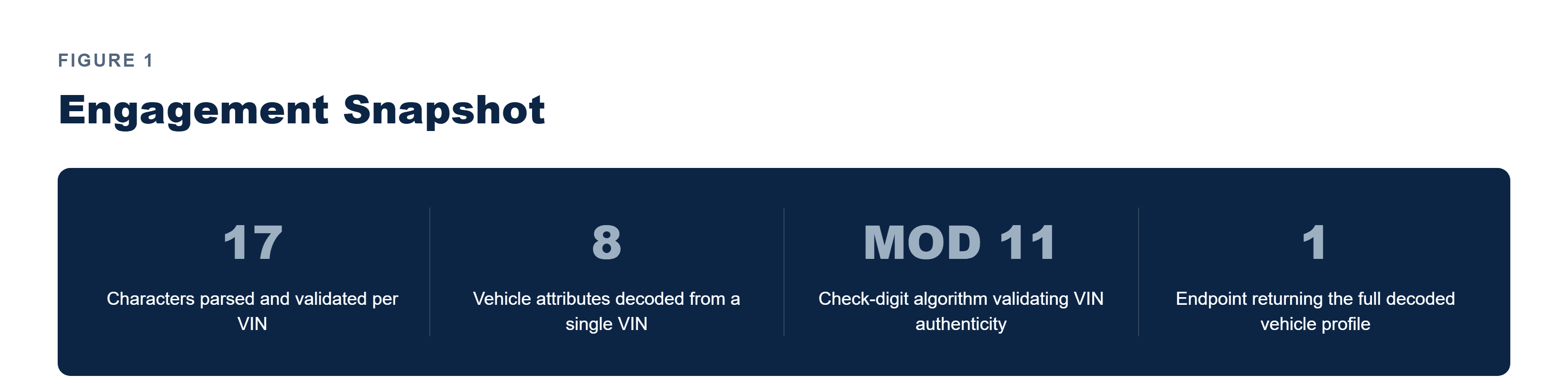
ENGAGEMENT SNAPSHOT

Figure 1 - Key figures from this engagement, at a glance.
EXECUTIVE SUMMARY
Our client needed to turn a raw 17-character Vehicle Identification Number into a trustworthy, structured vehicle profile - manufacturer, region, country, year, month, and body/model information - without asking a user or downstream system to interpret the VIN by hand.
A VIN isn't a simple lookup key: it's a positionally-encoded string where different character ranges mean different things, one embedded character is a checksum that has to be validated against a weighted algorithm before the rest of the data can be trusted, and the mapping from character to meaning - region, country, manufacturer, model year - varies by position and by manufacturer convention.
Pfactorial built a VIN decoding service that validates a VIN's check digit, extracts its three structural sections, and resolves eight attributes - WMI, VDS, VIS, region, country, year, manufacturer, and month - behind a single API endpoint.
Why this engagement is representative This engagement demonstrates Pfactorial's ability to build compact, correctness-critical parsing logic around an industry-standard encoding - the same rigor applies to any client working with structured identifier formats that carry embedded validation rules.
THE CHALLENGE
Turning a raw VIN string into a trustworthy vehicle profile meant getting a checksum-validated, positional parsing scheme exactly right.
1. A VIN's characters carry different meaning depending on position
The first three characters identify the manufacturer, the next six describe the vehicle, and the last eight carry a checksum plus a serial and plant code - treating the string as flat text loses that structure entirely.
2. The VIN has to be validated before any of its data can be trusted
A malformed or fraudulent VIN needs to be caught before the system reports a manufacturer, year, or region for it, which means running a weighted checksum algorithm against all 17 characters and comparing it to an embedded check digit.
3. Year and month extraction both depend on lookup tables, not arithmetic
The model year is encoded as a single character mapped through a fixed table, and the manufacturing month requires a nested mapping keyed by both the manufacturer's WMI and the character's position - neither can be computed directly from the VIN's numeric value.
4. Region, country, and manufacturer all resolve from the same three characters, differently
The WMI's first character maps to region, its first two characters map to country, and the full three characters map to manufacturer - three distinct lookups over overlapping slices of the same substring.
The real brief Not "split a VIN string into pieces" but "validate the VIN is genuine, then correctly resolve every attribute it encodes, position by position."
THE SOLUTION
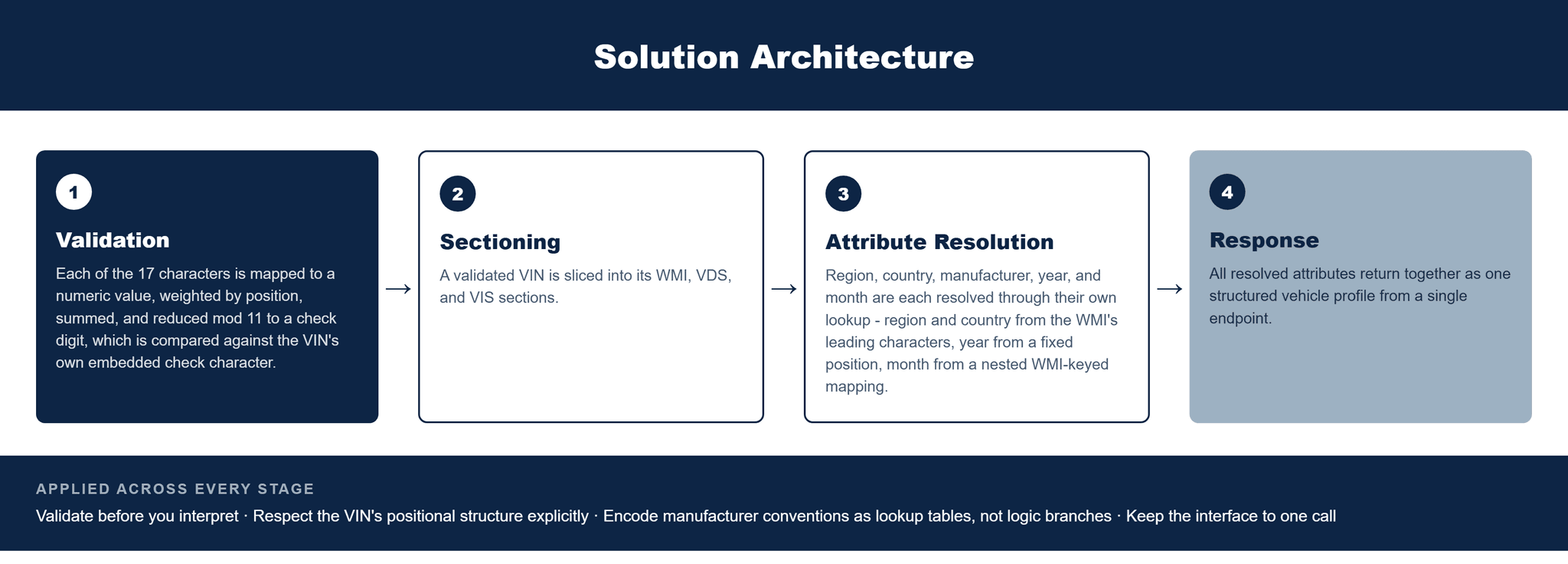
Pfactorial built a VIN decoding pipeline that validates the check digit first, then extracts and resolves every attribute the VIN encodes, served through a single POST/GET endpoint.

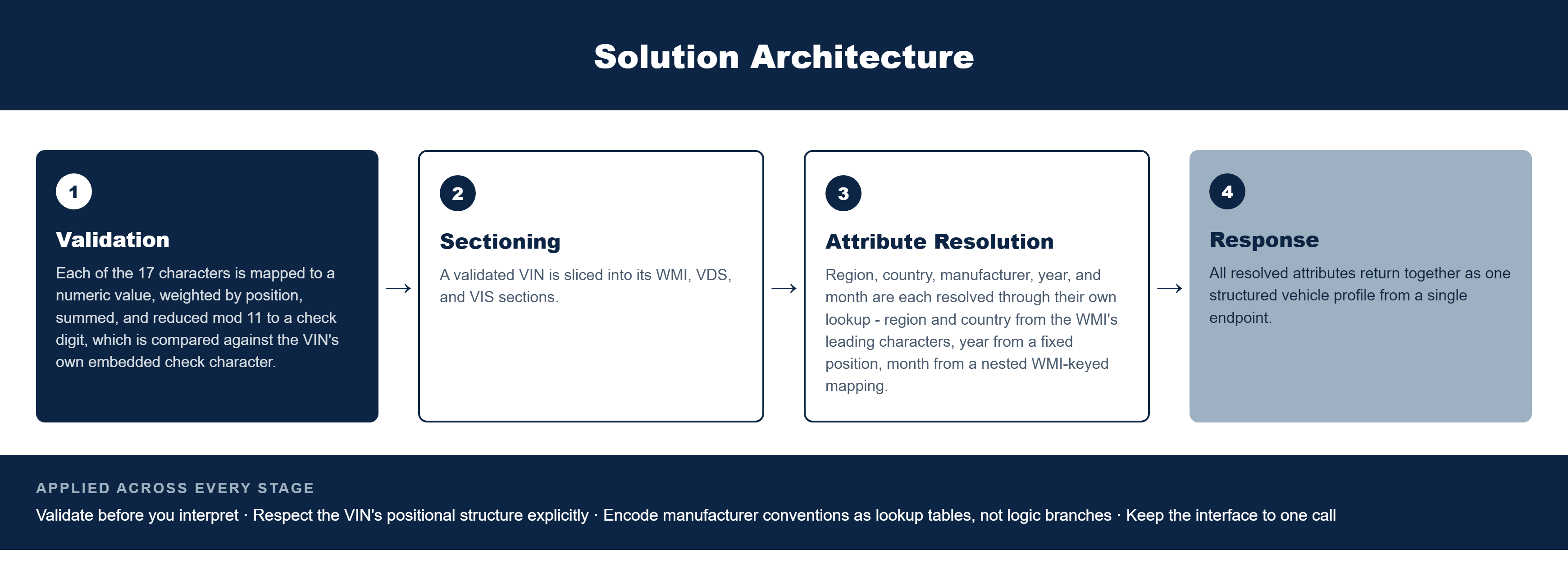
Figure 1 - Validation runs first - every downstream attribute resolution depends on the VIN having already passed its checksum.
Architectural principles
- Validate before you interpret - The check-digit algorithm runs before any attribute extraction, so the service never reports a manufacturer or year for a VIN that fails its own checksum.
- Respect the VIN's positional structure explicitly - WMI, VDS, and VIS are sliced out as distinct sections rather than treating the 17 characters as an undifferentiated string, matching the standard's own encoding.
- Encode manufacturer conventions as lookup tables, not logic branches - Region, country, manufacturer, year, and month all resolve through explicit mappings, which keeps the decoding logic simple and makes updating a convention a data change, not a code change.
- Keep the interface to one call - A single endpoint accepts a VIN and returns the full resolved profile, rather than exposing each attribute lookup as its own separate call a consumer has to orchestrate.
CAPABILITIES DELIVERED
Each capability resolves one piece of the vehicle profile a raw VIN encodes.
CAPABILITY | WHAT IT DOES |
|---|---|
VIN validation | A weighted, mod-11 checksum algorithm confirms a VIN is genuine before any attribute is extracted. |
WMI, VDS, and VIS extraction | The VIN's three structural sections - manufacturer identifier, vehicle descriptor, and vehicle indicator - are sliced out cleanly. |
Region and country resolution | The WMI's leading characters resolve to both a region and a specific country through dedicated mappings. |
Manufacturer identification | The full WMI resolves to the vehicle's manufacturer through a lookup table. |
Year and month of manufacture | A single-character position resolves to model year; a nested WMI-and-position mapping resolves to manufacturing month. |
Single-call decoding endpoint | One POST/GET endpoint accepts a VIN and returns the complete decoded profile in one response. |
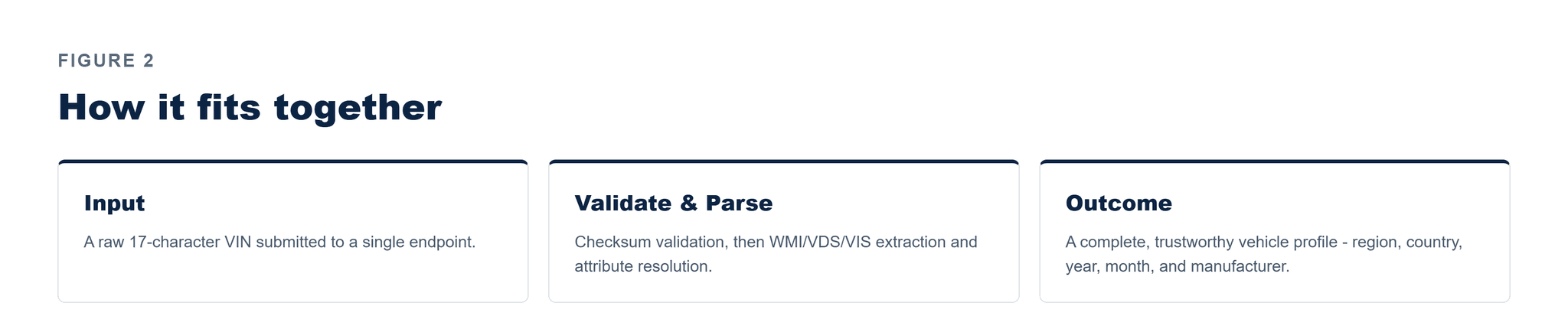
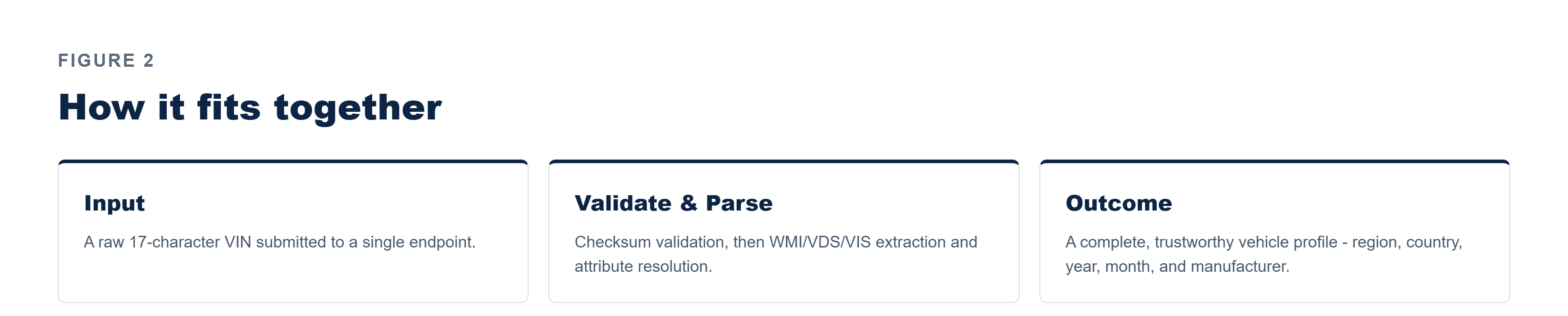
Figure 2 - Every VIN follows the same validate-then-resolve path, whatever attributes are ultimately requested.
Design note Validation and resolution are kept as strictly sequential steps rather than resolved in parallel - attribute lookups are cheap to compute but meaningless for a VIN that fails its checksum, so the design deliberately wastes no work resolving attributes for an invalid input.
ENGINEERING FOR SCALE AND RELIABILITY
Four decisions kept the decoding logic correct and easy to extend as VIN conventions evolve.
A single weighted-checksum function shared across the whole validation path
One check_vin implementation runs the mod-11 algorithm consistently, so validation logic isn't duplicated or subtly re-implemented anywhere else that touches a VIN.
Lookup tables instead of conditional logic for every resolved attribute
Region, country, manufacturer, year, and month are all implemented as mappings rather than branching logic, so a change to a manufacturer convention is a table update, not a code review of conditional branches.
A nested mapping for month, matching the standard's own nested encoding
Because month resolution genuinely depends on both the WMI and a position-specific character, the lookup is modeled as a nested mapping rather than forced into a flat table that would misrepresent the relationship.
One consolidated endpoint instead of one endpoint per attribute
WMI, VDS, VIS, region, country, year, manufacturer, and month all return from a single call, keeping the integration surface small for any consuming application.
DELIVERY APPROACH
The build worked outward from validation, since every later attribute resolution depends on a VIN having already passed its checksum.
1. Checksum validation - implementing the character-to-value mapping, positional weights, and mod-11 check-digit algorithm.
2. Section extraction - building the WMI, VDS, and VIS slicing logic against a validated VIN.
3. Attribute resolution - building the region, country, manufacturer, year, and month lookup mappings.
4. API endpoint - exposing validation, extraction, and resolution together behind a single POST/GET endpoint.
RESULTS AND IMPACT

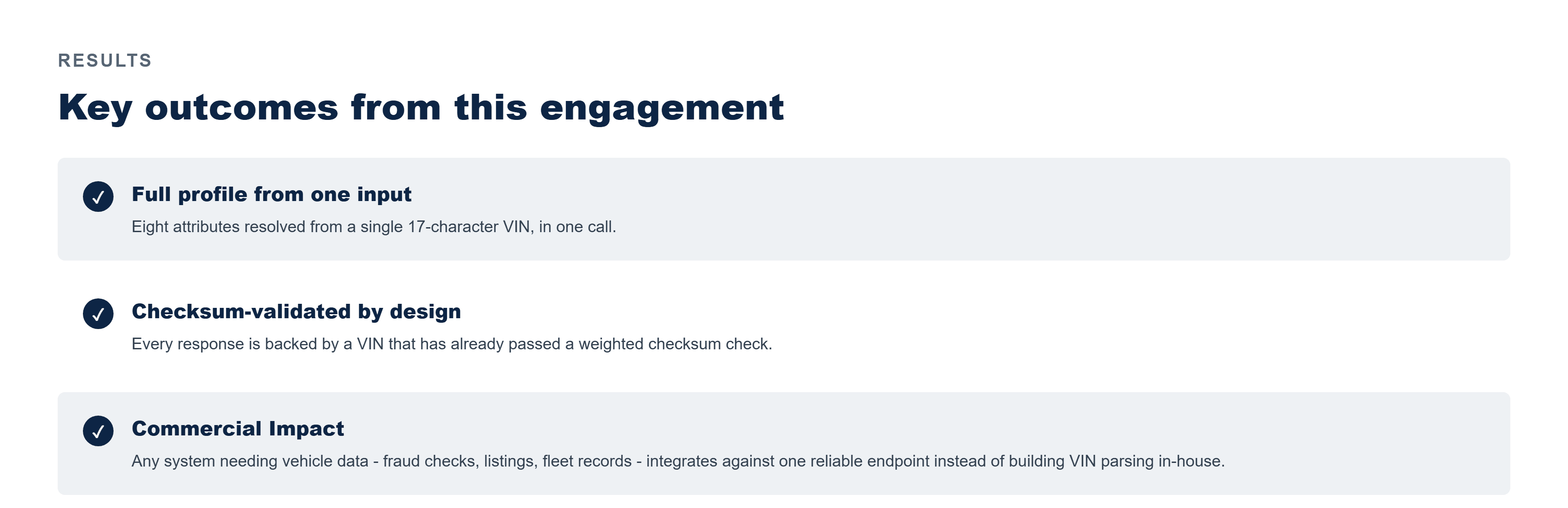
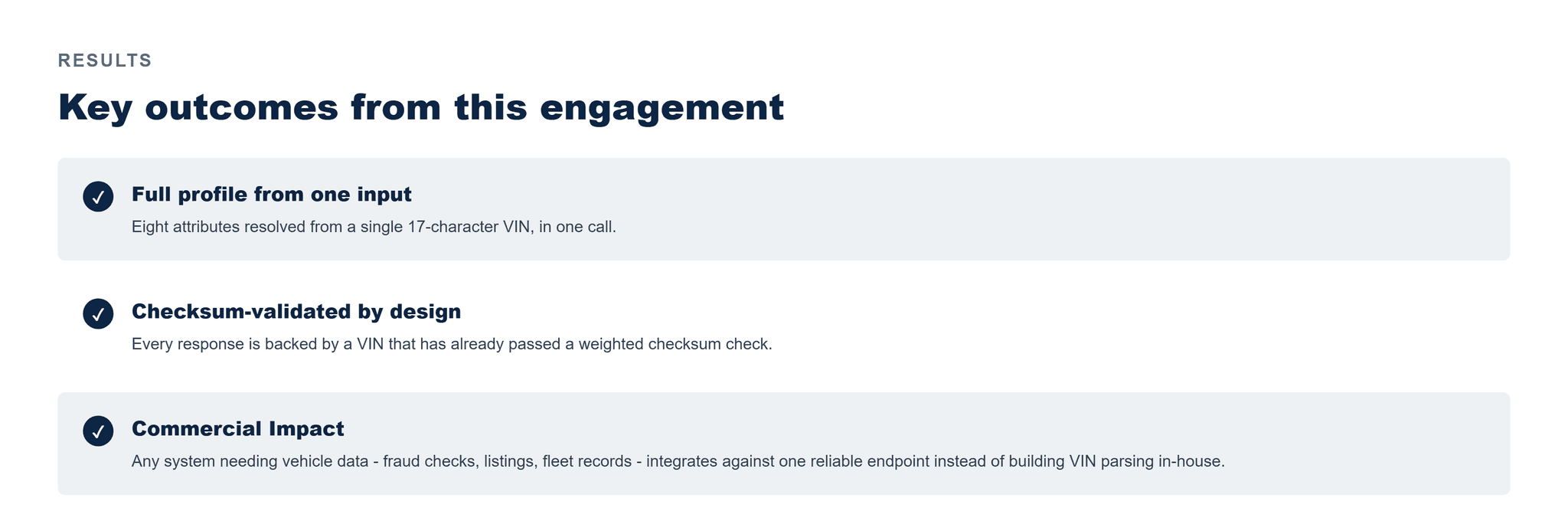
- Key outcomes from this engagement.
The decoder is built and functioning, taking a raw VIN through checksum validation and returning a complete profile - WMI, VDS, VIS, region, country, year, manufacturer, and month - from a single endpoint.
Because validation runs strictly before resolution, and every attribute is backed by an explicit, updatable lookup table rather than inline logic, the service stays correct as VIN conventions are revised and easy to extend if new attributes are added.
What it enabled commercially
The client can now integrate trustworthy VIN decoding - including fraud-relevant checksum validation - into any system that needs vehicle data, without building and maintaining VIN parsing logic in-house.
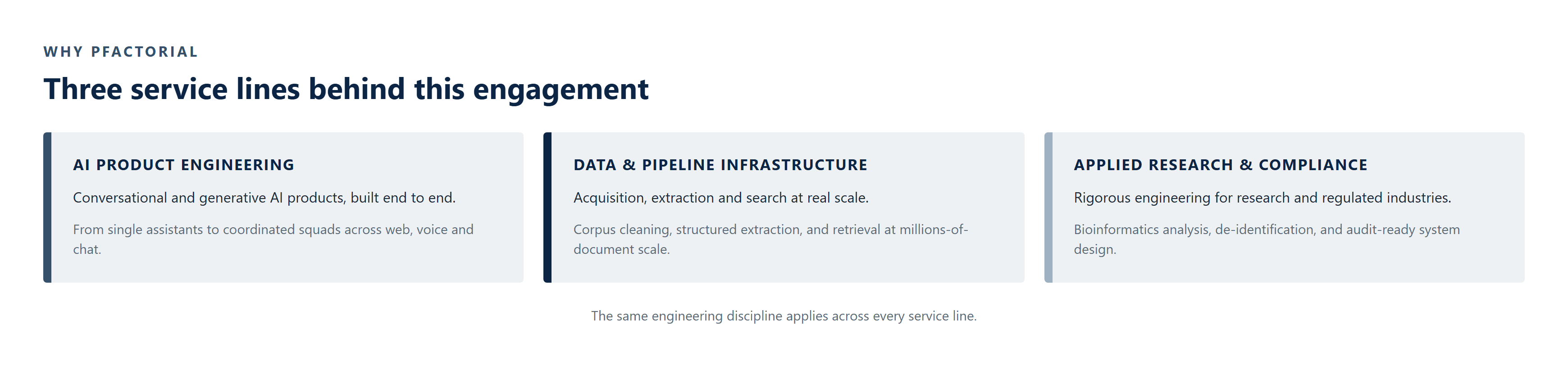
WHY PFACTORIAL
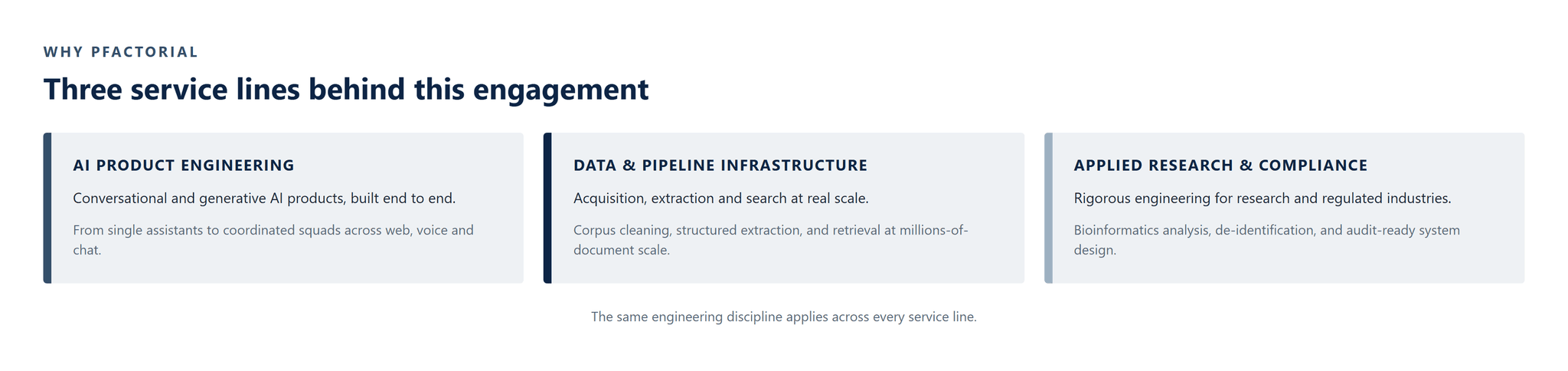
This engagement reflects Pfactorial's ability to implement industry-standard encodings correctly and defensively - validating data before trusting it, and modeling domain conventions as data rather than code, so the system stays maintainable as those conventions change.

- Service lines this engagement draws on.
Engagement enquiries Pfactorial Technologies works with organisations that need structured, standards-based identifiers - VINs, and formats like them - decoded and validated reliably. If you're evaluating a vehicle-data or identifier-parsing service, we're happy to give you an honest read on scope and risk before anyone commits to anything. · pfactorial.ai
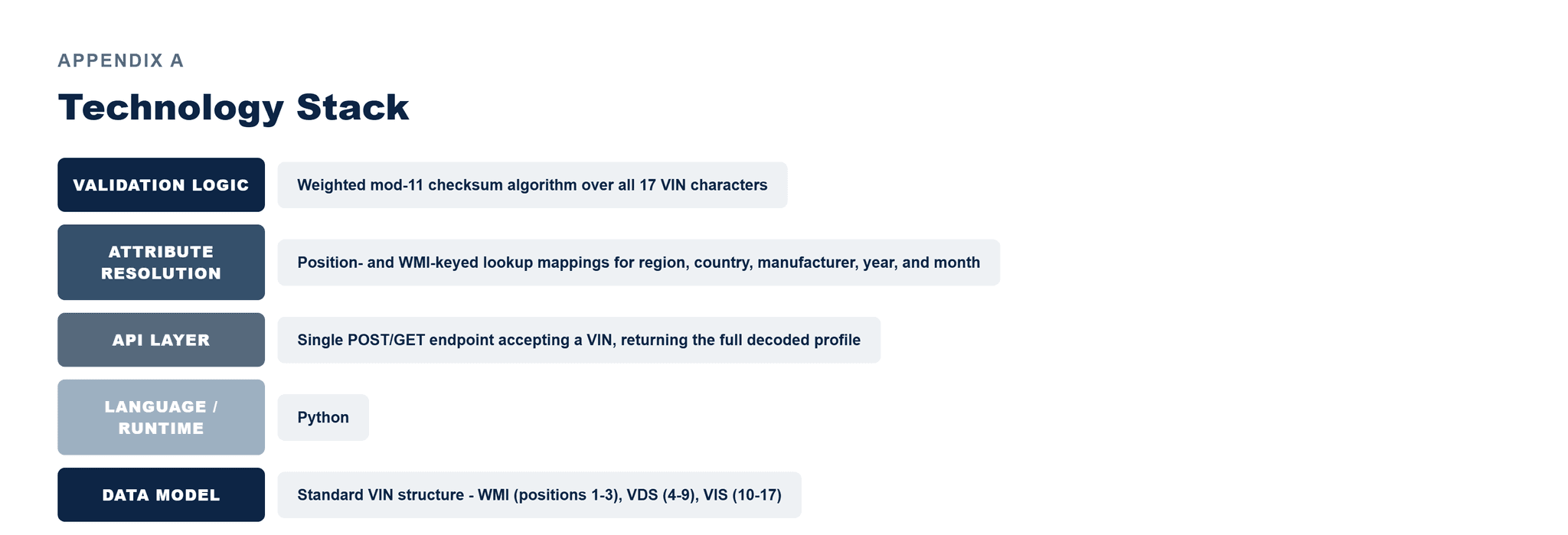
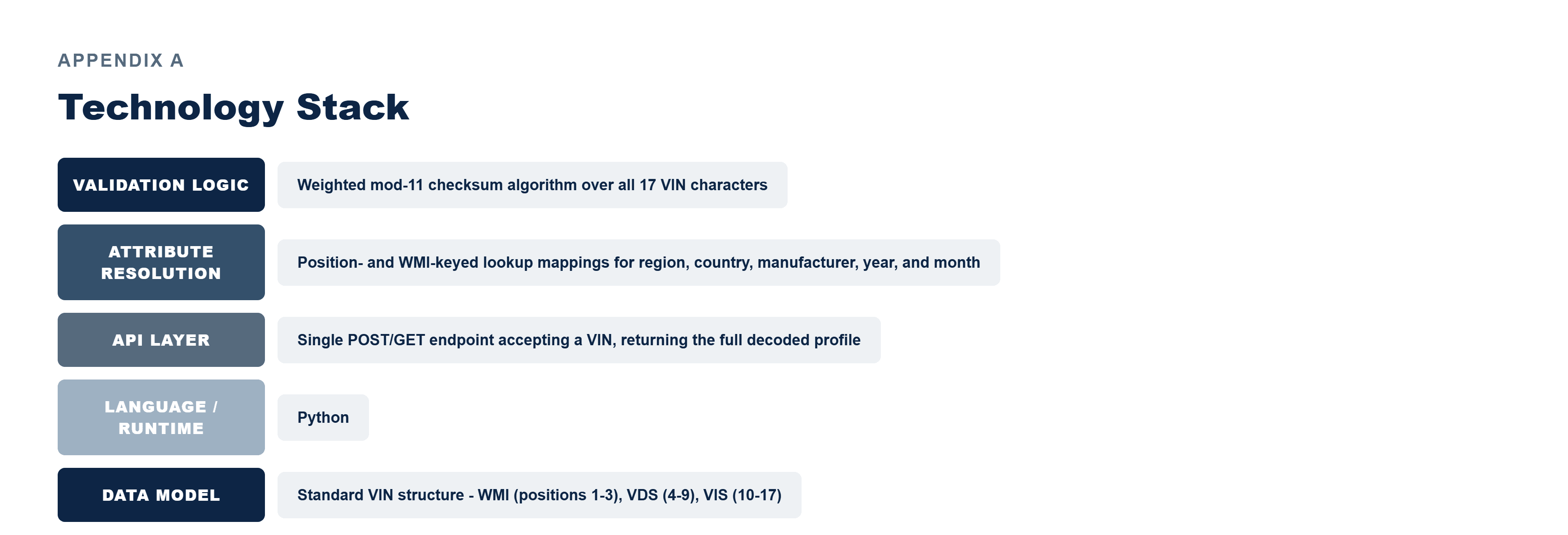
APPENDIX A - TECHNOLOGY STACK
The technology stack underpinning the system, grouped by the layer it serves.

Result and Analysis
ENGAGEMENT SNAPSHOT
How Pfactorial Technologies built a VIN decoding service that validates, parses, and returns a full vehicle profile from a single 17-character identification number.
CASE STUDIES

You might also like...

RAG & Semantic SearchAutomotive & Vehicle
Aug 21, 20267 min readRead

Automotive & Vehicle
A Browser-Native Neural Network Simulation That Learns to Drive From Experience
Aug 21, 20267 min readRead

OCR & Document ExtractionAutomotive & Vehicle
A Computer-Vision Platform for Real-Time Parking Occupancy and Vehicle Number-Plate Recognition
Aug 21, 20267 min readRead

Analytics & BI DashboardsAutomotive & Vehicle
A Five-Capability Computer Vision Platform for Vehicle Identity, Traffic, and Parking Intelligence
Aug 21, 20267 min readRead

Real Estate & PropertyAutomotive & Vehicle
A Voice AI Receptionist for Independent Auto Repair Shops
Aug 21, 20268 min readRead