Back
June 28, 2024
E-commerce & Retail
DYNAMIC PRICING STRATEGIES FOR ECOMMERCE
Pfactorial
Share

Introduction
If you were a shop owner ,would your product's price remain the same for your entire life? The answer is no, right? Product prices are subject to change according to various factors like demand, quality, economy etc. If you fail to understand the dynamic nature of prices, you will be left behind in the business competition. Dynamic pricing is necessary in today’s world to adapt to the market’s conditions and survive in the competitive businesses since even a news article or twitter post can change the fate of a company. Products on ecommerce websites have highly volatile prices due to the dynamic pricing . In this blog let us understand how dynamic pricing can be implemented in python.
When and why ?

Consider the scenario where you are running an ecommerce store
and you need to give offers based on festivals at different geographical locations at different times of the year.
Dynamic pricing strategies can be used here by understanding the customer purchasing behavior at a particular region from historical purchase data . Then we can use this data to train a machine learning model to predict the price for a particular period.
Use cases
- Survive in the competition: Dynamic pricing can help in a competitive business like e-commerce as different ecommerce platforms may have different prices for the same product. If one platform sells the same product at a lower price than another platform then the customer will naturally buy the product from the platform that sells the same product with a lower price.
- Avoiding loss: Dynamic pricing can help a business set the price of their products according to the changing market conditions and customers.
- More effective : More effective than static pricing because the price changes according to the customer and avoids losing customers.
- Understanding the demand : As dynamic pricing helps the businesses to test various pricing strategies the businesses can understand the demand of their product
Challenges
- Customer trust - Governments and regulatory bodies may impose restrictions on dynamic pricing practices to protect consumers from unfair practice such as suppressing competition by lowering the price beyond a limit
- Profit : Dynamic pricing can lead to pricing wars among competitors, which can negatively impact profit margins.
- Unpredictable demand : Demand of a product may not align with the dynamic pricing strategy. This can have a negative impact on the business
Implementing your own dynamic pricing strategy
Let us take a look at how we can implement dynamic pricing strategy using machine learning.
Dataset
We will be using an ecommerce dataset in the format :

We use the columns including the name of the product, number of photos in the ecommerce site, weight, length, height and width to predict the price of the product.
Preprocessing
Since our dataset contains outliers in the price column we filter our data between 5 percent and 95 percent .All values above 95 % and below 5% in the price column are removed.
Since our dataset contains categorical values in the column ‘product category name’ we need to numerically encode it using one hot encoding .For instance if there are 3 categories like ‘jeans’,’shirts’,’t shirt’.The encoding for each category will be
[1,0,0]
[0,1,0]
[0,0,1]
Creating the model
For creating the model we are using Random forest regressor. It is a machine learning algorithm that uses multiple decision trees to predict the output.
Here we join our original data frame to the one hot encoded data frame .Then split the data frame into train and test sets.
Then we train our initialized model using the training set. We use r2 score for measuring the performance of our model.
We save our trained model and our encoder using pickle.
Api
We have successfully created and saved our model. Now it’s time to build an api for our model. We are implementing the api using flask framework in python.
First we load our model and encoder.The function predict is used to encode the input and return the predictions from the model.
Then we create our endpoint ‘/dynamic_price’ returning the outputs from the model.
Testing the api
Ok! Now we have our api.To check whether it is working or not we need to test it right?
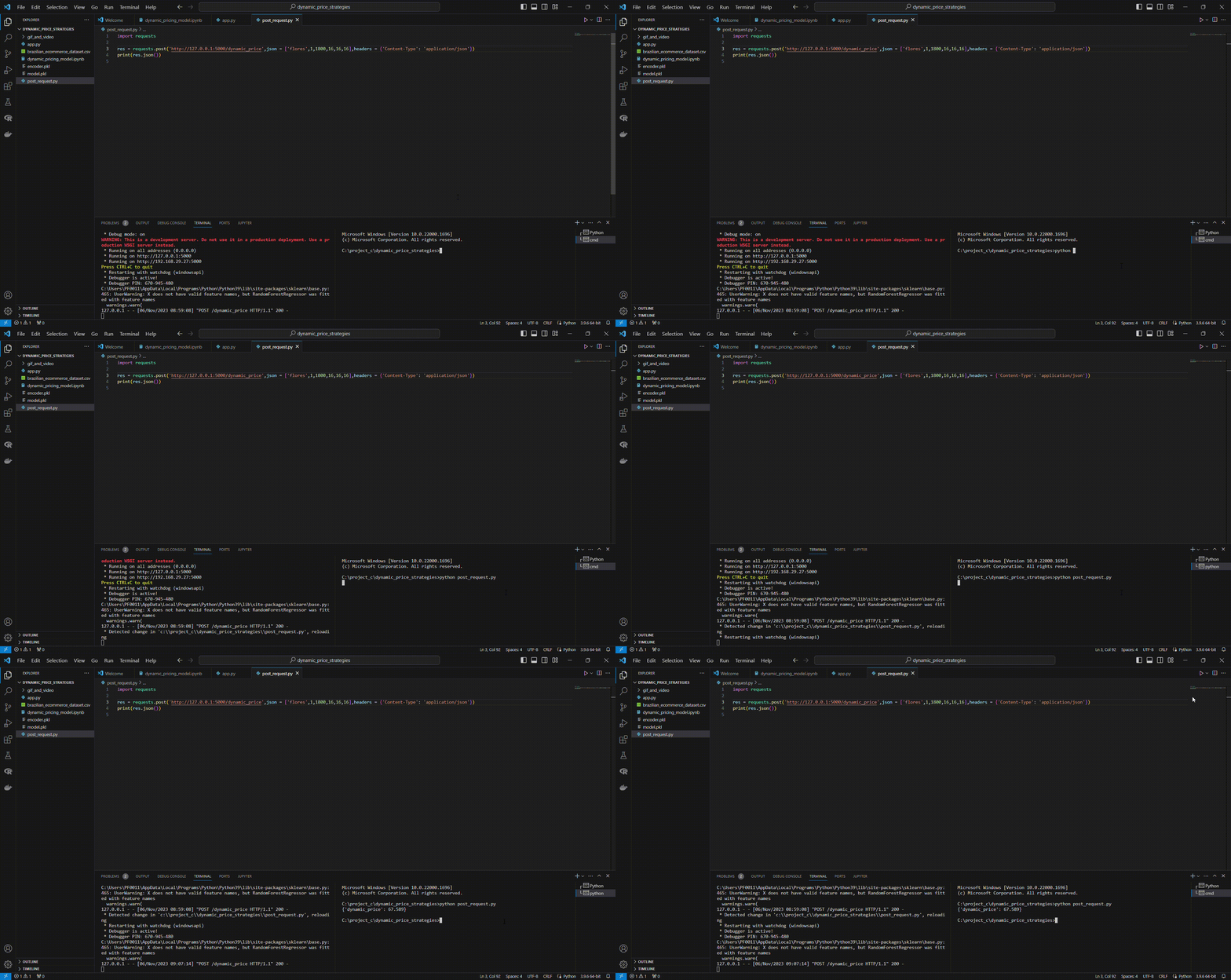
Let’s send some sample data using the requests library in python and see the results.

We send our input in json format and here we can see the output in the right terminal.
Conclusion
In this blog we have explored the implementation of dynamic pricing using machine learning. Remember, It is not always necessary to depend on machine learning techniques to build dynamic pricing strategies. There are also rule based techniques that can be applied to dynamically change the price of a product based on various factors. Hope you learned something new from our blog. Happy learning
BLOGS
You might also like...

Forcast using SARIMAData ScienceE-commerce & Retail+5
Jun 21, 20246 min readRead

Power biData VisualizationEnterprise Ops Platforms+3
Improving Employee Productivity with Time Tracking
Jun 20, 20245 min readRead

Deep learningData Science Deep Learning+4
Predictive Maintenance for Manufacturing
Jun 25, 20248 min readRead

PuLPData ScienceEnterprise Ops Platforms+3
Supply Chain Optimization
Jun 21, 20248 min readRead