Back
ML Infra, Classifiers & RL

Predictive Maintenance for Manufacturing

Author
Pfactorial
June 25, 2024
Share
predictive maintenance
Introduction
Imagine you have a smart refrigerator with a sensor to monitor its performance. One day its predictive maintenance system detects an unusual pattern that the compressor is taking longer to cool the interior, so you inform the technician and he analyses the problem and solves it before the refrigerator stops working. In this simple real life example, predictive maintenance for a refrigerator prevents a potential breakdown, saving you from the inconvenience of spoiled food and the cost of emergency repairs.
Manufacturing faces a similar challenge. Unforeseen equipment breakdowns can cripple production lines and cost a fortune. But what if machines could tell you they're about to malfunction, before disaster strikes? This is the power of predictive maintenance.
In this blog, we'll explore the world of predictive maintenance in manufacturing. We'll see how sensors and data analysis can turn your machines into fortune tellers, preventing costly downtime and keeping your operation running smoothly. Get ready to discover how a little foresight can save a lot of headaches (and money)!
What is predictive maintenance ?
Predictive maintenance is a proactive maintenance strategy that utilizes advanced data analytics, machine learning algorithms, and real-time sensor data to predict and prevent equipment failures before they occur. By analyzing historical performance data and identifying patterns or anomalies, predictive maintenance enables timely and targeted interventions, optimizing equipment reliability, minimizing downtime, and ultimately enhancing overall operational efficiency.
Predictive Maintenance with Machine Learning
Similar to other domains, machine learning plays a crucial role in  predictive maintenance. Advanced algorithms of ML analyze historical data, real-time sensor information, and patterns to forecast potential equipment failures before they occur.  There are mainly two machine learning-based predictive maintenance approaches . Can you guess ? Yes, you are correct. Classification and Regression approach. Classification approach predicts whether there are any possible failures in the remaining n -steps. It gives output in boolean format. The regression approach predicts the time of failure in the system. This is also known as Remaining Useful Life (RUL).
Let's  sort out the Benefits of using machine learning for predictive maintenance :
  • By  scheduling maintenance before a failure occurs, manufacturers can minimize downtime and ensure uninterrupted production.
  • Manufacturers can avoid the cost of unnecessary care and reduce the number of emergency repairs.
  • We can take measures to prevent equipment damage and extend the lifespan of equipment
  • Anticipating potential failures in advance enables more effective inventory management, diminishing the necessity for excessive stockpiling and ensuring the availability of parts when required.
Model implementation
Data Collection
Lets see how to implement a predictive maintenance model using machine learning. Here we are going to build a machine learning regression model using NASA Turbofan Jet Engine Data Set. The dataset can be downloaded from  this link https://data.nasa.gov/Aerospace/CMAPSS-Jet-Engine-Simulated-Data/ff5v-kuh6.

To begin, let's understand the data set. Within a turbofan jet engine, numerous components undergo degradation during operation. Datasets include simulations of multiple turbofan engines over time. The primary objective is to accurately predict the Remaining Useful Life (RUL) based on sensor readings and operational settings. The dataset includes engine numbers, operating cycles, corresponding operational setting values, and readings from 21 sensors.
The data contains 4 datasets here we are going to use the first data set (FD001).
sample dataset predictive maintenance
Data Preprocessing
The dataset contains details of 100 unique engines. In the train dataset RUL column (our target column) is not present. So we need to calculate RUL.

RUL = End of life of a Machine - Current Time Cycle

The machine's End of Life (EOL) can be determined by computing the maximum value of the time_cycle for each engine. This calculation is performed for each engine, and a new column is appended to the data frame. Subsequently, the Remaining Useful Life (RUL) is computed and added to the data frame.
data frame after preprocessing predictive maintenance
For analyzing the dataset we are going to plot the box plot of columns. From the box plot it is clear that some columns do not contribute to the performance of the engine. So we can drop those columns.
boxplot predictive maintanance
Next plot the correlation map to determine the correlation between columns.
correlation map predictive maintenance
Based on correlation map and boxplot we are going to drop these columns.
Columns to drop = setting1, setting2, setting3, S1, S5, S6, S9, S10 , S14, S16, S18, S19 , unit _number and time cycle . Finally we get a data frame like this.
data frame after preprocessing predictive maintanance
Data Splitting and Scaling
Next we need to split the data to features and target. Then scale the data frame. Here we are using standard scaling.
Now, we proceed with training the model and assessing its performance by comparing Root Mean Squared Error (RMSE). We aim to select a robust model based on this evaluation.
Model Selection
Here we fit the data with linear regression, lasso regression, ridge regression , Random Forest Regressor, decision tree regressor, and SVR.
Then calculated the evaluation metrics and created a data frame
RMSE before thresholding predictive maintenance
Here you can see the RMSE is very high. It means that our model is not performing well. So we need to improve our model.
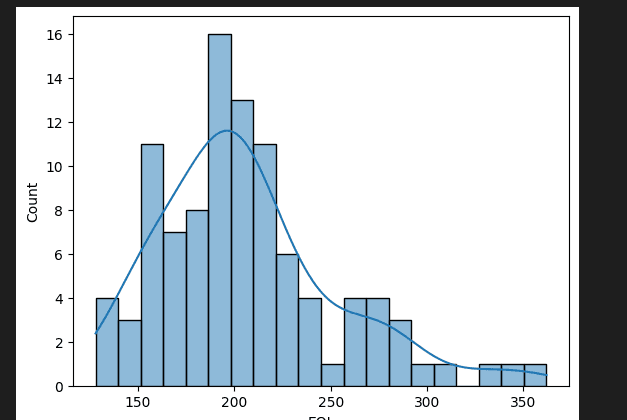
Let's examine our RUL column. When plotting a histogram it is clear that it is right skewed. It will affect our model performance. So set a threshold to RUL. and train the model.
histogram predictive maintanance
After thresholding we get the evaluation data frame like this
after thresholding RMSE predictive maintanance
Prediction
Subsequently, our task involves predicting the Remaining Useful Life (RUL) using a test dataset. Therefore, we read the dataset and perform the necessary preprocessing steps, similar to what was done with the training dataset. The provided Remaining Useful Life (RUL) dataset comprises 100 rows, each corresponding to a unique engine. So group the test dataset based on these distinct engine entries. And predict the output using our model. After prediction we calculate the mean squared error. So thresholding will help us to improve our model.
Our model is doing better than before, but we can make it even better. Let's look for ways to improve and fine-tune its performance.
SVR Model output predictive maintanance
Building Deep learning model
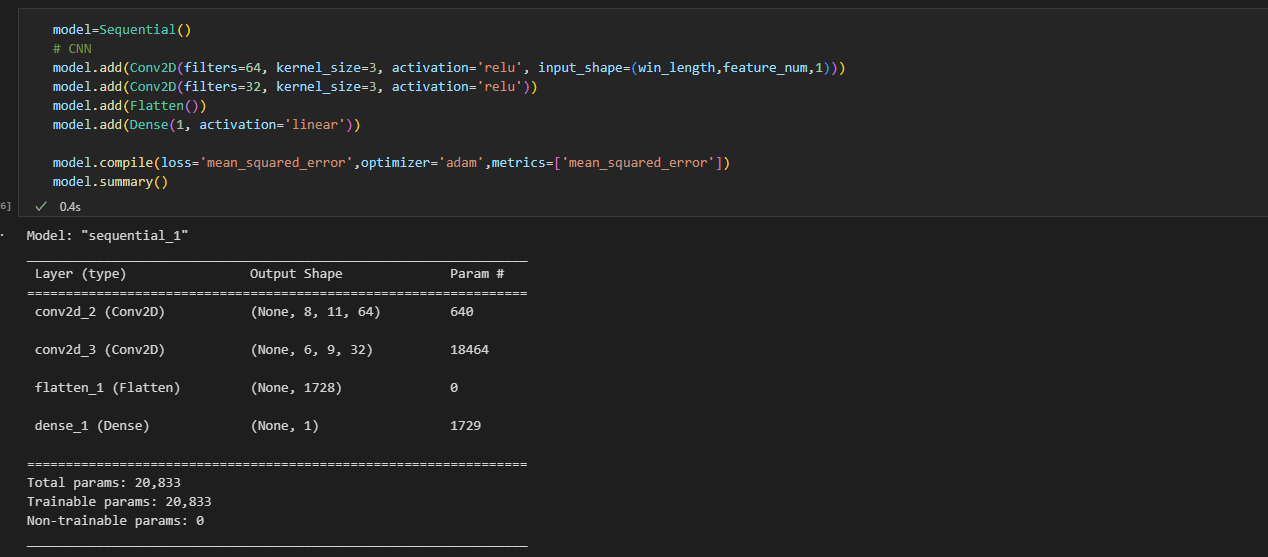
Let's build a deep learning model and see how well it performs. We'll follow the same steps as before: reading the dataset, scaling the data, and splitting it into features and the target variable. Next we need to prepare  time series data for a deep learning model . so we are using a function called TimeseriesGenerator.  And reshape our input. Then build a simple deep learning model.
Then build a simple deep learning model.
Train the model by fitting it to the prepared data, and then utilise the trained model to make predictions. After prediction we got RMSE as 12.26. Thus our model performance is improved.
deeplearning model code predictive maintanance
rmse deeplearning predictive maintanance
Use Cases
Now, let's discuss  the practical applications of predictive maintenance across various industries,  and its contributions to enhancing operational efficiency and reducing downtime.
  • Minimizing Unplanned Downtime
Imagine an automotive manufacturing plant where an unexpected breakdown of a crucial robotic arm could bring the entire production line to a halt. Predictive maintenance systems equipped with sensors and data analytics can monitor the health of machinery in real-time. By analysing patterns and anomalies, the system can predict when the robotic arm is likely to fail. This foresight allows maintenance teams to replace or repair components before a  failure occurs.
  • Extending equipment Life span
Let us consider the construction industry. Here, heavy machinery plays a pivotal role in completing projects efficiently. Predictive maintenance helps extend the lifespan of these expensive assets by providing insights into their health and performance. For instance, sensors embedded in excavators and bulldozers can monitor factors such as vibration, temperature, and fluid levels. By analysing this data, predictive maintenance algorithms can identify wear and tear patterns, enabling timely interventions like lubrication or part replacements. This proactive approach not only reduces the frequency of replacements but also ensures that machinery operates at optimal levels for an extended period.
  • Optimizing Maintenance Costs
Consider the example of Aerospace Manufacturing. Aircraft manufacturing involves complex machinery and precise processes. Unplanned maintenance in this sector can lead to significant financial losses and delays.By leveraging historical data and real-time monitoring, the system can determine the most cost-effective times for maintenance interventions. For instance, a predictive maintenance system may recommend scheduling routine maintenance during periods of reduced production demand, minimizing the impact on overall productivity and reducing maintenance costs.
  • Enhancing Safety and Compliance
In the pharmaceutical industry strict compliance with safety and quality standards is needed. For instance, sensors in pharmaceutical processing equipment can monitor factors such as temperature and pressure. If deviations from acceptable ranges are detected, the system can trigger alerts, allowing the manufacturing team to address potential issues before they compromise product quality or violate regulatory standards.
 

Predictive maintenance emerges as a transformative strategy in manufacturing, driven by the advancements in machine learning.  The ability to anticipate potential failures, facilitated through real-time data and advanced analytics, fundamentally alters the maintenance paradigm. In the  world of manufacturing, downtime is not just a challenge; it's a costly adversary. However, with the advent of predictive maintenance, manufacturers now have a powerful tool to anticipate equipment failures, optimize maintenance schedules, and ultimately enhance operational efficiency in the manufacturing domain.

DISCOVER MORE. CONNECT WITH US!

Intrigued by what you have read? Dive deeper and stay ahead with the latest insights and trends. We are here to answer your questions and help you explore further.