Back
Sales, Lead Gen & Outreach

Designing an Autonomous AI Sales Operations Employee

A proposed multi-agent system that carries a lead from first research through to a booked meeting - reasoning and acting inside explicit guardrails, rather than running a fixed outreach sequence.
August 21, 2026
Share
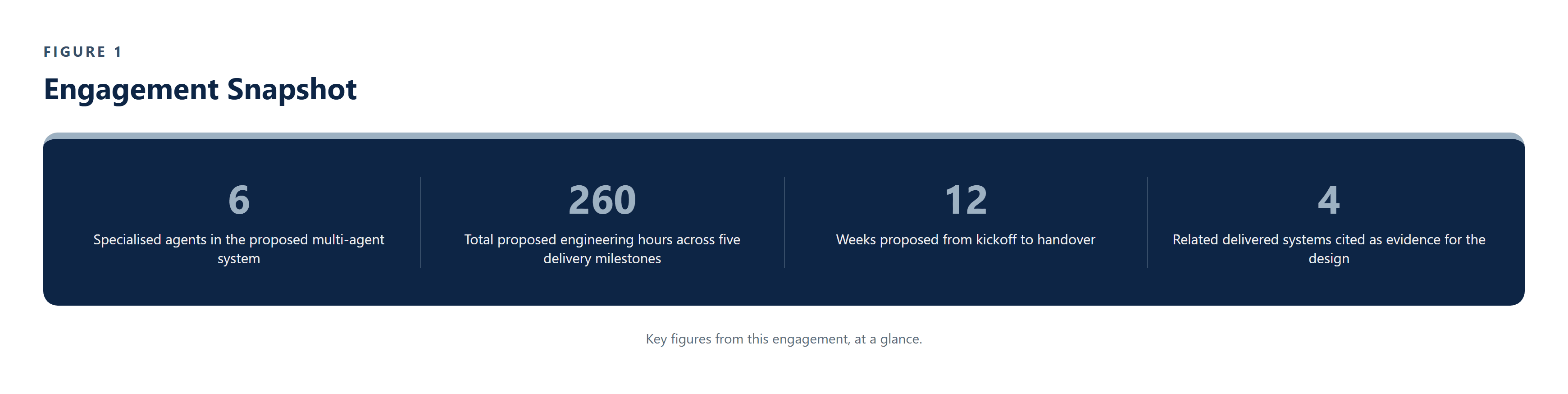
ENGAGEMENT SNAPSHOT

CS-003_AI_Sales_Operations_Employee image 1
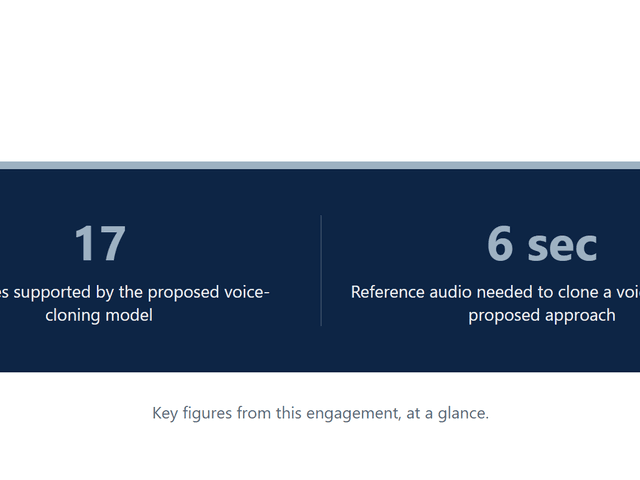
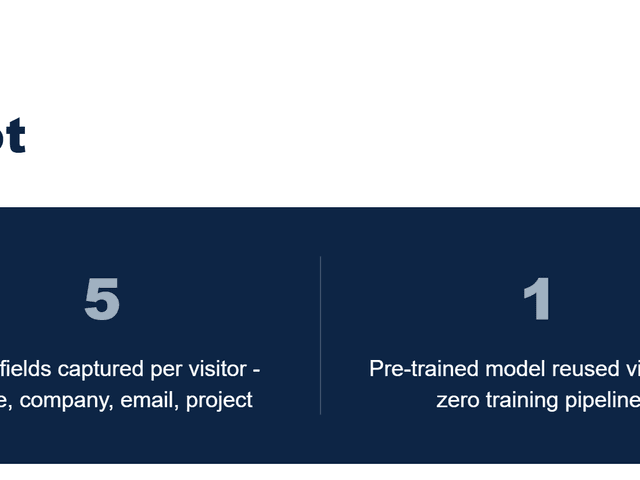
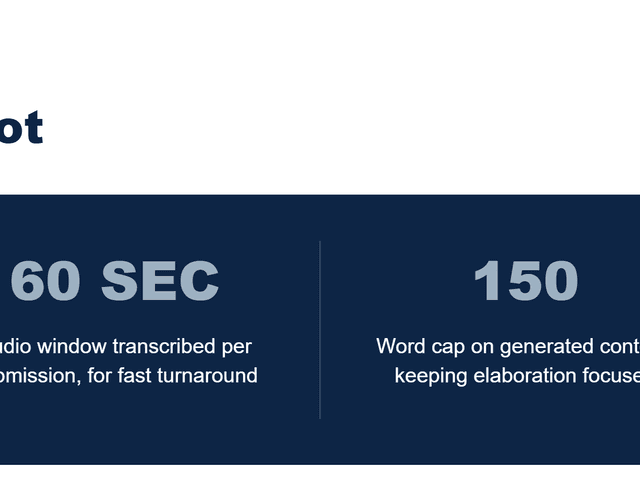
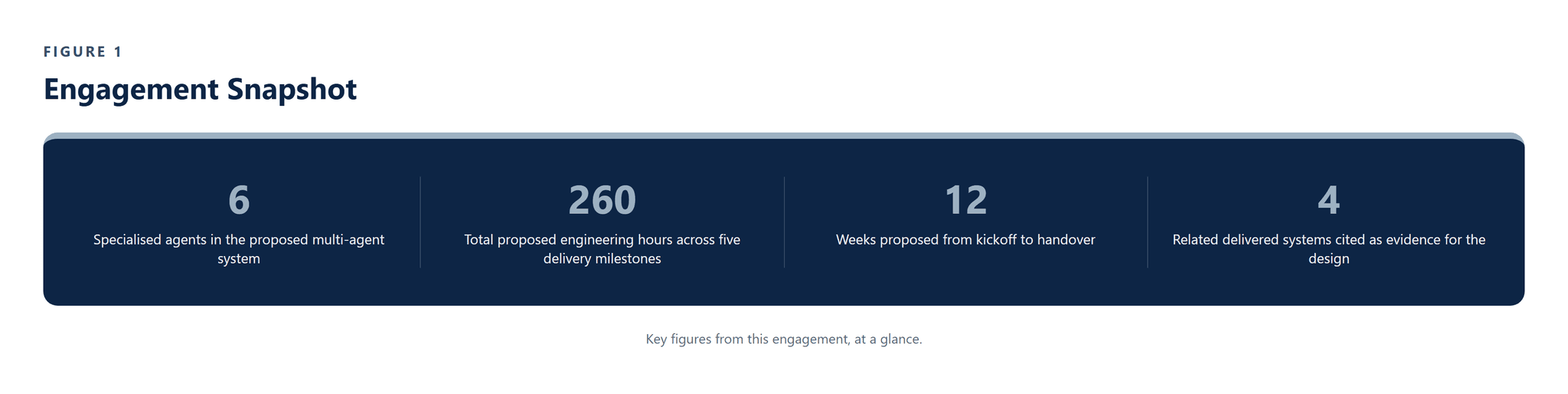
Figure 1 - Key figures from this engagement, at a glance.
EXECUTIVE SUMMARY
Our client's sales team was spending most of its week on a repeating manual loop: find companies, research them, find the right person, decide whether they are worth contacting, write, send, follow up, reply, book, and log it all - with conventional SDR sequence tools only automating the send-and-wait part of that loop.
Pfactorial Technologies proposed an autonomous AI Sales Operations Employee: a system built on a durable agent loop - observe, reason, decide, act - that carries a lead from research through qualification, personalized outreach, adaptive follow-up, and meeting booking, with the CRM kept in sync throughout. People stay in the loop only where judgment, authority, or a relationship is actually required.
The design is built around specialized agents with narrow, testable responsibilities rather than one general-purpose prompt, orchestrated on a framework chosen specifically for long-running, interruptible sales cycles that can sit mid-sequence for weeks and still survive a restart or deploy without losing context.
Why this engagement is representative This engagement demonstrates Pfactorial's approach to autonomous AI systems in a commercial context: an agent loop instead of a fixed script, explicit escalation policy instead of unbounded autonomy, and every customer-facing answer grounded in the client's own approved content rather than improvised.
THE CHALLENGE
Conventional SDR tooling automates the mechanics of sending messages, but not the judgment a human rep applies at every step. Four gaps shaped the proposed system.

1. Fixed sequences cannot read a reply

Conventional tooling runs a scripted sequence and stops the moment someone replies with anything the script did not anticipate, notifying a human and waiting - the personalization is a merge field and the intelligence is a calendar.

2. Research, qualification and outreach are disconnected today

Without research, personalization is weak; without qualification, effort goes to accounts that were never going to buy. A stack of separate tools loses the context gathered upstream by the time it reaches outreach.

3. Autonomy needs explicit boundaries, not implicit trust

An AI system acting on real prospects, a real CRM, and a real mailbox cannot be given unbounded autonomy - every action needs a defined policy for when the AI may act alone, when it must notify a rep, and when it must stop.

4. Sales cycles are long-running and interruptible

An account can sit mid-sequence for weeks waiting on a reply. The system has to survive restarts, deploys, and failures without losing its place in that account's history.
The real brief Not "automate email sending" but "build a digital coworker that owns the research-to-booked-meeting loop, uses real judgment inside defined guardrails, and hands off to a human only where a human is actually required."
THE SOLUTION
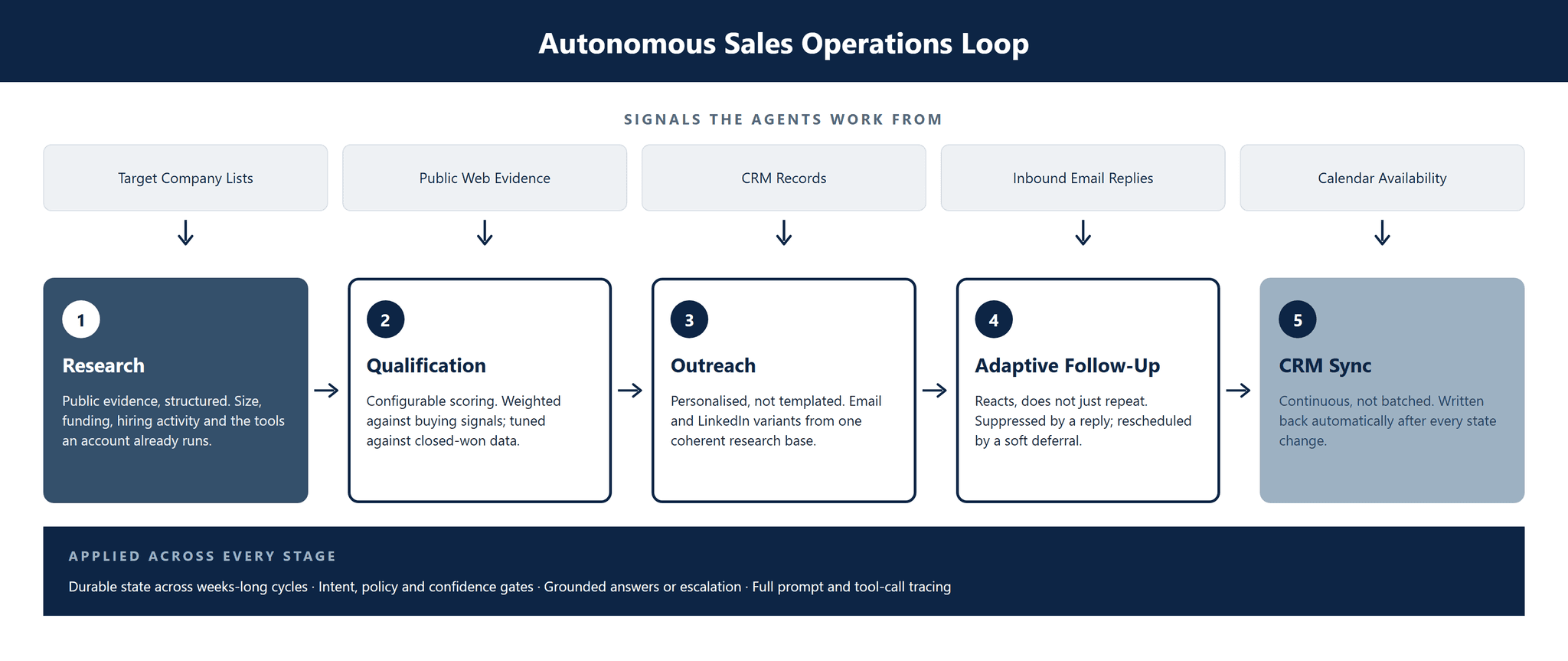
Pfactorial proposed a multi-agent system running on a stateful orchestration framework, with each agent owning a narrow, testable responsibility and every customer-facing answer grounded in the client's own approved content rather than the model's general training data.
CS-003_AI_Sales_Operations_Employee image 2
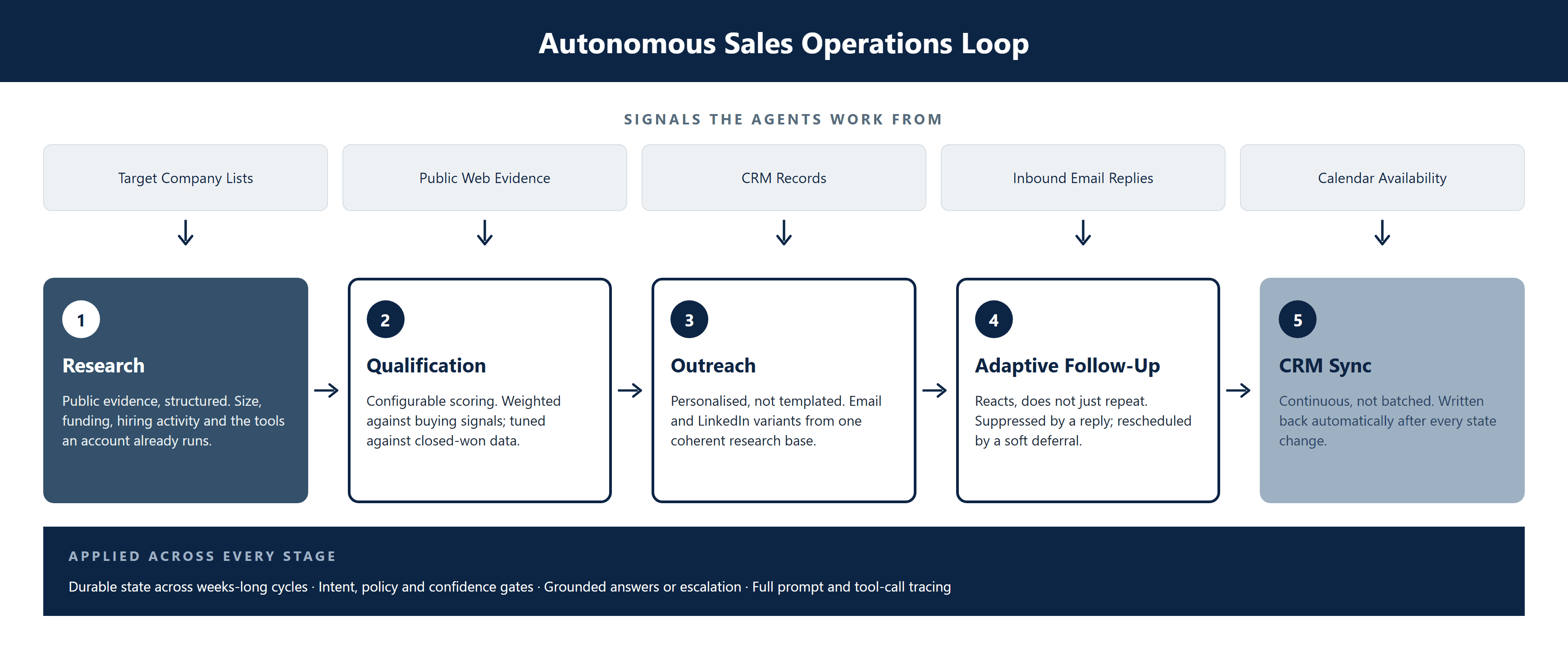
Figure 1 - The proposed sales loop: research and qualification, personalized outreach, adaptive follow-up, conversation handling, and CRM synchronisation, owned by specialised agents around shared account state.

Architectural principles

  • An agent loop, not a fixed sequence - the system observes what changed, reasons about what it means for that specific account, decides the best next action, and executes it against real tools - nobody scripts the branches; the model chooses inside defined guardrails.
  • Specialised agents over one general-purpose prompt - the work is split across agents with narrow, testable jobs and defined outputs, so a weak subject line is an outreach problem to fix - not a mystery inside a monolith.
  • Durable execution for weeks-long sales cycles - the orchestration framework was selected specifically for shared, inspectable state and native human-approval checkpoints, so an account mid-sequence for six weeks survives a restart without losing its place.
  • Grounded answers, not improvised ones - when the AI answers a prospect's product question, the answer is retrieved from the client's own indexed material through hybrid search - if retrieval returns nothing relevant, the system escalates instead of guessing.
CAPABILITIES DELIVERED
The proposed system covers the full loop from a list of target companies to a booked, logged meeting, with the CRM kept in sync at every step.
CAPABILITY
WHAT IT DOES
Automated Prospect Research
Gathers public evidence on each account - company size, funding, hiring activity, tools in use - and identifies the decision-maker and route to reach them.
Lead Qualification & Scoring
Weighs each account against the client's ICP definition and live buying signals to produce a configurable, tunable priority score.
Personalised, Multi-Touch Outreach
Writes email and LinkedIn messages from the research gathered, with adaptive follow-up that reacts to replies, soft deferrals, and stop conditions rather than firing on a fixed timer.
Decision, Escalation & Human Control
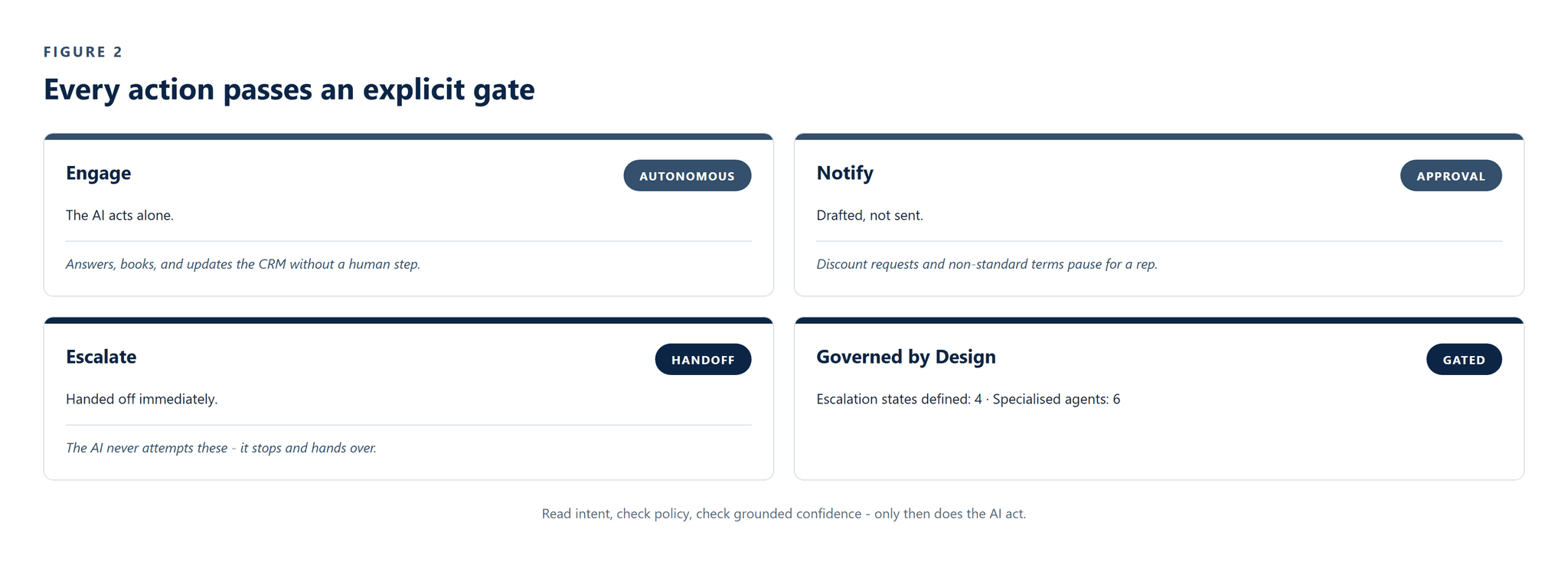
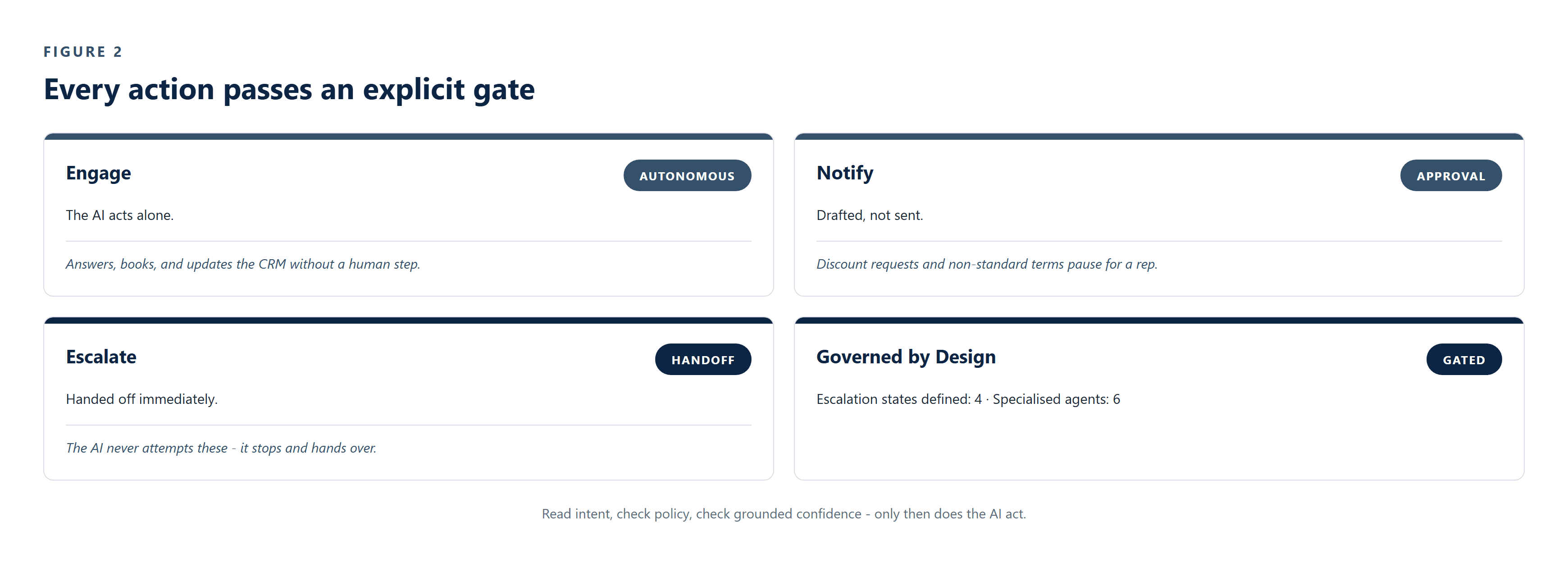
Every inbound message passes an intent, policy, and confidence check before the AI is permitted to engage, notify a rep, or escalate immediately.
Automatic CRM Synchronisation
Contacts, companies, deals, notes, and meetings are written back to the client's CRM continuously, with the database - not the CRM - as the system of record for agent state.
Meeting Scheduling
Checks live calendar availability and books directly, without a round of scheduling emails.
CS-003_AI_Sales_Operations_Employee image 3
Figure 2 - Decision and escalation policy: every inbound message is gated by intent, policy, and confidence checks before the AI is allowed to engage, notify, or escalate.
Design note The agent framework was selected specifically for durable execution, shared inspectable state, and native human-approval checkpoints - requirements that ruled out faster-to-prototype alternatives that give up control over state and approval gates for long-running, interruptible sales cycles.
ENGINEERING FOR SCALE AND RELIABILITY
Several engineering decisions shape whether an autonomous sales system is safe to run against real prospects, a real CRM, and a real mailbox.

Four escalation states, not a single autonomy switch

every message resolves to Engage (the AI acts and updates the CRM), Notify (a drafted reply awaits one-click approval), Escalate (the AI hands over immediately, e.g. pricing or legal exposure), or Stop (outreach ends on that account) - each explicitly scoped, not inferred.

The model layer is swappable by design

every model call goes through a common interface, so the underlying LLM can be swapped with a configuration change rather than a rewrite as pricing and capability shift, with cheaper models routed to simple classification and stronger models to drafting and reasoning.

The CRM is not the database

agent state, research, scores, decision history, prompt versions, and tool execution logs live in the application's own database, not pushed into the CRM - keeping the product usable by customers on any CRM rather than tied to one.

Approval checkpoints are configurable, not fixed

proposals, first contact with named strategic accounts, and any email above a value threshold can require human approval before send, configurable per campaign and typically loosened as confidence in the system grows.

Every generation is traced end to end

prompt and model version, full tool call history, token usage and cost per interaction, and every human override or escalation are logged, so a change in output quality can be traced to the change that caused it.

Security is architectural, not a hardening pass

OAuth with least-privilege scopes for every connection, encrypted and rotated secrets in a managed store, role-based access control, full audit logging, and tenant isolation are specified as day-one requirements given the platform handles prospect data, mailbox access, and CRM credentials.
DELIVERY APPROACH
The proposed twelve-week engagement runs in overlapping phases, so agents are judged against real integrations rather than a specification alone.
1. Foundations - agree ICP and scoring rules, and stand up environments and CI/CD - the base every later phase builds on.
2. First autonomous research and score - the system finds an account, researches it, and scores it without a human in the loop.
3. First AI sequence with live replies - personalized outreach is sent, replies are understood, and follow-ups adapt to what actually happened.
4. CRM and calendar end-to-end testing - a booked meeting appears in the calendar and the CRM with no manual step in between.
5. Handover - a completed pilot campaign, full documentation, and a working walkthrough of the architecture and agent logic with the client's team.
RESULTS AND IMPACT

CS-003_AI_Sales_Operations_Employee image 4
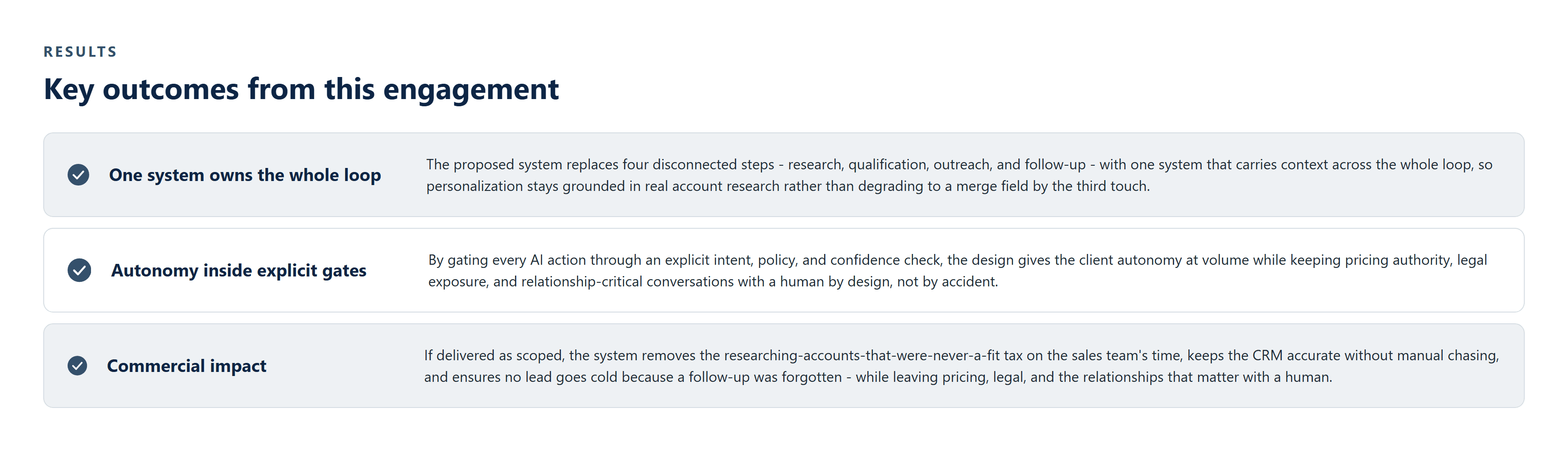
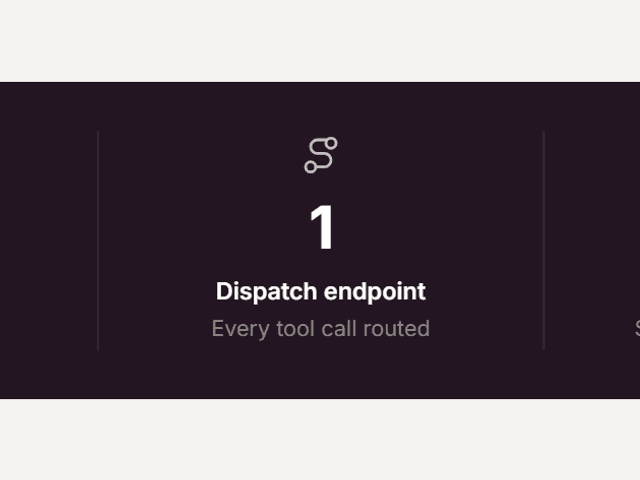
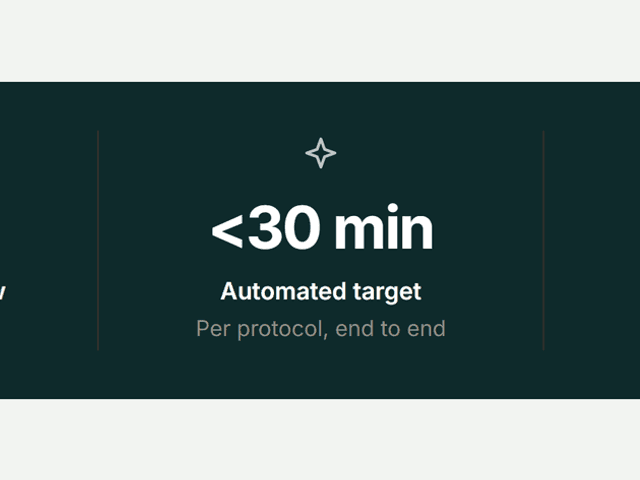
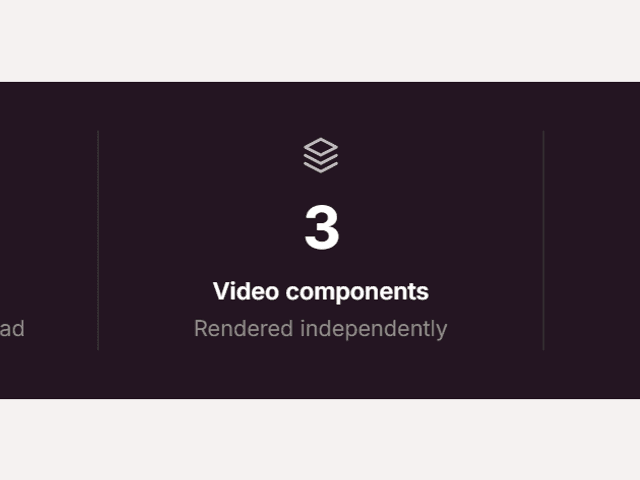
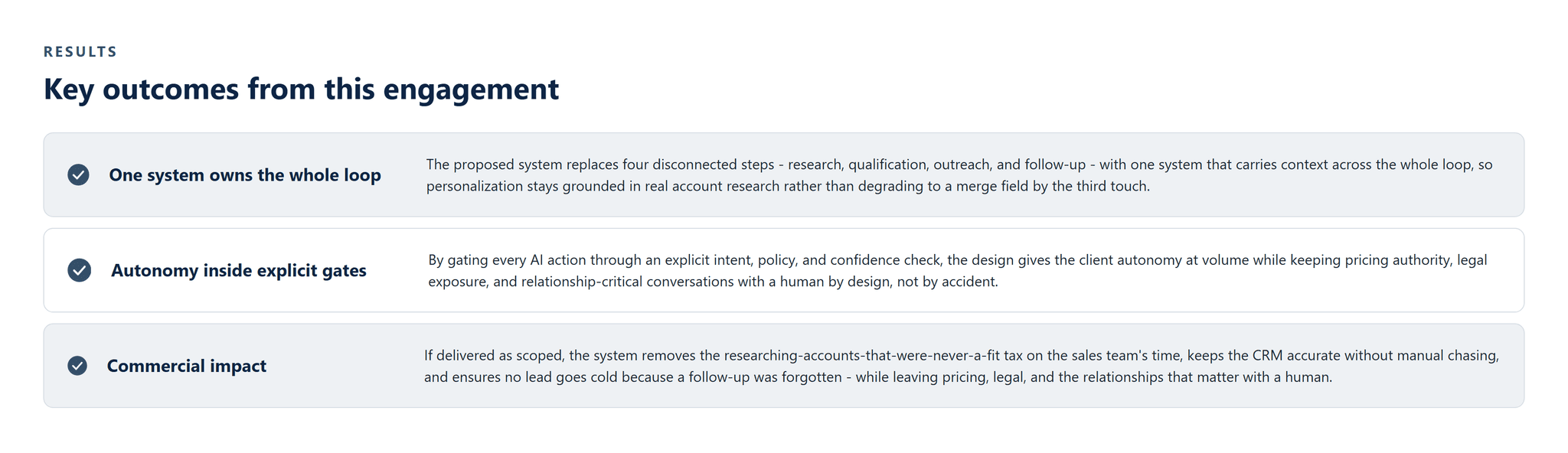
Figure - Key outcomes from this engagement.
The proposed system replaces four disconnected steps - research, qualification, outreach, and follow-up - with one system that carries context across the whole loop, so personalization stays grounded in real account research rather than degrading to a merge field by the third touch.
By gating every AI action through an explicit intent, policy, and confidence check, the design gives the client autonomy at volume while keeping pricing authority, legal exposure, and relationship-critical conversations with a human by design, not by accident.

What it enabled commercially

If delivered as scoped, the system removes the researching-accounts-that-were-never-a-fit tax on the sales team's time, keeps the CRM accurate without manual chasing, and ensures no lead goes cold because a follow-up was forgotten - while leaving pricing, legal, and the relationships that matter with a human.
WHY PFACTORIAL
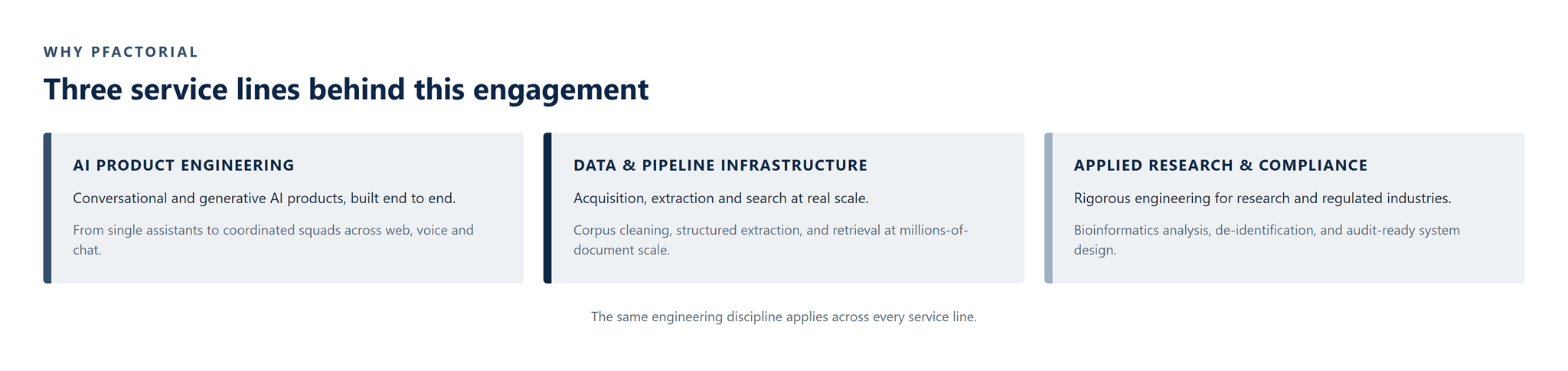
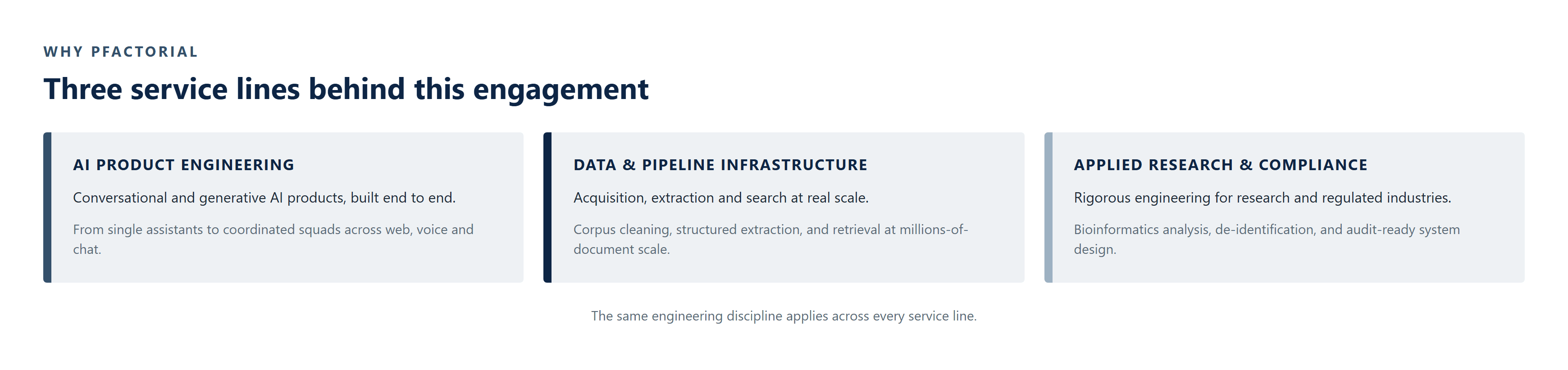
This engagement draws on Pfactorial's AI product engineering capability: multi-agent systems built on durable orchestration, grounded in the client's own data, and designed with explicit human-control boundaries rather than open-ended autonomy.
CS-003_AI_Sales_Operations_Employee image 5
Figure - Service lines this engagement draws on.
Engagement enquiries Pfactorial Technologies works with revenue teams looking to automate the research-to-meeting loop without losing judgment at the moments that matter. If you are evaluating an autonomous sales or outreach system, we are happy to give you an honest read on scope, cost, and risk before anyone commits to anything. · pfactorial.ai
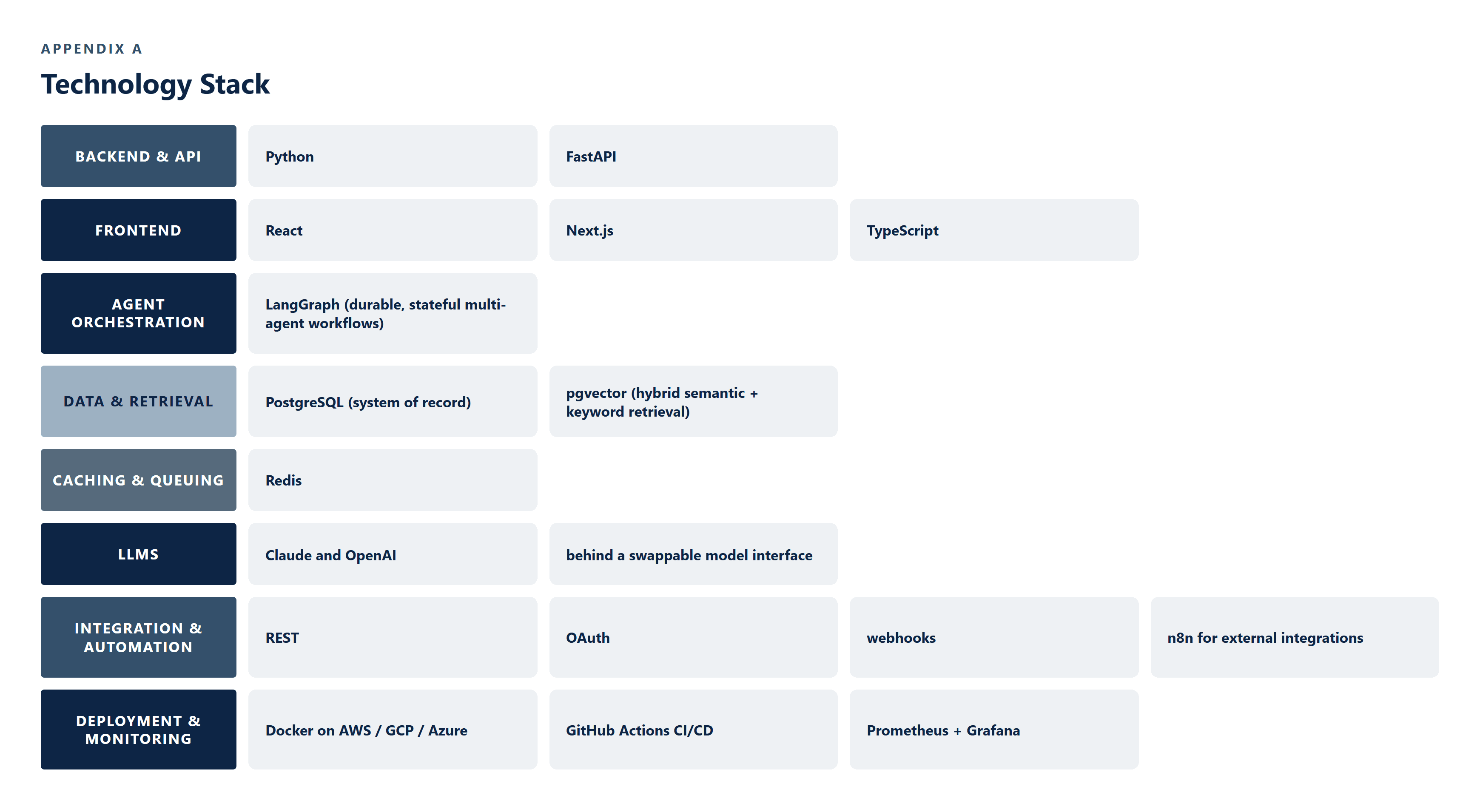
APPENDIX A - TECHNOLOGY STACK
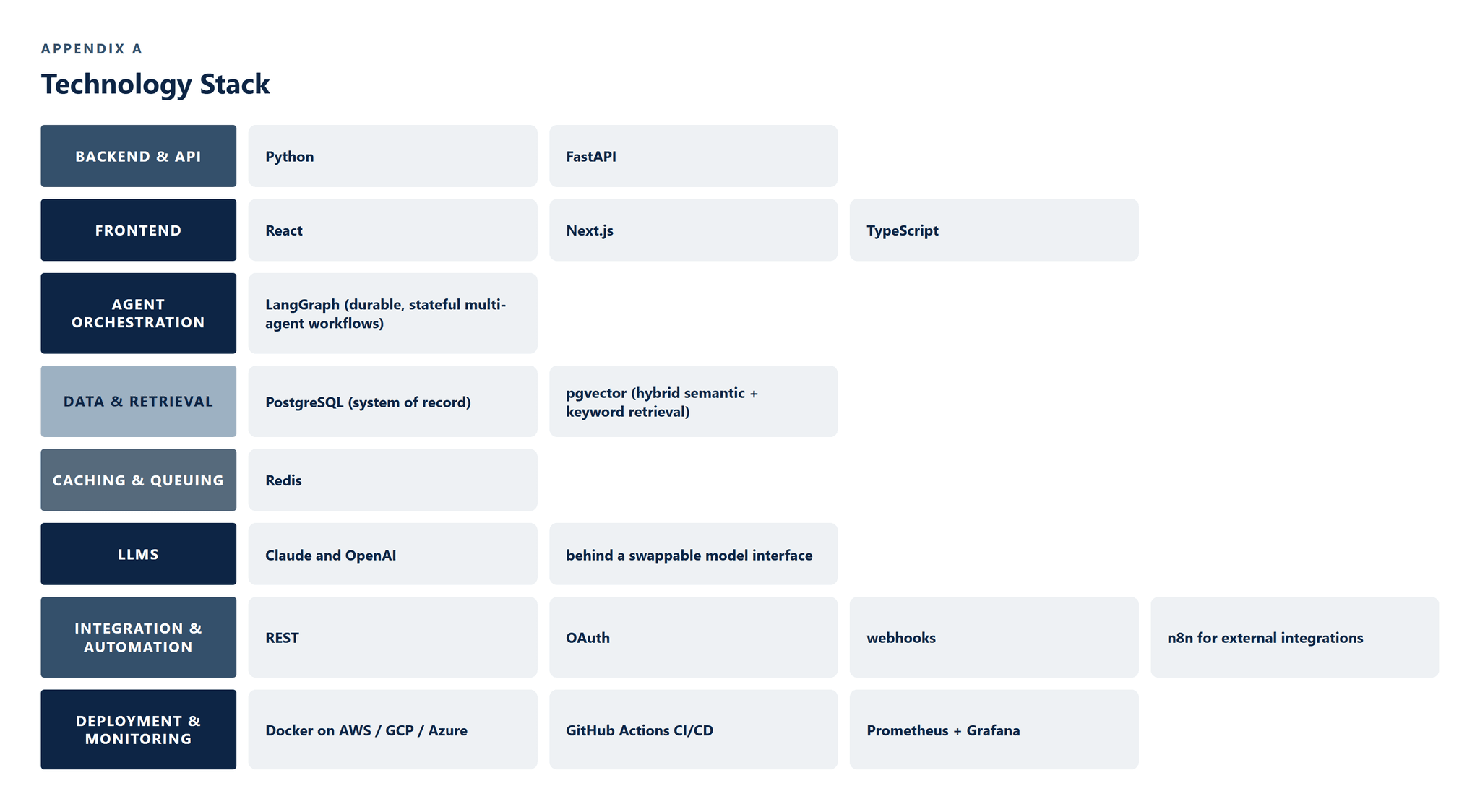
The technology stack underpinning the system, grouped by the layer it serves.
CS-003_AI_Sales_Operations_Employee image 6

Result and Analysis

ENGAGEMENT SNAPSHOT

A proposed multi-agent system that carries a lead from first research through to a booked meeting - reasoning and acting inside explicit guardrails, rather than running a fixed outreach sequence.
CS-003_AI_Sales_Operations_Employee image 1
CS-003_AI_Sales_Operations_Employee image 2
CS-003_AI_Sales_Operations_Employee image 3
CS-003_AI_Sales_Operations_Employee image 4
CS-003_AI_Sales_Operations_Employee image 5
CS-003_AI_Sales_Operations_Employee image 6