Back
Multi-Agent & Agentic Systems
Architecting an AI-Native Financial Context Engine for Creators
A five-layer MVP architecture that consolidates fragmented creator financial data into a single, ontology-driven view - designed on the same agentic, RAG, and hybrid-search patterns proven across Pfactorial's prior delivered systems.
August 21, 2026
Share
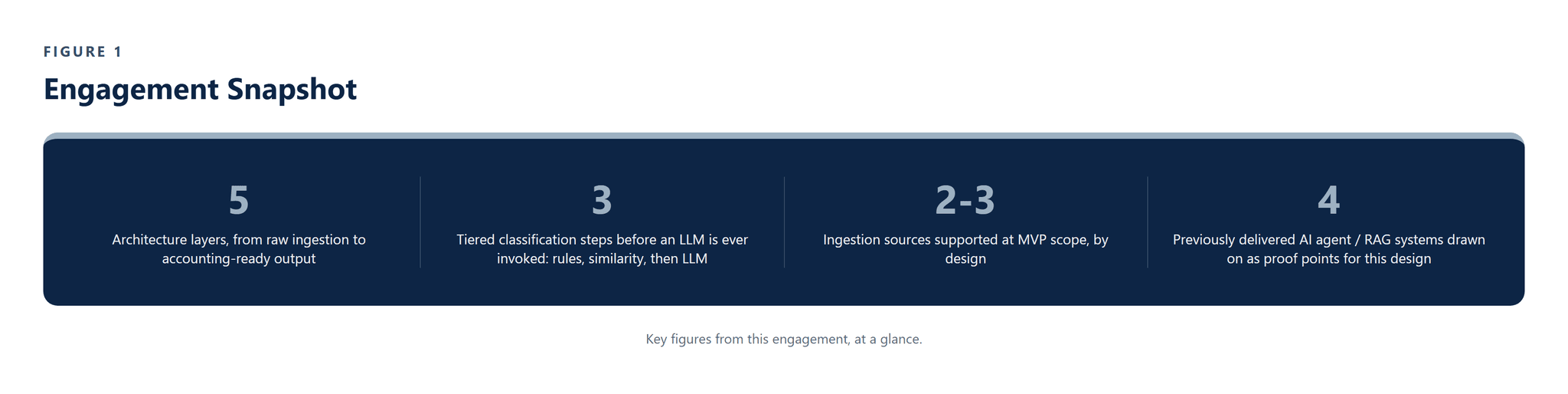
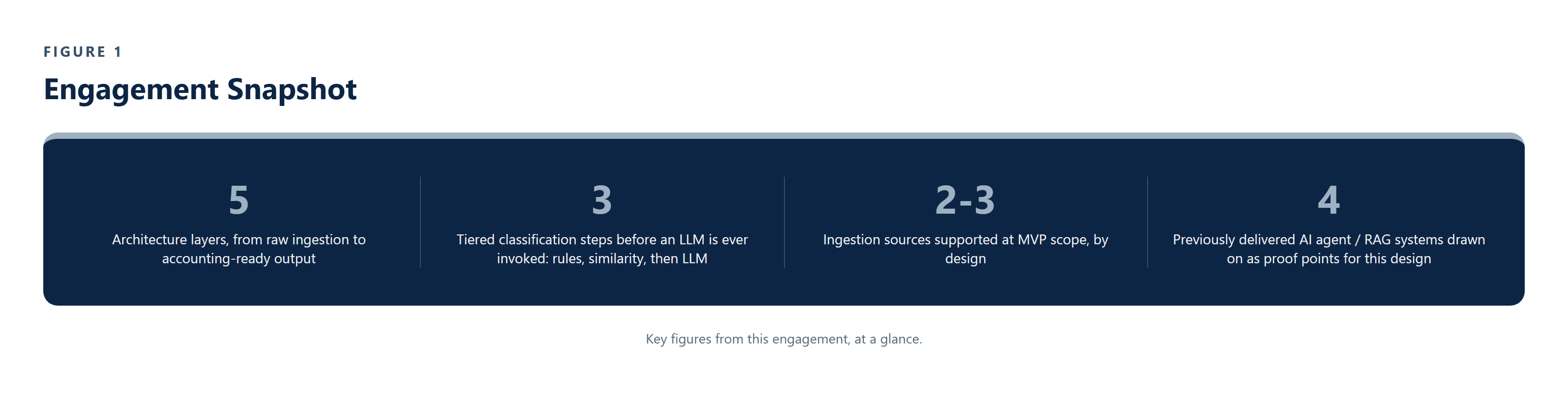
ENGAGEMENT SNAPSHOT

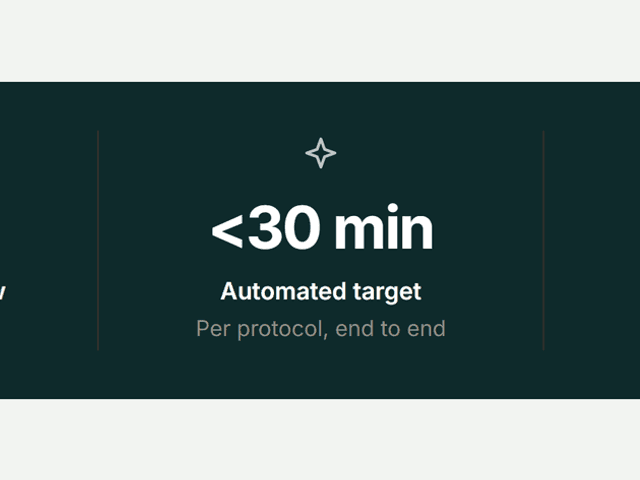
Figure 1 - Key figures from this engagement, at a glance.
EXECUTIVE SUMMARY
Our client is building an AI-native fintech product for online creators, whose income and expenses are scattered across platform payouts, payment processors, bank accounts, contracts, invoices, and manually uploaded files. No single source tells a creator - or their accountant - what actually happened financially in a given month.
Pfactorial Technologies was engaged to architect the MVP: a Financial Context Engine that ingests every one of those fragmented sources, applies domain-specific reasoning to understand how they relate, and generates structured accounting workflows a human reviews before anything is finalized. The design draws directly on Pfactorial's delivered work in agentic RAG systems, hybrid search, and structured knowledge extraction, adapted to the specific demands of financial data: auditability, traceability, and zero tolerance for silent misclassification.
Rather than proposing a single monolithic AI system, the architecture is deliberately layered - raw ingestion, normalization, financial ontology, reasoning and orchestration, and accounting output - so that every downstream decision can be traced back to its original source record, and so the system can start small and expand without a redesign.
Why this engagement is representative This engagement demonstrates Pfactorial's approach to architecting AI systems for regulated, high-stakes domains: layering deterministic rules, similarity matching, and constrained LLM reasoning so that automation earns trust incrementally, with every financial decision traceable back to its source.
THE CHALLENGE
Creator financial data is fragmented by nature, and a fintech product aimed at creators has to reconcile it without asking anyone to become a bookkeeper. Four problems shaped the architecture.
1. Financial data has no single source of truth
Creator income and expenses span platform APIs (YouTube/AdSense, Stripe, PayPal, Patreon), bank feeds, and manually uploaded CSVs, PDF statements, invoices, and brand-deal contracts - each with its own format and no shared schema.
2. Financial systems cannot tolerate silent errors
A miscategorized transaction or an unreconciled brand payment is not a cosmetic bug - it is a tax and audit problem. Every downstream decision needs to be traceable back to the original source record, timestamped and versioned.
3. Full automation and full manual review are both wrong
Rule-based logic alone cannot handle the ambiguity in real creator finances - brand deals, mixed-currency payouts, unusual expense categories - but sending every transaction to an LLM, or to a human, does not scale.
4. MVP scope has to be real, not a demo
The architecture had to work end to end for a genuinely useful slice - a handful of ingestion sources, one country's tax rules, the primary revenue streams - rather than a broad but shallow prototype.
The real brief Not "build an AI bookkeeper" but "design an MVP architecture that consolidates fragmented financial sources into structured, auditable accounting workflows - with a human validating every AI-generated output before it counts as done."
THE SOLUTION
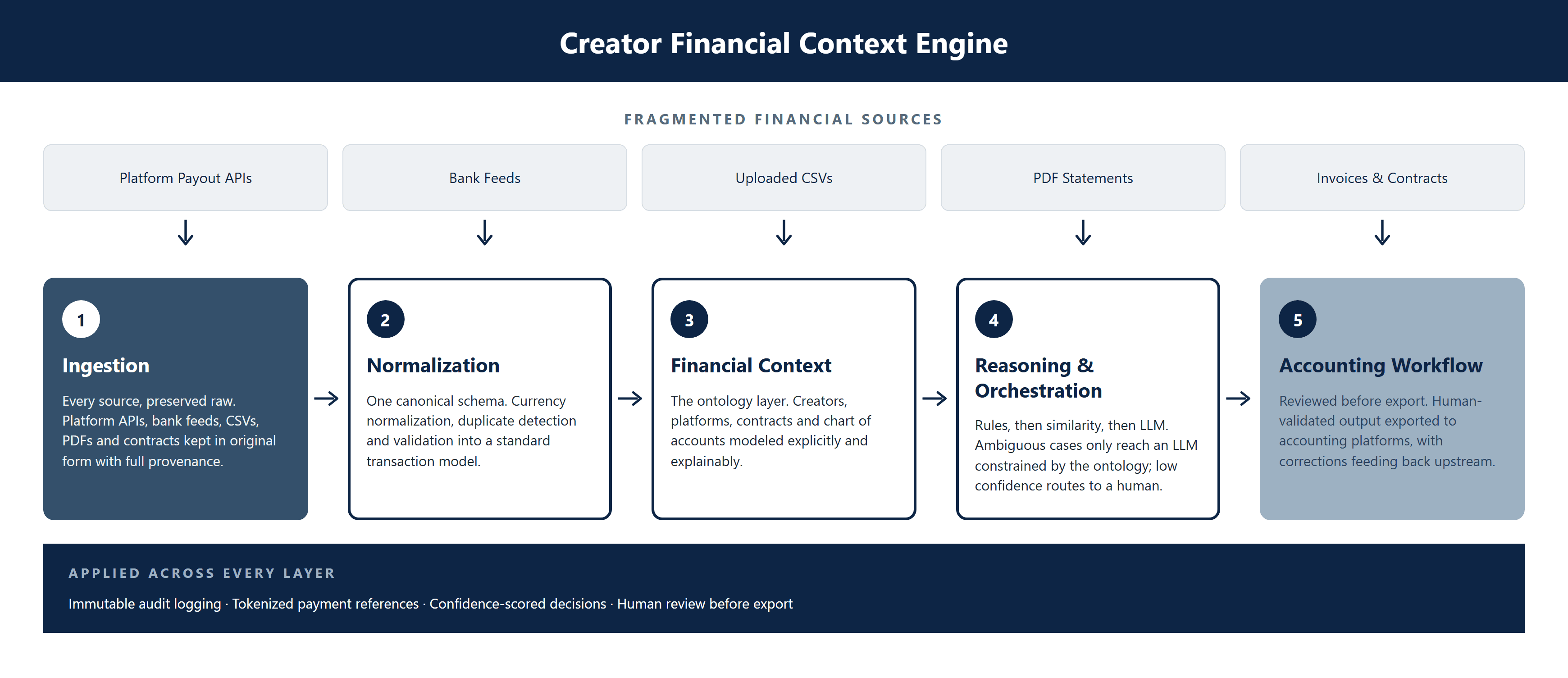
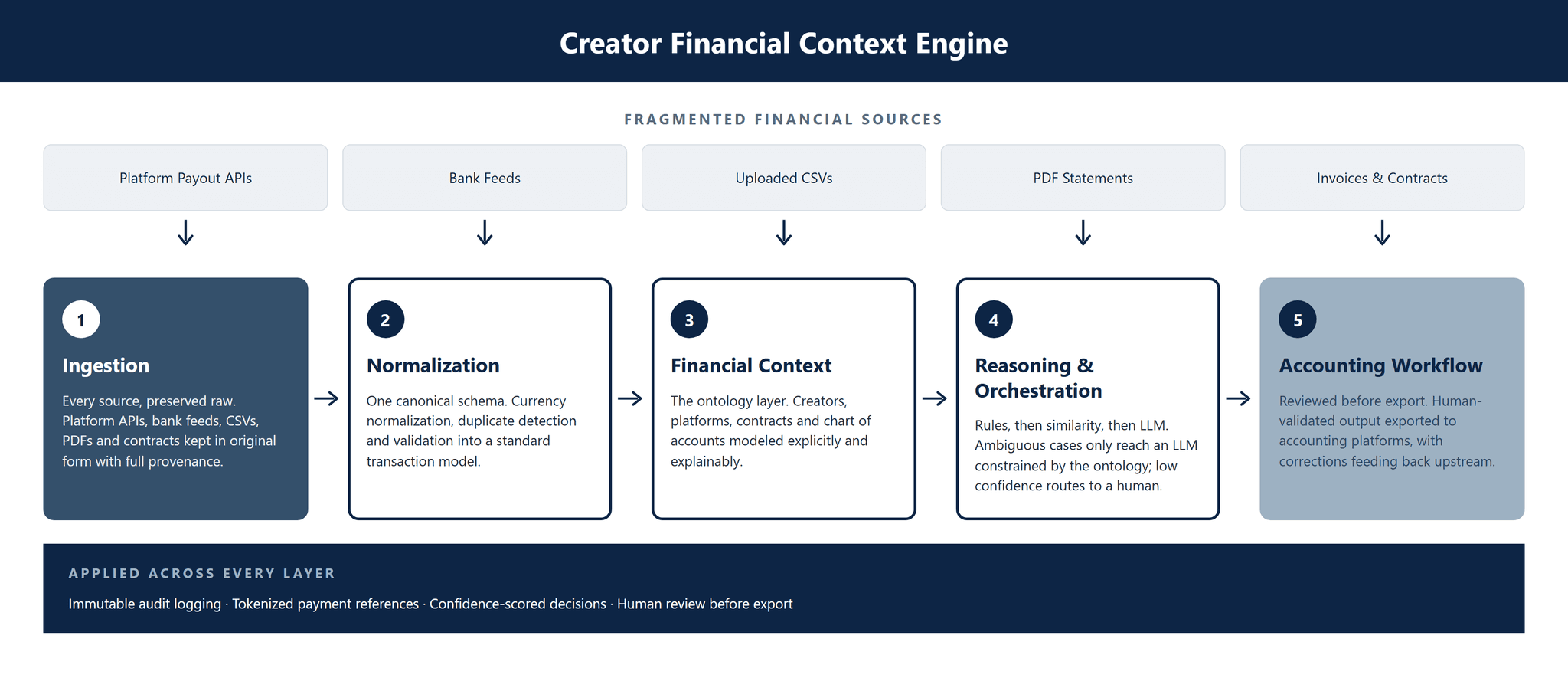
Pfactorial architected the Financial Context Engine as five layers, each with a single responsibility, so that fragmented raw data becomes a structured financial record before any reasoning is applied to it - and every corrected output feeds back into the system that produced it.

Figure 1 - The five-layer MVP architecture: ingestion, normalization, financial context (ontology), reasoning and orchestration, and accounting workflow output, with human corrections feeding back.
Architectural principles
- Raw data is immutable and provenanced - every incoming file or API response is preserved in its original form, with source metadata, timestamps, and unique identifiers, before any transformation - so every downstream record and decision can be traced back to its origin.
- One canonical schema, many source adapters - source-specific adapters map every platform export, bank feed, and manual upload into a single standardized transaction model, so downstream services never need to know where a record originally came from.
- Reasoning is tiered, not monolithic - deterministic rules handle predictable transactions first; unresolved cases are compared against similar, already-confirmed transactions; only genuinely ambiguous cases reach an LLM constrained by the financial ontology, with a confidence score attached to every output.
- Human correction is training signal, not just a fix - when a reviewer corrects an AI-generated classification or reconciliation, that correction is captured as a new rule or labeled example, so the system needs the LLM less often over time rather than staying flat.
CAPABILITIES DELIVERED
The architecture spans the full path from fragmented raw data to accounting-ready output, with security and auditability designed in from the first layer rather than added later.
CAPABILITY | WHAT IT DOES |
|---|---|
Multi-Source Ingestion | Collects data from creator platform APIs, bank feeds via financial aggregators, and manually uploaded CSVs, PDFs, and contracts, preserving the raw source before transformation. |
Canonical Normalization | Maps every source into one standardized transaction schema, with currency normalization, duplicate detection, and validation applied consistently. |
Financial Ontology | Models creators, platforms, brands, contracts, revenue streams, expense categories, and the chart of accounts as version-controlled, explainable relational entities. |
Tiered Classification & Reconciliation | Escalates from fixed rules to similarity matching to a constrained LLM, only as needed, with every classification carrying a confidence score and rationale. |
Human Review Loop | Routes low-confidence transactions to a reviewer, and captures every correction as a new rule or labeled example that reduces future escalations. |
Accounting-Ready Output | Produces categorized journal entries, revenue summaries, tax estimates, and reconciliation reports, exportable to accounting platforms via API or CSV. |
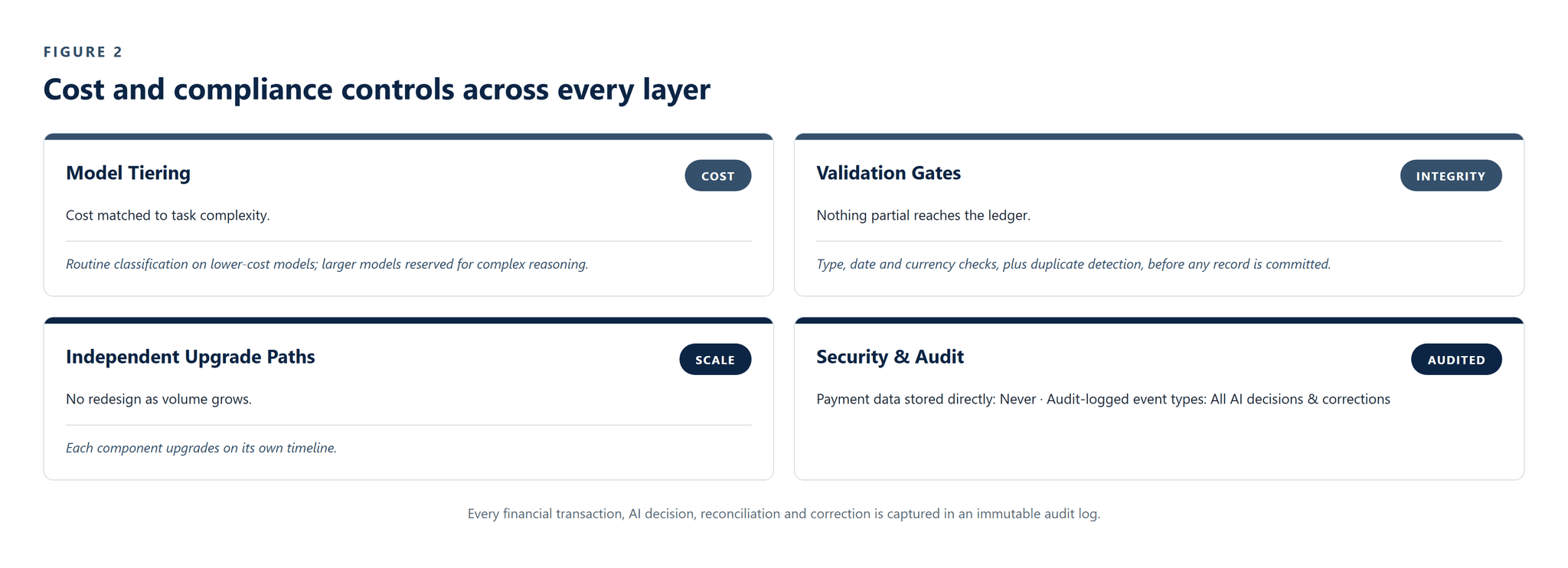
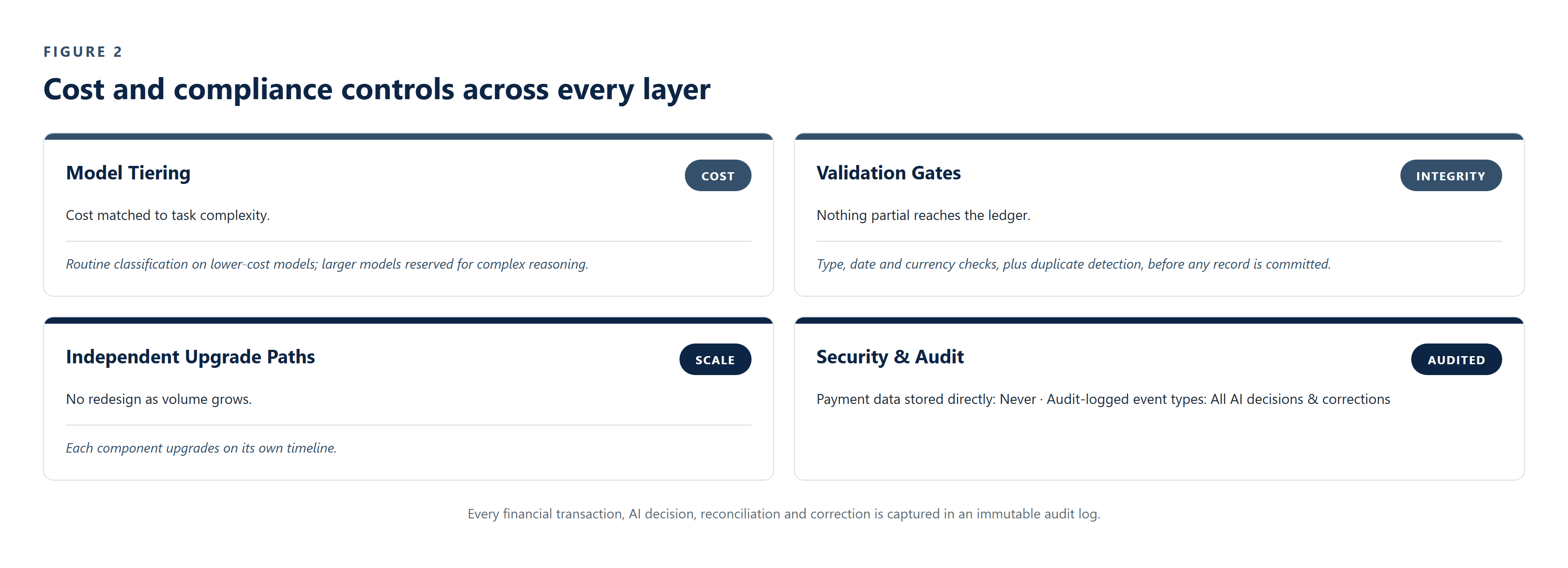
Figure 2 - Where the engine's outputs plug in, and the cost and compliance controls applied across every layer from day one.
Design note The MVP is intentionally scoped to two to three ingestion sources, a single country's tax rules, and the five primary creator revenue streams, with every architectural component (compute, vector storage, orchestration) chosen for a clear upgrade path as volume grows, rather than requiring a redesign at scale.
ENGINEERING FOR SCALE AND RELIABILITY
Several engineering decisions distinguish an architecture that survives contact with real, messy financial data from one that only works on a clean demo dataset.
Adapters isolate format risk
each source type - APIs, CSVs, PDFs, platform exports - has its own adapter that converts into the single canonical schema, so a format change in one source cannot silently corrupt records from another.
Validation gates protect the ledger
every record is checked for correct data type, valid dates, and currency values, with duplicate detection via a composite identifier; if any check in a batch fails, the whole batch is held rather than partially committed.
Cost is managed by model tiering, not by cutting corners
routine classification runs on smaller, lower-cost models, with larger models reserved for complex reasoning and reconciliation, alongside prompt caching, asynchronous batch processing, and pgvector instead of a dedicated vector database at MVP scale.
Every component has an independent upgrade path
compute (Fargate to Kubernetes) and vector storage (pgvector to a dedicated vector store) can each be upgraded independently as volume grows, without requiring an architectural redesign.
Security and audit logging apply from layer one
every financial transaction, AI decision, reconciliation, and user correction is captured in an immutable audit log; sensitive payment information is never stored directly, with providers like Stripe and Plaid integrated via tokenization to minimize PCI compliance scope.
Format drift is caught in testing, not production
each adapter is tested against sample files and the system tracks parsing success and auto-classification rates per source, so an unannounced format change from a data source is detected before it causes downstream errors.
DELIVERY APPROACH
The engagement moved from four open technical questions to a validated MVP architecture and stack recommendation in a structured design process.
1. Establish the evidence base - reviewed Pfactorial's delivered AI agent systems (contract intelligence, clinical trial matching, tax document search, real-time voice AI) for architectural patterns directly applicable to financial data reasoning.
2. Design the five-layer architecture - defined ingestion, normalization, financial context, reasoning and orchestration, and accounting workflow as separate layers with a single canonical schema running through all of them.
3. Specify the tiered classification approach - designed the rules-then-similarity-then-LLM escalation path, with a confidence threshold routing uncertain transactions to human review.
4. Recommend the MVP technical stack - selected managed, proven technologies (FastAPI, PostgreSQL with pgvector, Redis, S3, Fargate) prioritizing rapid delivery and a clear migration path over premature infrastructure complexity.
5. Define security and compliance posture - specified encryption at rest and in transit, tokenized payment references, role-based access, and immutable audit logging as day-one requirements, positioned for future SOC 2 Type II certification.
6. Scope the MVP boundary explicitly - defined the initial MVP as two to three ingestion sources, one country's tax rules, and the five primary revenue streams, with reviewer feedback captured as a continuous learning loop.
RESULTS AND IMPACT

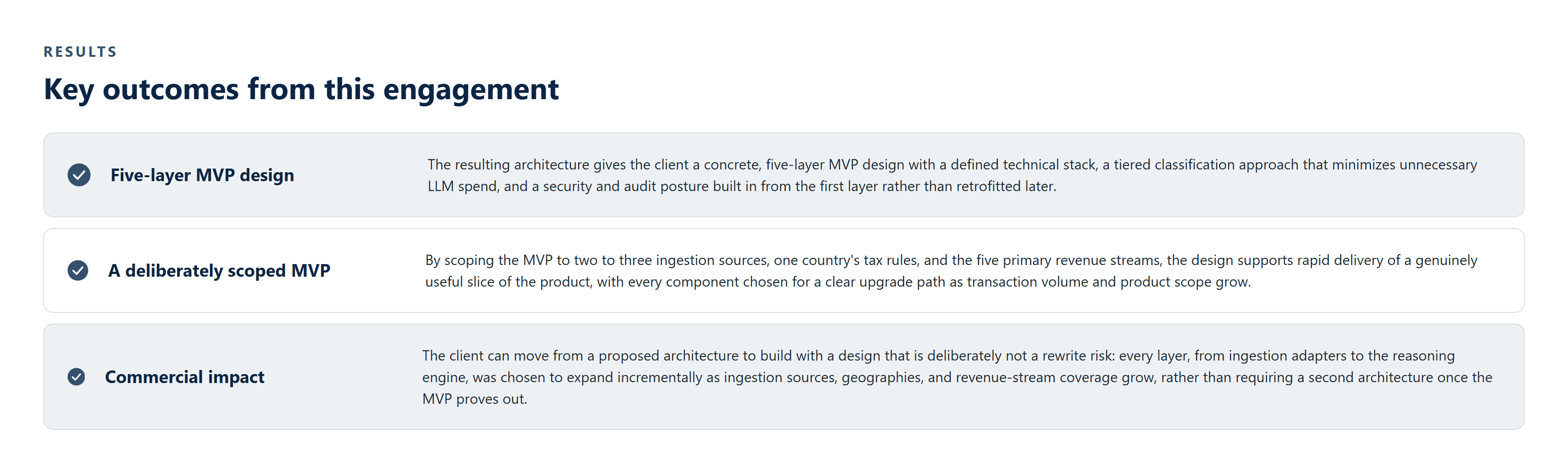
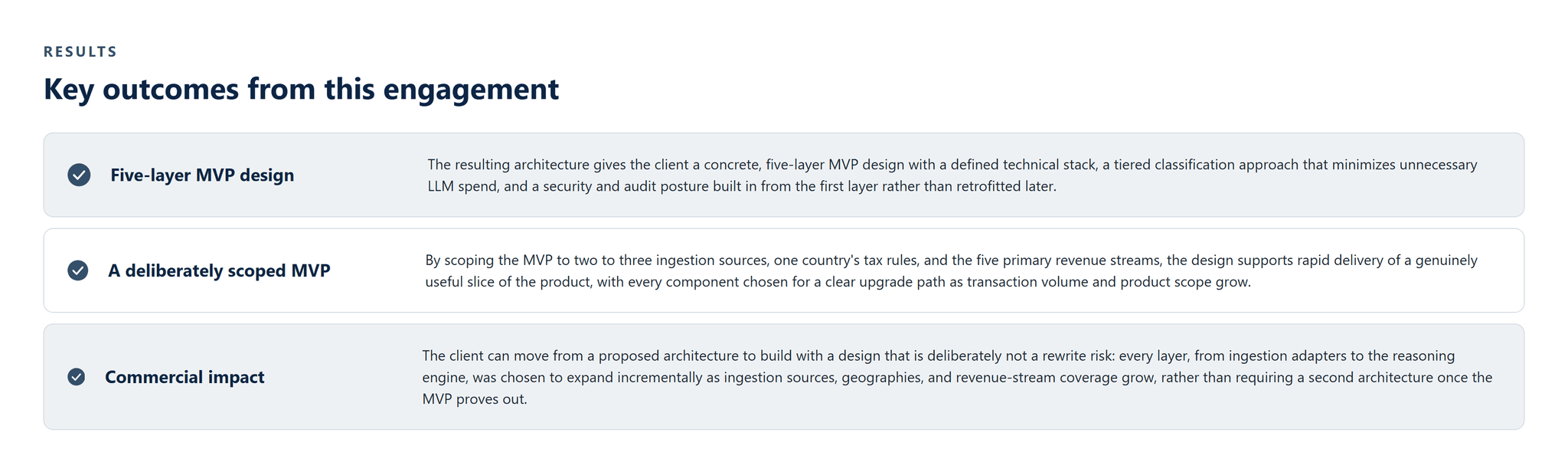
Figure - Key outcomes from this engagement.
The resulting architecture gives the client a concrete, five-layer MVP design with a defined technical stack, a tiered classification approach that minimizes unnecessary LLM spend, and a security and audit posture built in from the first layer rather than retrofitted later.
By scoping the MVP to two to three ingestion sources, one country's tax rules, and the five primary revenue streams, the design supports rapid delivery of a genuinely useful slice of the product, with every component chosen for a clear upgrade path as transaction volume and product scope grow.
What it enabled commercially
The client can move from a proposed architecture to build with a design that is deliberately not a rewrite risk: every layer, from ingestion adapters to the reasoning engine, was chosen to expand incrementally as ingestion sources, geographies, and revenue-stream coverage grow, rather than requiring a second architecture once the MVP proves out.
WHY PFACTORIAL
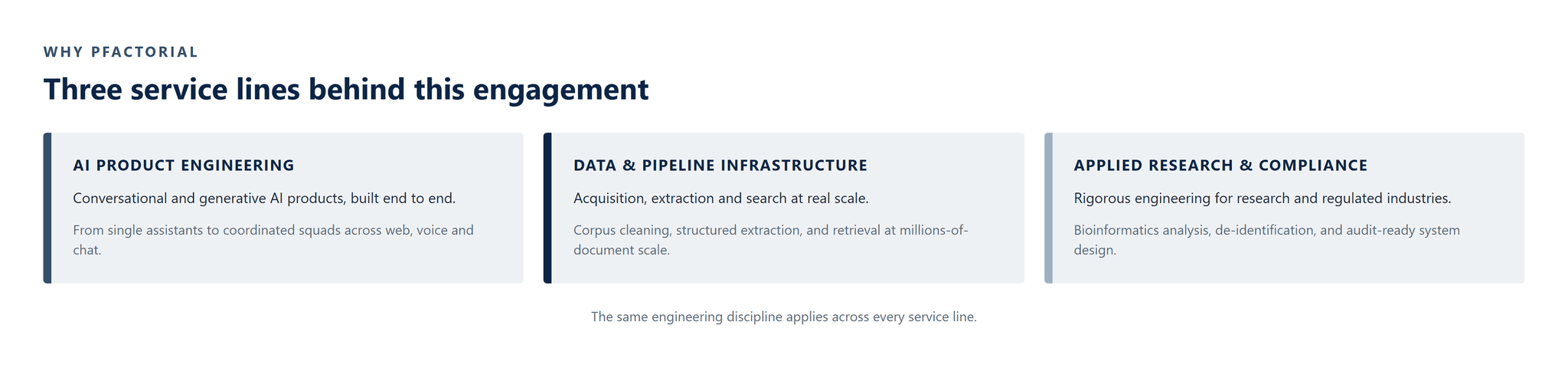
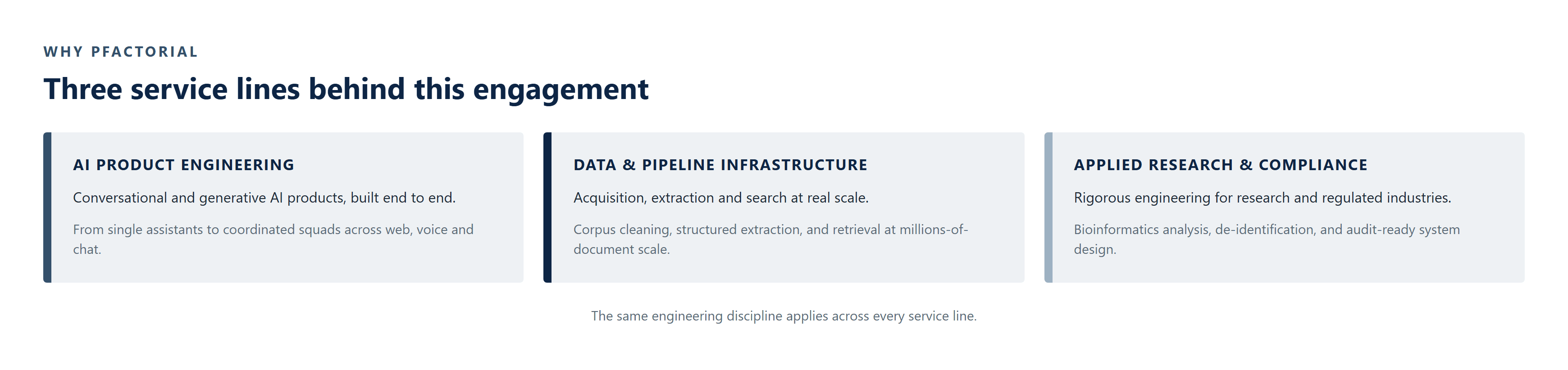
This engagement draws on Pfactorial's AI product engineering and data pipeline infrastructure capability: designing layered, auditable architectures for domains where an AI decision has to be explainable and traceable, not just statistically likely to be right.

Figure - Service lines this engagement draws on.
Engagement enquiries Pfactorial Technologies works with fintech and data-intensive product teams who need an AI architecture that is both fast to ship and safe to operate. If you are scoping an MVP where trust and auditability matter as much as automation, we are happy to give you an honest read on architecture, cost, and risk before anyone commits to anything. · pfactorial.ai
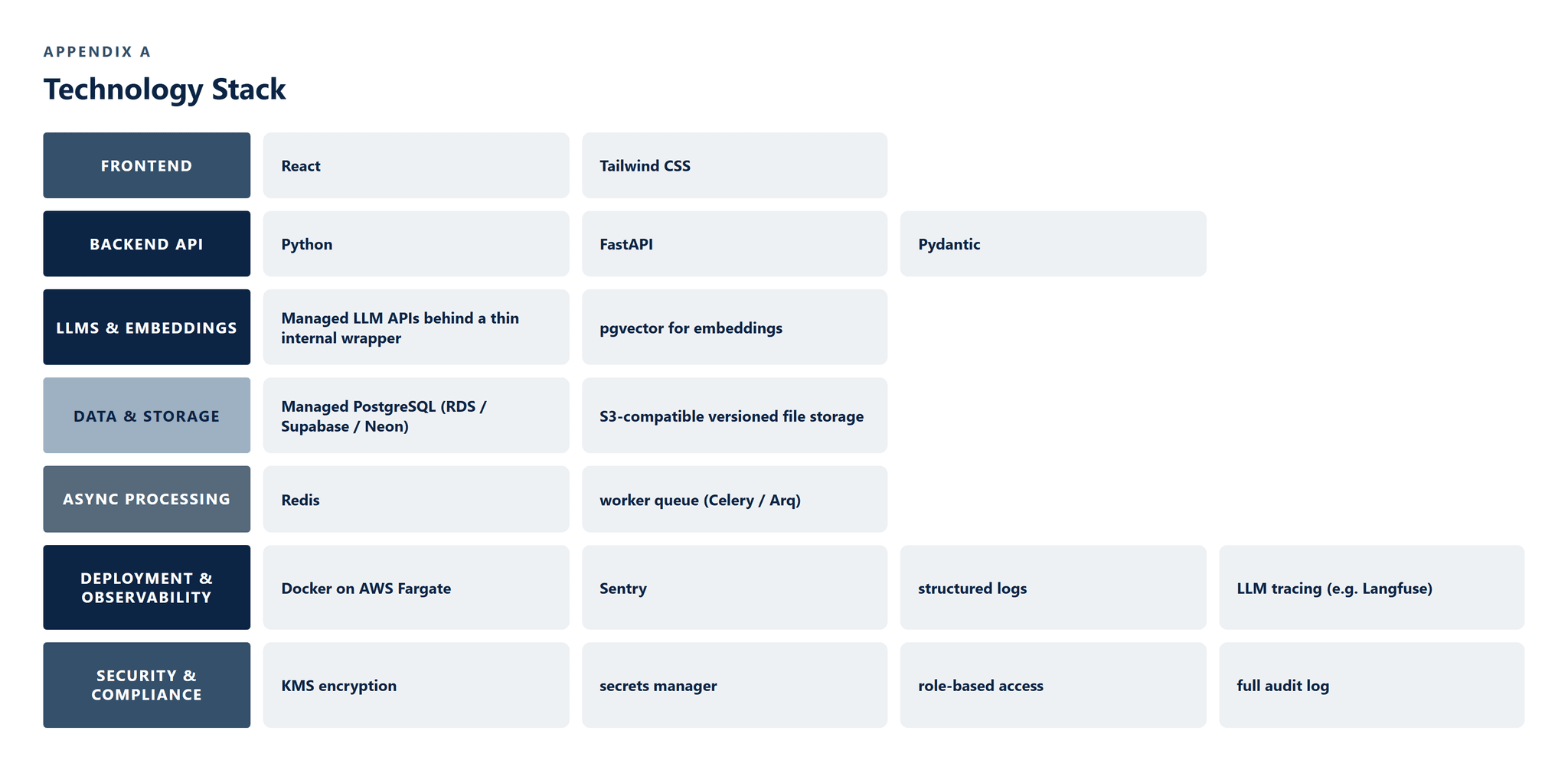
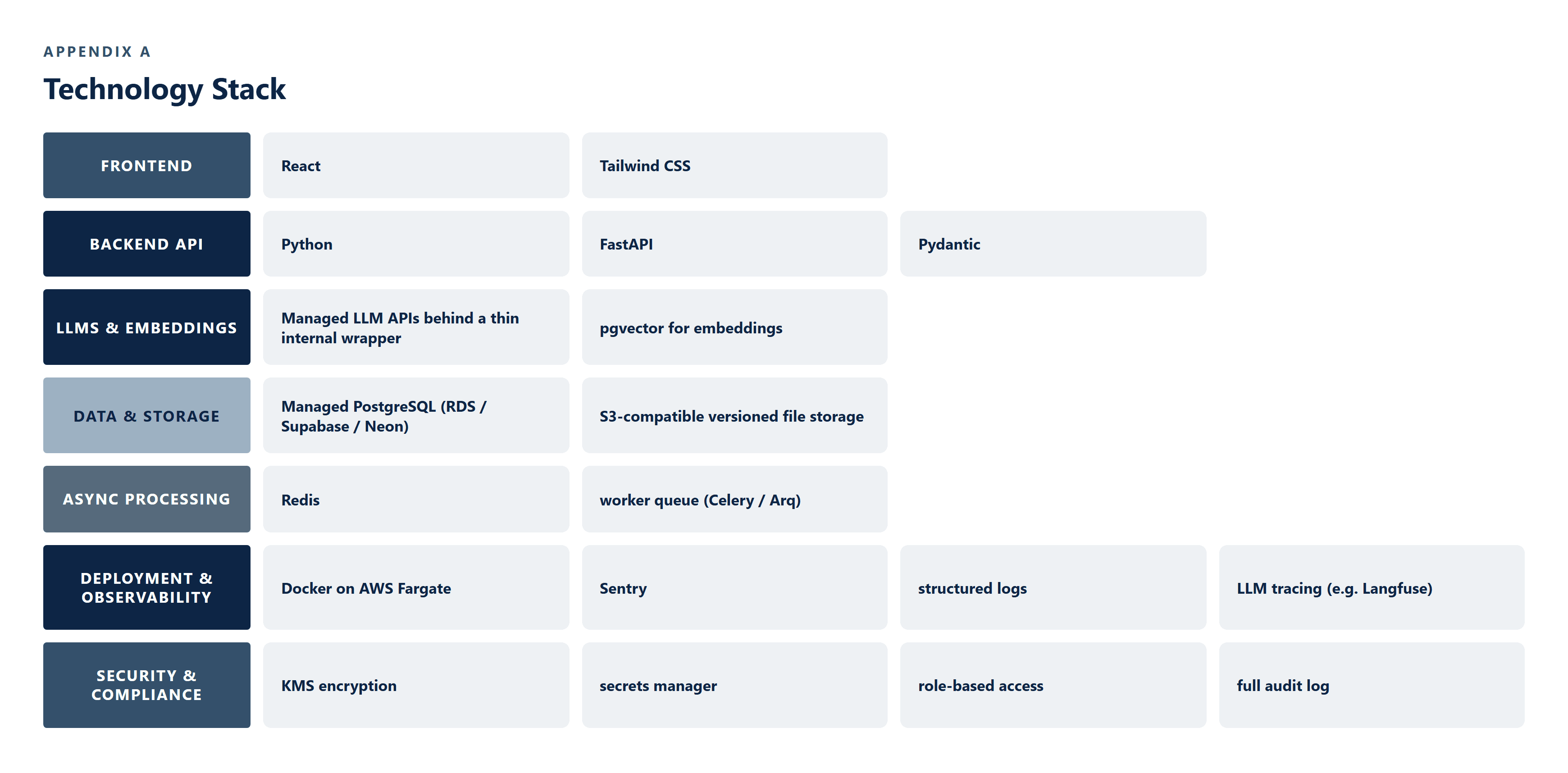
APPENDIX A - TECHNOLOGY STACK
The technology stack underpinning the system, grouped by the layer it serves.

Result and Analysis
ENGAGEMENT SNAPSHOT
A five-layer MVP architecture that consolidates fragmented creator financial data into a single, ontology-driven view - designed on the same agentic, RAG, and hybrid-search patterns proven across Pfactorial's prior delivered systems.
CASE STUDIES
You might also like...

OCR & Document ExtractionRAG & Semantic SearchFinance & Payments
Aug 21, 20267 min readRead

Multi-Agent & Agentic SystemsRAG & Semantic Search
An Agentic, Six-Agent Pipeline for Deterministic Clinical Trial Eligibility Matching
Aug 21, 20267 min readRead

RAG & Semantic Search
Designing a Shared Agentic Knowledge Infrastructure Across Slack, Notion, and Meetings
Aug 21, 20269 min readRead

Multi-Agent & Agentic Systems
Matching Surgical Instrument Inquiries to Catalog Items by Meaning, Not Keywords
Aug 21, 20268 min readRead

RAG & Semantic SearchAutomotive & Vehicle
A Botpress-Built AI Sales & Service Assistant That Qualifies Automotive Leads 24/7
Aug 21, 20267 min readRead

RAG & Semantic Search
A Layered Analytics Platform for CXO-Level Decision-Making
Aug 21, 20268 min readRead