Back
Content & Media Generation
An Abstractive Text Summarization Service Built on a Gap-Sentence Transformer Model
How Pfactorial Technologies built a PEGASUS-based summarizer that condenses long-form text into a summary and an auto-generated headline through one pipeline.
August 21, 2026
Share
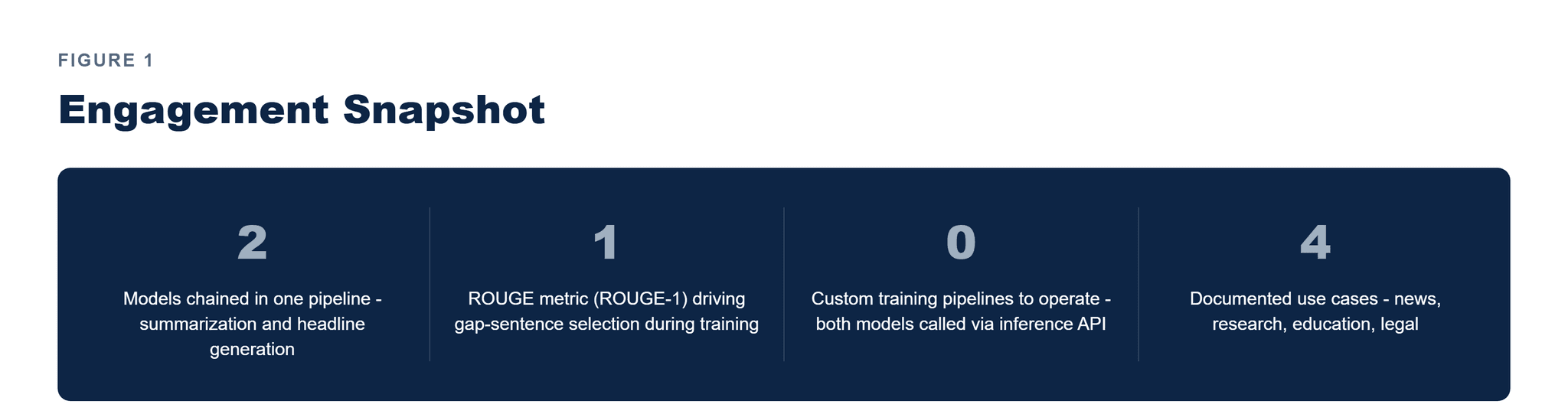
ENGAGEMENT SNAPSHOT

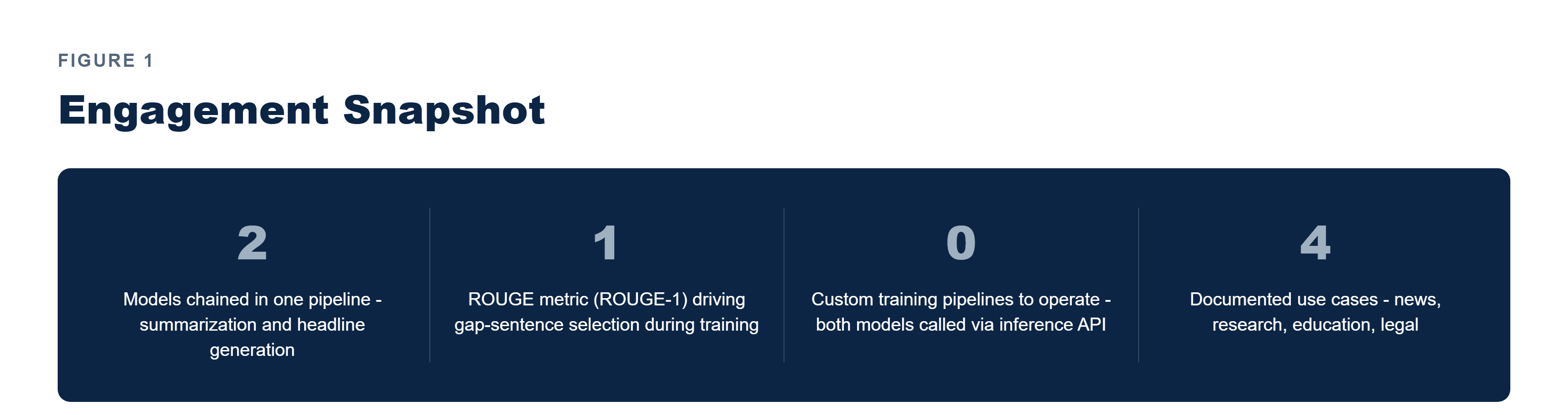
Figure 1 - Key figures from this engagement, at a glance.
EXECUTIVE SUMMARY
Our client needed a way to condense long-form text - news articles, research papers, lecture material, legal documents - into a short summary and headline, without a reader having to work through the entire source.
Building and training a summarization transformer from scratch is a substantial undertaking, and naive extractive approaches that simply pull sentences verbatim from the source don't produce the more natural, easily scanned phrasing a genuine summary needs; what was needed was abstractive summarization without owning a training pipeline.
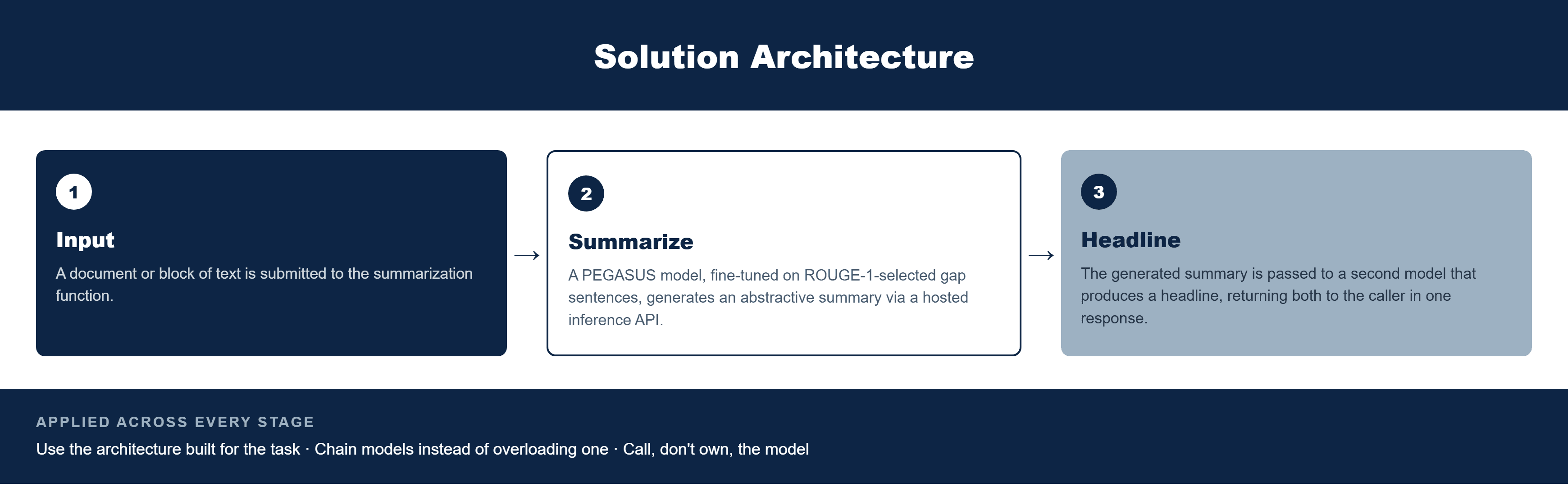
Pfactorial built a two-stage pipeline chaining a fine-tuned PEGASUS abstractive-summarization model with a headline-generation model, both called through a hosted inference API, wrapped behind a single function and endpoint.
Why this engagement is representative This engagement demonstrates Pfactorial's ability to select and apply the transformer architecture actually built for a task - PEGASUS's gap-sentence pretraining for summarization - rather than defaulting straight to a general-purpose model.
THE CHALLENGE
Producing a genuinely abstractive summary and headline from arbitrary long-form text surfaced problems that a naive approach doesn't solve.
1. Long-form text needs both a summary and a scannable headline
A summary alone doesn't give a reader the one-line hook, so the pipeline needed to produce both outputs from the same input, not just one.
2. Abstractive summarization is a harder problem than extraction
Simply pulling existing sentences out of the source reads as choppy; producing new, coherent sentences that capture the same meaning requires a model trained specifically for that task.
3. Selecting the right sentences to train on isn't arbitrary
The model's gap-sentence training data has to be built by scoring candidate sentences for how representative they are of the source, not chosen at random.
4. Abstractive summarization can lose detail a reader wanted
Condensing necessarily drops some specifics, so the trade-off between brevity and completeness has to be visible and documented, not hidden from the client.
The real brief Not "return the first few sentences of the article" but "generate a genuinely abstractive summary and headline, using a model architecture built for exactly that trade-off, and be honest about what it costs."
THE SOLUTION
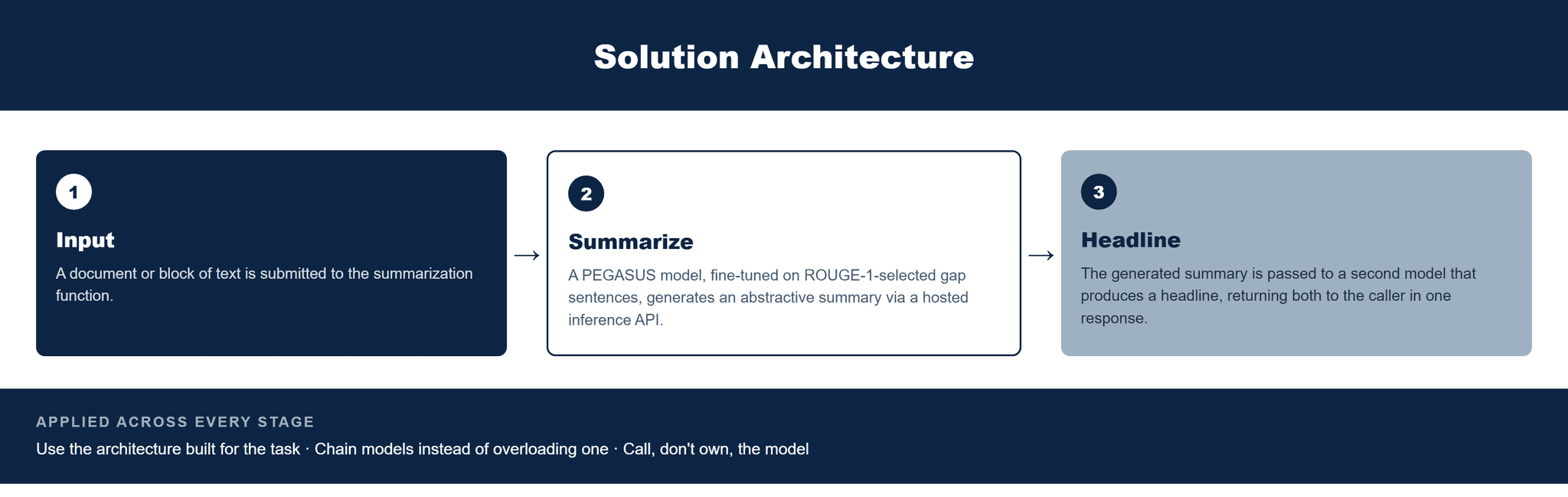
Pfactorial built a chained, two-model pipeline that turns submitted text into an abstractive summary and a matching headline through one function.

Figure 1 - One function chains two purpose-fit inference calls into a single summary-and-headline response.
Architectural principles
- Use the architecture built for the task - PEGASUS's gap-sentence pretraining is purpose-built for abstractive summarization, chosen as the more defensible fit over a general-purpose model for this specific problem.
- Chain models instead of overloading one - Summarization and headline generation are two distinct calls to two distinct models, not one model asked to do both jobs at once.
- Call, don't own, the model - Both models run behind a hosted inference API, so the deliverable is the pipeline and its integration, not a self-hosted training and serving stack.
CAPABILITIES DELIVERED
Each capability addresses a distinct part of turning long-form text into something a reader can scan in seconds.
CAPABILITY | WHAT IT DOES |
|---|---|
Abstractive summary generation | Condenses submitted text into a shorter, reworded summary rather than an excerpt. |
Automatic headline generation | The generated summary is passed through a second model to produce a scannable headline. |
Single-function API | One function serves both summarization and headline generation depending on which endpoint is called. |
Multi-domain applicability | Documented for use across news and media, research papers, textbooks and lectures, and legal documents. |
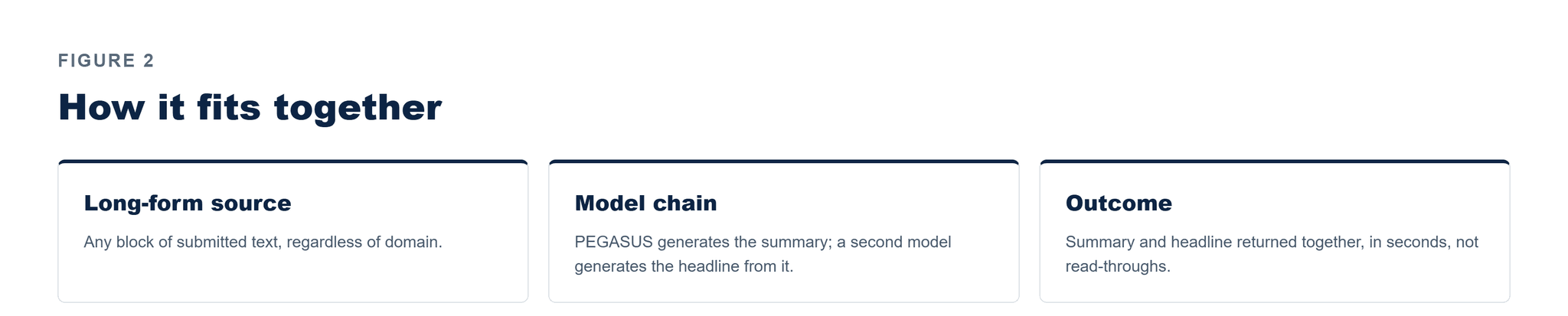
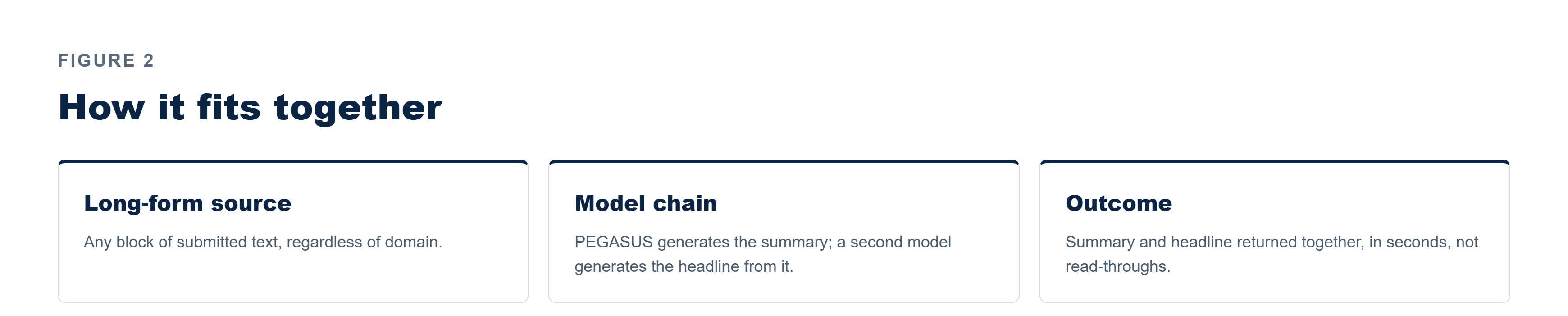
Figure 2 - One submitted document produces both a summary and a headline through the same chained pipeline.
Design note A side-by-side comparison against a general-purpose LLM on the same source text showed the fine-tuned PEGASUS pipeline losing some of the finer detail the larger model retained - a disclosed trade-off of a smaller, purpose-built model against a general-purpose one, not a defect hidden from the client.
ENGINEERING FOR SCALE AND RELIABILITY
Four decisions shaped the pipeline as a lean, inference-API-based service rather than a hosted training stack.
A fine-tuned, task-specific model instead of a general-purpose LLM
PEGASUS's gap-sentence-generation pretraining directly targets summarization; the pipeline's own comparison against a general-purpose model shows this trades some completeness for a smaller, purpose-fit model - an explicit, disclosed choice rather than a default.
ROUGE-1-driven gap-sentence selection for training data
Scoring candidate sentences by unigram overlap (ROUGE-1 F1) gives the training process an objective, repeatable criterion for what becomes a gap sentence, instead of manual selection.
Two chained inference calls instead of one overloaded model
Summarization and headline generation are separate model calls sharing one function signature, keeping each model focused on a single task.
Hosted inference API instead of self-hosted model serving
Both models run behind a hosted inference API, avoiding the operational overhead of hosting and scaling transformer inference directly.
DELIVERY APPROACH
The build moved from model selection through to a documented, honest comparison against a general-purpose alternative.
1. Model selection & fine-tuning - selecting PEGASUS for its gap-sentence pretraining and fine-tuning it using ROUGE-1-scored gap sentences from the training corpus.
2. Headline model integration - wiring a second, chained inference call that generates a headline from the summarizer's output.
3. Pipeline function & endpoint - building the summarization function and the request-handling endpoint that routes between summary and headline generation.
4. Evaluation against a general-purpose baseline - comparing pipeline output against a general-purpose LLM on the same source text to document the completeness trade-off.
RESULTS AND IMPACT

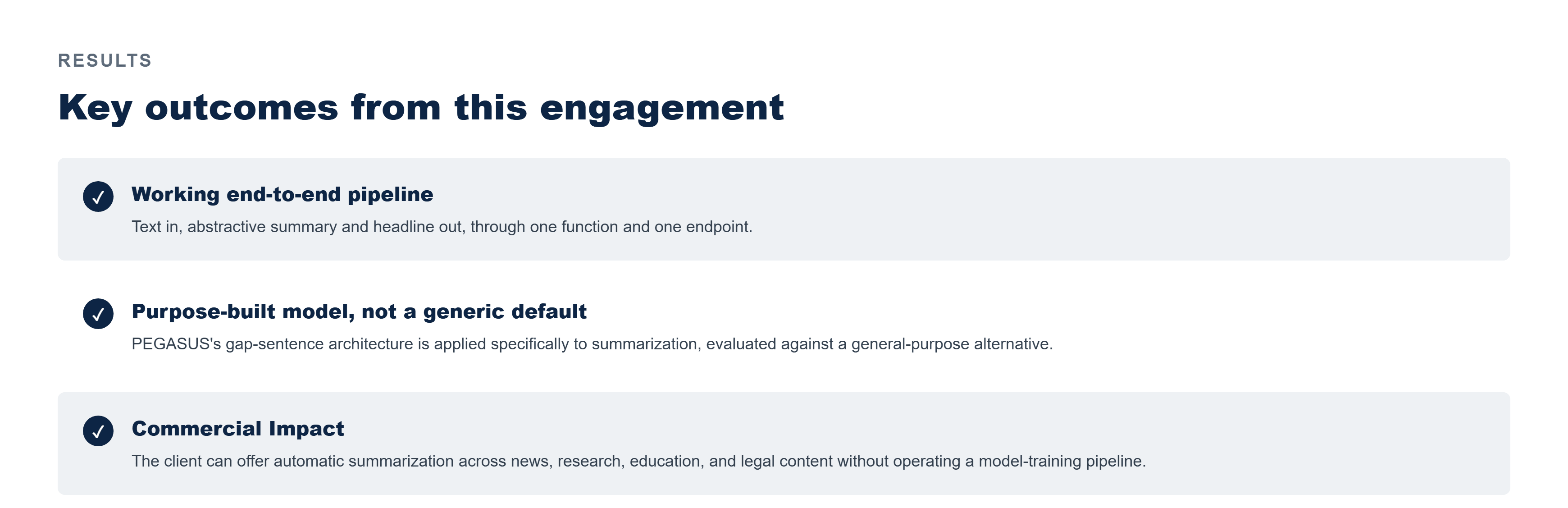
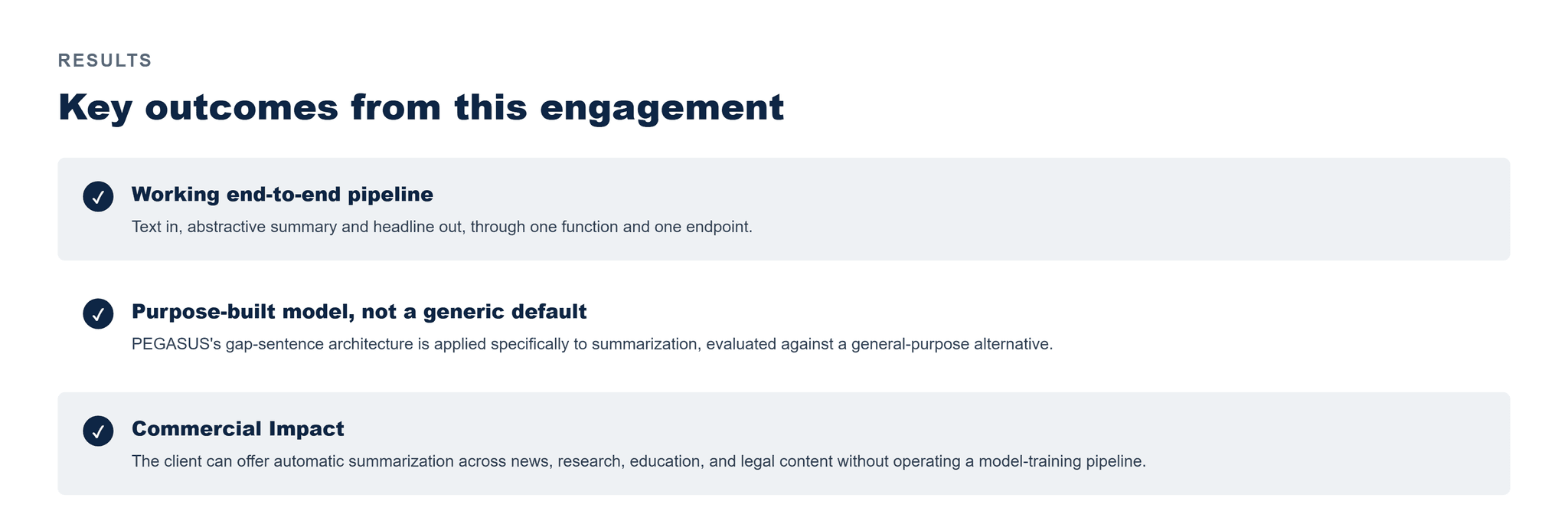
- Key outcomes from this engagement.
The pipeline reliably produces an abstractive summary and a matching headline from submitted text, through a single function chaining two purpose-fit inference calls.
A direct comparison against a general-purpose LLM summarizing the same source text showed the PEGASUS pipeline losing some finer detail that the larger model retained - a disclosed, known trade-off of using a smaller, task-specific model rather than a general one.
What it enabled commercially
The client can add automatic summarization and headline generation to a content workflow - news, research, educational, or legal - without building or hosting a training pipeline, while making an informed choice between this purpose-built model and a general-purpose LLM based on the documented completeness trade-off.
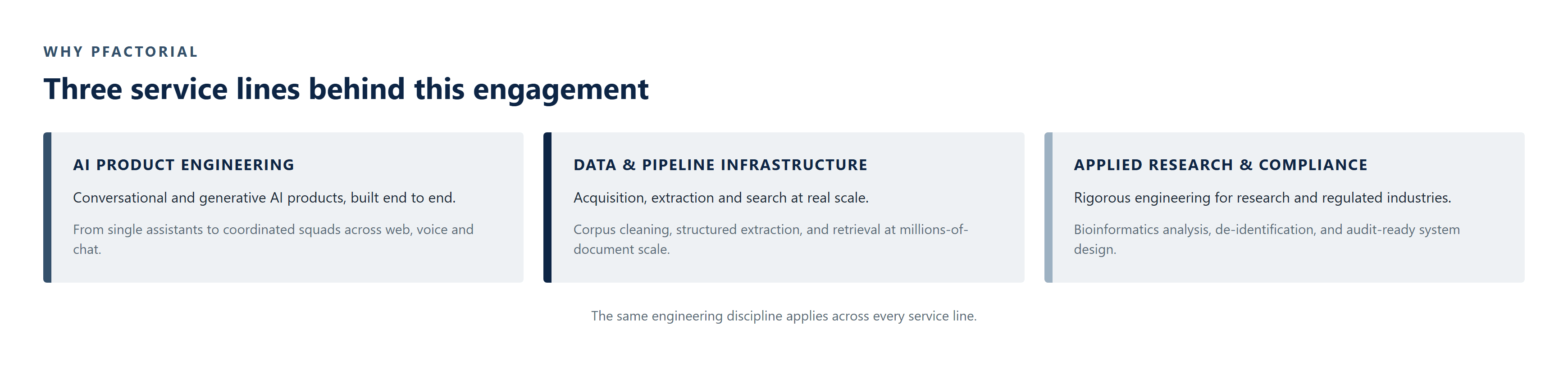
WHY PFACTORIAL
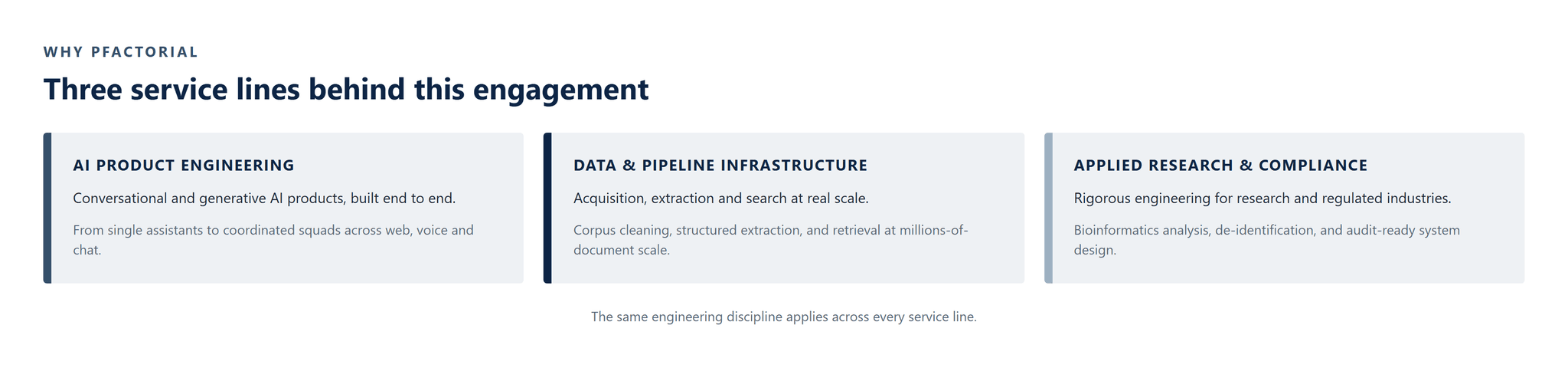
This engagement reflects Pfactorial's ability to select and integrate the model architecture that actually fits the problem - PEGASUS's gap-sentence pretraining for summarization - rather than reaching for a general-purpose LLM by default, and to be transparent about the resulting trade-offs.

- Service lines this engagement draws on.
Engagement enquiries Pfactorial Technologies works with organisations that need long-form content condensed reliably, without standing up a model-training pipeline of their own. If you're evaluating a summarization or content-processing capability, we're happy to give you an honest read on scope and risk before anyone commits to anything. · pfactorial.ai
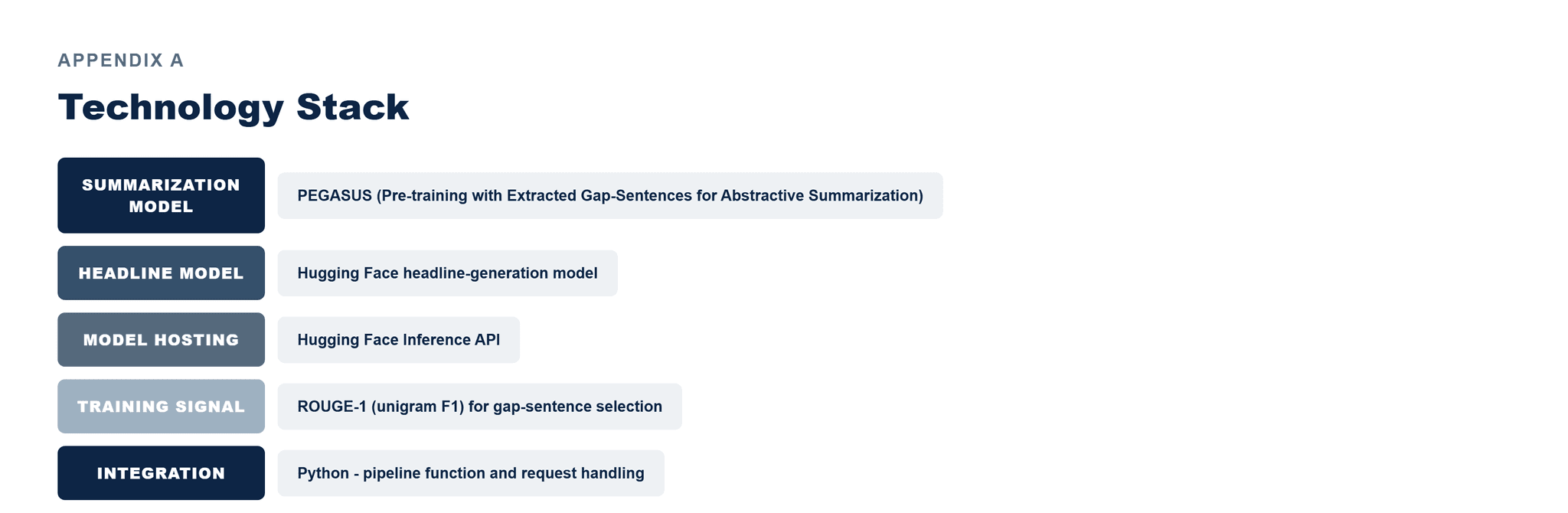
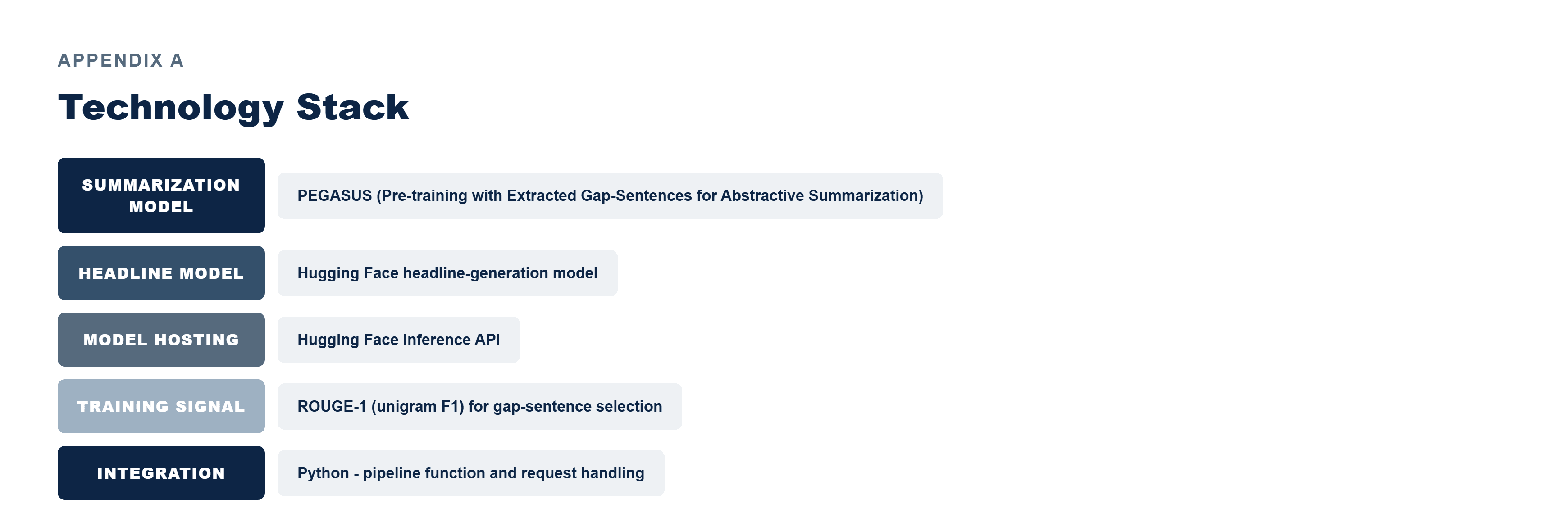
APPENDIX A - TECHNOLOGY STACK
The technology stack underpinning the system, grouped by the layer it serves.

Result and Analysis
ENGAGEMENT SNAPSHOT
How Pfactorial Technologies built a PEGASUS-based summarizer that condenses long-form text into a summary and an auto-generated headline through one pipeline.
CASE STUDIES

You might also like...

Content & Media Generation
Aug 21, 20267 min readRead

A Five-Step AI Pipeline That Turns One Keyword Into a Fully Illustrated, Publish-Ready Article
Aug 21, 20267 min readRead

Sales, Lead Gen & OutreachMulti-Agent & Agentic Systems
A Personalized AI Avatar Video Platform for Outreach at Scale
Aug 21, 20266 min readRead

A Six-Capability AI Writing Companion Spanning Grammar, Translation, and Originality Checks
Aug 21, 20267 min readRead

A Two-Model Pipeline That Turns Any Passage Into Study-Ready Question-and-Answer Flashcards
Aug 21, 20268 min readRead

A Two-Stage Grammar Correction and Error-Annotation Service for Writing Quality at the Point of Use
Aug 21, 20266 min readRead