Back
Content & Media Generation

A Six-Capability AI Writing Companion Spanning Grammar, Translation, and Originality Checks

How Pfactorial Technologies built an AI writing companion that unifies grammar correction, predictive writing, translation, and originality checking behind one interface.
August 21, 2026
Share
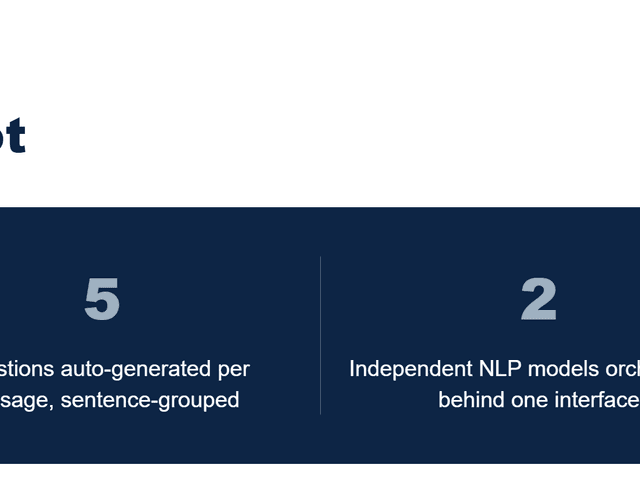
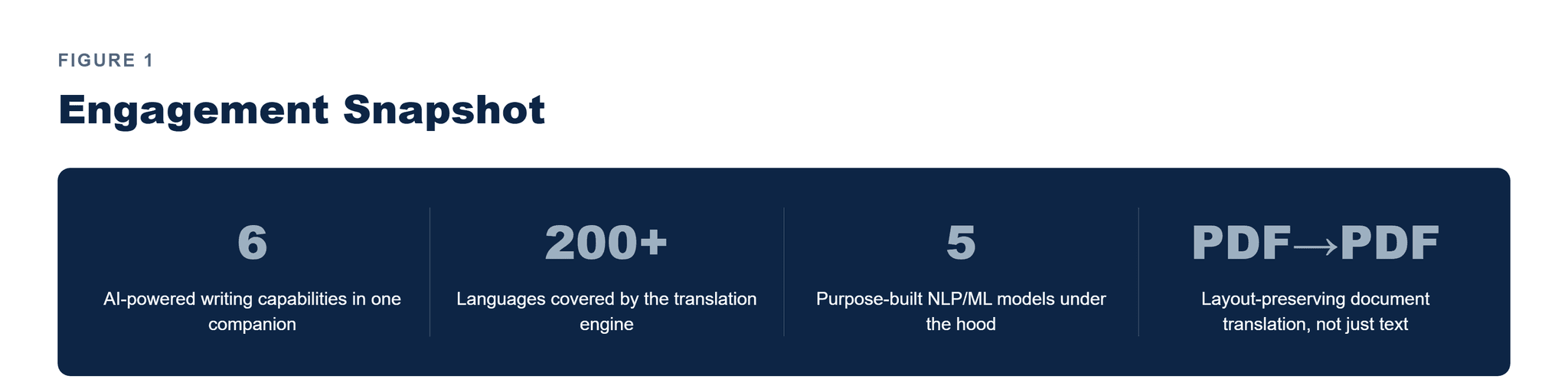
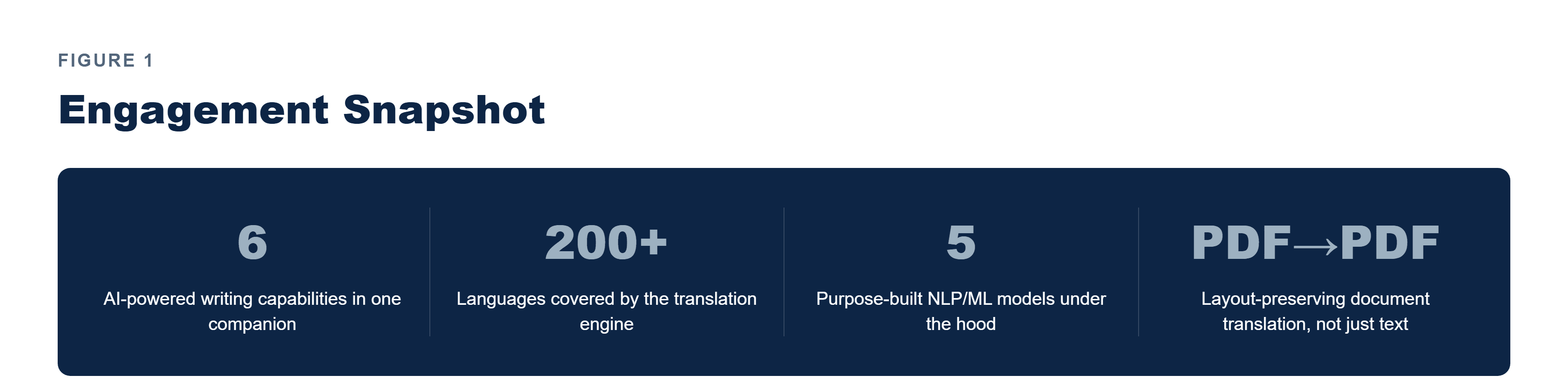
ENGAGEMENT SNAPSHOT

Pfactorial_Case_Study_VerboLift image 1
Figure 1 - Key figures from this engagement, at a glance.
EXECUTIVE SUMMARY
Our client wanted one writing companion that covered the full arc of producing a document - catching grammar mistakes, speeding up drafting, translating it, and checking it for originality - instead of asking writers to stitch together five or six separate single-purpose tools.
Bolting a grammar checker onto a translator doesn't get there: each capability needs its own model family tuned for its own task - sequence correction for grammar, language modeling for prediction, OCR-aware document translation for PDFs, embedding similarity for plagiarism and sentence comparison - and a workflow like PDF-to-PDF translation additionally has to preserve the original layout, not just the text.
Pfactorial built Verbo-Lift's writing companion: six purpose-built NLP capabilities - grammar correction, next-word prediction, language translation, layout-preserving PDF-to-PDF translation, plagiarism detection, and sentence similarity scoring - served behind one consistent interface.
Why this engagement is representative This engagement demonstrates Pfactorial's ability to assemble a suite of independently-tuned NLP models - not one generic language model stretched across tasks - into a single coherent product surface.
THE CHALLENGE
Covering the full writing workflow in one product meant solving problems that a single general-purpose model doesn't solve well on its own.

1. No single model is good at all six tasks

Grammar correction, next-word prediction, translation, plagiarism detection, and similarity scoring each reward a different model architecture, so the product needed several distinct model families working in concert, not one model wearing different hats.

2. PDF translation has to preserve layout, not just translate text

A PDF is a visual document as much as a text one - tables, columns, and formatting have to survive translation, which means the pipeline needs to read document structure via OCR before it can safely re-render translated text into it.

3. Plagiarism detection needs to search a large reference corpus fast

Comparing input text against a vast database of existing sources one-to-one doesn't scale; the comparison has to happen through an index built for fast approximate nearest-neighbor search over long-document embeddings.

4. Next-word prediction has to be fast enough to feel invisible

Suggestions offered while someone is actively typing only add value if they arrive with no perceptible delay, which rules out a heavyweight model in that specific path.
The real brief Not "add a grammar checker to a text box" but "give writers one companion that corrects, predicts, translates, and verifies originality, each backed by the right model for that specific job."
THE SOLUTION
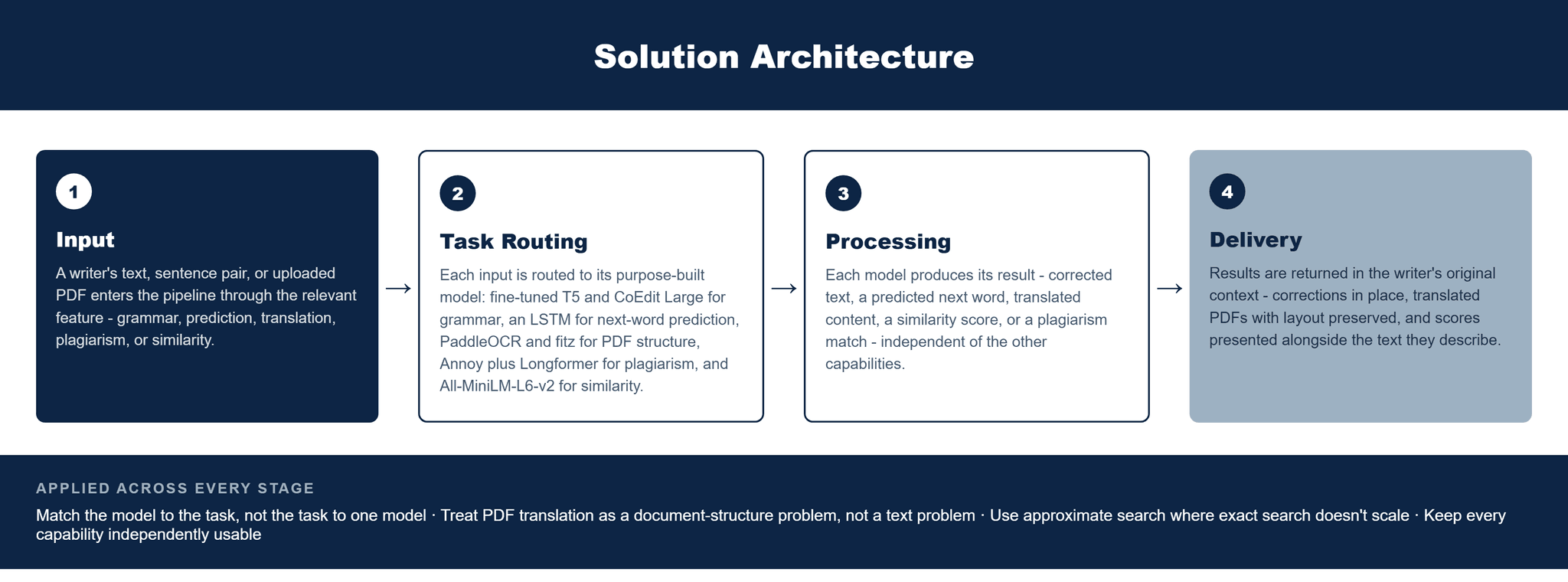
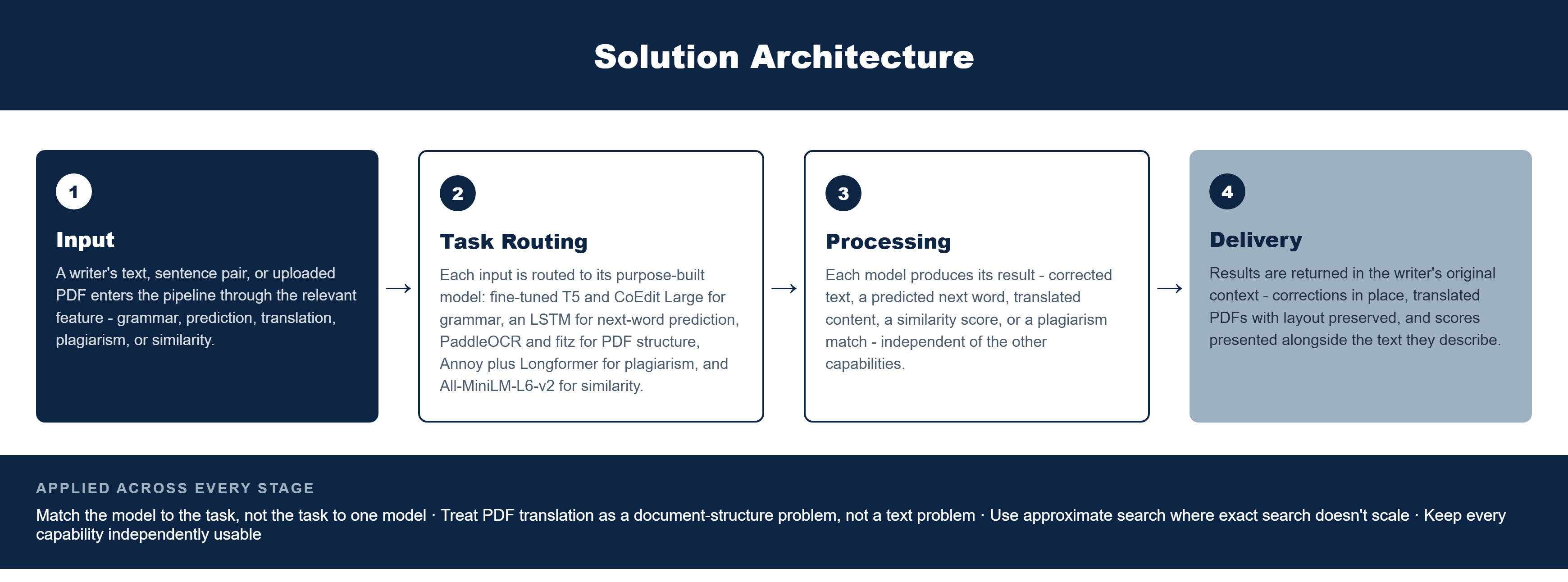
Pfactorial built Verbo-Lift around six independent NLP services, each backed by the model family best suited to its task, unified behind one writing interface.
Pfactorial_Case_Study_VerboLift image 2
Figure 1 - Six independent NLP services, each matched to its task, converge behind one writing interface.

Architectural principles

  • Match the model to the task, not the task to one model - A fine-tuned T5/CoEdit pairing for grammar, an LSTM for prediction, and a sentence-embedding model for similarity each outperform a single general-purpose model stretched across all of them.
  • Treat PDF translation as a document-structure problem, not a text problem - PaddleOCR reads the document's visual structure before translation happens, so fitz can re-render translated content into the original layout instead of producing a stripped-down text dump.
  • Use approximate search where exact search doesn't scale - Annoy indexing over Longformer embeddings lets plagiarism comparison run against a large reference corpus without a linear scan of every source document.
  • Keep every capability independently usable - Grammar, prediction, translation, and originality checking are separate services behind one interface, so a writer can use exactly the capability they need without the others being in the way.
CAPABILITIES DELIVERED
Each capability targets a distinct point in a writer's workflow, from the first draft to a finished, verified document.
CAPABILITY
WHAT IT DOES
Grammar checking
Fine-tuned T5 and Grammarly CoEdit Large models identify and correct grammar, spelling, and punctuation errors in place.
Next-word prediction
An LSTM model analyzes context and prior words to suggest the next word as the writer types.
Language translation
Text, phrases, or full documents translate across 200-plus languages.
PDF-to-PDF translation
Uploaded PDFs translate into a target language with the original layout preserved, powered by PaddleOCR and fitz.
Plagiarism checking
Annoy-indexed Longformer embeddings compare submitted text against a large reference corpus to flag unintended similarity.
Sentence similarity scoring
All-MiniLM-L6-v2 embeddings score how closely an input sentence matches a source sentence.
Pfactorial_Case_Study_VerboLift image 3
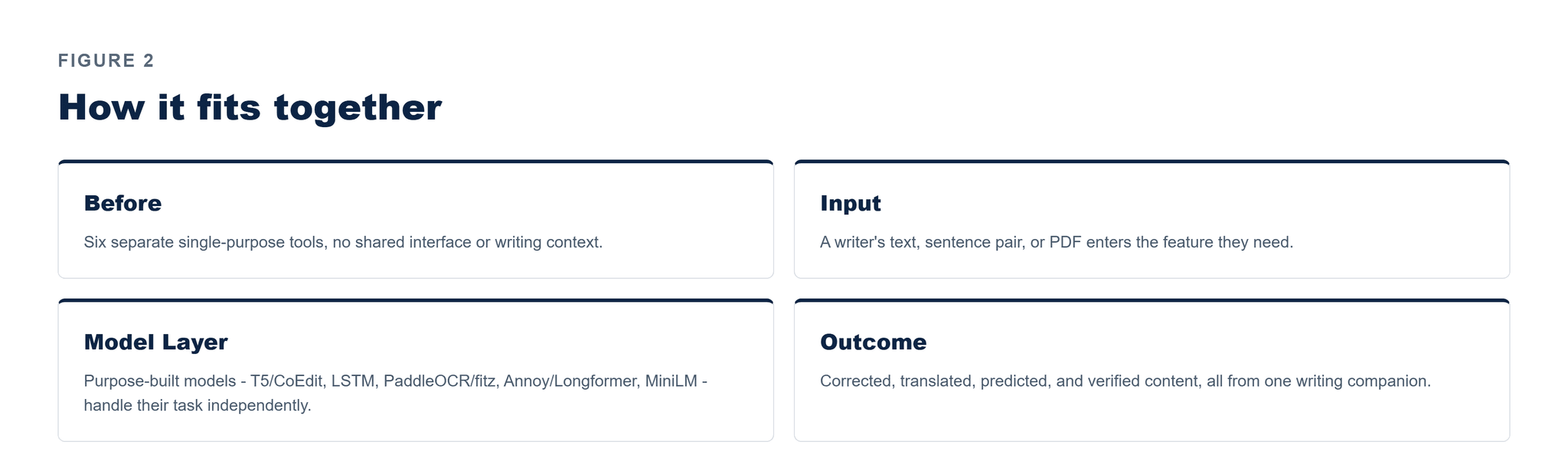
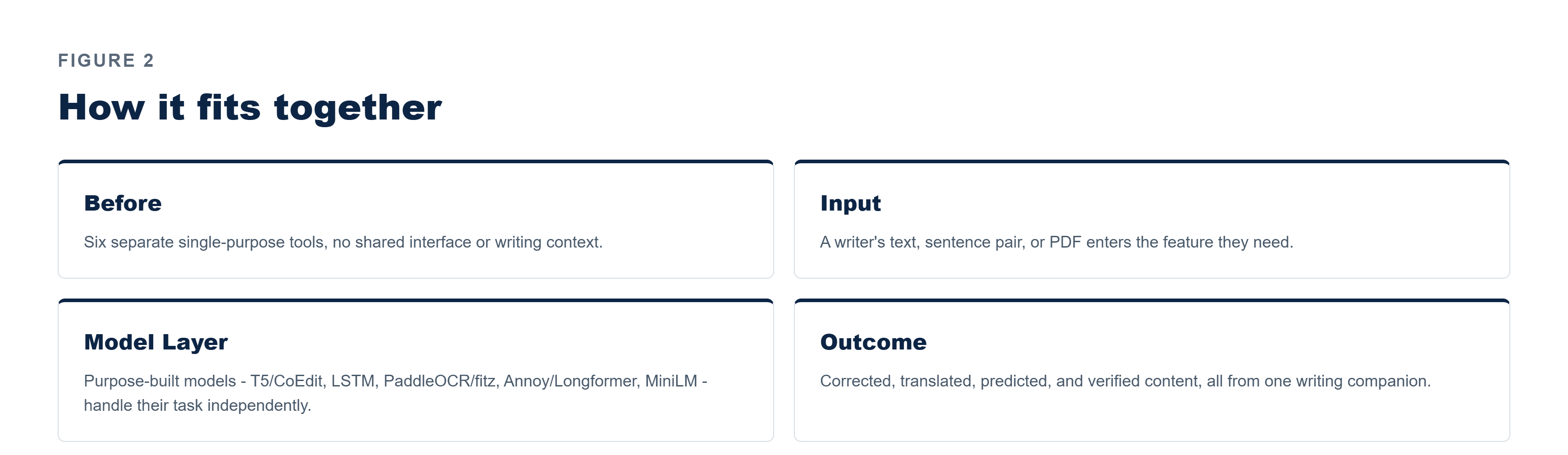
Figure 2 - The same interface surfaces all six capabilities, each backed by its own dedicated model.
Design note Sentence similarity and plagiarism detection are deliberately kept as two separate capabilities rather than merged into one score - a similarity score between two specific sentences answers a different question than a plagiarism scan against an entire reference corpus, and collapsing them would blur both.
ENGINEERING FOR SCALE AND RELIABILITY
Four decisions kept six independently-modeled capabilities coherent as one product.

Approximate nearest-neighbor indexing for plagiarism, not brute-force comparison

Annoy indexing over Longformer embeddings makes corpus-scale comparison tractable; a naive pairwise comparison against every reference document would not scale to a usable response time.

A dedicated OCR step ahead of PDF translation

PaddleOCR extracts document structure before fitz re-renders translated text, so PDF-to-PDF translation preserves the original layout instead of returning translated text stripped of its formatting.

A lightweight LSTM for next-word prediction rather than a larger model

Prediction sits directly in the typing path, where latency is felt immediately, so a smaller, fast model was chosen over a larger one that would have added noticeable lag for a marginal quality gain.

Fine-tuning existing models rather than training grammar correction from scratch

T5 base and Grammarly CoEdit Large were fine-tuned rather than trained from scratch, reaching production-quality grammar correction without the cost of building a language model from the ground up.
DELIVERY APPROACH
The build delivered capability by capability, each shipped as an independently working feature rather than waiting for all six to be complete.
1. Grammar checker - fine-tuning T5 base and Grammarly CoEdit Large for grammar, spelling, and punctuation correction.
2. Next-word prediction - training and integrating the LSTM model into the writing interface for real-time suggestions.
3. Translation and PDF-to-PDF translation - adding language translation, then layering PaddleOCR and fitz to extend it to layout-preserving PDF documents.
4. Plagiarism checking - building the Annoy index over Longformer embeddings against the reference corpus.
5. Sentence similarity checker - integrating All-MiniLM-L6-v2 to score similarity between an input sentence and a source sentence.
RESULTS AND IMPACT

Pfactorial_Case_Study_VerboLift image 4
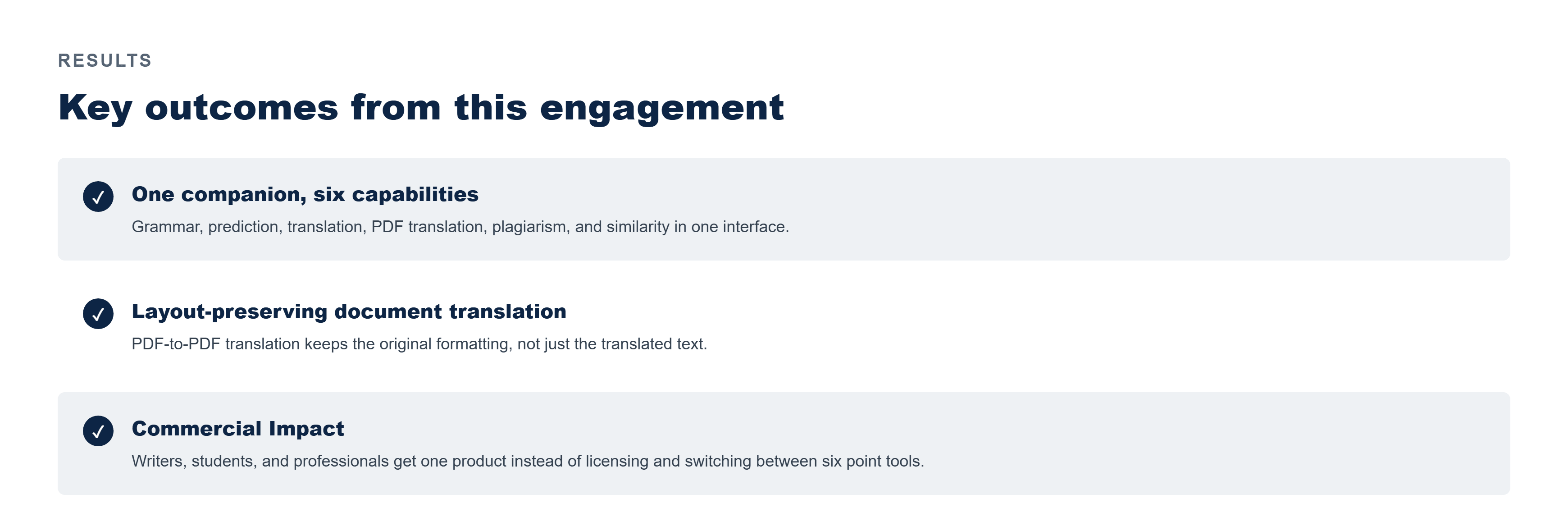
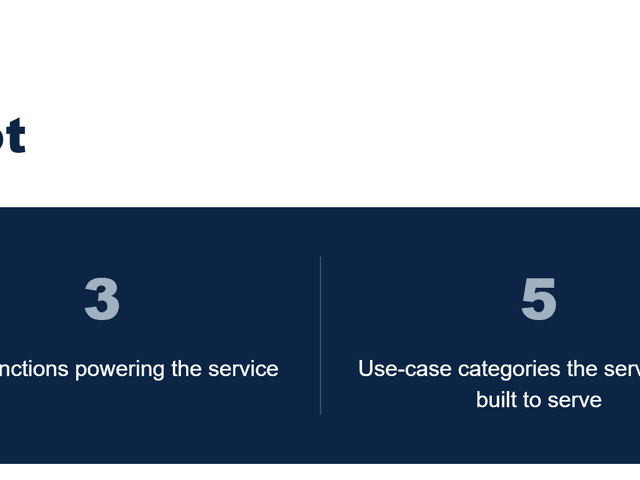
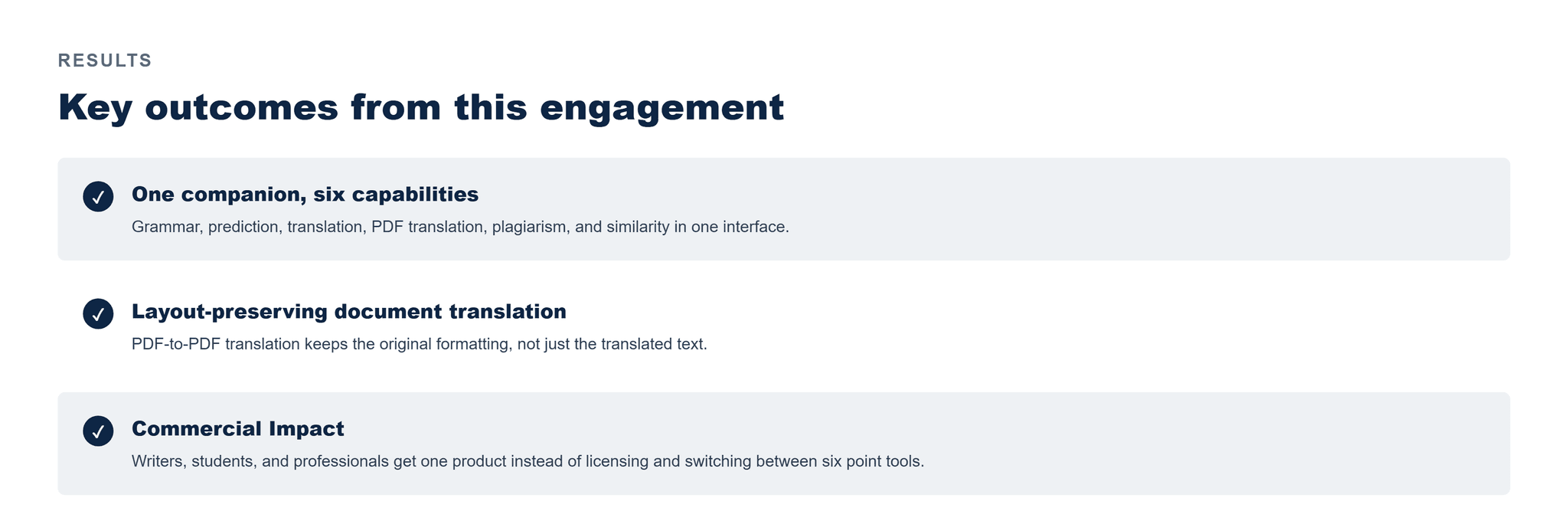
- Key outcomes from this engagement.
Verbo-Lift is built and running with all six capabilities live - grammar correction, next-word prediction, translation across 200-plus languages, layout-preserving PDF-to-PDF translation, plagiarism checking, and sentence similarity scoring.
Because each capability is backed by a model chosen specifically for its task rather than one model generalized across all of them, each service can be improved or retrained independently without disrupting the other five.

What it enabled commercially

The client now offers a single writing product that covers grammar, prediction, translation, and originality checking, letting them compete with point solutions on breadth without asking users to adopt five or six separate tools.
WHY PFACTORIAL
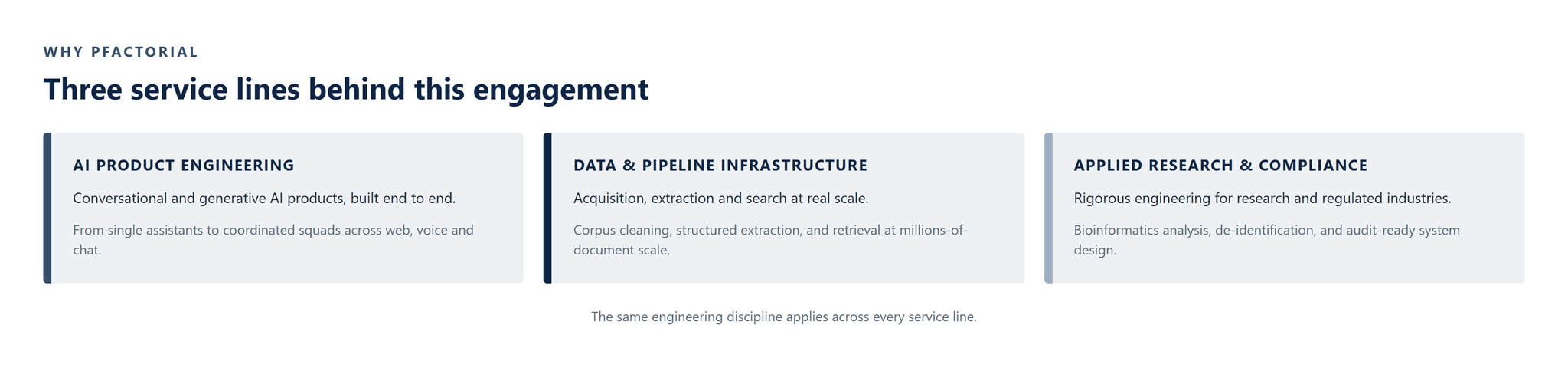
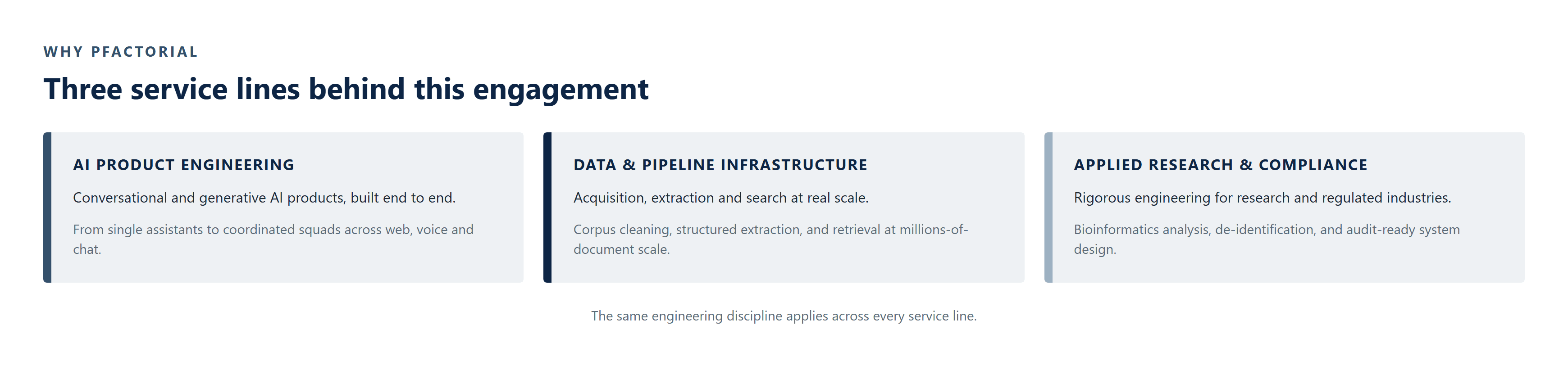
This engagement reflects Pfactorial's ability to assemble a coherent product out of multiple independently-tuned NLP models - matching each task to the right model family rather than forcing one model to cover a broad feature set.
Pfactorial_Case_Study_VerboLift image 5
- Service lines this engagement draws on.
Engagement enquiries Pfactorial Technologies works with organisations that need multiple NLP capabilities delivered as one coherent product, not a patchwork of point tools. If you're evaluating a language-technology or writing-assistant platform, we're happy to give you an honest read on scope and risk before anyone commits to anything. · pfactorial.ai
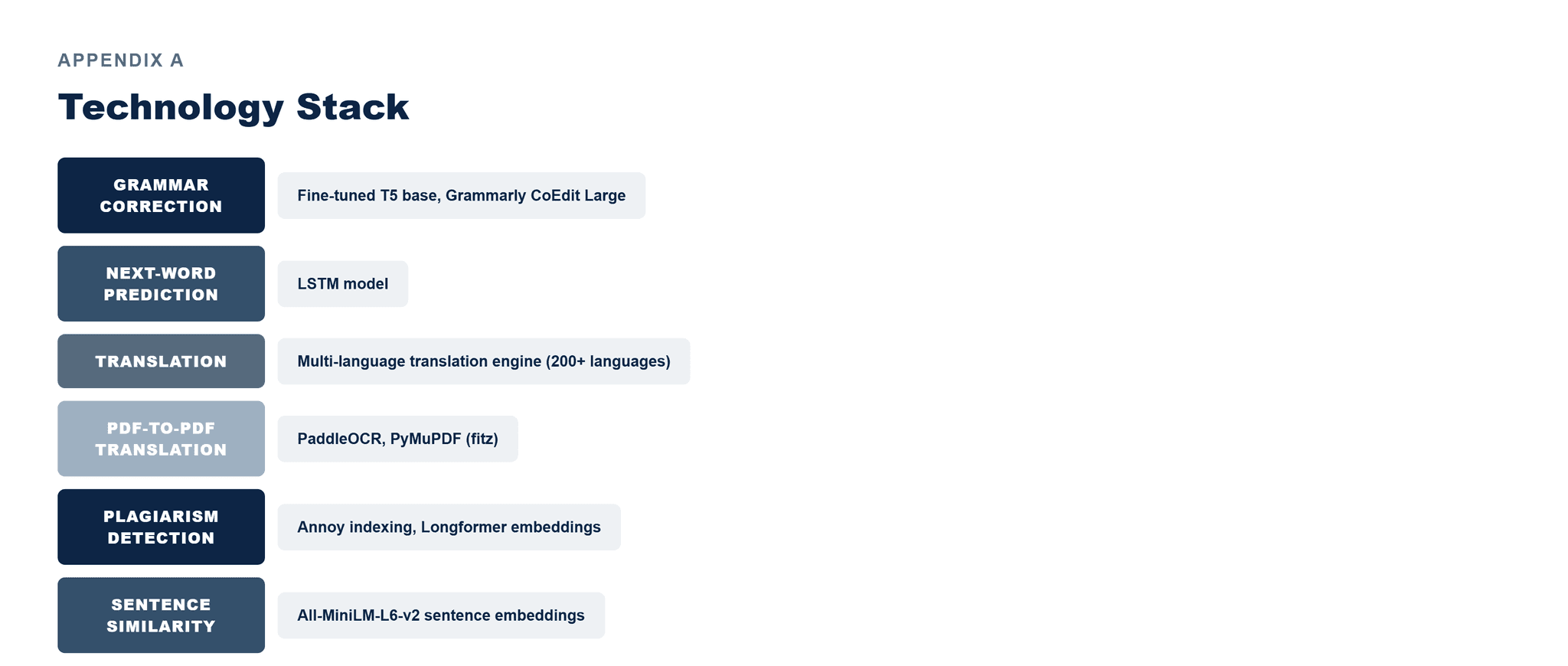
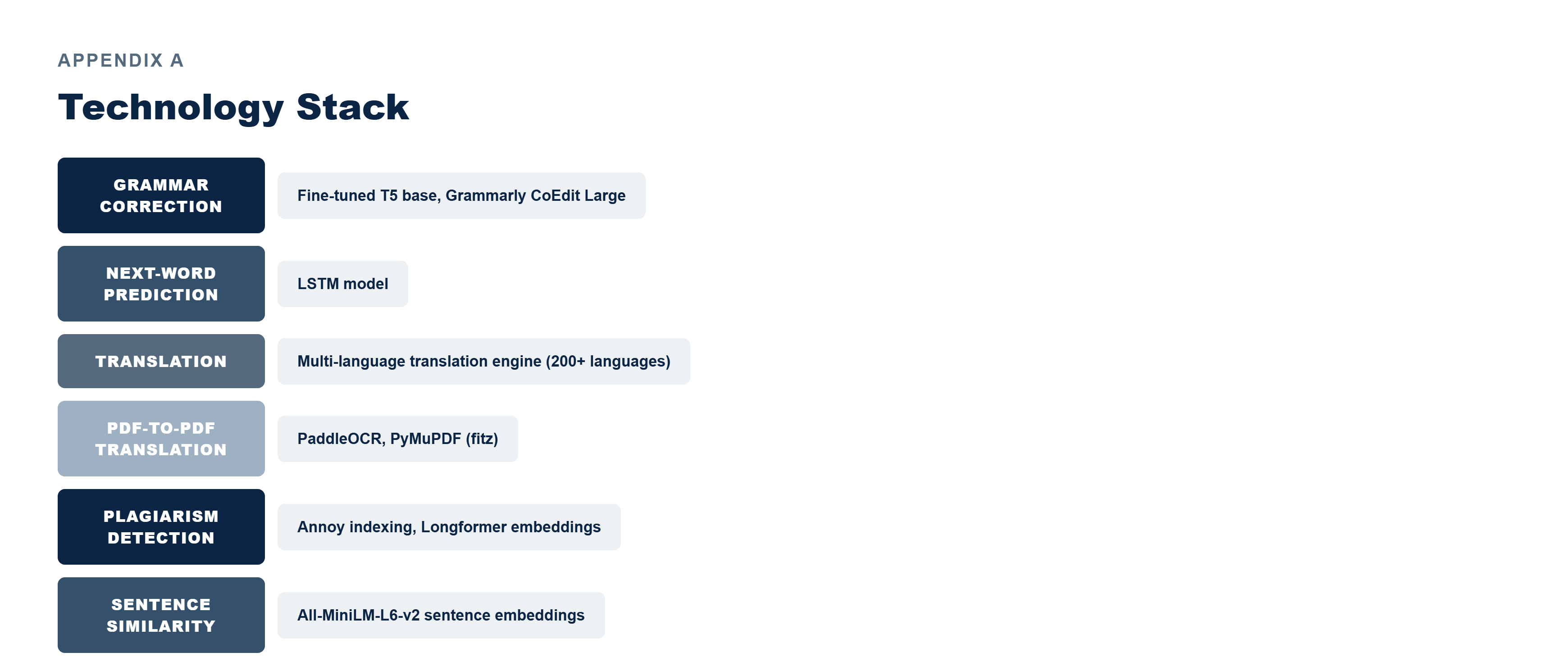
APPENDIX A - TECHNOLOGY STACK
The technology stack underpinning the system, grouped by the layer it serves.
Pfactorial_Case_Study_VerboLift image 6

Result and Analysis

ENGAGEMENT SNAPSHOT

How Pfactorial Technologies built an AI writing companion that unifies grammar correction, predictive writing, translation, and originality checking behind one interface.
Pfactorial_Case_Study_VerboLift image 1
Pfactorial_Case_Study_VerboLift image 2
Pfactorial_Case_Study_VerboLift image 3
Pfactorial_Case_Study_VerboLift image 4
Pfactorial_Case_Study_VerboLift image 5
Pfactorial_Case_Study_VerboLift image 6