Back
Conversational AI & Chatbots
A Tiered-Verification Voice & Chat Assistant for Regulated Banking
How Pfactorial Technologies designed and built Aria, an AI banking assistant that gates every action behind the identity verification its risk actually warrants - across both voice and chat.

August 21, 2026
Share
ENGAGEMENT SNAPSHOT

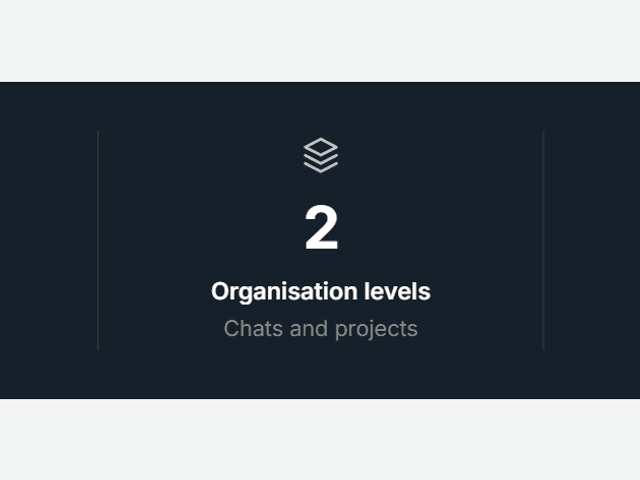
Figure 1 - Key figures from this engagement, at a glance.
EXECUTIVE SUMMARY
Our client is a retail banking provider that wanted customers to be able to handle routine account tasks - checking a balance, moving money, reporting a lost card - by simply talking or typing, instead of navigating a call queue or a dense web portal.
The obstacle was not conversational quality. It was that a banking assistant capable of moving money is also a banking assistant capable of moving money for the wrong person, and every capability the product added was also a new compliance and fraud surface. A chatbot that is pleasant to talk to but cannot be signed off by a bank's security and compliance teams has no path to production.
Pfactorial designed and built Aria: a voice- and chat-based assistant that matches the depth of identity verification to the risk of the action being requested, encrypts sensitive data beyond what transport-layer security alone provides, and closes every session with an auditable, automatically-expiring record - operating under PCI-DSS, SOC 2, and GDPR-aligned controls throughout.
Why this engagement is representative This engagement demonstrates a specific Pfactorial capability that generic conversational-AI vendors rarely have to prove: building an assistant whose security architecture, not just its dialogue quality, has to satisfy a regulated institution's compliance function before it ever reaches a customer.
THE CHALLENGE
The client had a clear customer-experience goal and a much harder set of constraints sitting underneath it. Four problems had to be solved before “talk to your bank” could become a real product.
1. Every action carries a different amount of risk
Looking up a branch address and moving five thousand dollars cannot reasonably require the same proof of identity. A flat verification bar either locks honest customers out of trivial requests or lets risky ones through too easily - the system needed a model where friction scales with consequence, not a single gate in front of everything.
2. Voice has none of the trust signals a web form has
A logged-in browser session carries cookies, device fingerprints and a padlock icon a customer can see. A phone call carries none of that by default. The assistant had to establish and continuously prove a secure, encrypted channel over voice - and fail safely, by ending the call, the moment it couldn't.
3. Regulatory retention rules are not uniform
Session tokens, call recordings, chat transcripts and transaction logs are not equally sensitive and are not governed by the same clock. Transaction logs must be kept seven years under regulation; session tokens should not outlive the hour they were issued in. Getting this wrong in either direction is a compliance finding waiting to happen.
4. The assistant needed to fail safe, not fail clever
A general-purpose conversational AI is built to be helpful under ambiguity - exactly the wrong instinct next to a customer's money. Encryption doubt, a suspicious transaction, or a third failed verification attempt all needed to stop the interaction rather than have the assistant guess its way through.
The real brief Not “build a banking chatbot” but “build an assistant a bank's security and compliance function would actually approve for production.” That distinction shaped the verification model, the encryption approach, and the retention design before a single conversation flow was written.
THE SOLUTION
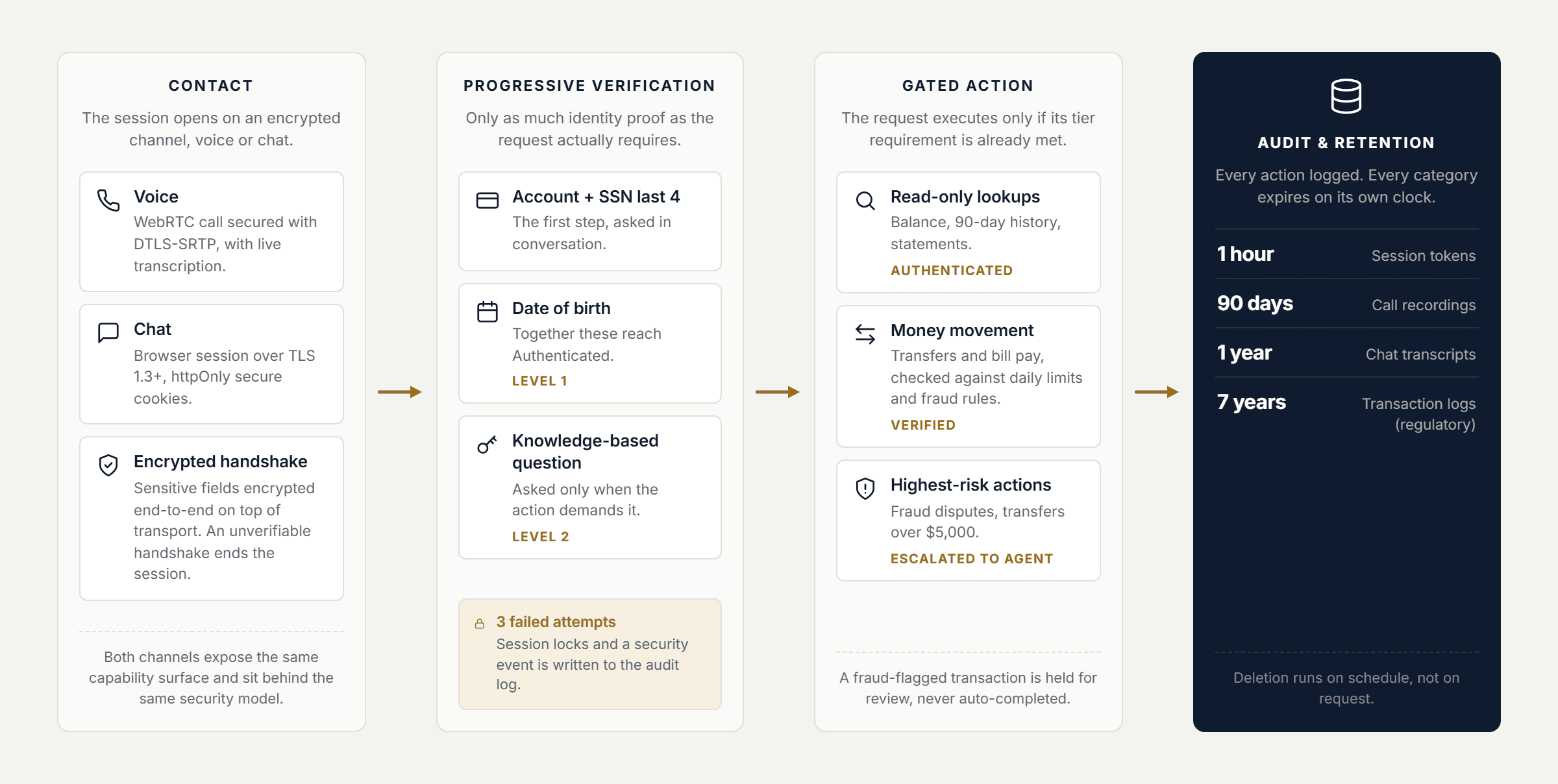
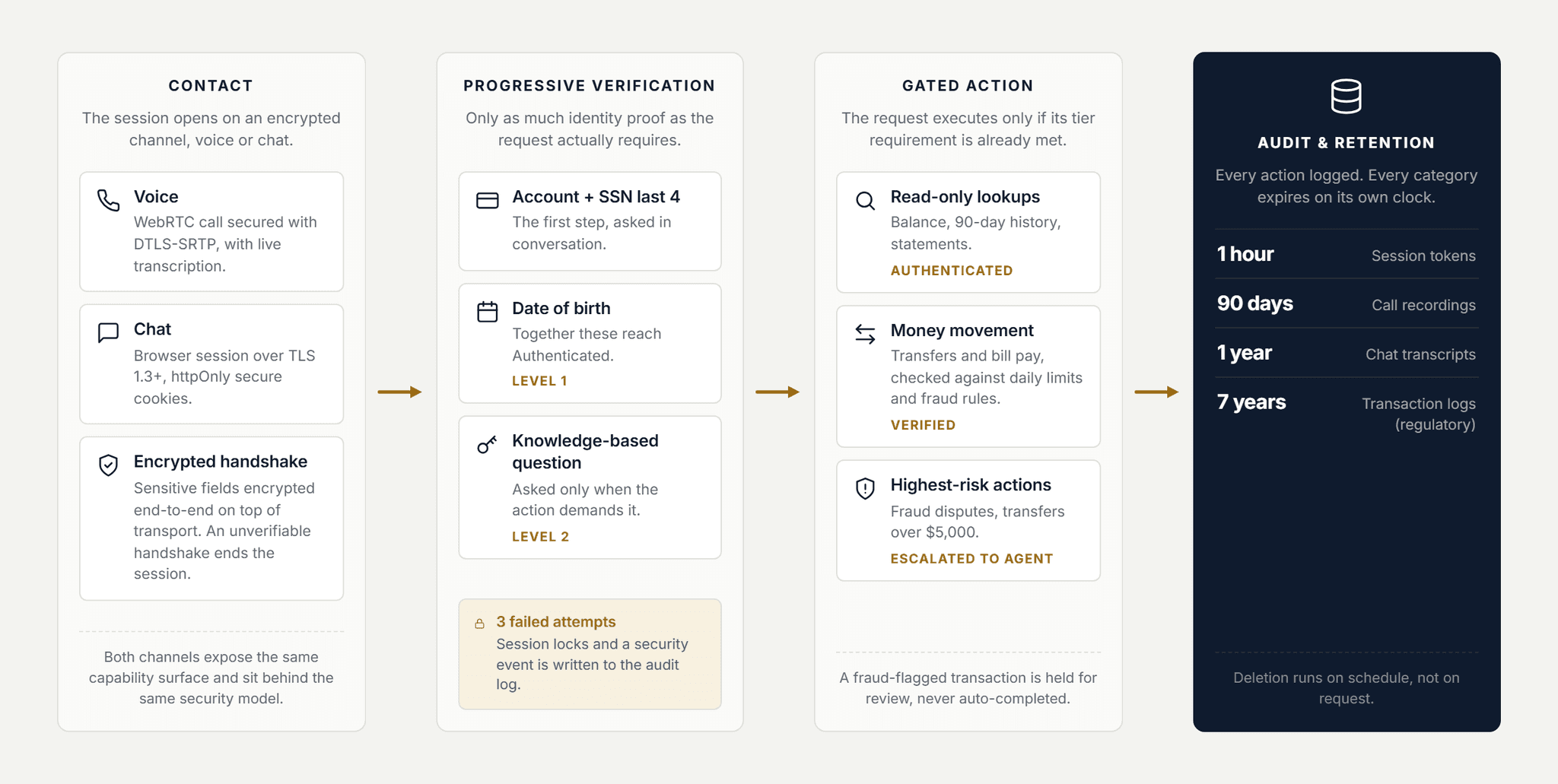
Pfactorial built Aria around a progressive verification model: identity proof is requested incrementally, only when a specific action requires it, and every session closes into an audited, automatically-expiring record regardless of channel.

Figure 2 - Session pipeline from first contact through a gated, audited action.
Architectural principles
- Progressive verification - Customers are asked for identity proof step by step - account and date of birth first, a security question only if the request demands it - rather than front-loading every check before any conversation can begin.
- Channel parity - Voice (over WebRTC via VAPI.ai) and chat (over TLS 1.3+) expose the same capability surface and sit behind the same security model, so a customer's sense of what is and isn't safe doesn't change depending on how they reached Aria.
- Defense beyond transport - Transport encryption is the floor, not the ceiling. Social Security numbers, dates of birth, account numbers and transaction details are encrypted end-to-end on top of TLS, and no PII is ever written to browser local or session storage.
- Fail safe by default - An unverifiable encryption handshake ends the call. A third failed verification attempt locks the session and logs the event. A fraud-flagged transaction is held for review, never completed automatically.
CAPABILITIES DELIVERED
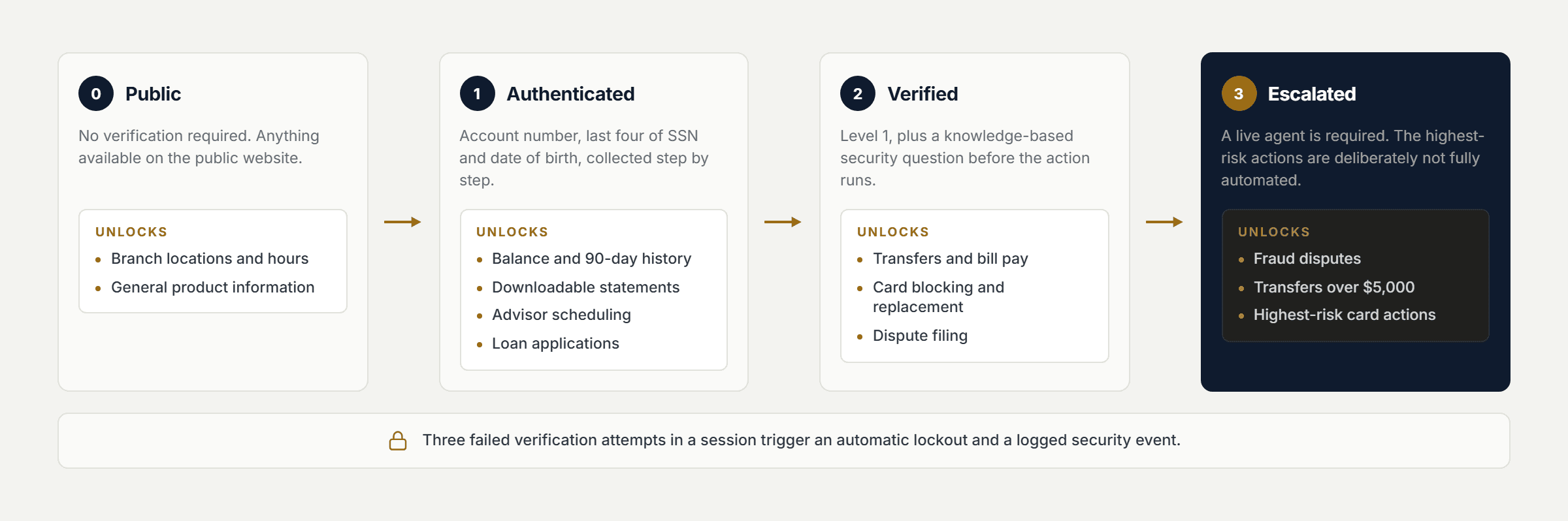
Every action Aria can take is mapped to the minimum security level that action's risk justifies - read-only lookups sit lower than money movement, and the highest-risk actions require live-agent escalation rather than being fully automated.
CAPABILITY | WHAT IT DOES |
|---|---|
Balance & transaction lookup | Current balance, filterable 90-day transaction history, downloadable statements. Authenticated level. |
Fund transfers & bill pay | Transfers and scheduled payments, checked against daily limits and fraud rules before execution. Verified level. |
Card management | Immediate card blocking, replacement requests, and fraud reporting - blocking takes effect instantly rather than being queued. Verified / Escalated. |
Dispute filing | Formal challenge of a specific transaction, opening a trackable case with a reference number. Verified level. |
Advisor scheduling | Books a meeting with a financial advisor via calendar integration. Authenticated level. |
Branch & loan info | Branch location and hours lookup at Public level; new loan applications at Authenticated level. |
Session history | Encrypted transcript and security-level record of every session, retrievable via a time-limited authenticated link. |
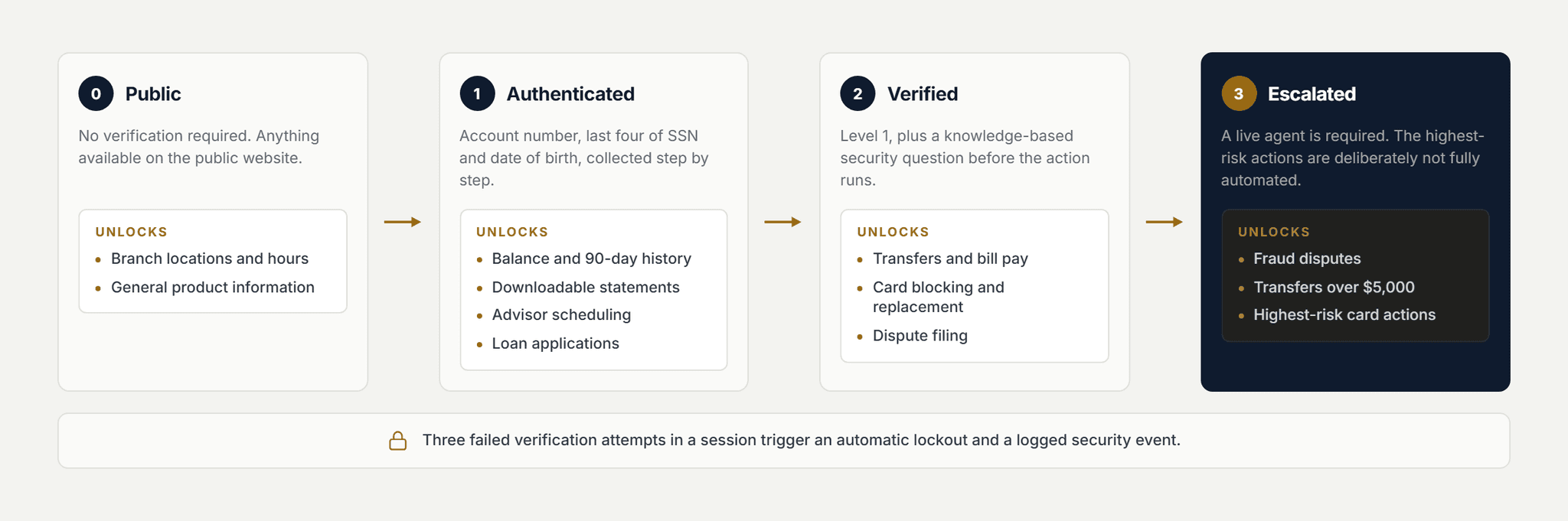
Figure 3 - The four-tier verification model gating Aria's banking actions.
Design note Matching verification depth to actual risk is what keeps the product usable. A customer asking for a branch address gets an instant answer; a customer moving money answers one extra question. Neither path is compromised to make the other convenient.
ENGINEERING FOR SCALE AND RELIABILITY
The difference between a demo assistant and one a bank can deploy is what happens around the edges of a normal conversation. Six decisions carry Aria through the cases that matter most.
Layered encryption
HTTPS with TLS 1.3+ covers all traffic; voice calls add WebRTC with DTLS-SRTP. On top of that transport layer, the most sensitive fields - SSNs, dates of birth, account numbers, transaction details - are encrypted end-to-end in their own right.
No PII at rest in the browser
Session tokens live only in secure, httpOnly cookies. No personally identifiable information is ever written to local or session storage, removing an entire class of client-side data exposure.
Progressive verification with lockout
Identity checks run step by step - account and SSN last-4, then date of birth, then a security question for higher-risk actions. Three failed attempts in a session ends the call or chat and logs a lockout event rather than permitting further guesses.
Automatic session timeout
Fifteen minutes of inactivity clears the session token, marks the customer unauthenticated, and closes the interaction with a clear expiry message - any customer action resets the clock.
Differentiated, automated retention
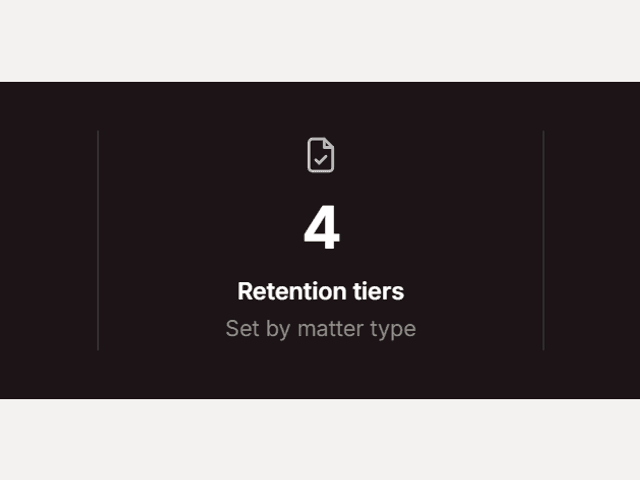
Session tokens expire in an hour, call recordings in 90 days, chat transcripts in a year, and transaction logs are held seven years to satisfy regulatory requirement - deletion runs on schedule rather than depending on someone remembering to purge data.
Fail-safe error handling
An unverifiable encryption handshake ends the session immediately. A transaction flagged by fraud rules is held and escalated, never auto-completed. Card numbers are never stored or spoken in full - only masked references are used in conversation, with full numbers tokenized wherever they must be referenced internally.
DELIVERY APPROACH
The engagement moved from risk mapping to a compliance-ready assistant in stages, so the highest-risk decisions were settled before conversational flows were built on top of them.
1. Risk & compliance mapping - every candidate action - balance check through fund transfer - scored for risk and mapped to one of four verification tiers before any dialogue design began.
2. Core session architecture - shared backend contract for voice (VAPI.ai) and chat sessions, so both channels expose identical capability and security behavior.
3. Identity verification engine - the progressive multi-factor flow - account details, date of birth, security question - with lockout after three failed attempts.
4. Banking operations layer - account information, money movement, card management and session history services, each gated at its assigned tier.
5. Compliance hardening - end-to-end field encryption, audit logging on every transaction-affecting action, and automated, category-specific data retention.
6. Documentation and handover - a technical overview covering the security model, verification flow, backend services and retention policy, so the system remains auditable independent of any single engineer.
RESULTS AND IMPACT

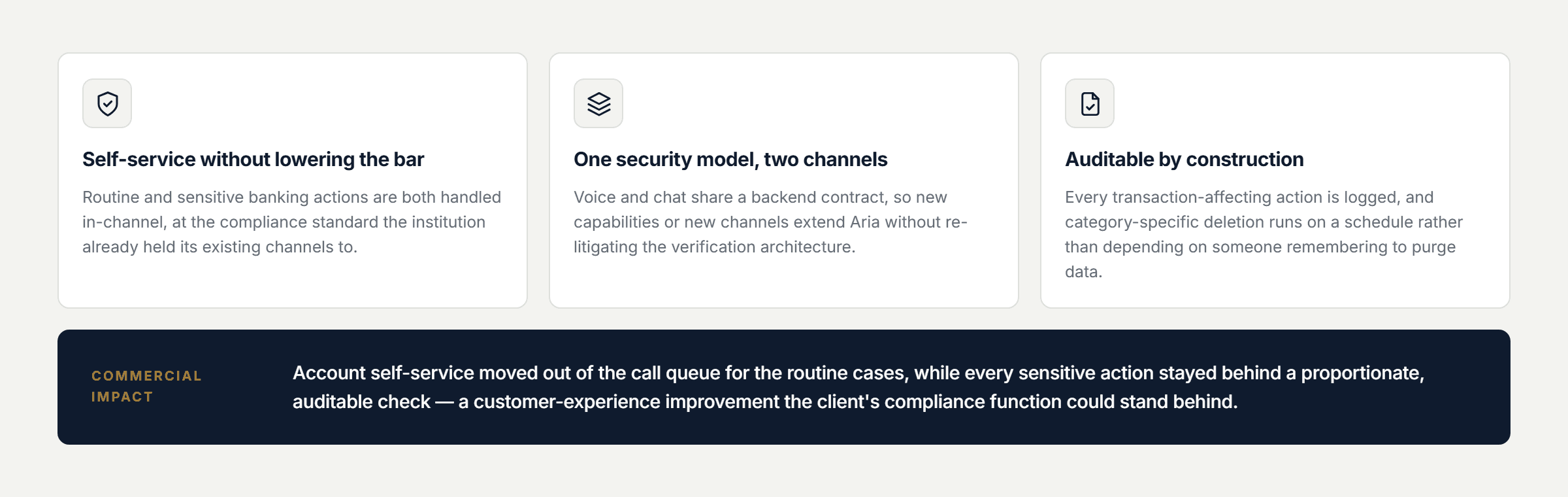
Figure 4 - Key outcomes from this engagement.
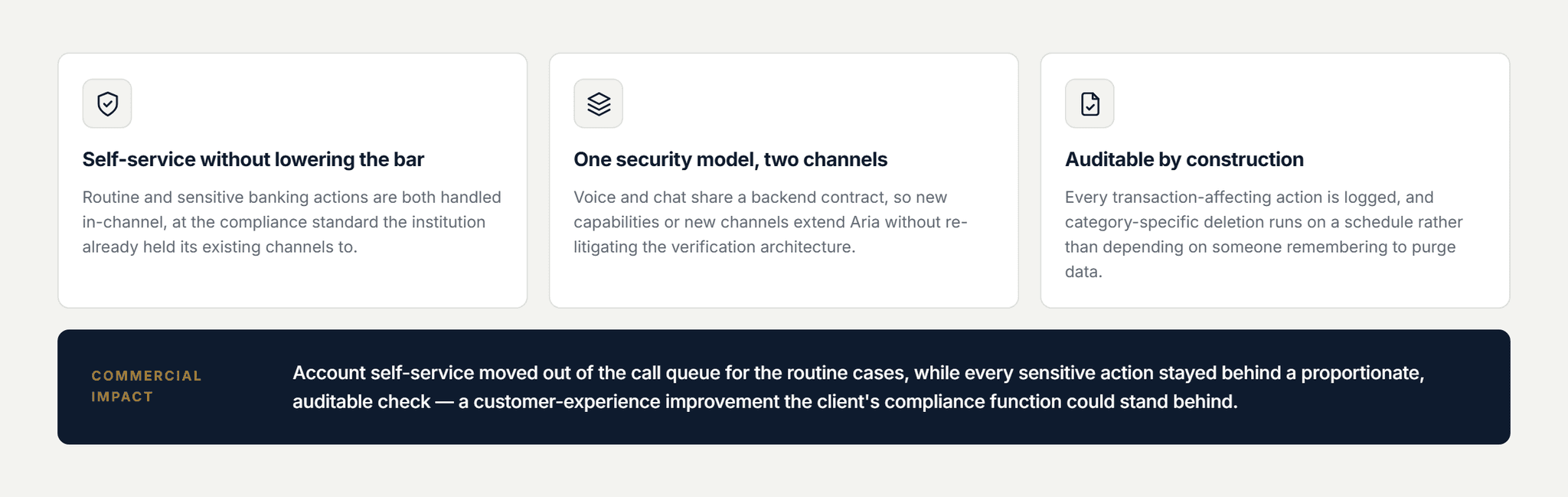
With the verification and compliance architecture solved, the client was able to offer customers a genuinely self-service channel for both routine and sensitive banking actions - without asking their security or compliance teams to accept a lower bar than their existing channels.
Because voice and chat share one security model and one backend contract, the client can extend Aria to new capabilities or new channels without re-litigating the verification architecture each time.
What it enabled commercially
The assistant moved account self-service out of the call queue for the routine cases while keeping every sensitive action behind a proportionate, auditable check - giving the client a customer-experience improvement that its compliance function could actually stand behind.
WHY PFACTORIAL
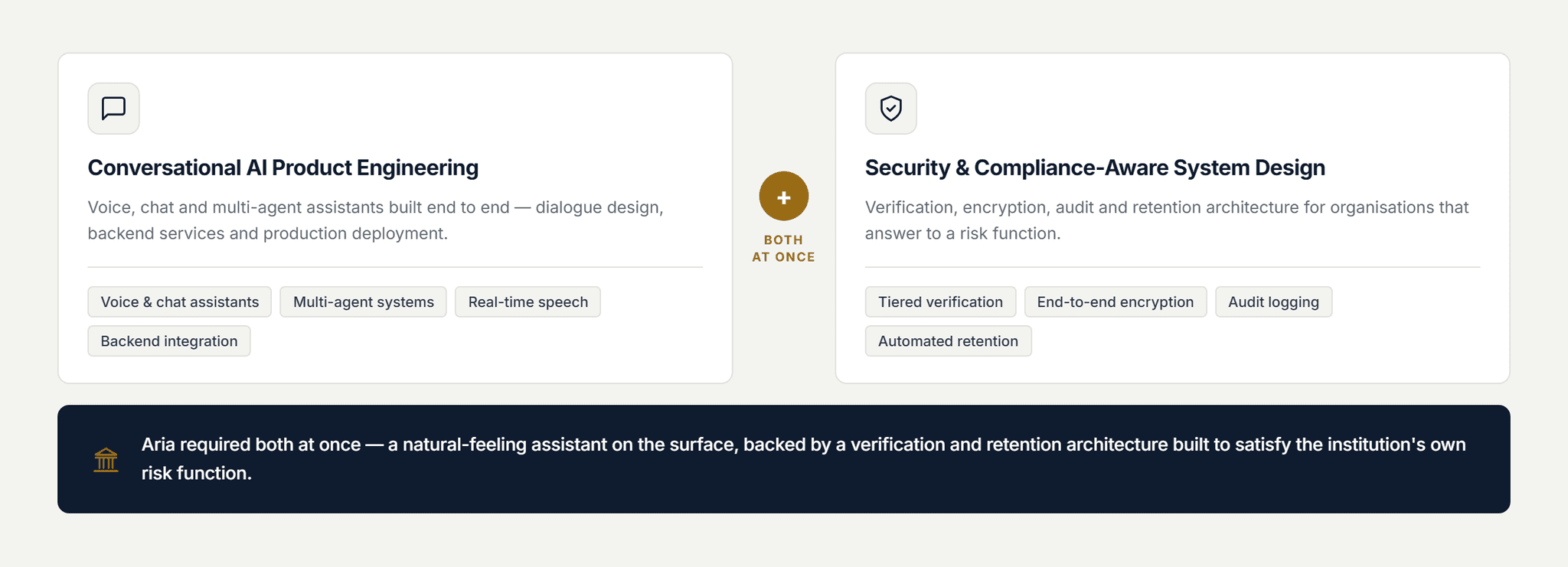
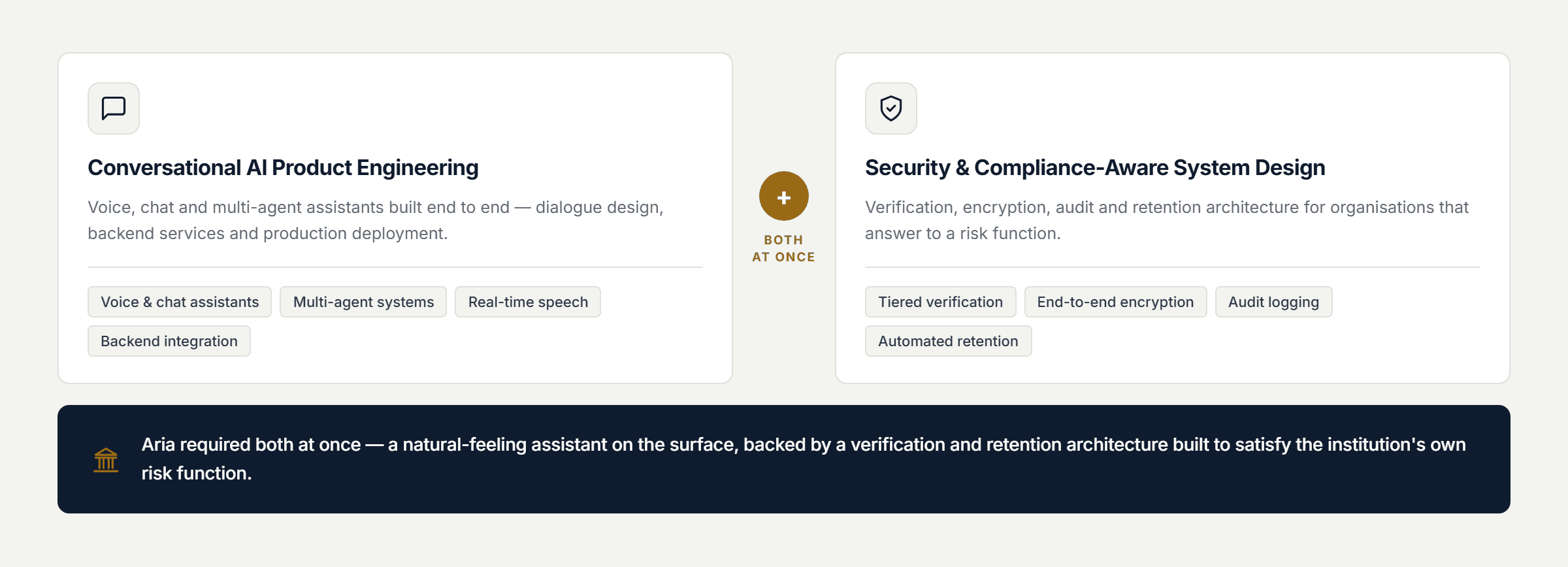
This engagement sits at the intersection of two service lines Pfactorial delivers for clients: conversational AI product engineering, and security- and compliance-aware system design for regulated industries. Aria required both at once - a natural-feeling assistant on the surface, backed by a verification and retention architecture built to satisfy an institution's own risk function.

Figure 5 - Service lines this engagement draws on.
Engagement enquiries Pfactorial Technologies works with regulated and security-conscious organizations that need conversational AI products built to a compliance bar, not just a demo bar. If you're evaluating what it would take to bring an assistant like this to production, we're happy to give you an honest read on scope and risk before anyone commits to anything. · pfactorial.ai
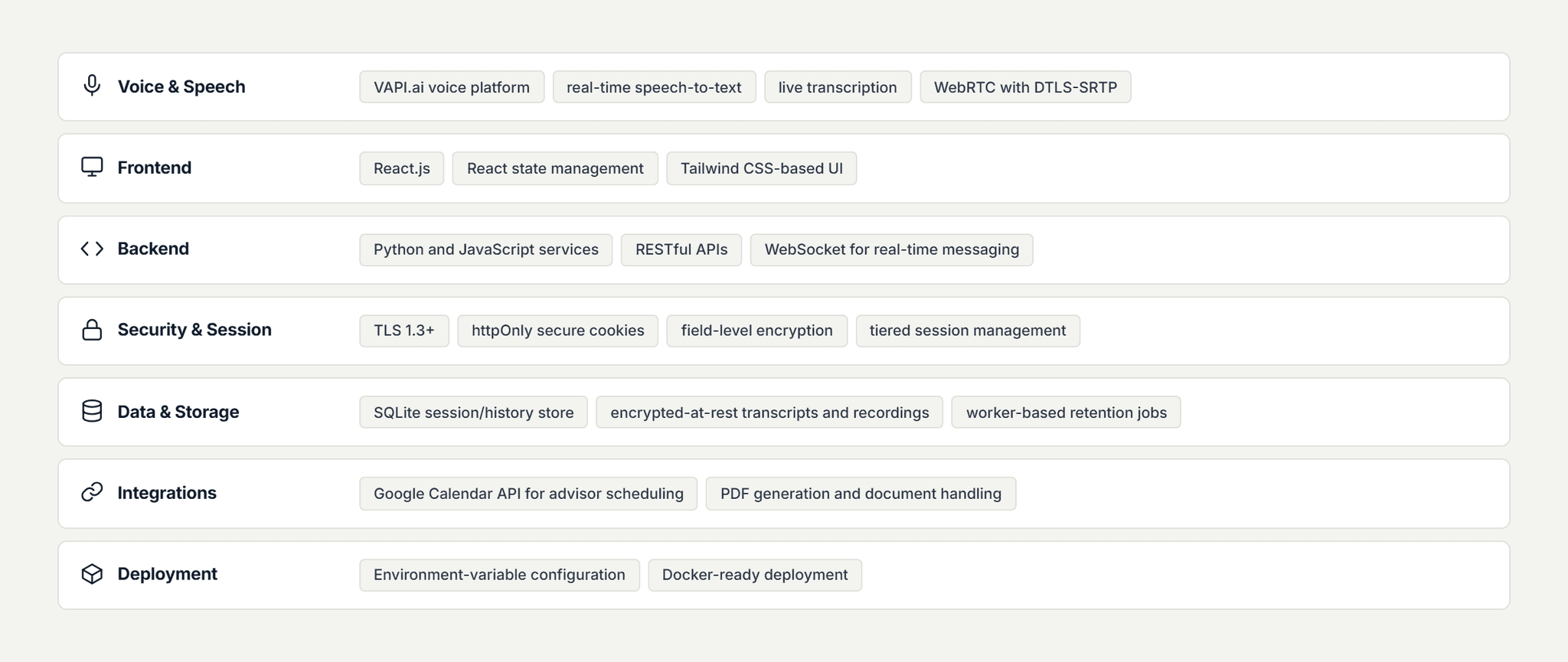
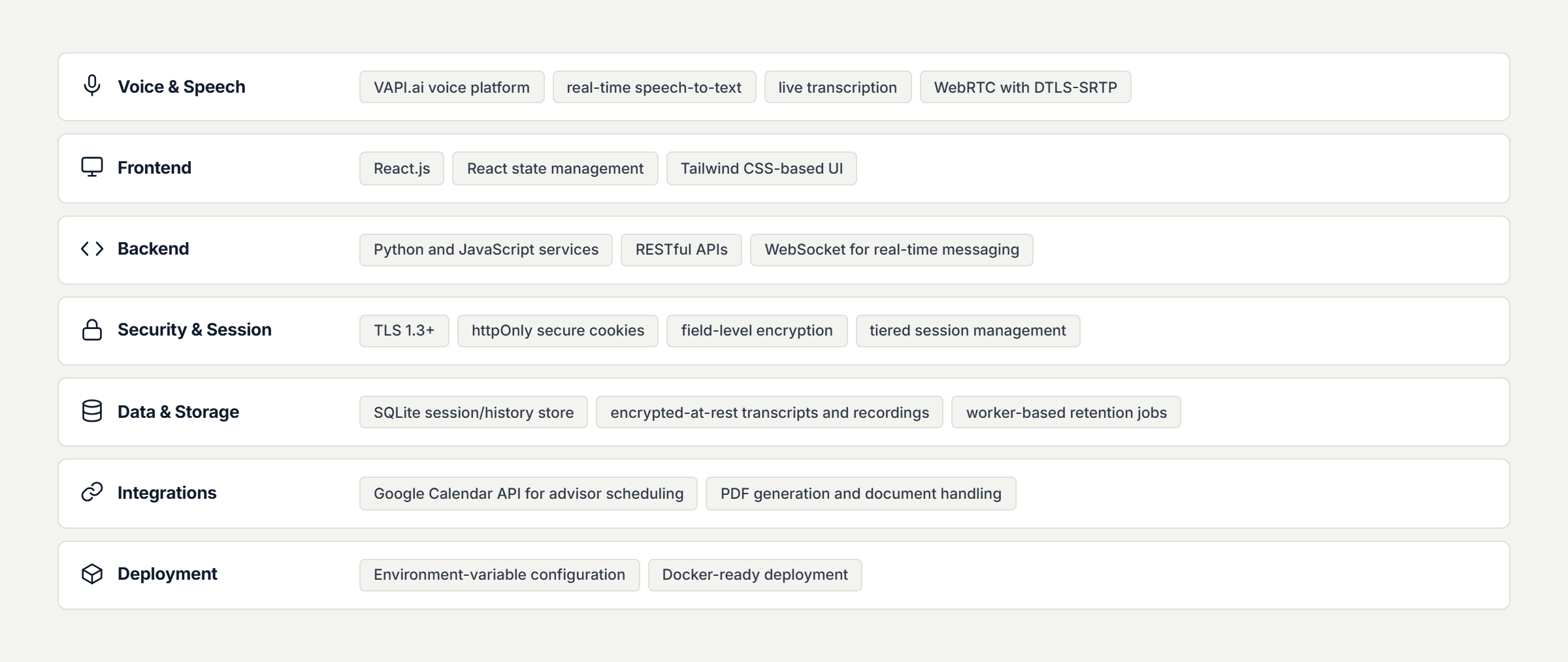
APPENDIX A - TECHNOLOGY STACK
The technology stack underpinning the system, grouped by the layer it serves.

© 2026 Pfactorial Technologies. Client identity and product-specific implementation detail are withheld or generalized; no client data, credentials, source code, or infrastructure detail is included in this document.
Result and Analysis
ENGAGEMENT SNAPSHOT
How Pfactorial Technologies designed and built Aria, an AI banking assistant that gates every action behind the identity verification its risk actually warrants - across both voice and chat.

CASE STUDIES

You might also like...

ML Infra, Classifiers & RL
Aug 21, 20266 min readRead

RAG & Semantic SearchAutomotive & Vehicle
A Botpress-Built AI Sales & Service Assistant That Qualifies Automotive Leads 24/7
Aug 21, 20267 min readRead

A File-Aware AI Chat Platform With Project-Based Conversation Organization
Aug 21, 20267 min readRead

Conversational AI & Chatbots
A Five-Specialist AI Intake System for Law Firms, Built Around Attorney-Client Privilege
Aug 21, 20267 min readRead

Conversational AI & ChatbotsML Infra, Classifiers & RL
A Layered Safety Pipeline for a Healthcare Patient Companion
Aug 21, 20268 min readRead

Multi-Agent & Agentic SystemsE-commerce & Retail
A Multi-Agent Voice & Chat Shopping Assistant Built on a Coordinated Squad Architecture
Aug 21, 20267 min readRead