Back
Healthcare & Clinical

A Risk-Stratification Framework Linking Clinical Milestones to PAH Survival Outcomes

How Pfactorial Technologies built a survival-analysis framework showing which clinical milestones actually predict longer, event-free survival in Pulmonary Arterial Hypertension patients.

August 21, 2026
Share
ENGAGEMENT SNAPSHOT

Pfactorial_Case_Study_Risk_Outcomes_PAH image 1
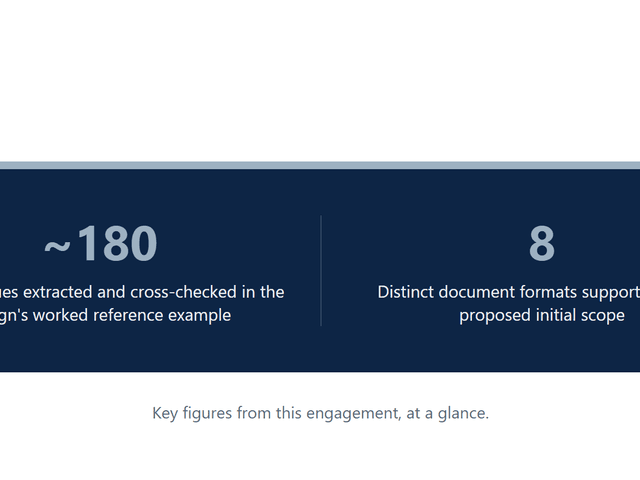
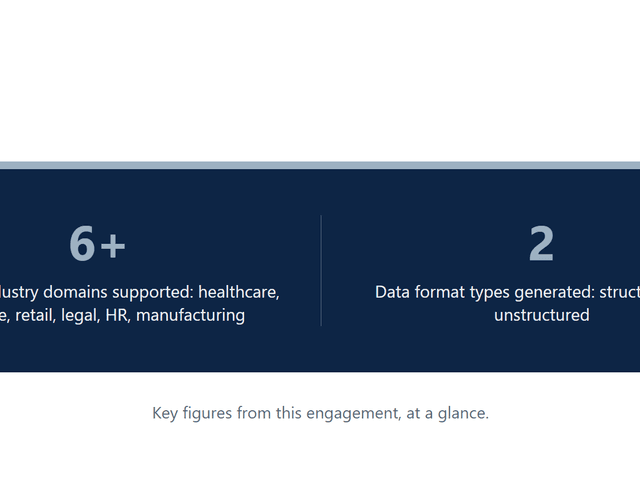
Figure 1 - Key figures from this engagement, at a glance.
EXECUTIVE SUMMARY
Pulmonary Arterial Hypertension (PAH) management benefits from clear, actionable treatment targets, and our client wanted to know which specific clinical milestones actually change patient outcomes - not just which ones correlate loosely with the disease.
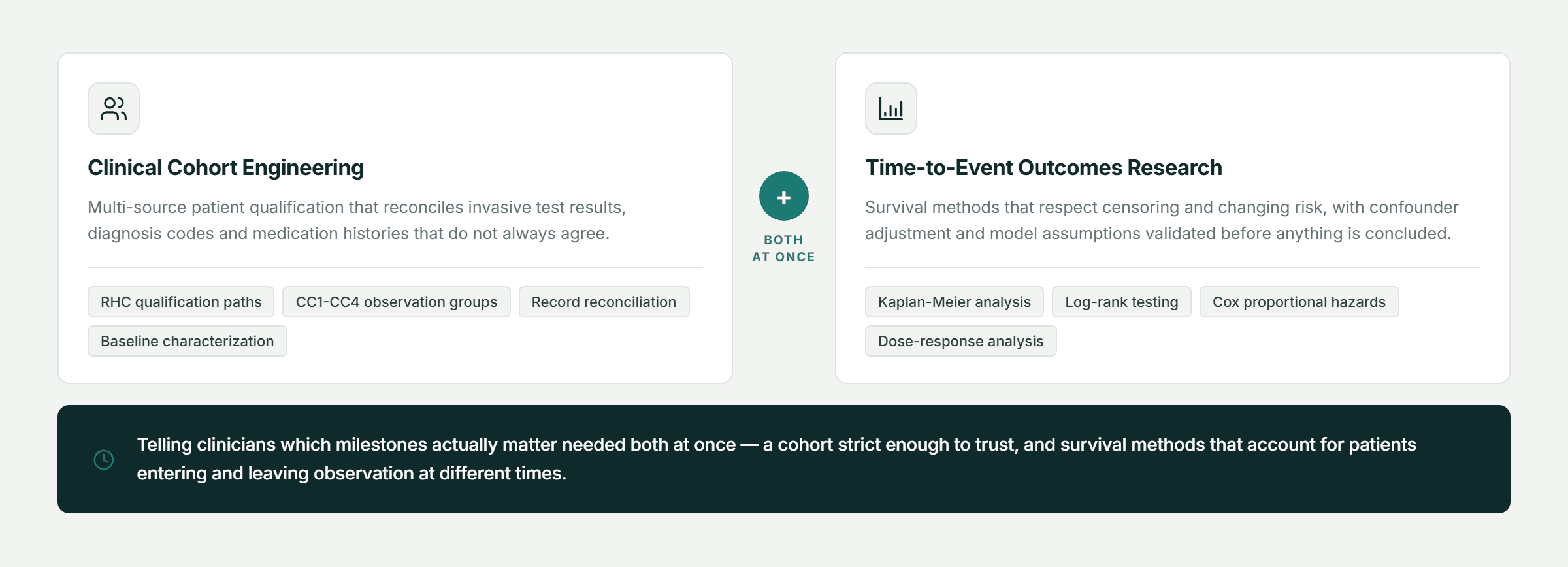
Assembling a valid PAH cohort from medical records means reconciling invasive test results, diagnosis codes and medication histories that don't always agree, and survival outcomes are time-dependent and incomplete in ways standard statistics can't handle without specialized methods.
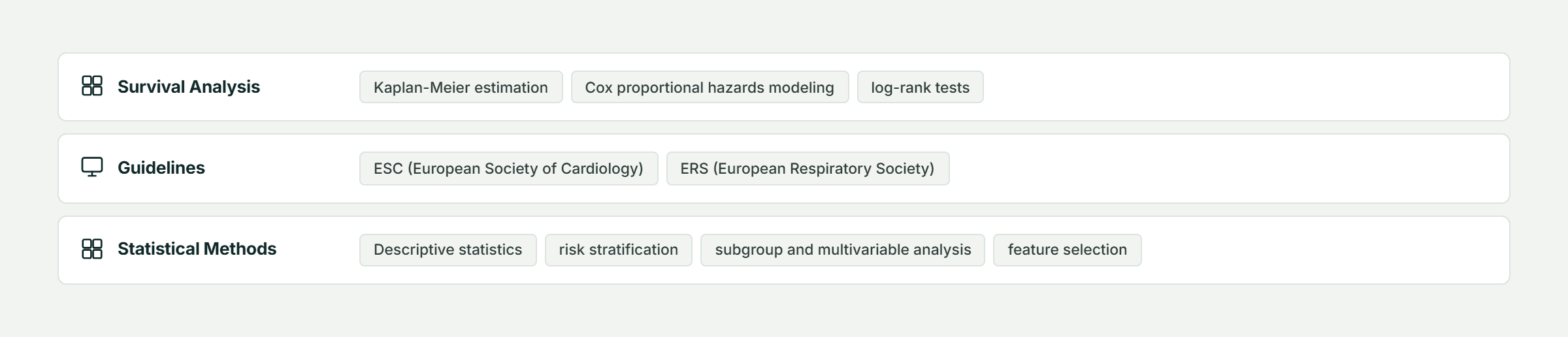
Pfactorial built a multi-stage cohort-qualification pipeline and a survival-analysis framework - combining ESC/ERS-aligned risk stratification, Kaplan-Meier analysis and Cox proportional hazards modeling - to show clinicians which specific, achievable improvements are worth targeting.
Why this engagement is representative This engagement shows Pfactorial's ability to turn a large, messy medical-records dataset into a validated, guideline-aligned framework clinicians can use to set concrete treatment targets - not just a descriptive report of correlations.
THE CHALLENGE
Answering “which milestones actually matter” required solving four problems in the underlying data and methodology.

1. Not every improvement predicts survival equally

A patient can improve on one clinical measure without meaningfully changing their outlook; the framework needed to identify which combinations of improvement actually move survival, not just which correlate with it.

2. Cohort qualification has to be rigorous to be trusted

Assembling a valid PAH cohort from medical records means reconciling invasive test results, diagnosis codes and medication histories that don't always agree with each other.

3. Survival data is time-dependent and incomplete

Patients enter and leave observation at different times, and standard statistical methods can't handle that without specialized time-to-event techniques.

4. Rare but critical events need attention too

Events like lung transplantation are life-altering but too infrequent for standard statistical power, and can't simply be excluded from the analysis.
The real brief Not “report survival rates” but “show clinicians which specific, achievable clinical milestones are worth targeting because they measurably change outcomes.”
THE SOLUTION
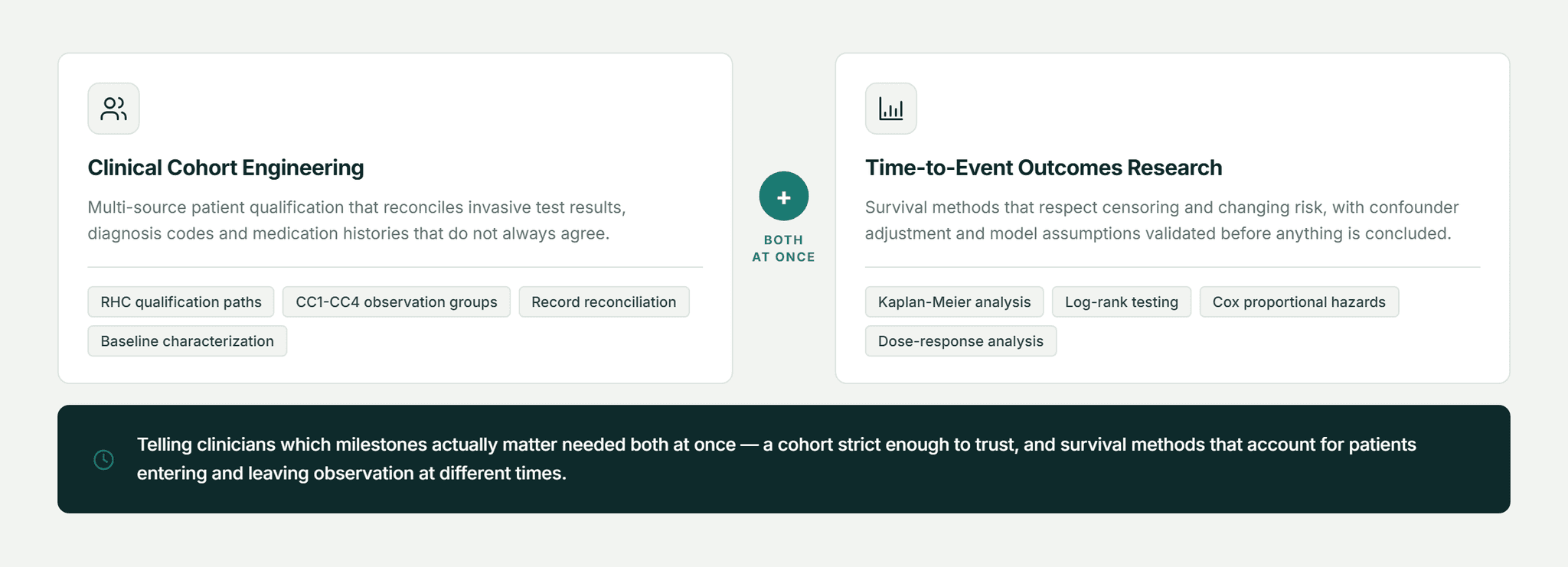
Pfactorial built a multi-source cohort qualification pipeline feeding a composite risk-classification and time-aware survival-analysis framework, so findings reflect real, well-documented PAH cases and hold up under statistical scrutiny.
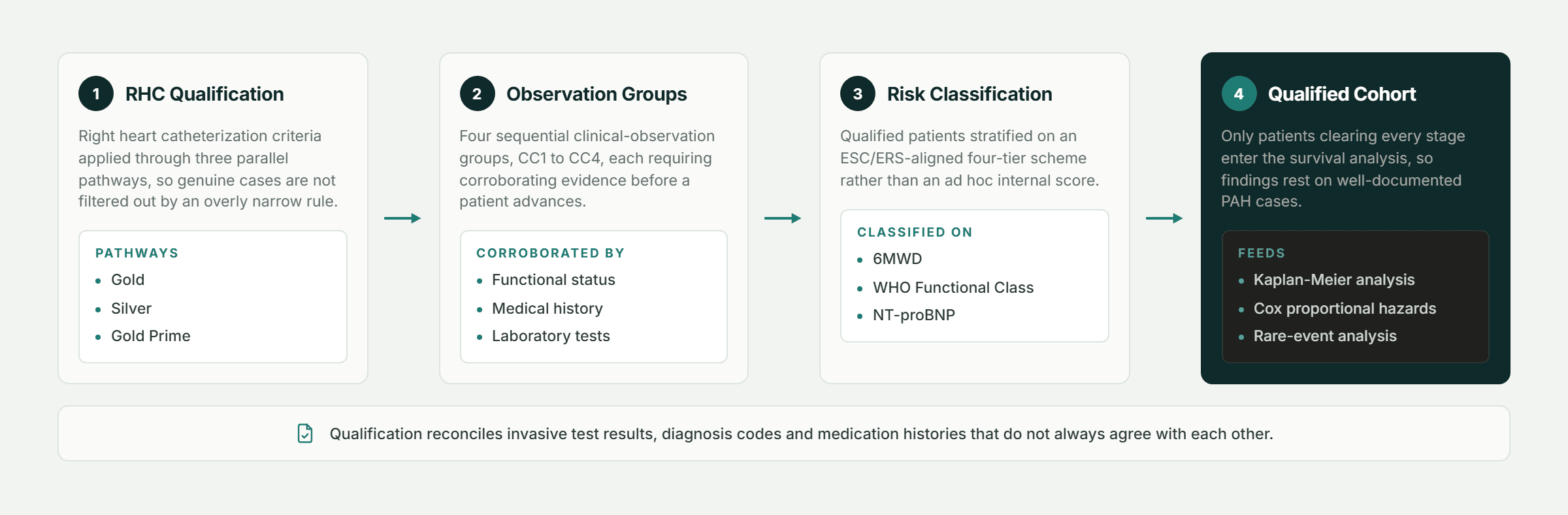
Pfactorial_Case_Study_Risk_Outcomes_PAH image 2
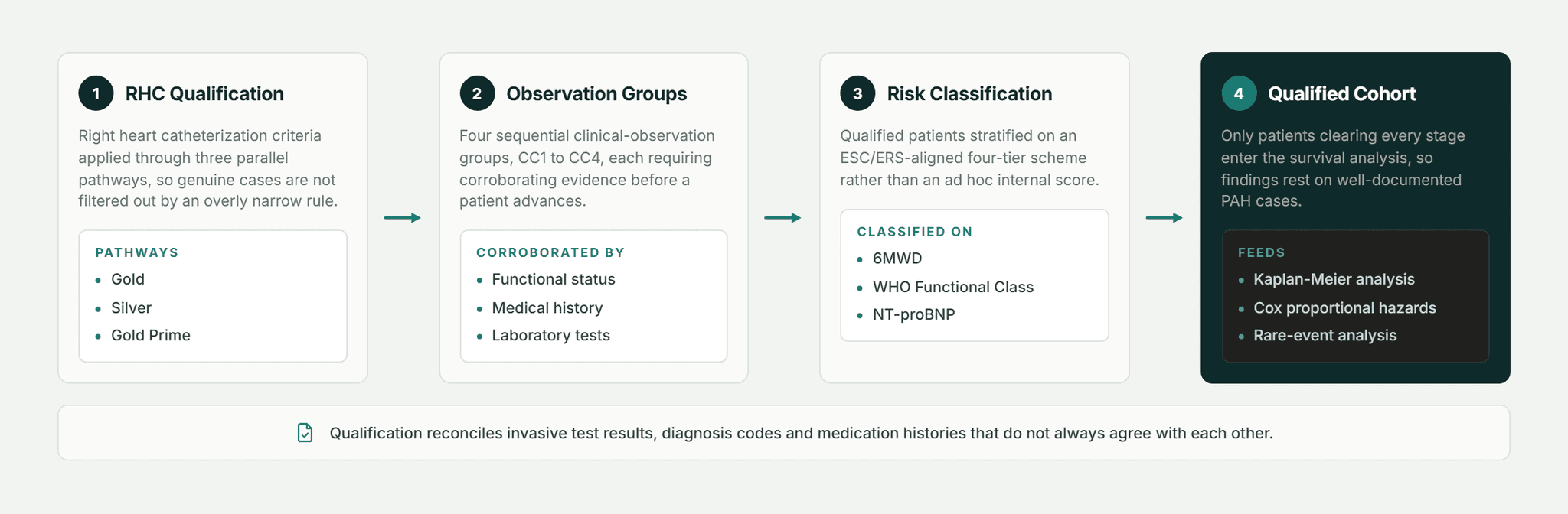
Figure 2 - Patients had to qualify across every clinical group, not just one.

Architectural principles

  • Multi-tier cohort qualification - Patients pass through Right Heart Catheterization qualification criteria and four sequential clinical-observation groups before inclusion, ensuring the cohort reflects real, well-documented PAH cases.
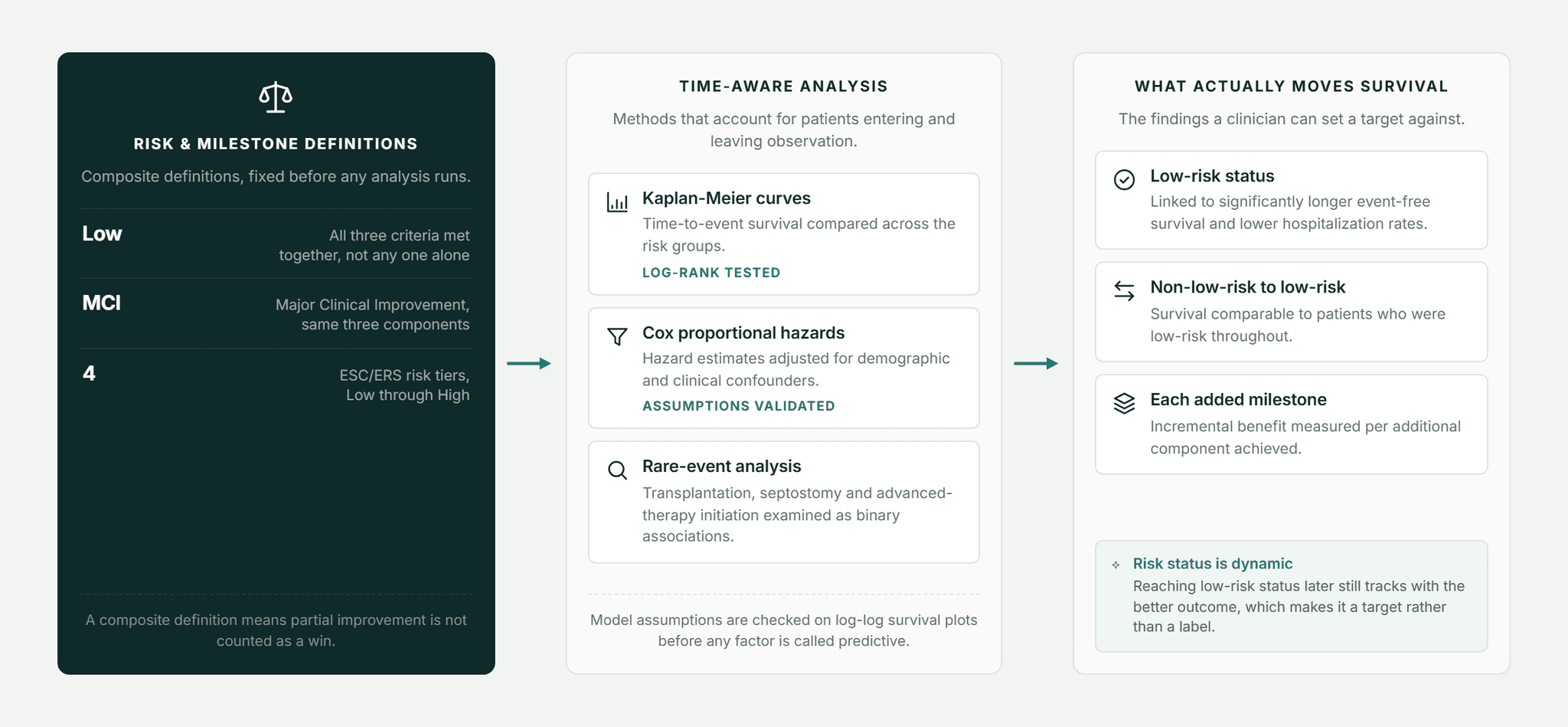
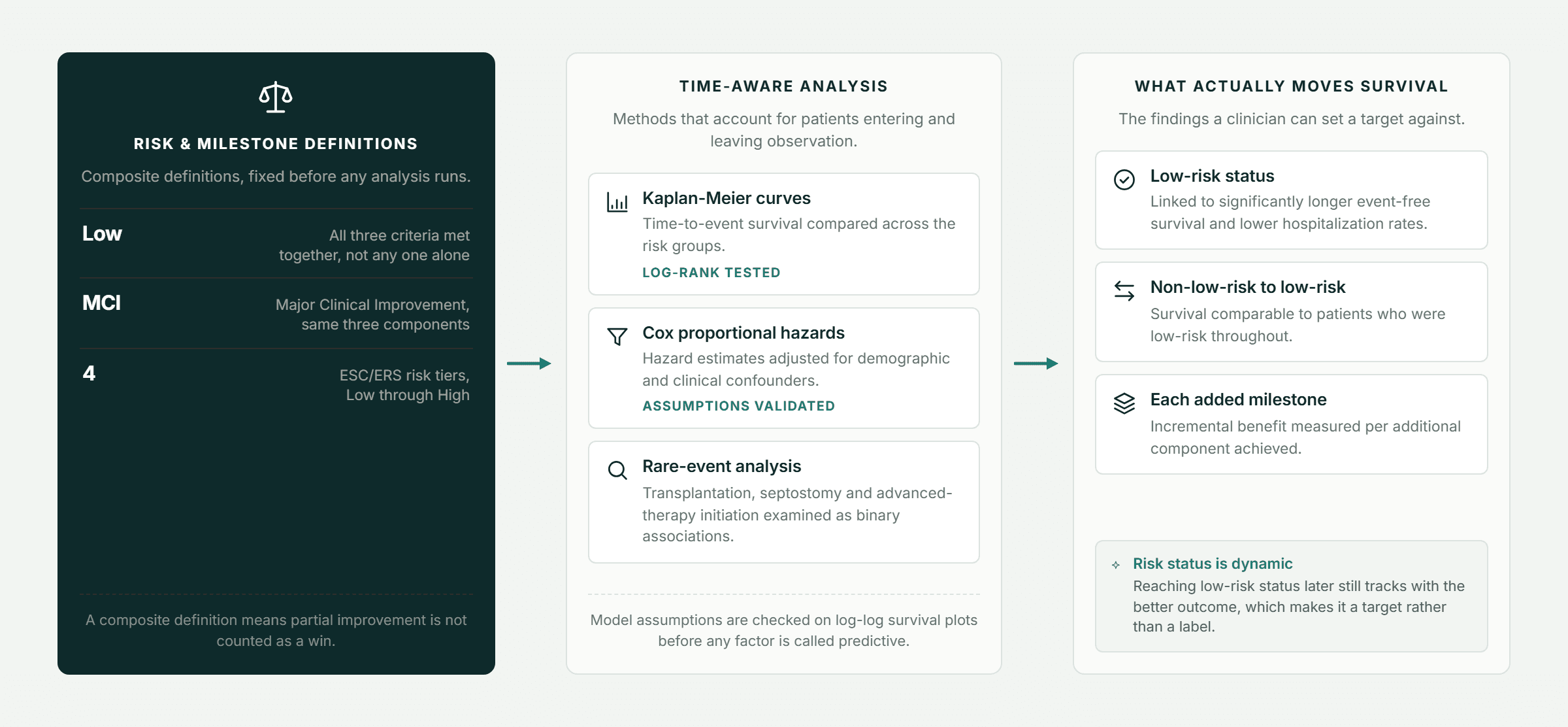
  • Composite over single-metric risk - “Low-risk” status and “Major Clinical Improvement” are both defined as achieving all three of exercise capacity, functional class and biomarker criteria together - not any one alone.
  • Time-aware survival methods - Kaplan-Meier curves and Cox proportional hazards models, rather than static survival rates, capture how risk evolves and when events actually occur.
  • Adjust before you conclude - Cox models control for demographic and clinical confounders, with model assumptions validated via log-log survival plots, before any factor is called predictive.
CAPABILITIES DELIVERED
Each deliverable moves from cohort assembly through to clinically actionable survival findings.
CAPABILITY
WHAT IT DOES
Multi-source cohort qualification
RHC criteria combined with four sequential clinical-observation groups (CC1-CC4).
Risk stratification
ESC/ERS-aligned four-tier classification (Low, Intermediate-Low, Intermediate-High, High).
Kaplan-Meier survival analysis
Time-to-event curves with log-rank comparison across risk groups.
Cox proportional hazards modeling
Confounder-adjusted hazard estimation with validated model assumptions.
Rare-event exploratory analysis
Transplantation, septostomy and advanced-therapy initiation examined as binary associations.
Dose-response analysis
Incremental survival benefit measured per additional milestone achieved.
Pfactorial_Case_Study_Risk_Outcomes_PAH image 3
Figure 3 - Risk tiers feed directly into survival and hospitalization outcomes.
Design note The finding clinicians can act on isn't “low-risk patients survive longer” - it's that patients who move from non-low-risk to low-risk status show survival comparable to patients who started there. Risk status is dynamic, and that's the actionable part.
ENGINEERING FOR SCALE AND RELIABILITY
Six methodological decisions keep the framework's conclusions defensible and clinically usable.

Three-path RHC qualification

Gold, Silver and Gold Prime qualification pathways include genuine PAH cases without applying an overly narrow inclusion filter that would exclude real patients.

Sequential clinical-observation groups

Four groups (CC1-CC4) require corroborating data across functional status, medical history and lab tests before a patient qualifies for the final cohort.

Guideline-aligned risk classification

ESC/ERS-based four-tier risk stratification enables direct comparison against established clinical guidelines rather than an ad hoc scoring scheme.

Kaplan-Meier with log-rank testing

Survival curves across risk groups are compared statistically via log-rank tests, not just visually, to establish significance.

Confounder-adjusted Cox modeling

Hazard ratios are adjusted for demographic and clinical confounders, with model assumptions validated using log-log survival plots.

Interpretable multivariable modeling

Feature-selection techniques kept the multivariable survival models focused on genuinely predictive factors rather than an unwieldy full variable set.
DELIVERY APPROACH
The engagement built the cohort qualification framework first, then layered risk stratification and survival modeling on top of a validated patient population.
1. Cohort qualification framework - RHC criteria combined with the four sequential clinical-observation groups (CC1-CC4).
2. Risk-tier classification - ESC/ERS-aligned stratification into four risk categories based on 6MWD, WHO FC and NT-proBNP.
3. Descriptive baseline characterization - summary statistics establishing the qualified cohort's demographic and clinical profile.
4. Kaplan-Meier & log-rank analysis - time-to-event survival curves compared statistically across risk groups.
5. Cox proportional hazards modeling - confounder-adjusted hazard estimation with validated model assumptions.
6. Rare-event exploratory analysis - binary association analysis of rare but critical clinical events.
RESULTS AND IMPACT

Pfactorial_Case_Study_Risk_Outcomes_PAH image 4
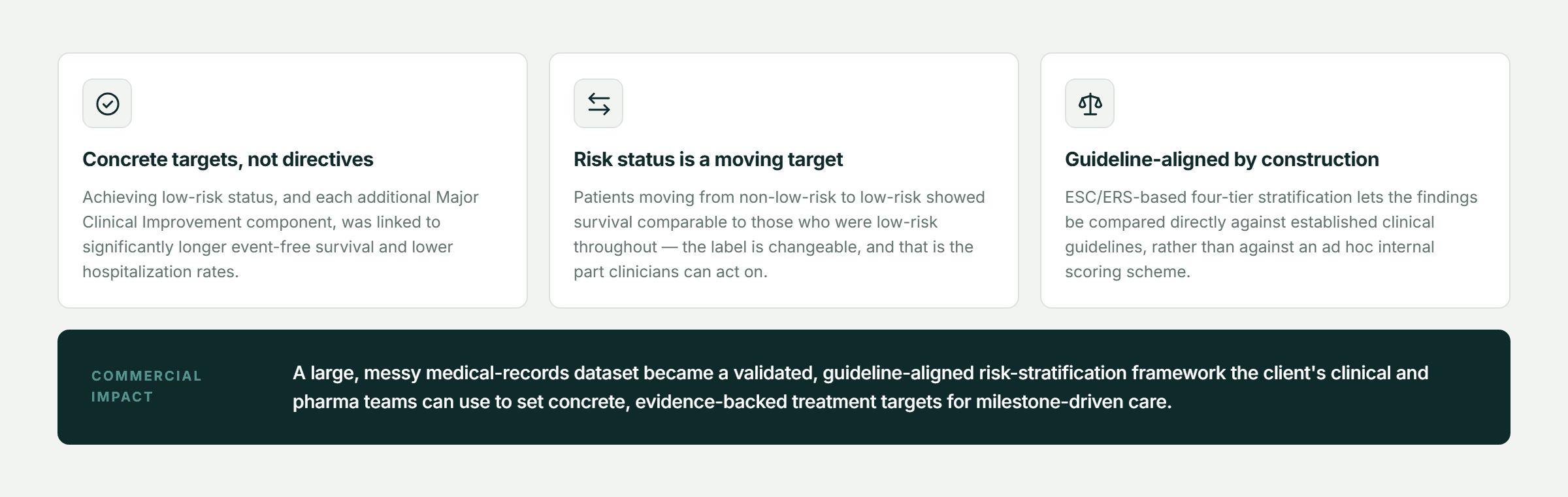
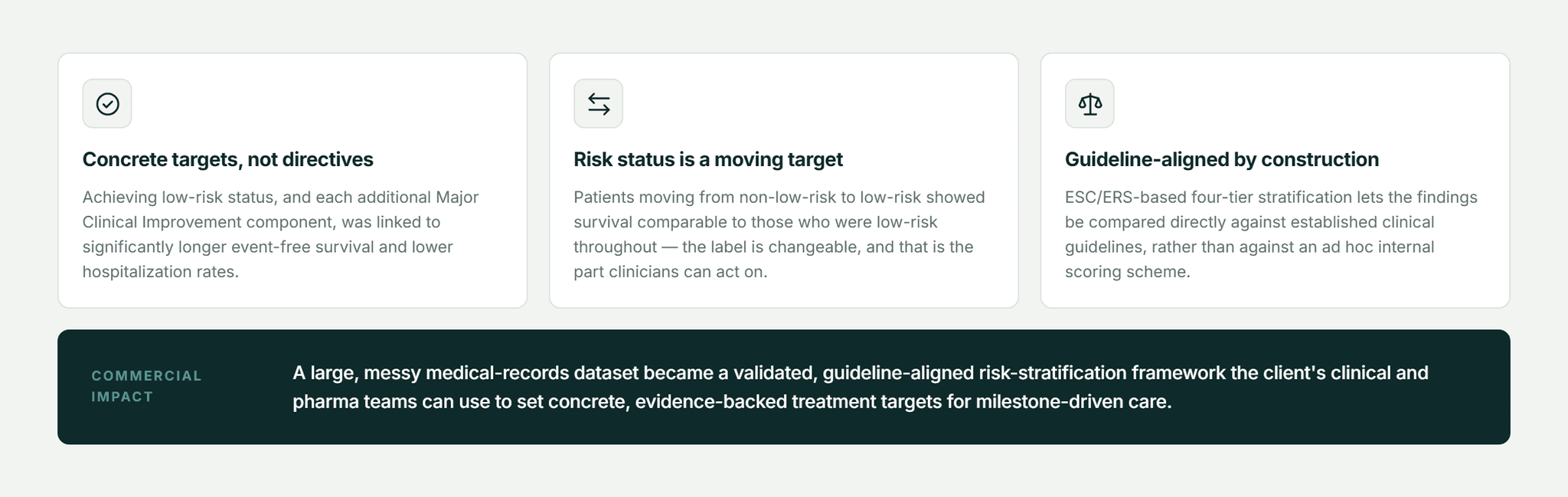
Figure 4 - Key outcomes from this engagement.
Achieving low-risk status, and each additional Major Clinical Improvement component, was linked to significantly longer event-free survival and lower hospitalization rates - giving clinicians concrete, measurable targets rather than an abstract management directive.
Patients transitioning from non-low-risk to low-risk status showed survival outcomes comparable to those who maintained low-risk status throughout, underscoring that risk status is a dynamic, actionable target rather than a fixed label.

What it enabled commercially

The framework converts a large, messy medical-records dataset into a validated, guideline-aligned risk-stratification tool clinicians can use to set concrete treatment targets, giving the client's clinical or pharma team evidence-based support for milestone-driven care.
WHY PFACTORIAL
This engagement reflects Pfactorial's applied clinical-outcomes research service line: rigorous cohort qualification and time-aware statistical methods that convert raw medical records into clinically actionable findings.
Pfactorial_Case_Study_Risk_Outcomes_PAH image 5
Figure 5 - Service lines this engagement draws on.
Engagement enquiries Pfactorial Technologies works with life-sciences and clinical research teams that need medical-records data turned into validated, actionable outcomes research. If you're evaluating a clinical outcomes or risk-stratification initiative, we're happy to give you an honest read on scope and risk before anyone commits to anything. · pfactorial.ai
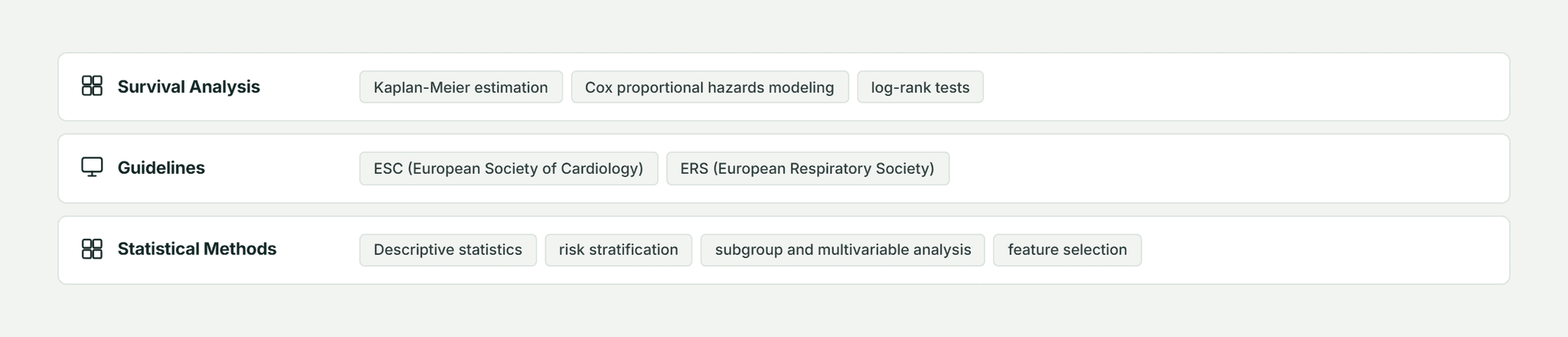
APPENDIX A - TECHNOLOGY STACK
The technology stack underpinning the system, grouped by the layer it serves.
Pfactorial_Case_Study_Risk_Outcomes_PAH image 6
© 2026 Pfactorial Technologies. Client identity and product-specific implementation detail are withheld or generalized; no client data, credentials, source code, or infrastructure detail is included in this document.

Result and Analysis

ENGAGEMENT SNAPSHOT

How Pfactorial Technologies built a survival-analysis framework showing which clinical milestones actually predict longer, event-free survival in Pulmonary Arterial Hypertension patients.

Pfactorial_Case_Study_Risk_Outcomes_PAH image 1
Pfactorial_Case_Study_Risk_Outcomes_PAH image 2
Pfactorial_Case_Study_Risk_Outcomes_PAH image 3
Pfactorial_Case_Study_Risk_Outcomes_PAH image 4
Pfactorial_Case_Study_Risk_Outcomes_PAH image 5
Pfactorial_Case_Study_Risk_Outcomes_PAH image 6