Back
RAG & Semantic Search
A Multi-Perspective AI Response Engine Grounded in Three Religious Texts
How Pfactorial Technologies built Unicite, an app that answers a single question with three parallel, text-grounded responses drawn from the Bhagavad Gita, the Quran, and the Bible.
August 21, 2026
Share
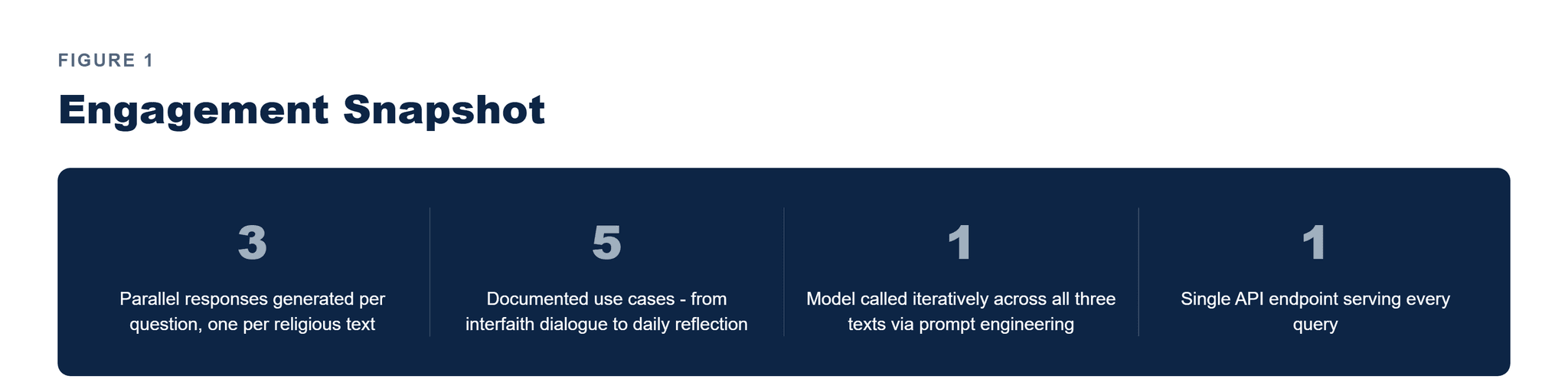
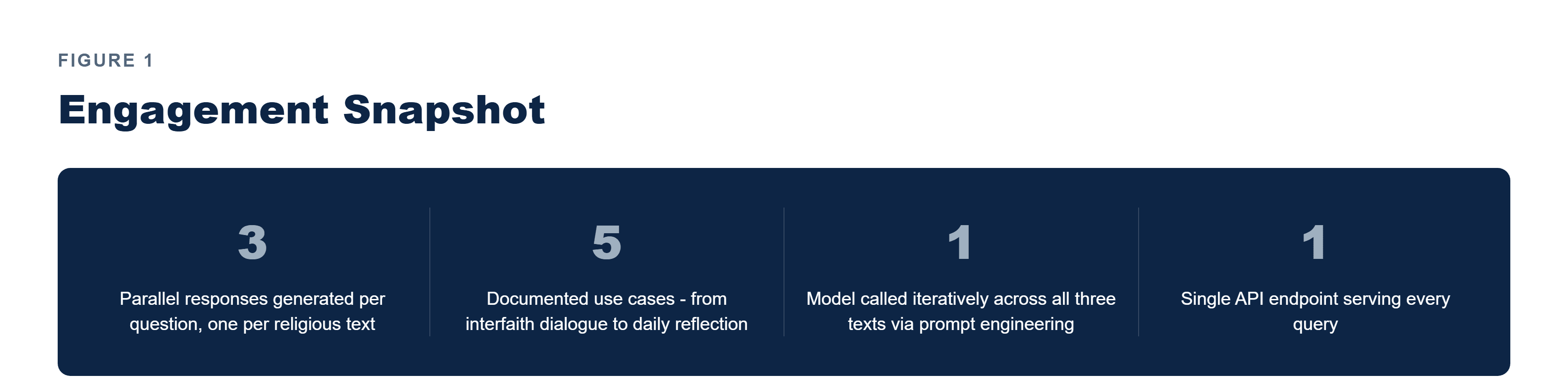
ENGAGEMENT SNAPSHOT

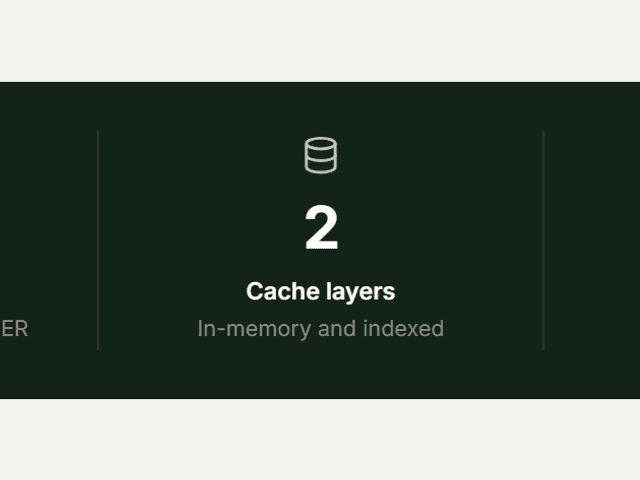
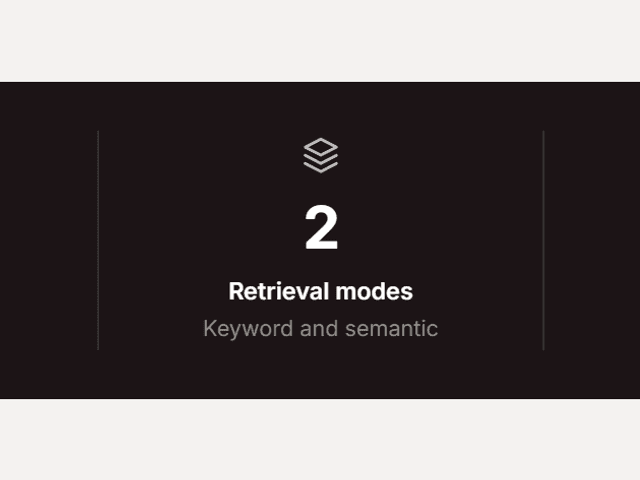
Figure 1 - Key figures from this engagement, at a glance.
EXECUTIVE SUMMARY
Our client wanted a way for users to explore a question or quote through the lens of multiple religious traditions at once, rather than researching each tradition's text separately.
A single general-purpose model response tends to blend traditions together or default to one perspective; getting a genuinely distinct, text-grounded voice for each of three different traditions from the same input requires deliberate per-tradition prompting, not one generic prompt reused three times.
Pfactorial built Unicite: a Flask-backed app that runs a user's question through three separately engineered prompts - one grounded in the Bhagavad Gita, one in the Quran, one in the Bible - via GPT-3.5-turbo, and returns all three responses together.
Why this engagement is representative This engagement demonstrates Pfactorial's ability to get consistent, distinctly voiced output from a single underlying model across multiple parallel use cases, purely through disciplined prompt design.
THE CHALLENGE
Producing three genuinely distinct, comparable perspectives from one model surfaced problems a single generic prompt doesn't solve.
1. One model, three genuinely distinct voices
The same question needed a response grounded in and stylistically consistent with each of three different traditions, not one generic answer restated three times.
2. Responses had to actually reflect their source text, not just its reputation
A shallow, generic answer without real grounding in a specific text's content and tone would defeat the product's premise of a genuine comparative perspective.
3. Every tradition's answer needed to be short and consistent
Comparing three answers side by side only works if each one holds to a similar length and tone, which meant constraining every prompt the same way.
4. The app depends entirely on one external model provider
Every response for every tradition routes through a single third-party API, so its cost and availability directly gate the product.
The real brief Not "a chatbot that talks about religion" but "one question answered three separate, text-grounded ways, side by side, so the comparison itself is the product."
THE SOLUTION
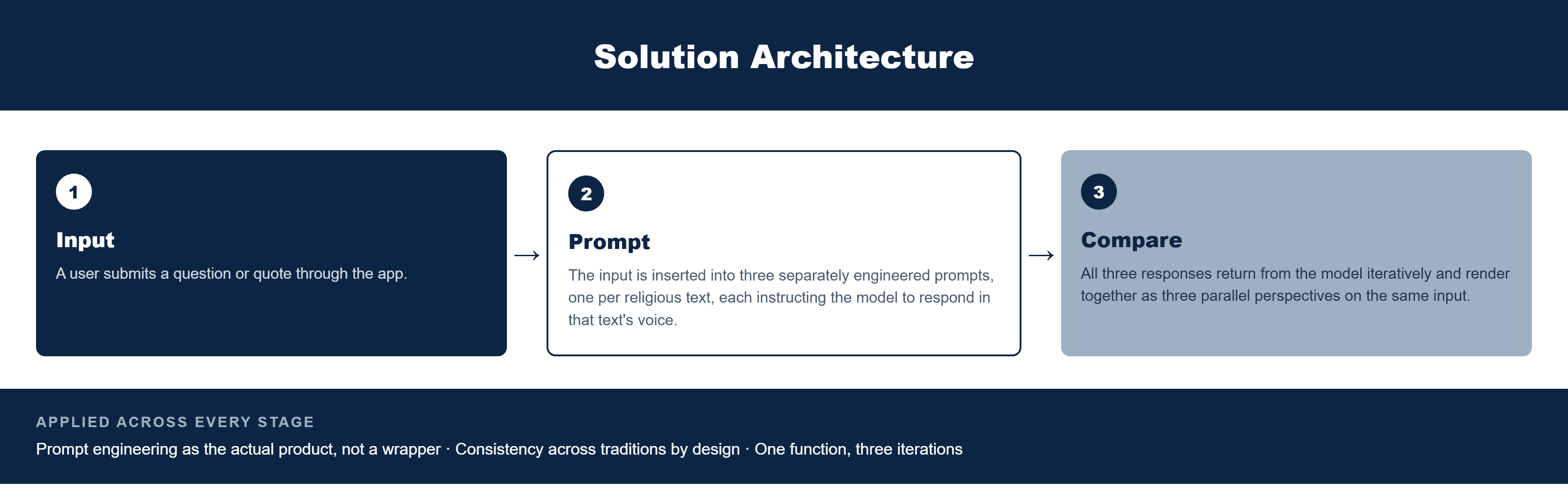
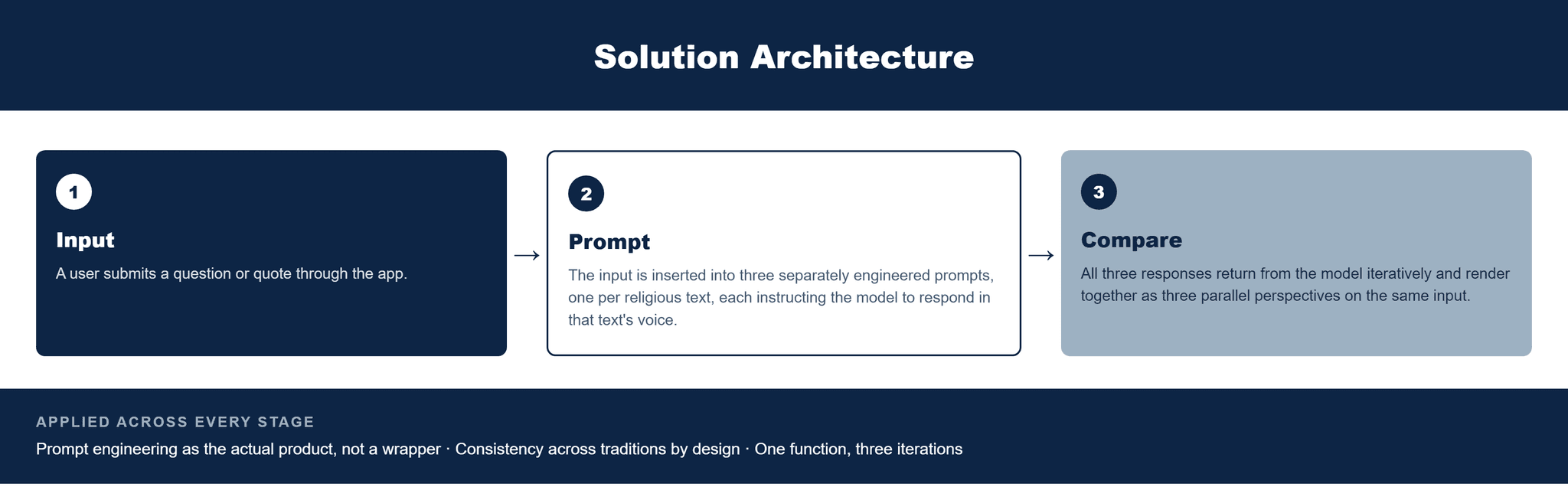
Pfactorial built Unicite around a single response-generation function called three times, once per religious text, each with its own engineered prompt.

Figure 1 - One question produces three separately generated, text-grounded responses through the same model.
Architectural principles
- Prompt engineering as the actual product, not a wrapper - Three distinct, carefully constrained prompts are what makes one model produce three genuinely different, text-grounded voices.
- Consistency across traditions by design - Every prompt is built to the same constraints on tone, length, and greeting style, so the three answers are genuinely comparable, not just three unrelated outputs.
- One function, three iterations - A single response-generation function is called once per religious text rather than maintaining three parallel code paths, keeping the logic in one place even as the prompt content differs.
CAPABILITIES DELIVERED
Each capability supports the core premise of a single question answered from three distinct, text-grounded perspectives.
CAPABILITY | WHAT IT DOES |
|---|---|
Multi-perspective response generation | A single question returns three parallel responses, one grounded in each of the Bhagavad Gita, the Quran, and the Bible. |
Text-grounded prompt engineering | Each response is generated from a prompt purpose-built to reflect that text's tone and content, not a single generic instruction. |
Side-by-side comparison view | The three responses render in three parallel sections so a user can compare perspectives directly. |
Simple single-endpoint API | One Flask endpoint accepts a query and returns all three responses in one call. |
Reusable across five documented use cases | The same engine supports interfaith dialogue, spiritual guidance, comparative religion study, reflection, and cultural literacy. |
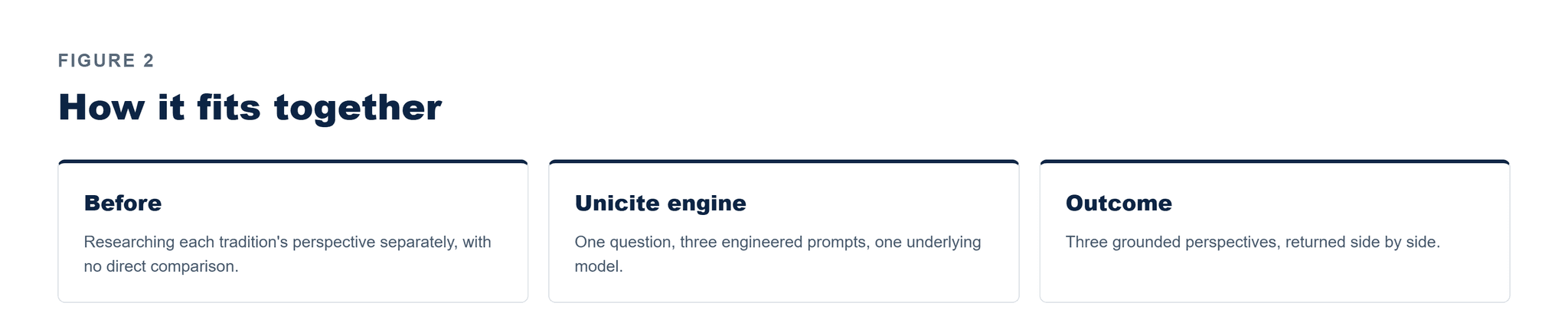
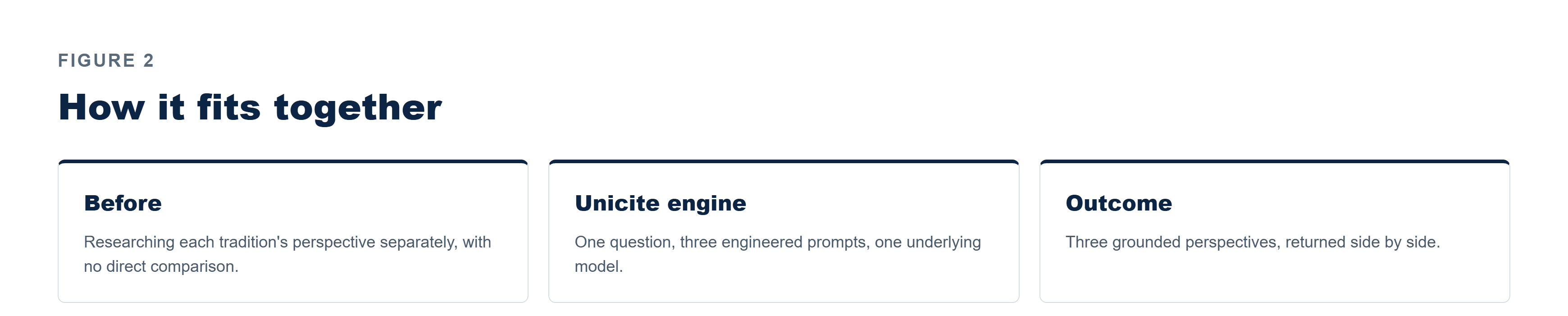
Figure 2 - The same question produces three comparable, text-grounded perspectives in a single call.
Design note Routing every response for every tradition through a single third-party model provider was a deliberate simplicity trade-off for a proof of concept - it minimizes engineering surface area at the cost of concentrating cost and availability risk in one vendor, a trade-off the underlying documentation itself flags as a future cost risk.
ENGINEERING FOR SCALE AND RELIABILITY
Four decisions shaped how Unicite gets three distinct voices out of one underlying model.
Per-tradition prompt engineering instead of one shared prompt
Three separately crafted prompts, each instructing the model to answer in a specific text's voice and constraints, produce genuinely distinct output instead of one generic answer repeated three times.
Sequential calls to one model instead of three separate models
GPT-3.5-turbo is called iteratively with each of the three prompts, so the system depends on one model API rather than integrating and maintaining three.
Explicit length and tone constraints baked into every prompt
Each prompt caps response length and specifies a consistent greeting and tone style, so the three answers stay genuinely comparable side by side.
A single response list assembled server-side
All three model calls complete and are packaged into one list before being handed to the frontend, so the UI receives one clean payload per query instead of managing three separate requests.
DELIVERY APPROACH
The build moved from per-tradition prompt design through to a single aggregated response served by one endpoint.
1. Prompt design per religious text - engineering and testing three distinct prompts, one grounded in each of the Bhagavad Gita, the Quran, and the Bible.
2. Model integration - wiring calls to the GPT-3.5-turbo API, iterated once per prompt.
3. Response aggregation - building the function that collects all three model responses into a single list.
4. API & frontend delivery - exposing the response endpoint in Flask and rendering the three perspectives in parallel sections on the frontend.
RESULTS AND IMPACT

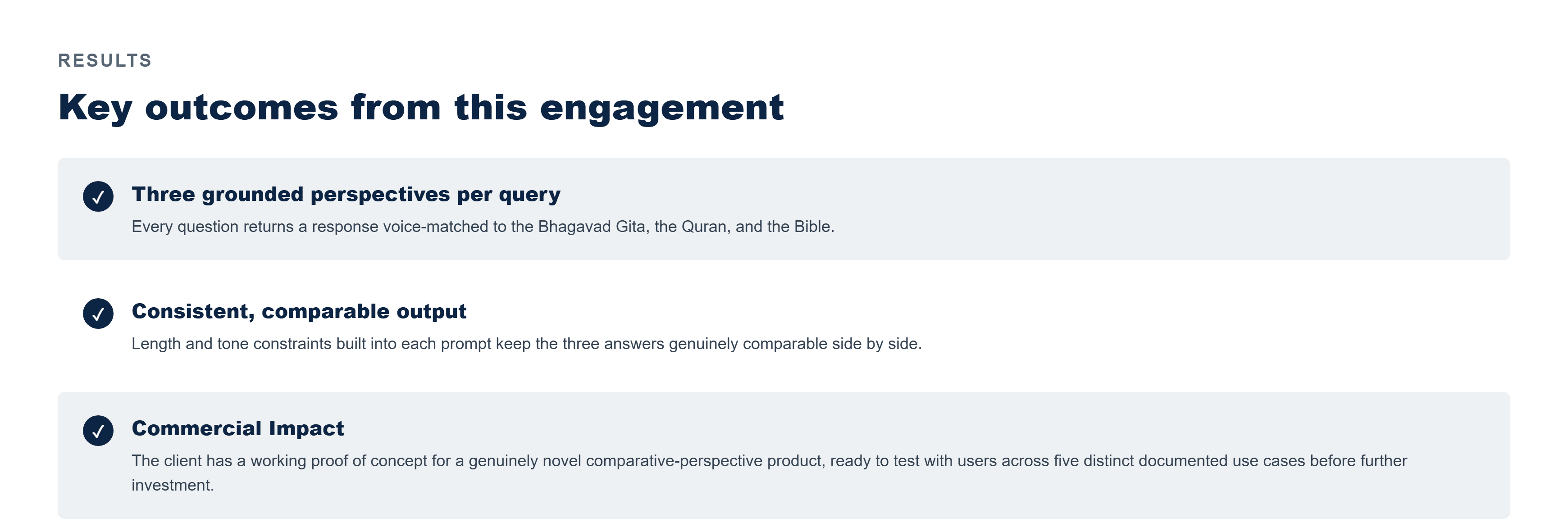
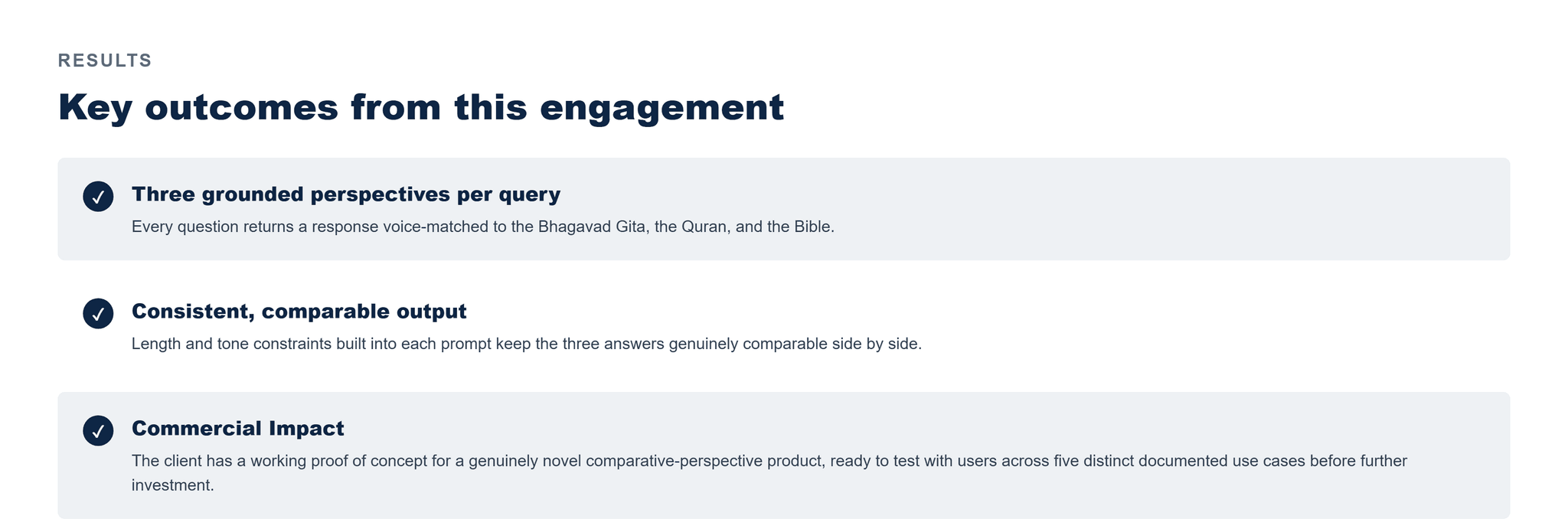
- Key outcomes from this engagement.
Unicite takes a single user question and returns three separately generated, text-grounded responses - one reflecting the Bhagavad Gita, one the Quran, one the Bible - through one Flask endpoint and one underlying model called three times with three distinct prompts.
Because every prompt is built to the same length and tone constraints, the three responses read as genuinely comparable perspectives rather than three unrelated outputs, which is what makes the side-by-side comparison the product depends on actually work.
What it enabled commercially
The client has a working proof of concept validating a comparative, multi-perspective product across interfaith dialogue, spiritual guidance, comparative-religion study, reflection, and cultural-literacy use cases, before committing to scaling model spend or expanding to further texts.
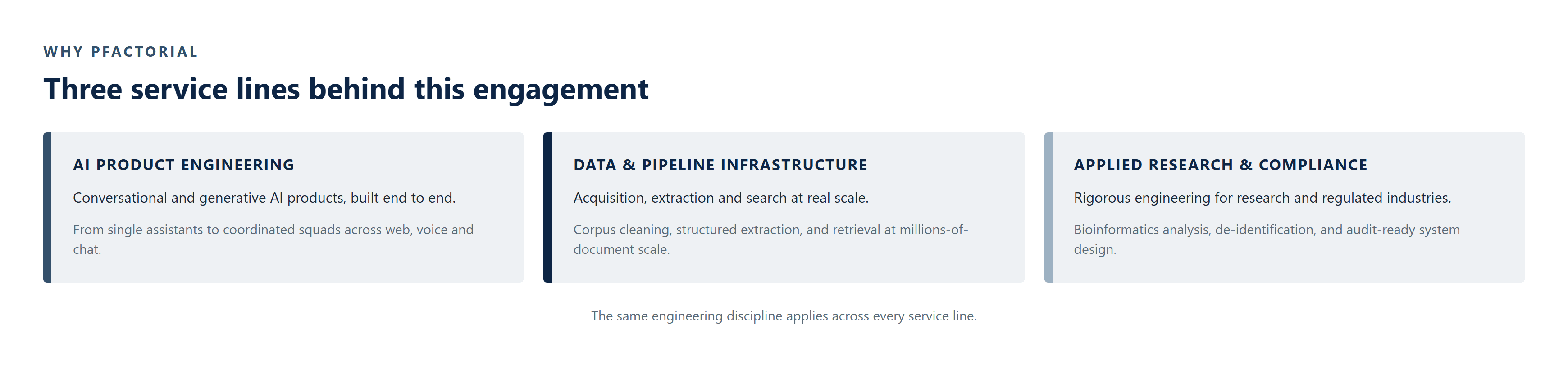
WHY PFACTORIAL
This engagement reflects Pfactorial's applied prompt-engineering practice: getting a single foundation model to reliably produce multiple, genuinely distinct, text-grounded voices through disciplined prompt design rather than model proliferation.

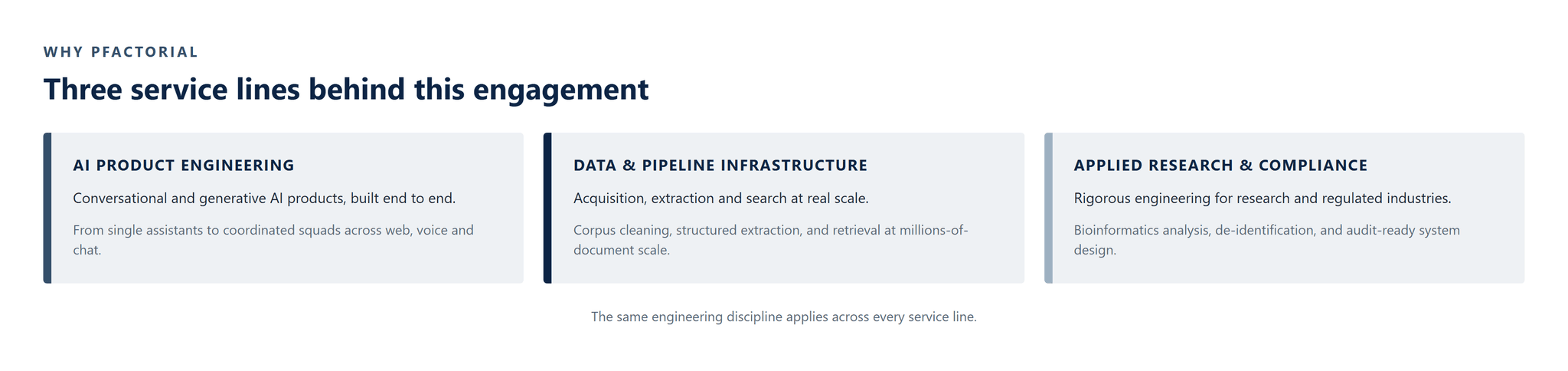
- Service lines this engagement draws on.
Engagement enquiries Pfactorial Technologies works with organisations that need a single model to reliably produce multiple distinct, grounded perspectives rather than one generic response. If you're evaluating a comparative or multi-perspective AI product, we're happy to give you an honest read on scope and risk before anyone commits to anything. · pfactorial.ai
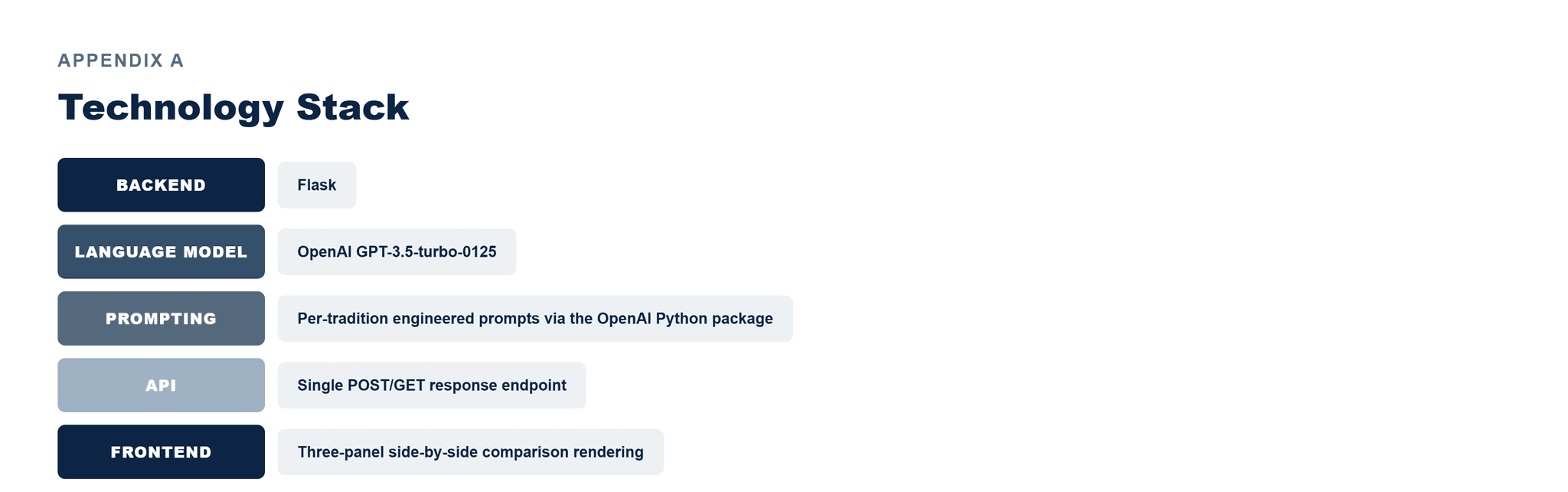
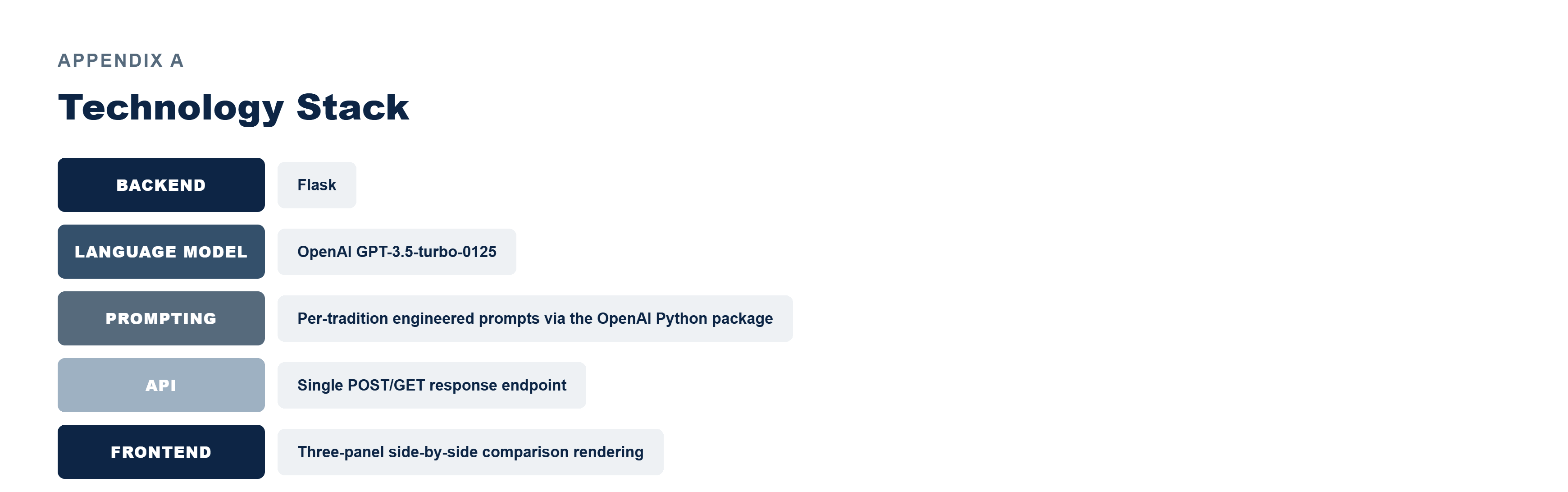
APPENDIX A - TECHNOLOGY STACK
The technology stack underpinning the system, grouped by the layer it serves.

Result and Analysis
ENGAGEMENT SNAPSHOT
How Pfactorial Technologies built Unicite, an app that answers a single question with three parallel, text-grounded responses drawn from the Bhagavad Gita, the Quran, and the Bible.
CASE STUDIES
You might also like...

RAG & Semantic SearchAutomotive & Vehicle
Aug 21, 20267 min readRead

RAG & Semantic Search
A Layered Analytics Platform for CXO-Level Decision-Making
Aug 21, 20268 min readRead

Recruiting & HR TechRAG & Semantic Search
A Natural-Language Candidate Search Platform That Replaces Boolean Query Building
Aug 21, 20267 min readRead

OCR & Document ExtractionRAG & Semantic SearchFinance & Payments
A Purpose-Built Search Engine for 1.6 Million SEC & SEDAR Agreements
Aug 21, 20267 min readRead

Conversational AI & ChatbotsRAG & Semantic Search
A Retrieval-Augmented Chat Interface Over Structured Tax Records
Aug 21, 20267 min readRead

A Retrieval-Augmented Q&A Tool That Turns Any Set of Web Articles Into a Queryable, Source-Cited Knowledge Base
Aug 21, 20267 min readRead