Back
Enterprise Ops Platforms

Turning Recurring ClickUp Workflows Into Cost-Controlled AI Automation

A proposed automation architecture that routes every step of a process to the cheapest reliable option - code, an LLM, or a person - rather than automating every decision with a model by default.
August 21, 2026
Share
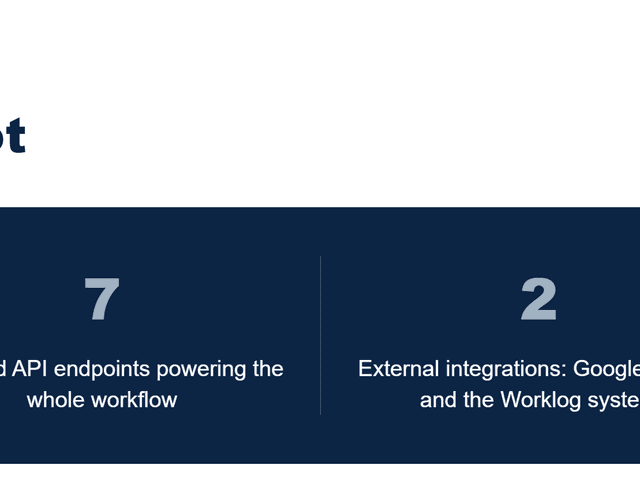
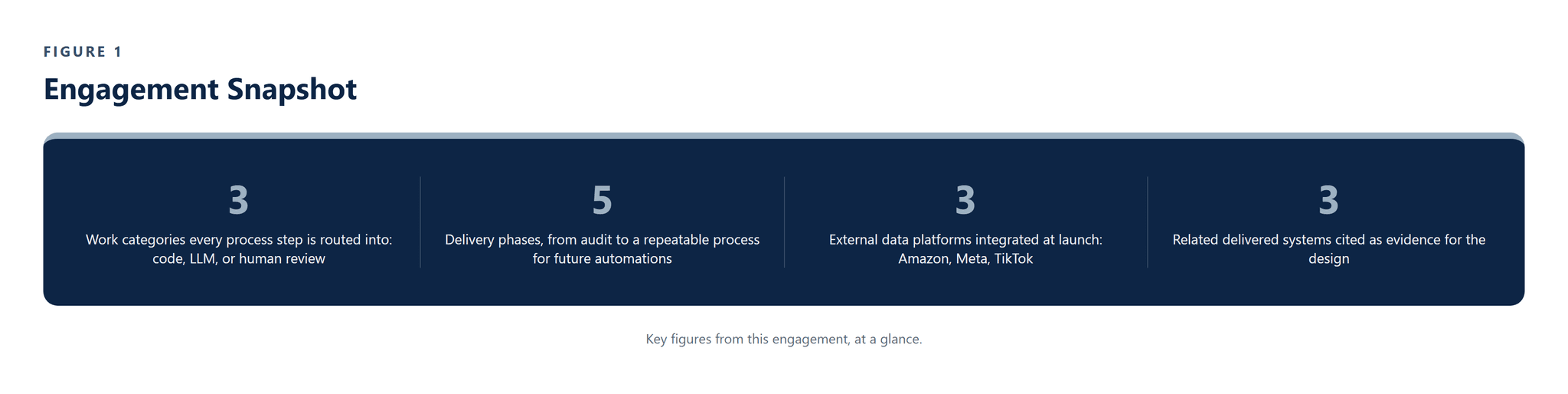
ENGAGEMENT SNAPSHOT

CS-004_ClickUp_AI_Automation image 1
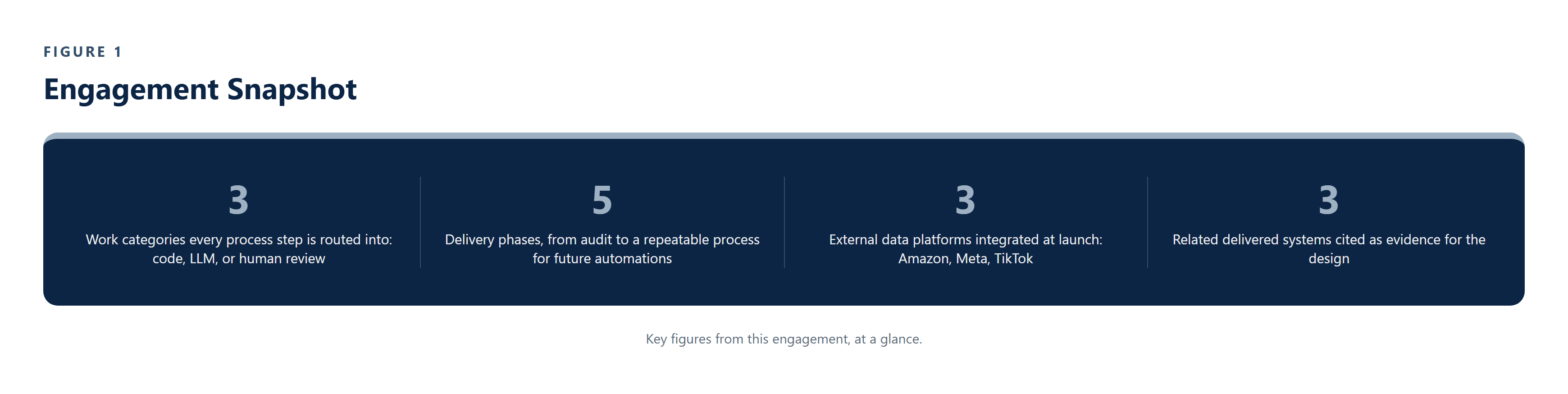
Figure 1 - Key figures from this engagement, at a glance.
EXECUTIVE SUMMARY
Our client runs a substantial share of its operations as recurring ClickUp tasks and SOPs - work that was either done manually every time or automated in a way that ran up unpredictable LLM cost without clear guardrails around what the AI was actually allowed to decide.
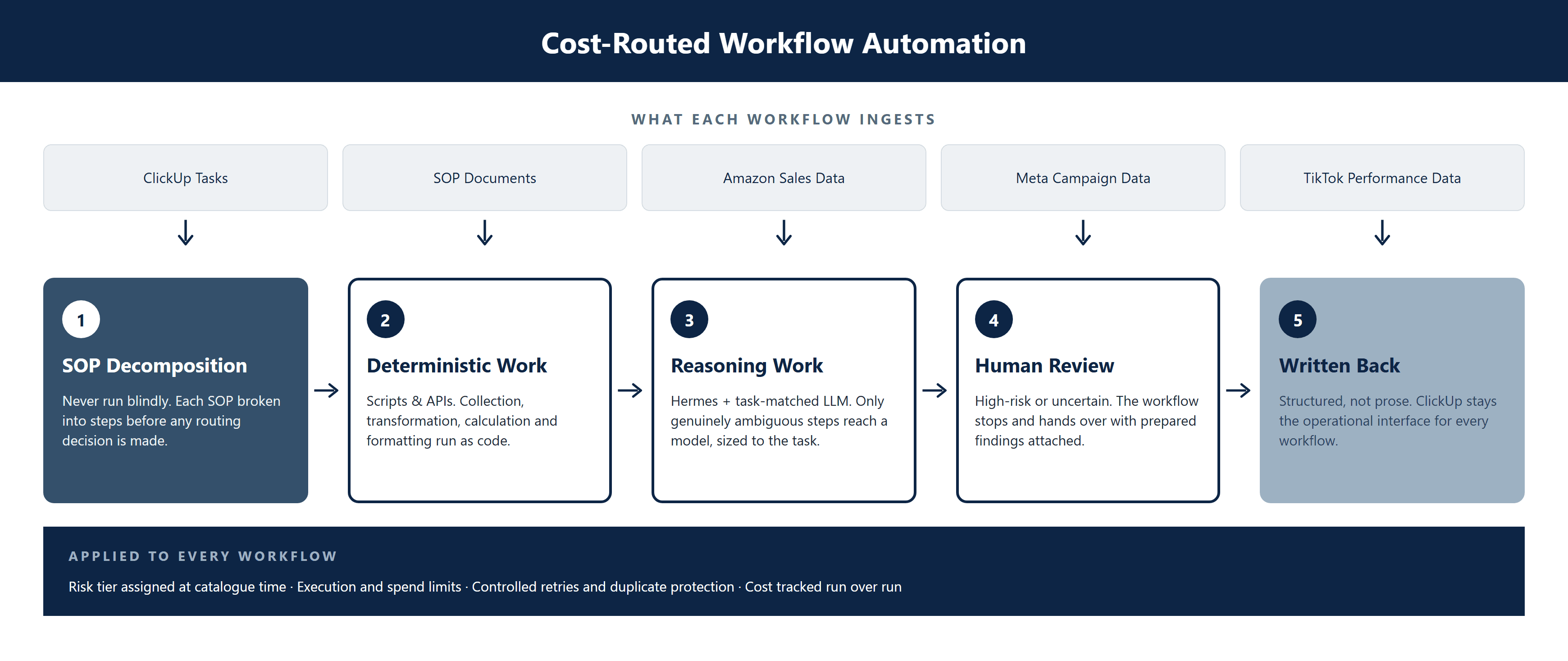
Pfactorial Technologies proposed an automation architecture built around a simple routing principle: deterministic work goes to scripts and APIs, reasoning work goes to an AI orchestration layer on a model matched to the task, and high-risk or uncertain work stops and escalates to a human through ClickUp - rather than asking an LLM to do everything.
Every tool the automation can use is assigned a risk tier at the point it is catalogued, and that tier - not the model's own confidence - decides whether it may act alone. Cost control is treated as a core engineering requirement from the outset, not a cleanup pass after the automation is already running.
Why this engagement is representative This engagement demonstrates Pfactorial's approach to production AI automation: treating cost and reliability as design constraints from day one, assigning risk tiers to every tool an agent can use, and routing work to the cheapest reliable option rather than defaulting to the most capable model.
THE CHALLENGE
Turning ad hoc AI experimentation into dependable operational automation surfaced four recurring problems.

1. Not every step needs a model

Collection, transformation, calculation, formatting, and validation are predictable operations that a script or API call handles more reliably and far more cheaply than an LLM call - but it is easy to default to the model anyway.

2. An SOP pasted into a prompt is not a reliable workflow

Running an entire standard operating procedure through an agent in one shot gives up the reliability and cost control that comes from decomposing it into individual operations and implementing each one at its most reliable option.

3. Autonomy needs boundaries set before the agent runs, not judged after

Production agents acting against real business systems need execution and spend limits, controlled retries, duplicate protection, and a full trace defined in advance - not discovered from an incident.

4. Unmanaged LLM spend hides in ordinary places

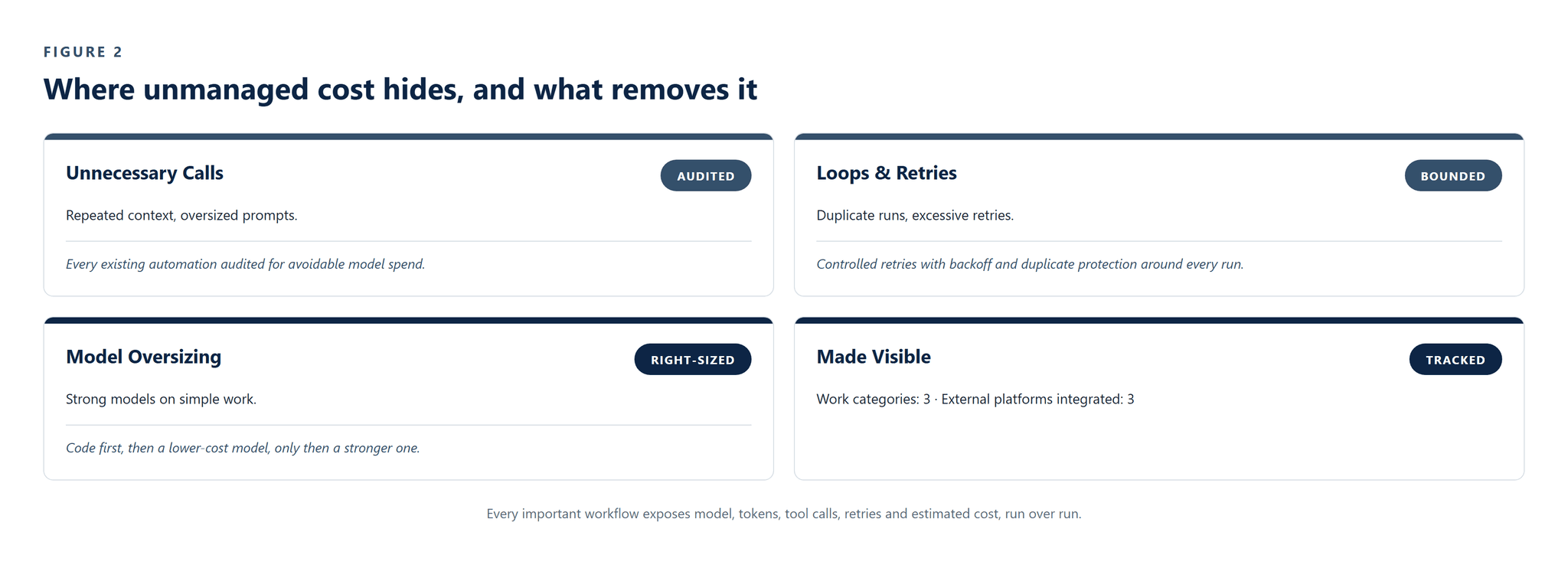
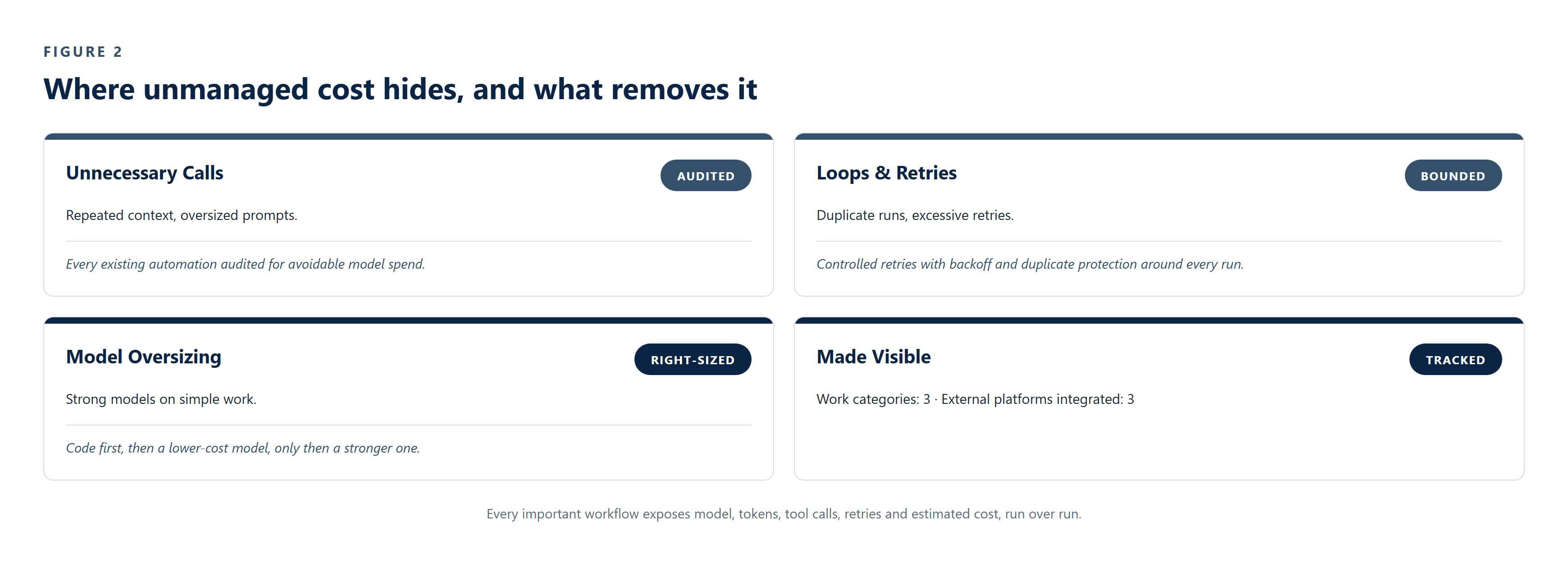
Unnecessary calls, repeated context, oversized prompts, retained tool output, agent loops, excessive retries, duplicate runs, and an expensive model used for simple work all quietly inflate cost without any single failure being visible.
The real brief Not "automate every ClickUp task with AI" but "turn existing tasks, SOPs and recurring processes into dependable automation, with predictable behaviour, measurable cost, and clear human oversight where it is actually needed."
THE SOLUTION
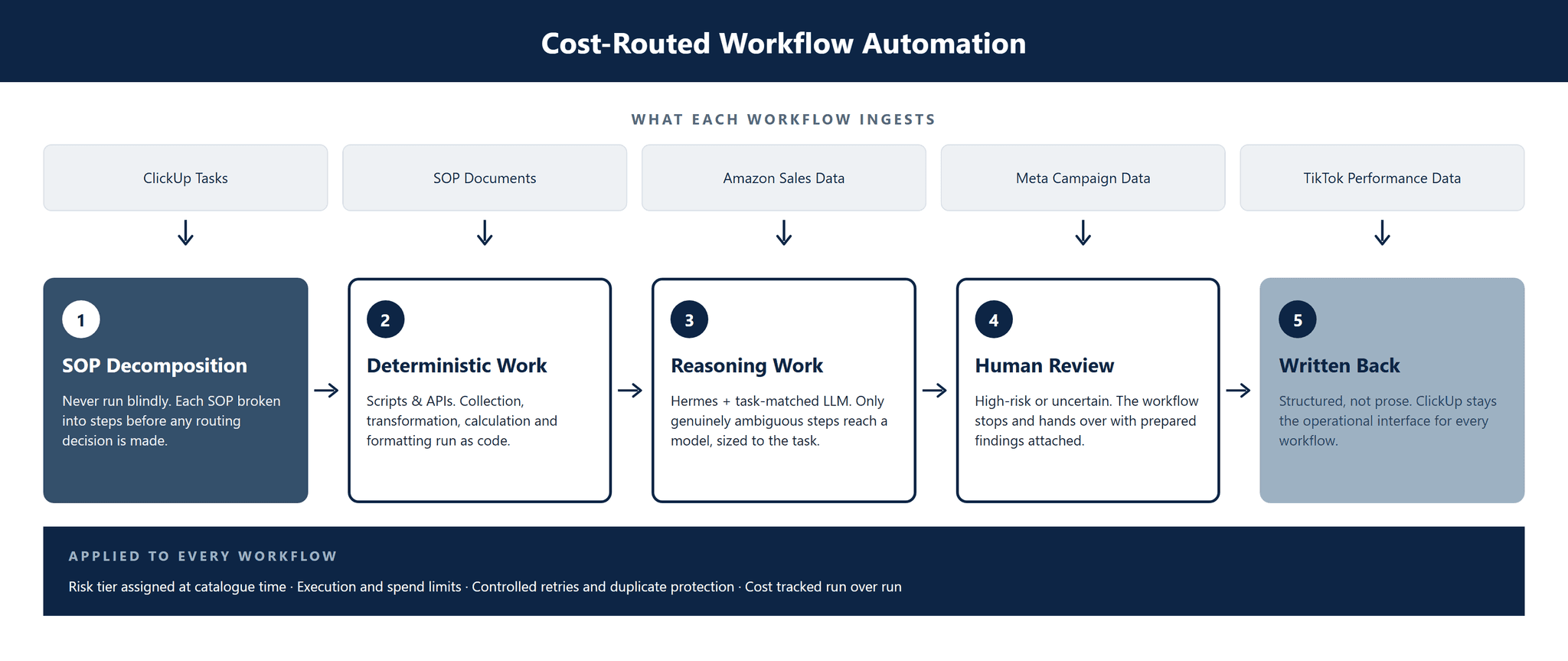
Pfactorial proposed decomposing every recurring process into individual operations and routing each one - by design, not by default - to the cheapest option that reliably does the job.
CS-004_ClickUp_AI_Automation image 2
Figure 1 - Every process step is routed to code, an LLM matched to the task, or a person - decided at design time, not inferred by the model at runtime.

Architectural principles

  • Deterministic first, reasoning only where needed - collection, transformation, calculation, formatting, and validation use normal code wherever the operation is predictable; interpretation, analysis, summarisation, and classification are the only steps handled by the reasoning layer.
  • SOPs are decomposed, never run blindly - each SOP is broken into individual operations and each one is implemented as its most reliable option - usually a script or API call, with the model reserved for the steps that genuinely require reasoning.
  • Risk tier decides autonomy, not model confidence - every tool in the automation's surface is assigned a risk tier at inventory time, and that tier - fixed in advance - determines whether the agent may act alone or must stop and escalate.
  • Cost is an engineering requirement, not a cleanup pass - existing and proposed workflows are reviewed for unnecessary LLM calls, oversized prompts, retained tool output, and expensive models used for simple work, with model selection following task complexity rather than defaulting upward.
CAPABILITIES DELIVERED
The proposed automation platform spans controlled ClickUp integration, external data ingestion, and the guardrails needed to run both safely at production scale.
CAPABILITY
WHAT IT DOES
Controlled ClickUp Integration
Retrieves assigned tasks, descriptions, comments and supporting SOPs, then writes structured results back - comments, reports, custom fields, status changes, and human-review flags.
SOP Decomposition
Breaks each standard operating procedure into individual operations, implementing each as a script, an API call, or a model call, matched to what the step actually requires.
Normalized External Data Integration
Reaches required platforms through MCP servers, APIs, and webhooks, normalizing and reducing data - relevant metrics, not raw rows - before it reaches a model.
Risk-Tiered Tool Governance
Assigns every callable tool a risk tier at catalogue time, with execution and spend limits, controlled retries, and duplicate protection applied around every run.
Human-in-the-Loop Escalation
Where the automation cannot safely determine the next action, it stops, updates ClickUp with its findings and a recommended action, and marks the task for human review.
Per-Workflow Cost Observability
Every important workflow exposes model, token usage, tool calls, retries, runtime, and estimated cost, so real ROI can be judged run over run.
CS-004_ClickUp_AI_Automation image 3
Figure 2 - Cost and reliability review scope: the categories of unnecessary spend identified and removed as a standard part of hardening every workflow.
Design note The goal of the design is not maximum AI usage - it is maximum useful automation at controlled cost. Some steps run on the reasoning layer, some on a lightweight script, and some are deliberately left to stop and ask a human; correctly drawing that boundary is what turns an agent prototype into a dependable operational system.
ENGINEERING FOR SCALE AND RELIABILITY
Several engineering decisions shape whether an agent automation is dependable enough to run unattended against real business systems.

Data is reduced before it reaches a model

external platform data is normalized and reduced to relevant metrics rather than thousands of raw rows before being passed to a model, improving both cost and reliability in the same step.

Workflows are triggered by real events, not polling

automations are initiated by ClickUp webhooks, status changes, assignments, or scheduled jobs, depending on the use case, rather than a constant polling loop.

Execution and spend limits are set before the agent runs

controlled retries with backoff, duplicate protection, and hard execution and spend limits surround every run, so a failure mode is bounded rather than open-ended.

Human review receives prepared findings, not a blank task

when a workflow escalates, the person receives the automation's findings and a recommended action already attached, so review is a decision, not a re-investigation from scratch.

Model selection follows task complexity, not habit

if plain code does the job reliably it stays a script; if it needs light reasoning it goes to a lower-cost model; only genuine difficulty reaches a stronger model.

Delivery is flagship-first

the foundation and two high-value pilot workflows are built end to end early in delivery, so there is something real to react to within the first weeks rather than a specification to approve at the end.
DELIVERY APPROACH
The proposed engagement runs in five phases, moving from an audit of existing automation spend to a documented, repeatable process for converting future workflows.
1. Audit - review existing agents, integrations, model configuration and SOPs to identify the major credit and reliability hotspots.
2. Foundation - establish the ClickUp and MCP integration layer, risk-tiering approach, and the routing logic between code, reasoning, and human review.
3. Pilot workflows, end to end - complete several high-value recurring jobs through the automation against real data, unattended, with the guardrails actively firing.
4. Hardening and optimization - add limits, retries, validation, error handling, cost tracking, and human escalation, while removing unnecessary calls, context, loops, and model cost.
5. Documentation and expansion - document every workflow and establish a repeatable process for converting future ClickUp processes into automations.
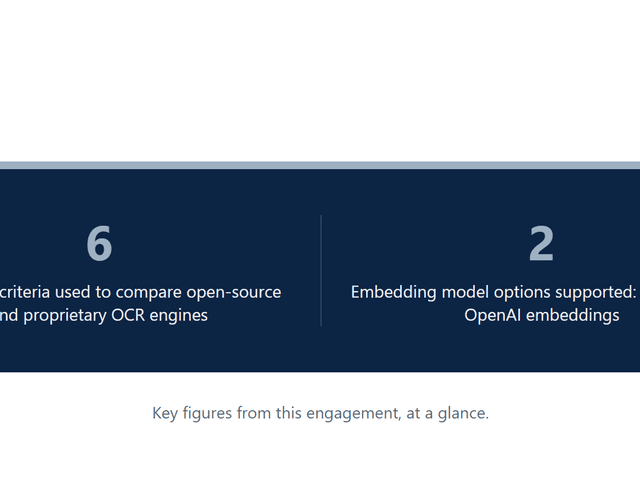
RESULTS AND IMPACT

CS-004_ClickUp_AI_Automation image 4
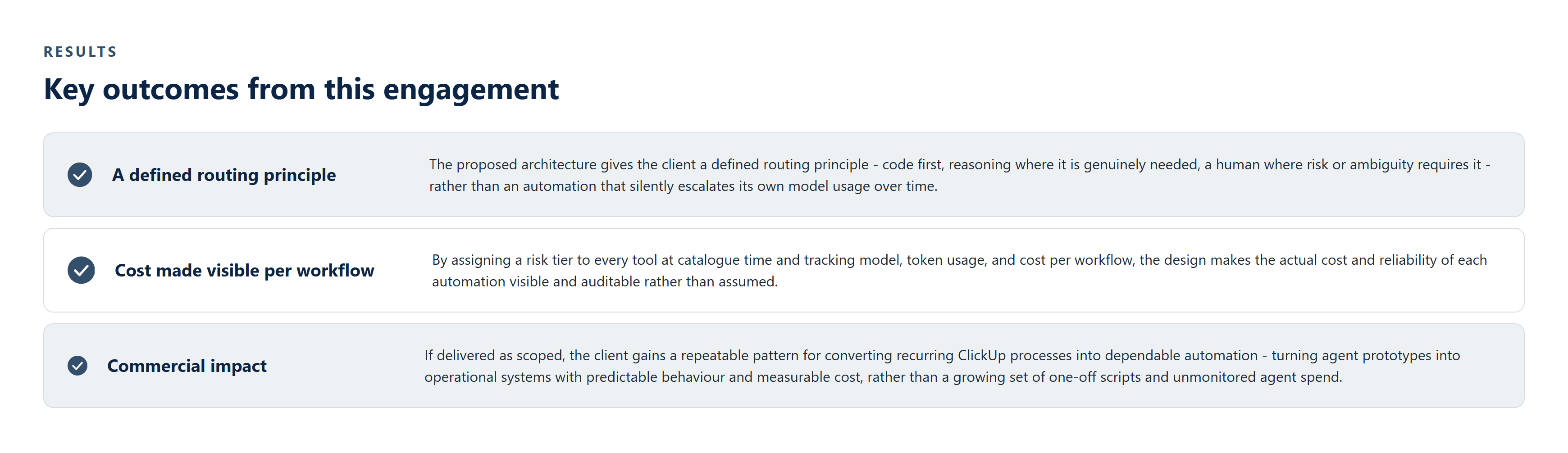
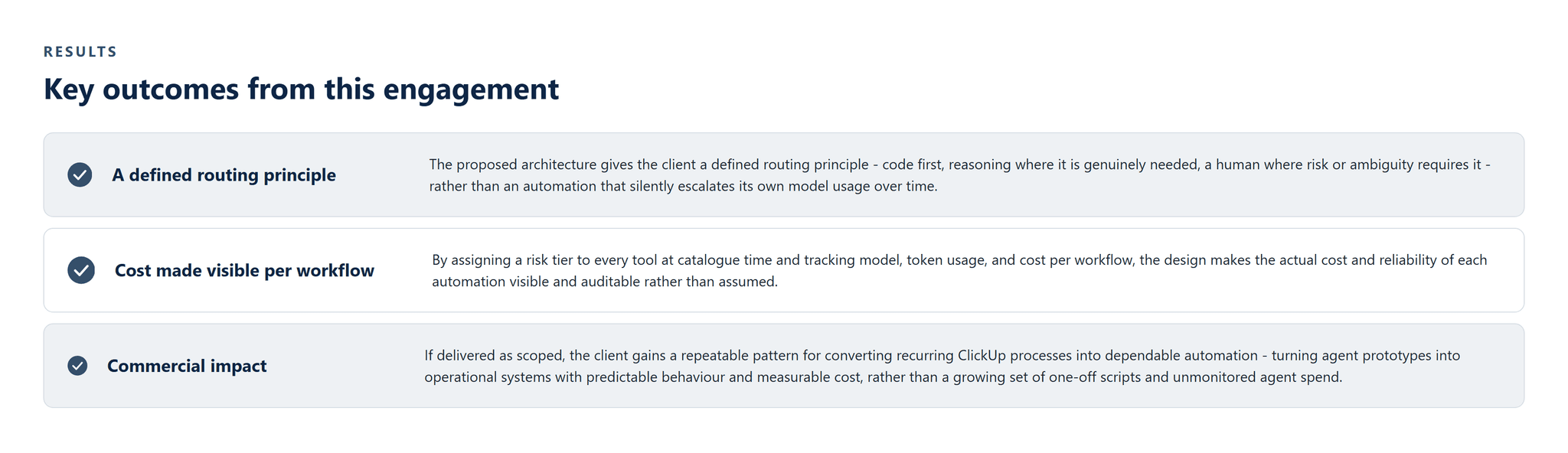
Figure - Key outcomes from this engagement.
The proposed architecture gives the client a defined routing principle - code first, reasoning where it is genuinely needed, a human where risk or ambiguity requires it - rather than an automation that silently escalates its own model usage over time.
By assigning a risk tier to every tool at catalogue time and tracking model, token usage, and cost per workflow, the design makes the actual cost and reliability of each automation visible and auditable rather than assumed.

What it enabled commercially

If delivered as scoped, the client gains a repeatable pattern for converting recurring ClickUp processes into dependable automation - turning agent prototypes into operational systems with predictable behaviour and measurable cost, rather than a growing set of one-off scripts and unmonitored agent spend.
WHY PFACTORIAL
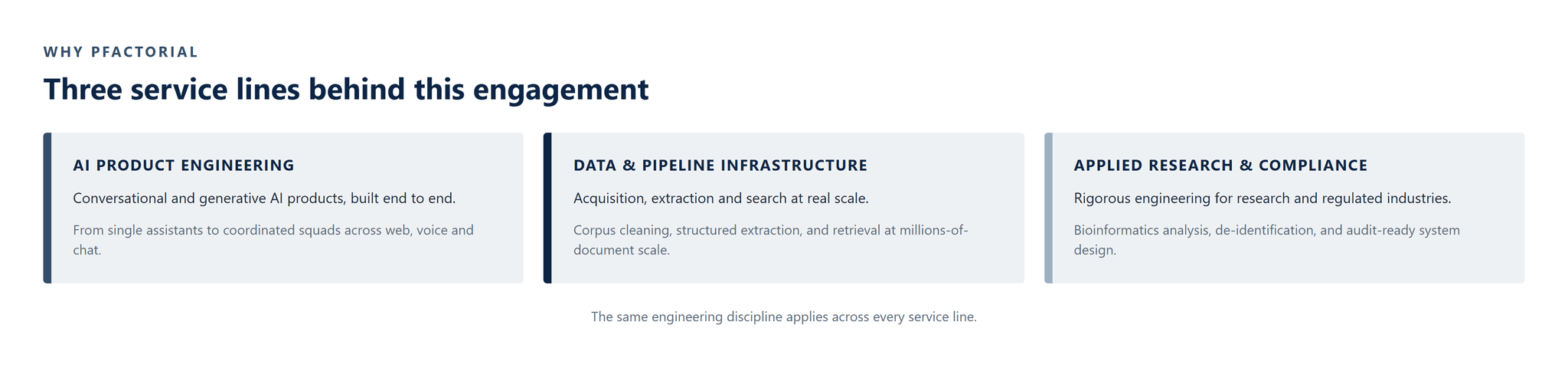
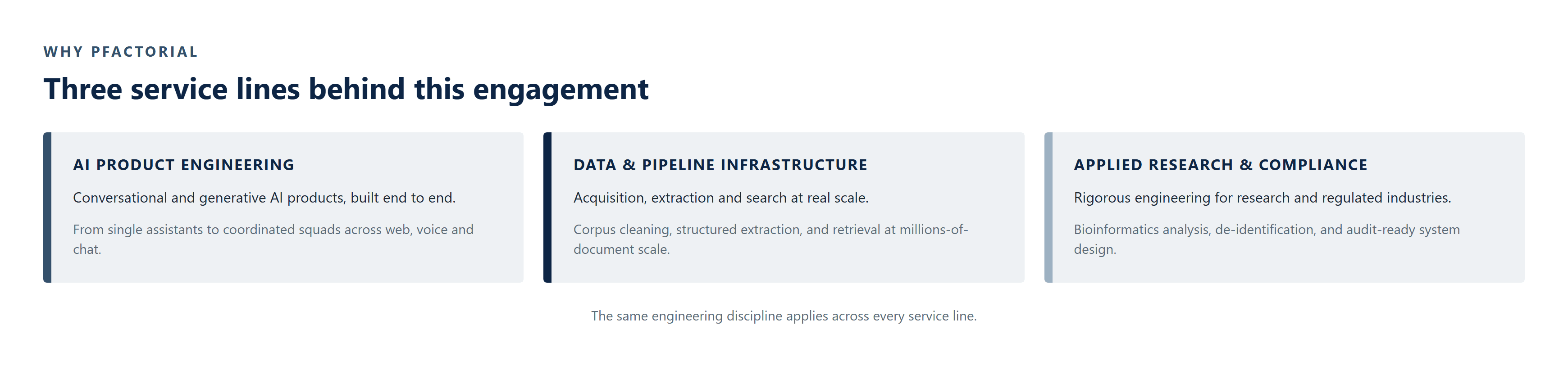
This engagement draws on Pfactorial's AI product engineering capability: designing production agent automation where cost, risk, and reliability are engineering requirements set before the system runs, not discovered afterward.
CS-004_ClickUp_AI_Automation image 5
Figure - Service lines this engagement draws on.
Engagement enquiries Pfactorial Technologies works with operations teams looking to convert recurring manual processes into dependable, cost-controlled automation. If you are weighing where an agent genuinely earns its place versus where a script or a person still wins, we are happy to give you an honest read on scope, cost, and risk before anyone commits to anything. · pfactorial.ai
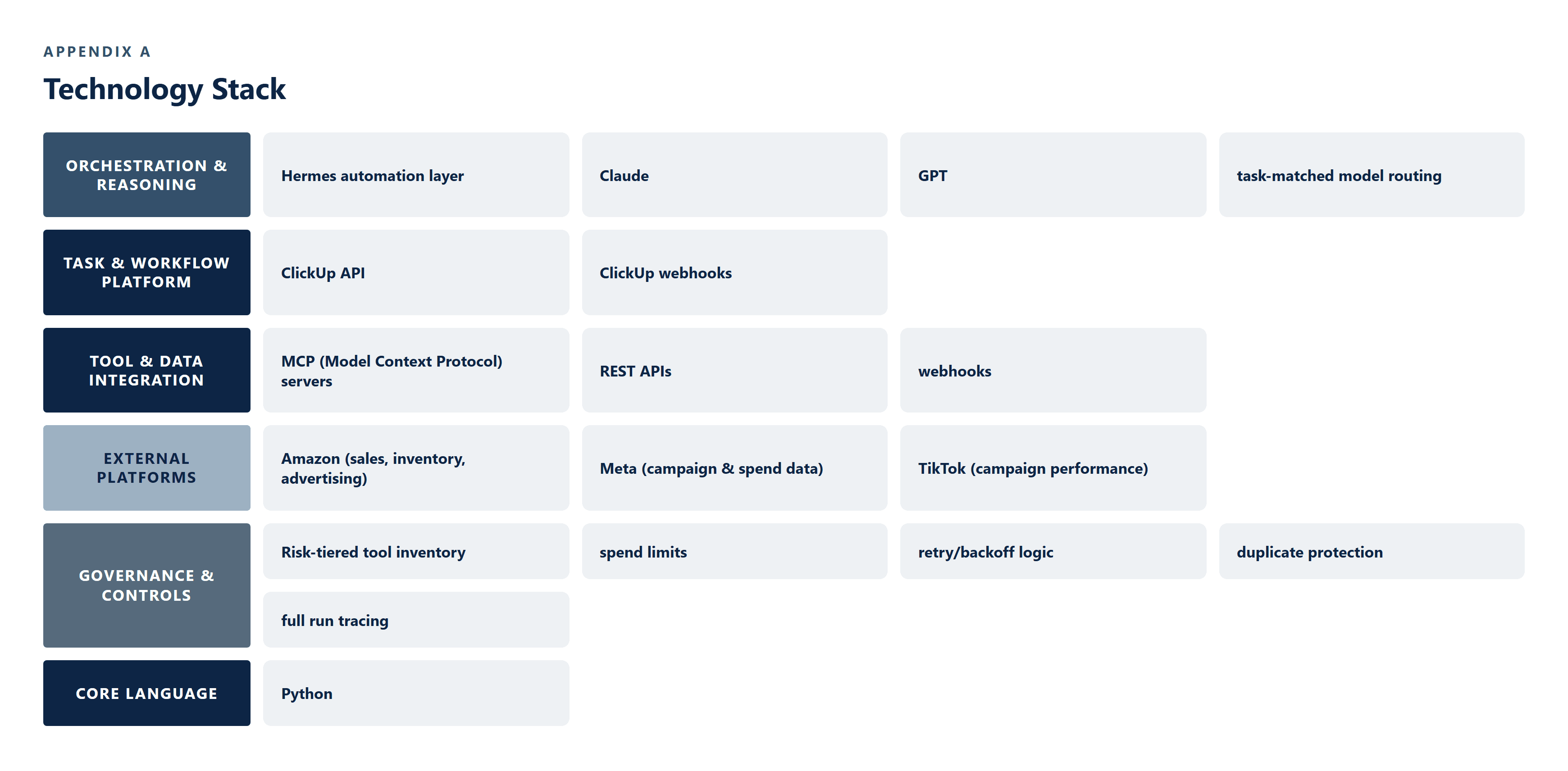
APPENDIX A - TECHNOLOGY STACK
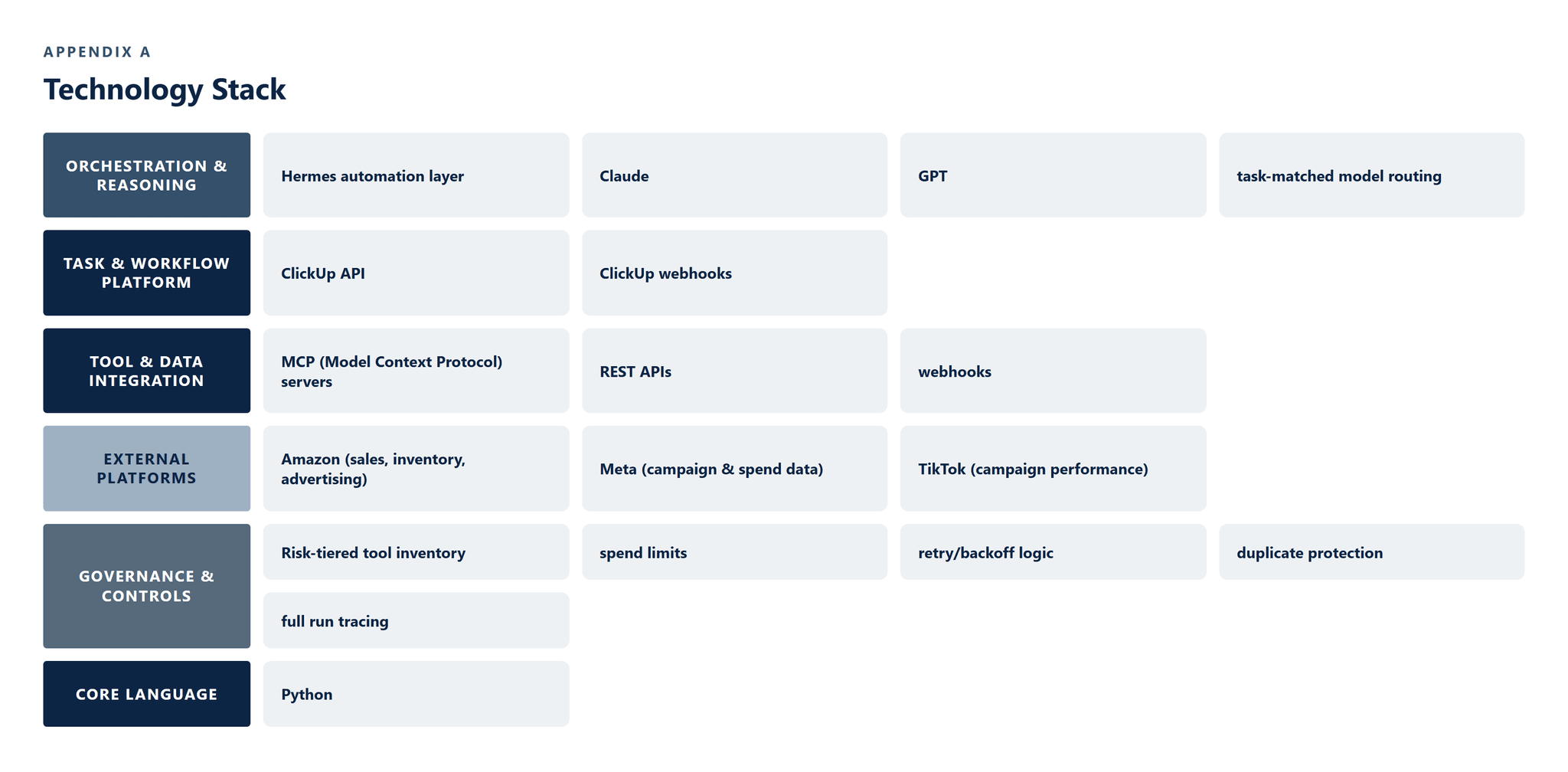
The technology stack underpinning the system, grouped by the layer it serves.
CS-004_ClickUp_AI_Automation image 6

Result and Analysis

ENGAGEMENT SNAPSHOT

A proposed automation architecture that routes every step of a process to the cheapest reliable option - code, an LLM, or a person - rather than automating every decision with a model by default.
CS-004_ClickUp_AI_Automation image 1
CS-004_ClickUp_AI_Automation image 2
CS-004_ClickUp_AI_Automation image 3
CS-004_ClickUp_AI_Automation image 4
CS-004_ClickUp_AI_Automation image 5
CS-004_ClickUp_AI_Automation image 6