Back
Data Scraping & Aggregation

A Multi-Platform Review Intelligence Tool Turning Raw E-Commerce Reviews Into Topic-Scored Sentiment

How Pfactorial Technologies built a review-intelligence platform that aggregates, topic-models, and sentiment-scores product reviews across four e-commerce platforms.
August 21, 2026
Share
ENGAGEMENT SNAPSHOT

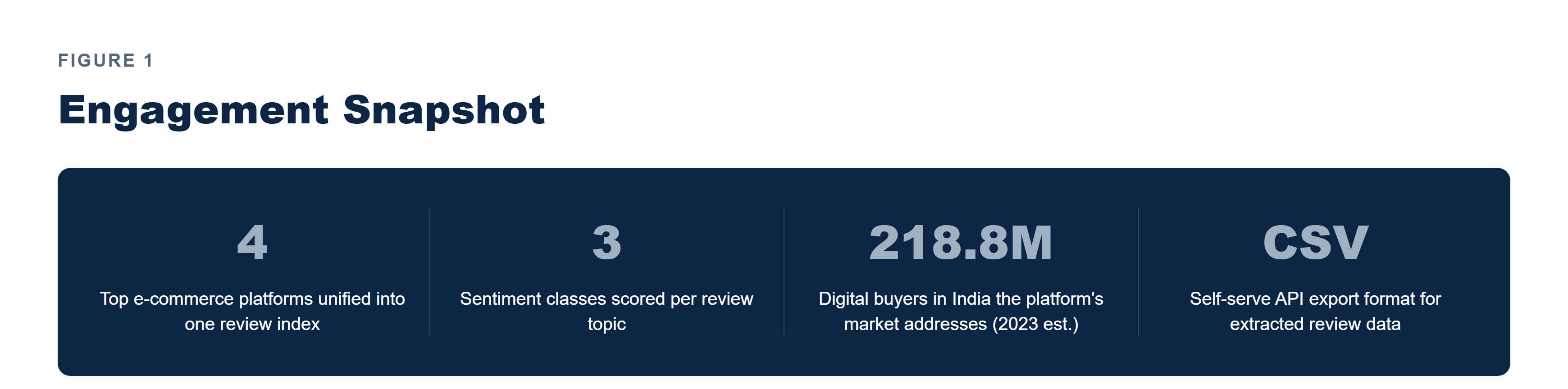
Pfactorial_Case_Study_VerdictAI image 1
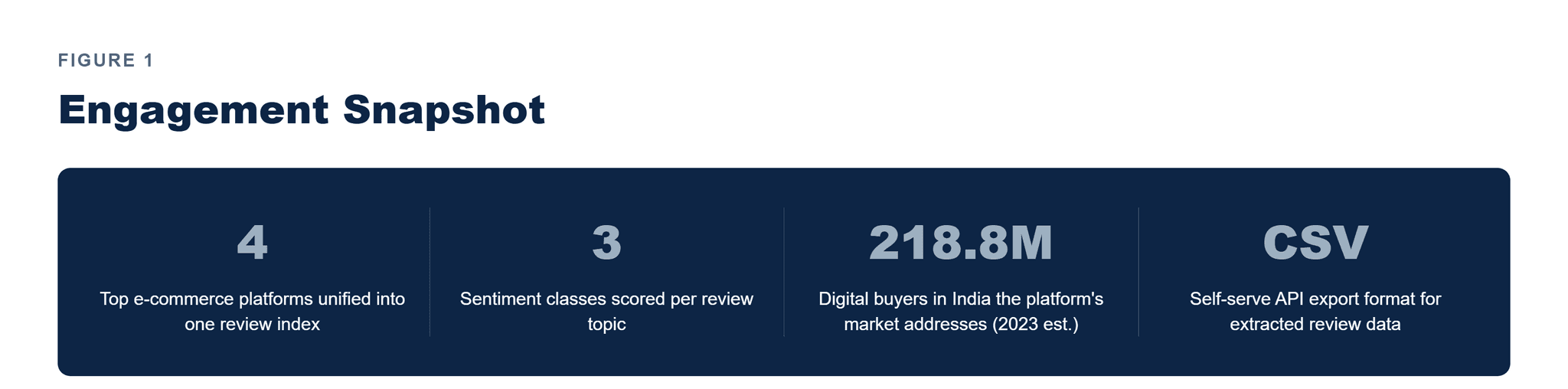
Figure 1 - Key figures from this engagement, at a glance.
EXECUTIVE SUMMARY
Our client wanted shoppers and sellers to see past a single blended star rating - buyers needed reviews organized by the specific feature they cared about, and sellers needed to see where a product was actually falling short, across the top e-commerce platforms rather than one site at a time.
A general product rating doesn't answer either question: reviews for the same product live on separate platforms with no shared format, a single overall sentiment hides which feature is driving it - one buyer's 'bad battery' complaint reads identically to another's 'bad camera' complaint in an aggregate score - and getting to feature-level insight requires first discovering what topics reviewers are actually discussing, not assuming a fixed feature list.
Pfactorial built Verdict AI: a pipeline that extracts reviews from four leading e-commerce platforms, discovers the topics reviewers are actually discussing through topic modeling, and scores sentiment per topic, so a buyer or seller sees a feature-level breakdown instead of one blended number.
Why this engagement is representative This engagement demonstrates Pfactorial's ability to turn unstructured, cross-platform review text into structured, feature-level insight - a repeatable pattern for any client that needs to make sense of aggregated customer feedback at scale.
THE CHALLENGE
Turning raw reviews from four separate platforms into feature-level insight meant solving problems a simple star-rating aggregator doesn't face.

1. Reviews for the same product live on four platforms with no shared format

Amazon, Flipkart, Croma, and Reliance Digital each present product and review data differently, so a single product's reviews have to be reconciled across four independently-structured sources before any analysis can happen.

2. An overall rating hides which feature is actually the problem

A product with a middling star average could be loved for its display and hated for its battery, but a blended score gives no way to tell those two signals apart.

3. The relevant topics aren't known in advance

What buyers care about varies by product category - gaming laptops get judged on specs a battery-focused shopper never mentions - so the system has to discover topics from the review text itself rather than work from a fixed, hand-built feature list.

4. Sentiment has to be scored per topic, not per review

A single review often expresses different sentiment about different aspects of a product, so sentiment analysis applied to the whole review at once would average away exactly the distinction the product is meant to surface.
The real brief Not "aggregate star ratings from a few sites" but "turn scattered review text into a feature-by-feature sentiment breakdown a buyer or seller can act on."
THE SOLUTION
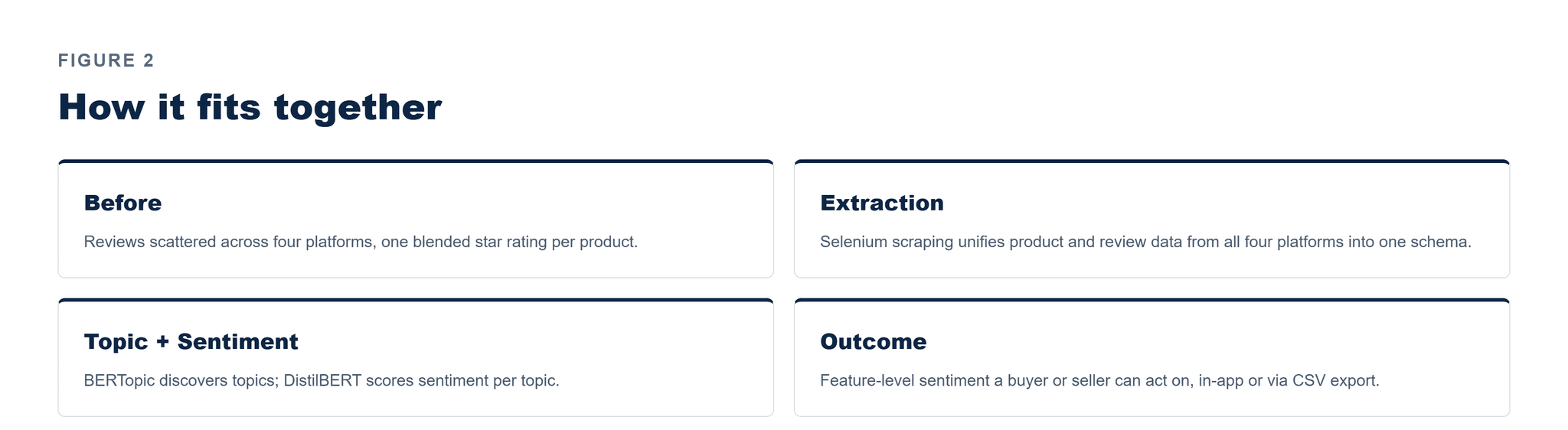
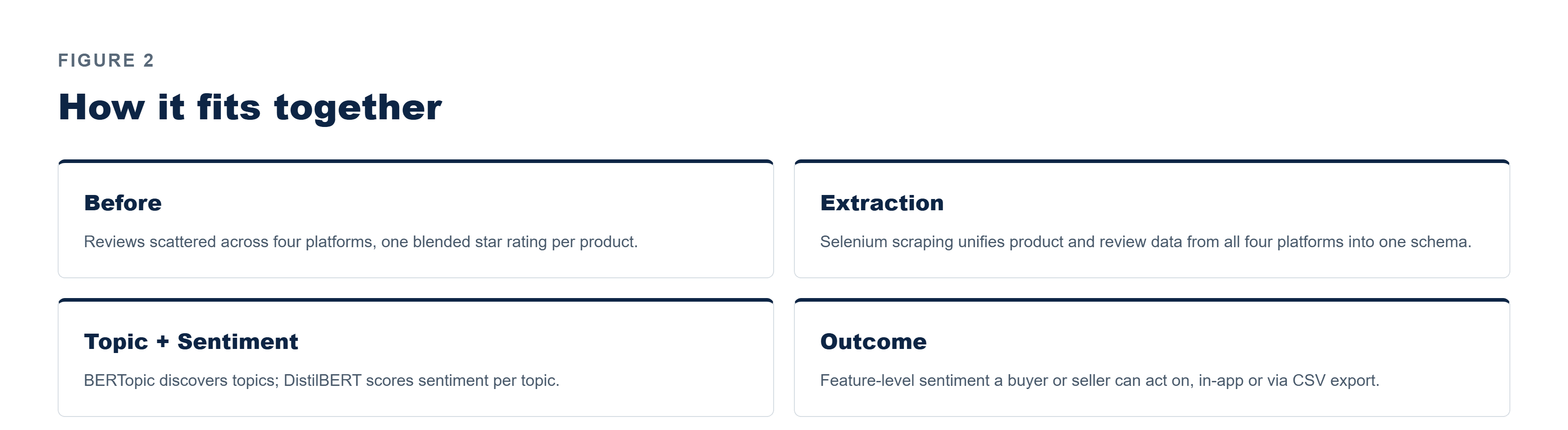
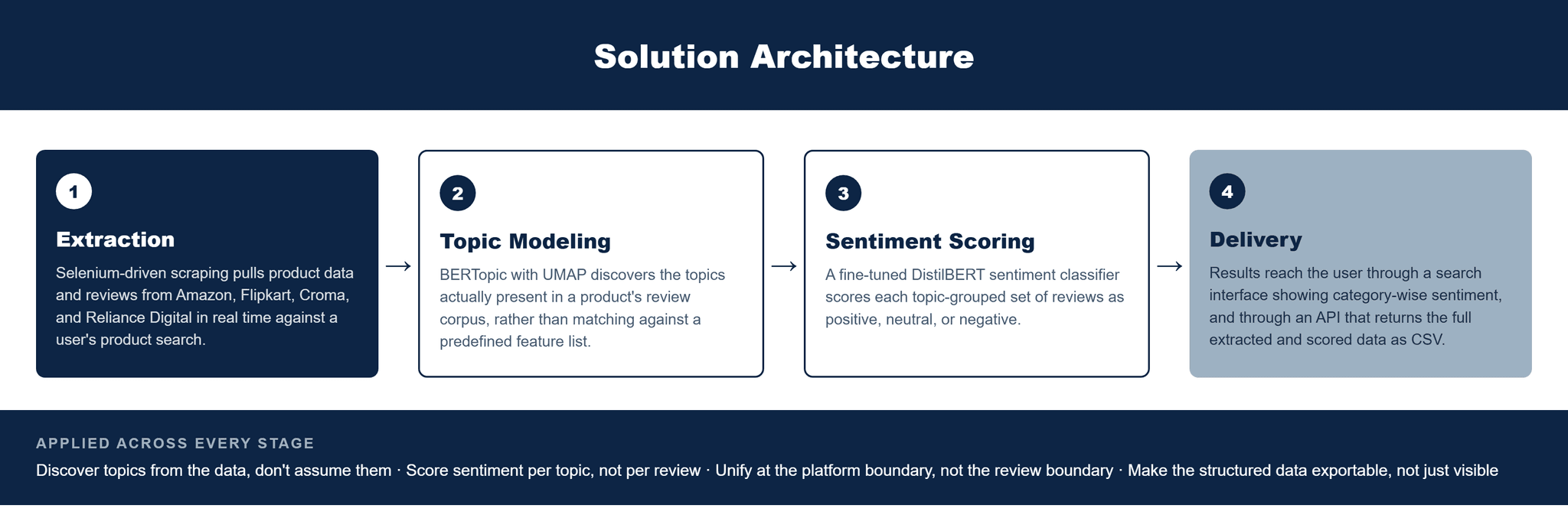
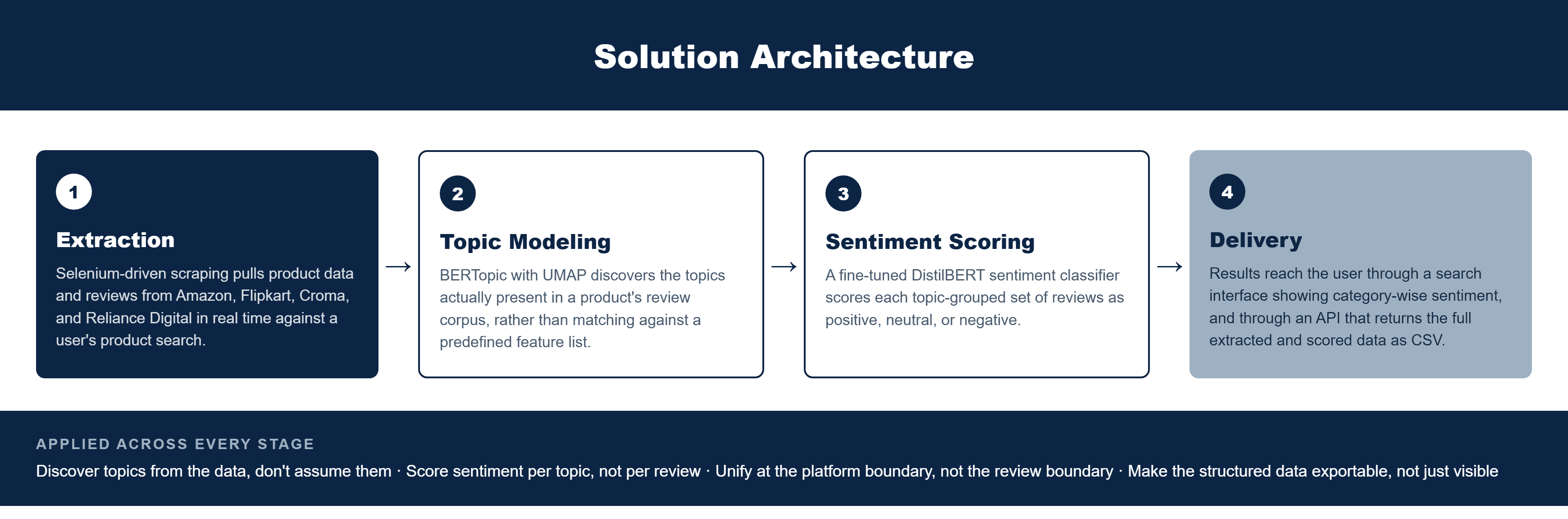
Pfactorial built Verdict AI as a three-stage pipeline - extraction, topic discovery, and per-topic sentiment scoring - served through both a search interface and a CSV export API.
Pfactorial_Case_Study_VerdictAI image 2
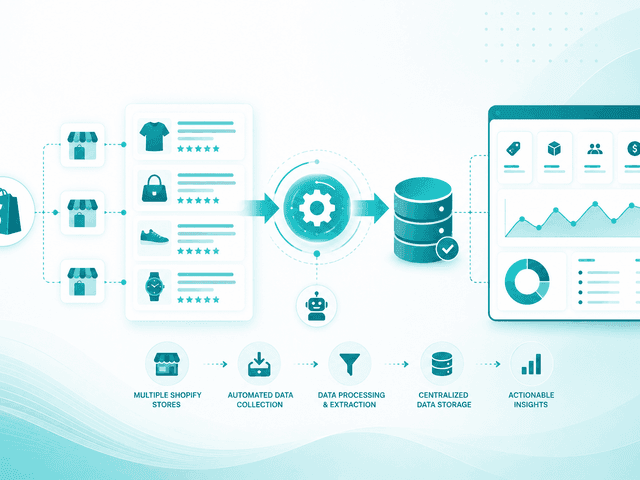
Figure 1 - Every review passes through the same extraction, topic discovery, and sentiment pipeline before reaching either the search interface or the export API.

Architectural principles

  • Discover topics from the data, don't assume them - BERTopic with UMAP finds the categories reviewers are actually discussing for a given product, so a laptop and a phone don't get forced through the same fixed feature checklist.
  • Score sentiment per topic, not per review - Grouping reviews by topic before running sentiment analysis keeps a mixed review's praise for one feature from canceling out its complaint about another.
  • Unify at the platform boundary, not the review boundary - Extraction is built per-platform so each site's specific structure is handled once, at the point of scraping, and everything downstream works against one normalized review schema.
  • Make the structured data exportable, not just visible - The API returns the same extracted, topic-modeled, and sentiment-scored data as CSV, so a business can run its own analysis rather than being limited to the built-in views.
CAPABILITIES DELIVERED
Each capability turns raw, cross-platform review text into something a buyer or seller can act on directly.
CAPABILITY
WHAT IT DOES
Cross-platform review extraction
A single product search pulls reviews, ratings, and variant data from Amazon, Flipkart, Croma, and Reliance Digital.
Topic-wise review categorization
BERTopic groups reviews by the features and themes reviewers actually raise, discovered per product rather than assumed.
Per-topic sentiment scoring
Each topic's reviews are scored positive, neutral, or negative, so a buyer sees sentiment broken down by feature, not blended into one number.
Rating distribution and variant view
Overall ratings, rating distribution, and product variants surface alongside the topic-level breakdown.
CSV export via API
A self-serve API returns the full extracted and scored review dataset as CSV for external analysis.
Pfactorial_Case_Study_VerdictAI image 3
Figure 2 - The same extraction, topic discovery, and scoring pipeline serves both the in-app search view and the CSV export API.
Design note Sentiment is deliberately scored per discovered topic rather than per platform or per star rating - a five-star review can still carry a negative sentiment on one specific feature, and collapsing to platform- or rating-level sentiment would erase exactly that distinction the product exists to surface.
ENGINEERING FOR SCALE AND RELIABILITY
Four decisions kept the pipeline accurate across four structurally different source platforms.

Unsupervised topic discovery instead of a fixed feature taxonomy

BERTopic with UMAP finds topics directly from each product's review corpus, so the system adapts to whatever features matter for that specific product category without requiring a hand-maintained taxonomy per category.

A fine-tuned sentiment classifier instead of a lexicon-based approach

The DistilBERT-based classifier, fine-tuned on the SST-2 sentiment task, handles the nuance and phrasing variety of real review text more reliably than a keyword or lexicon-based sentiment score.

Per-platform scraping logic instead of one generic scraper

Amazon, Flipkart, Croma, and Reliance Digital each get extraction logic built for their specific page structure, so a layout change on one platform doesn't risk the other three.

Both a UI and an API surface for the same underlying data

The in-app search view and the CSV export API are two presentations of the same extraction-and-scoring pipeline, so a business gets the same structured data whether they browse it or pull it programmatically.
DELIVERY APPROACH
The build proceeded stage by stage through the pipeline, validating extraction before adding the analysis layers on top.
1. Multi-platform extraction - building Selenium-driven scrapers for Amazon, Flipkart, Croma, and Reliance Digital, normalized to one review schema.
2. Topic modeling - integrating BERTopic with UMAP to discover review topics per product from the normalized extraction output.
3. Sentiment scoring - fine-tuning a DistilBERT-based sentiment classifier and applying it per discovered topic.
4. Search interface and export API - building the user-facing search experience and the CSV export API on the same underlying pipeline.
RESULTS AND IMPACT

Pfactorial_Case_Study_VerdictAI image 4
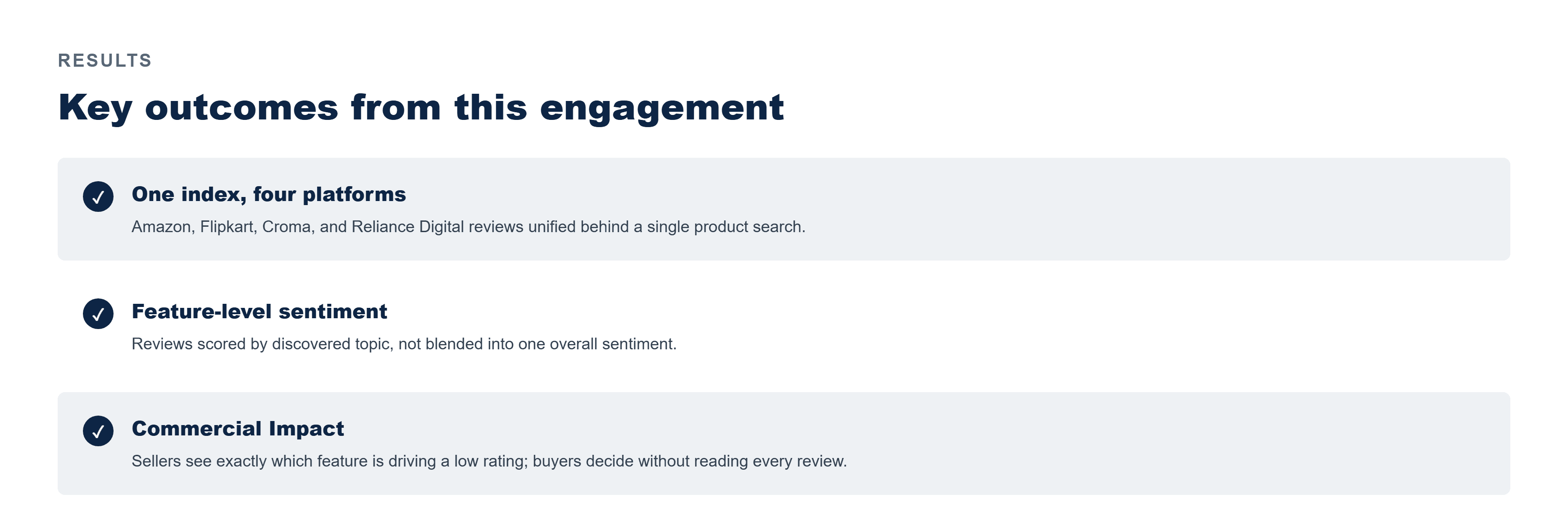
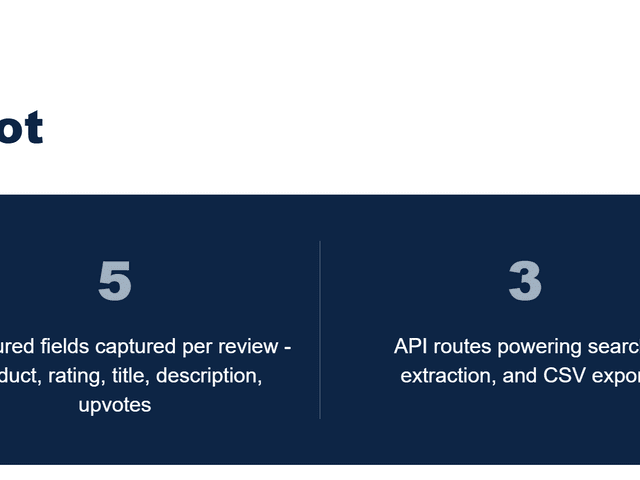
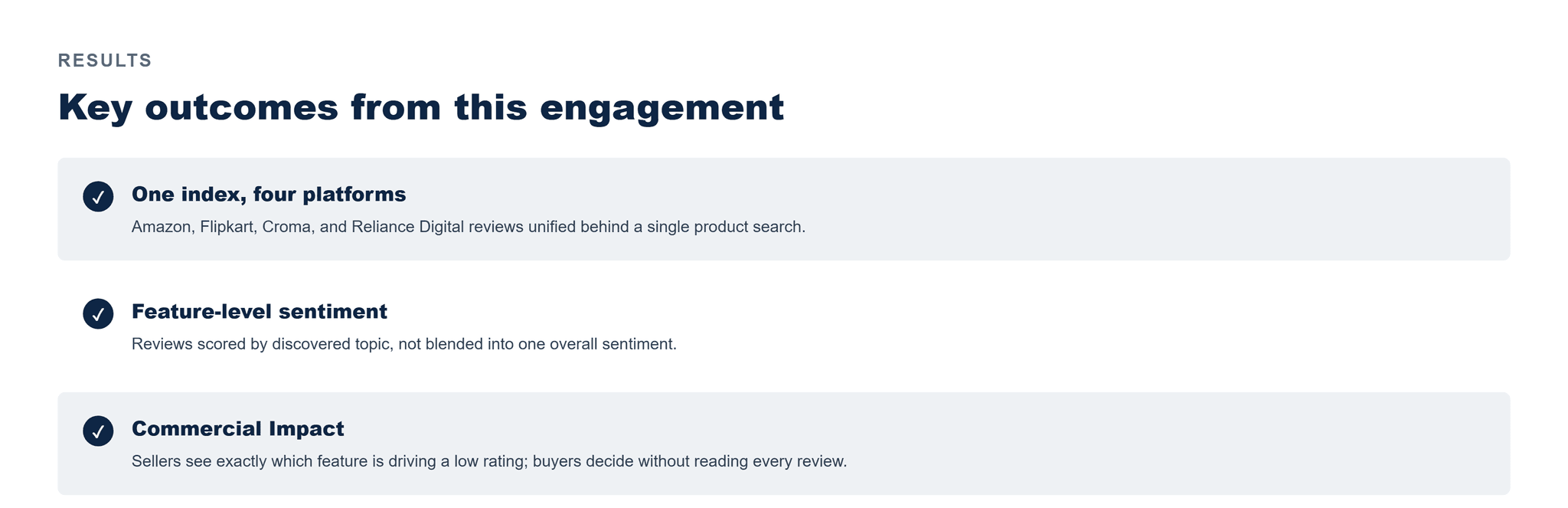
- Key outcomes from this engagement.
Verdict AI is built and running, extracting and analyzing reviews from four major e-commerce platforms with topic-wise sentiment scoring available through both the search interface and the CSV export API.
Because topic discovery runs per product rather than against a fixed feature list, the same pipeline holds up across product categories as different as laptops and appliances without category-specific rework.

What it enabled commercially

The client can now offer buyers a feature-level basis for comparison instead of a single blended rating, and give sellers a structured, topic-scored view of exactly where a product is underperforming - addressing a market of over 200 million digital buyers in India alone.
WHY PFACTORIAL
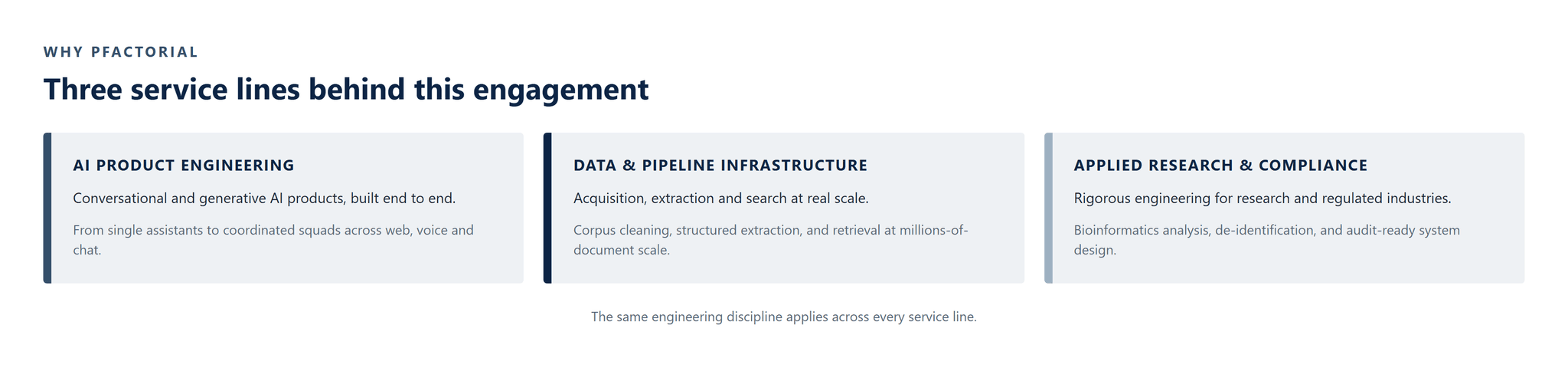
This engagement reflects Pfactorial's ability to combine multi-source data extraction with unsupervised topic discovery and sentiment analysis into one coherent product - turning unstructured customer feedback into structured, actionable insight.
Pfactorial_Case_Study_VerdictAI image 5
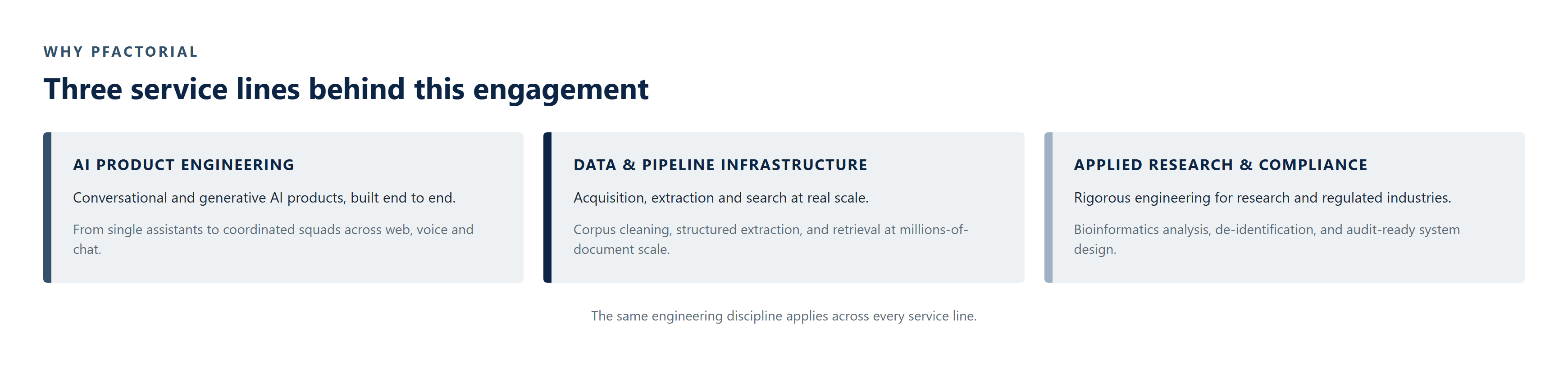
- Service lines this engagement draws on.
Engagement enquiries Pfactorial Technologies works with organisations that need customer feedback turned into structured, feature-level insight rather than a single blended score. If you're evaluating a review-intelligence or customer-analytics platform, we're happy to give you an honest read on scope and risk before anyone commits to anything. · pfactorial.ai
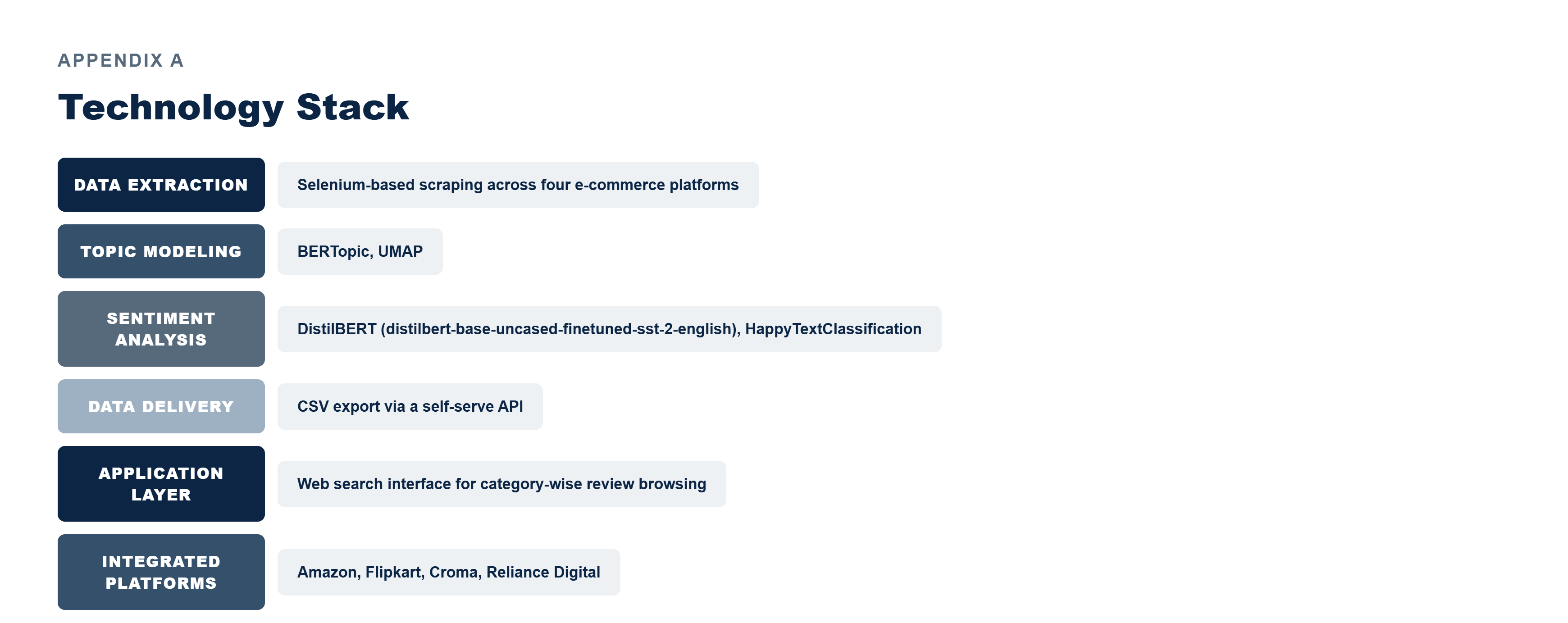
APPENDIX A - TECHNOLOGY STACK
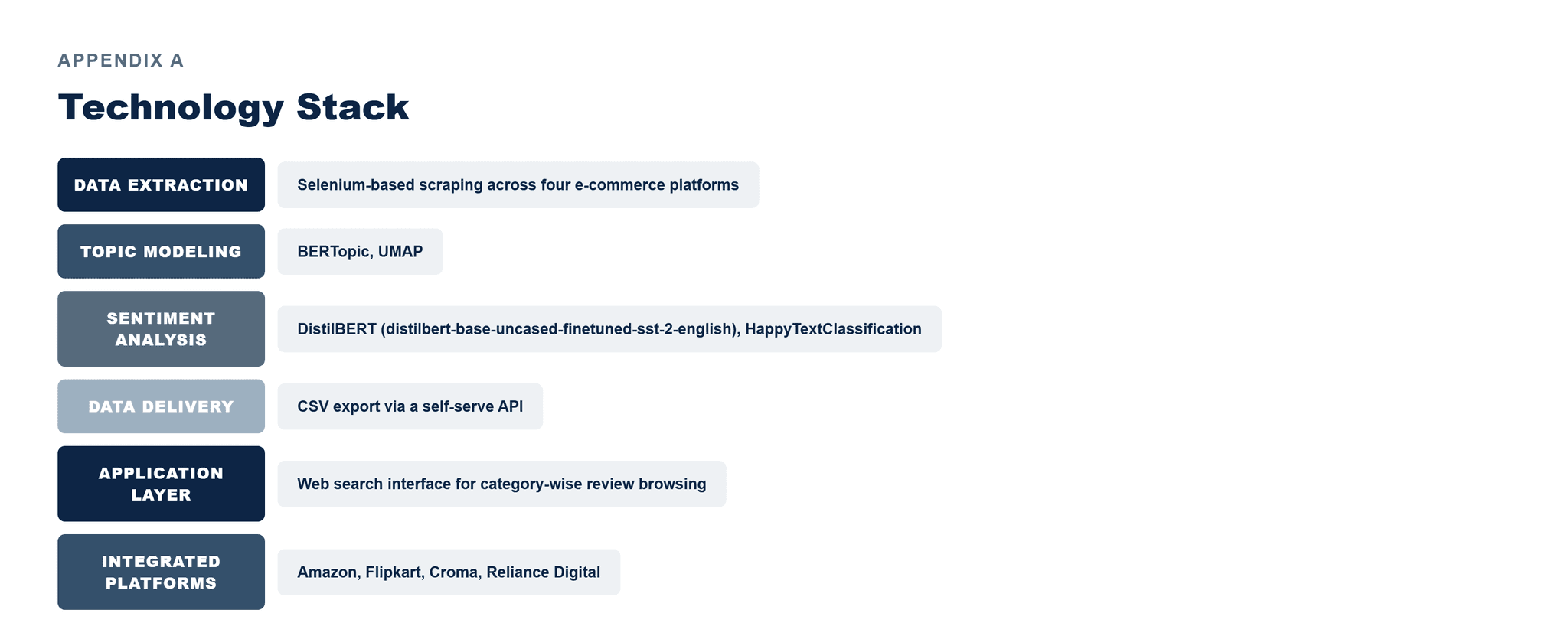
The technology stack underpinning the system, grouped by the layer it serves.
Pfactorial_Case_Study_VerdictAI image 6

Result and Analysis

ENGAGEMENT SNAPSHOT

How Pfactorial Technologies built a review-intelligence platform that aggregates, topic-models, and sentiment-scores product reviews across four e-commerce platforms.
Pfactorial_Case_Study_VerdictAI image 1
Pfactorial_Case_Study_VerdictAI image 2
Pfactorial_Case_Study_VerdictAI image 3
Pfactorial_Case_Study_VerdictAI image 4
Pfactorial_Case_Study_VerdictAI image 5
Pfactorial_Case_Study_VerdictAI image 6